Why do we embrace the burden of evangelism while relegating the burden of Case Making to professional “apologists”? Paul says something interesting in his letter to the Ephesians:
Ephesians 4:11-13
And He gave some as apostles, and some as prophets, and some as evangelists, and some as pastors and teachers, for the equipping of the saints for the work of service, to the building up of the body of Christ; until we all attain to the unity of the faith, and of the knowledge of the Son of God, to a mature man, to the measure of the stature which belongs to the fullness of Christ.
Paul repeatedly tells us that some of us are designed and given to perform certain functions. Some are apostles, some are prophets, some are evangelists, some are teachers, and some are pastors. Think about that for a minute. The reasonable inference here is that some of us are given to function in this waysome of us are not. You may be gifted and given by God to be a pastor or you may not. In a similar way, you may not be an evangelist. We may be called to share our faith (as described in the passages in Mark, Luke, John and Acts), but we probably shouldn’t beat ourselves up and feel guilty if we aren’t great at evangelism. That may not be our gift or our God-given role.
But there’s another calling we ought to feel on our lives as Christians that we usually ignore altogether. Look at what Peter says in a letter written to “exiles scattered throughout the provinces of Pontus, Galatia, Cappadocia, Asia and Bithynia”:
1 Peter 3:15-16:
But in your hearts set apart Christ as Lord. Always be prepared to give an answer to everyone who asks you to give the reason for the hope that you have. But do this with gentleness and respect, keeping a clear conscience, so that those who speak maliciously against your good behavior in Christ may be ashamed of their slander.
When addressing Christ followers who had been dispersed into regions filled with non-believers, Peter reminded Christians that everyone shared a responsibility to defend what they believed.
I attended Intervarsity Christian Fellowship while getting my undergraduate degree and Campus Crusade for Christ while getting my graduate degree. Both groups had leadership teams that rejected apologetics – including the showing of debate DVDs – because evangelism was mandatory while apologetics was only for professionals who had a special gift. It turns out that they had it exactly backwards. Make sure you get your marching orders right.
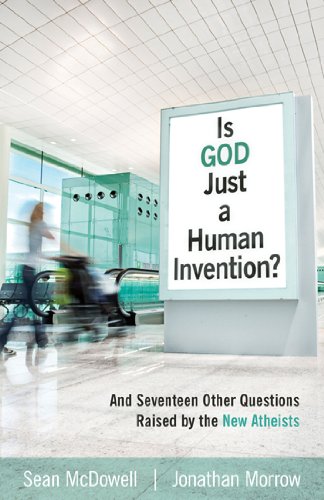
Here’s the link to the Kindle edition of the book. I consider this book to be my favorite introduction to Christian apologetics. I give this book to everyone and one of my friends even started teaching it to a group of women in her church.
One of the brashest challenges that religious truth has experienced over the past several decades is the remarkable rise of the pugnacious New Atheists. Sean McDowell and Jonathan Marrow, new generation Christian apologists, have undertaken the task of contesting this anti-theistic upsurge. And in Is God Just a Human Invention? And Seventeen Other Questions Raised by the New Atheists the authors have pulled together a wide range of research that powerfully critiques the arguments from the combative non-theists.
[…]The authors deal with the scientific and philosophical challenges to Christian theism in a reasoned and respectful manner.
[…]Is God Just a Human Invention? is loaded with exceptional quotes from Christian and non-Christian thinkers. Additionally, the book furnishes very short essays at the back of each chapter from various erudite Christian scholars that augment the thesis of what was advanced by the authors.
This volume combines simplicity and applicability without forfeiting precision. The authors lead the reader into the full girth of the many contemporary discussions concerning the defense of Christianity. They offer several of the leading arguments for Christian theism while toppling some of the most belligerent of the objections promoted by the New Atheists. They have written, with abundant care, to attain a thoroughness that is not often established in popular books. The wisdom and excellence with which each chapter is written makes this a crucial volume for the budding apologist’s library.
Here are the 18 topics, and after each topic a Christian scholar discusses the relevance of each topic.
Is Faith Irrational? (Commentary by: Gregory Koukl)
Are Science and Christianity at Odds? (Commentary by: John Warwick Montgomery)
Are Miracles Possible? (Commentary by: Gary R. Habermas)
Is Darwinian Evolution the Only Game in Town? (Commentary by: William A. Dembski)
How Did the Universe Begin? (Commentary by: R. Douglas Geivett)
How Did Life Begin? (Commentary by: Fazale R. Rana)
Why Is the Universe Just Right for Life? (Commentary by: Jay W. Richards)
Has Science Shown There Is No Soul? (Commentary by: Dale Fincher and Jonalyn Fincher)
Is God Just a Human Invention? (Commentary by: Garry DeWeese)
Is Religion Dangerous? (Commentary by: Douglas Groothuis)
Does God Intend for Us to Keep Slaves? (Commentary by: Paul Copan)
Is Hell a Divine Torture Chamber? (Commentary by: Frank Turek)
Is God a Genocidal Bully? (Commentary by: Clay Jones)
Is Christianity the Cause of Dangerous Sexual Repression? (Commentary by: Kerby Anderson)
Can People Be Good Without God? (Commentary by: Mark D. Linville)
Is Evil Only a Problem for Christians? (Commentary by: Randy Alcorn)
What Good Is Christianity? (Commentary by: Glenn S. Sunshine)
Why Jesus Instead of the Flying Spaghetti Monster? (Commentary by: Darrell L. Bock)
If you’re looking for a good book on Christian apologetics for beginners, this is a great choice. My Dad read it and he liked it, and he’s not an expert in apologetics.
Here’s a lecture from N.T. Wright, whose multi-volume case for the historicity of the bodily resurrection of Jesus seems to be getting a lot of respect from the other side, (although I strongly disagree with his economic and political views, which are naive at best). Wright has taught at Cambridge University, Oxford University, Duke University, McGill University, and lectured on dozens of prestigious campuses around the world. He’s published 40 books.
Here’s the video:
For those who cannot see the video, here is a written version of the lecture that Wright gave on the resurrection. And please note that I do not endorse anything that N.T. Wright says on any topic outside of history. History is his field of expertise, and I think he has no authority outside of the field of history.
N.T. Wright’s historical case for the bodily resurrection of Jesus
Wright basically argues that the resurrection cannot have been a myth invented by the early Christian community, because the idea of the Messiah dying and being bodily resurrected to eternal life was completely unexpected in Jewish theology, and therefore would not have been fabricated.
In Judaism, when people die, they stay dead. At the most, they might re-appear as apparitions, or be resuscitated to life for a while, but then die again later. There was no concept of the bodily resurrection to eternal life of a single person, especially of the Messiah, prior to the general resurrection of all the righteous dead on judgment day.
Wright’s case for the resurrection has 3 parts:
The Jewish theological beliefs of the early Christian community underwent 7 mutations that are inexplicableapart from the bodily resurrection of Jesus
The empty tomb
The post-mortem appearances of Jesus to individuals and groups, friends and foes
Here’s the outline of Wright’s case:
…the foundation of my argument for what happened at Easter is the reflection that this Jewish hope has undergone remarkable modifications or mutations within early Christianity, which can be plotted consistently right across the first two centuries. And these mutations are so striking, in an area of human experience where societies tend to be very conservative, that they force the historian… to ask, Why did they occur?
The mutations occur within a strictly Jewish context. The early Christians held firmly, like most of their Jewish contemporaries, to a two-step belief about the future: first, death and whatever lies immediately beyond; second, a new bodily existence in a newly remade world. ‘Resurrection’ is not a fancy word for ‘life after death’; it denotes life after ‘life after death’.
And here are the 7 mutations:
Christian theology of the afterlife mutates from multiples views (Judaism) to a single view: resurrection (Christianity). When you die, your soul goes off to wait in Sheol. On judgment day, the righteous dead get new resurrection bodies, identical to Jesus’ resurrection body.
The relative importance of the doctrine of resurrection changes from being peripheral (Judaism) to central (Christianity).
The idea of what the resurrection would be like goes from multiple views (Judaism) to a single view: an incorruptible, spiritually-oriented body composed of the material of the previous corruptible body (Christianity).
The timing of the resurrection changes from judgment day (Judaism) to a split between the resurrection of the Messiah right now and the resurrection of the rest of the righteous on judgment day (Christianity).
There is a new view of eschatology as collaboration with God to transform the world.
There is a new metaphorical concept of resurrection, referred to as being “born-again”.
There is a new association of the concept of resurrection to the Messiah. (The Messiah was not even supposed to die, and he certainly wasn’t supposed to rise again from the dead in a resurrected body!)
There are also other historical puzzles that are solved by postulating a bodily resurrection of Jesus.
Jewish people thought that the Messiah was not supposed to die. Although there were lots of (warrior) Messiahs running around at the time, whenever they got killed, their followers would abandon them. Why didn’t Jesus’ followers abandon him when he died?
If the early Christian church wanted to communicate that Jesus was special, despite his shameful death on the cross, they would have made up a story using the existing Jewish concept of exaltation. Applying the concept of bodily resurrection to a dead Messiah would be a radical departure from Jewish theology, when an invented exaltation was already available to do the job.
The early church became extremely reckless about sickness and death, taking care of people with communicable diseases and testifying about their faith in the face of torture and execution. Why did they scorn sickness and death?
The gospels, especially Mark, do not contain any embellishments and “theology historicized”. If they were made-up, there would have been events that had some connection to theological concepts. But the narratives are instead bare-bones: “Guy dies public death. People encounter same guy alive later.” Plain vanilla narrative.
The story of the women who were the first witnesses to the empty tomb cannot have been invented, because the testimony of women was inadmissible under almost all circumstances at that time. If the story were invented, they would have invented male discoverers of the tomb. Female discovers would have hampered conversion efforts.
There are almost no legendary embellishments in the gospels, while there are plenty in the later gnostic forgeries. No crowds of singing angels, no talking crosses, and no booming voices from the clouds.
There is no mention of the future hope of the general resurrection, which I guess they thought was imminent anyway.
To conclude, Wright makes the argument that the best explanation of all of these changes in theology and practice is that God raised Jesus (bodily) from the dead. There is simply no way that this community would have made up the single resurrection of the Messiah – who wasn’t even supposed to die – and then put themselves on the line for that belief.
And remember, the belief in a resurrected Jesus was something that the earliest witnesses could really assess, because they were the ones who saw him killed and then walking around again after his death. They were able to confirm or deny their belief in the resurrection of Jesus based on their own personal experiences with the object of those beliefs.