Tag Archives: Apologetics

Sean Carroll debates William Lane Craig on cosmology and God’s existence

Here’s the video of the debate:

Carroll was as good of a speaker as Craig in terms of style. Very easy to listen to, very quick on his feet, very civil. There was no clear winner on style.

It was difficult to assess the truth value of scientific points being made, especially for the layperson. I explained a few of them in my posts earlier this week, but I think laypeople might struggle with them if they are hearing about these things for the first time.

A couple of Craig’s slides: (click for larger images)

Slide 1 of 2:
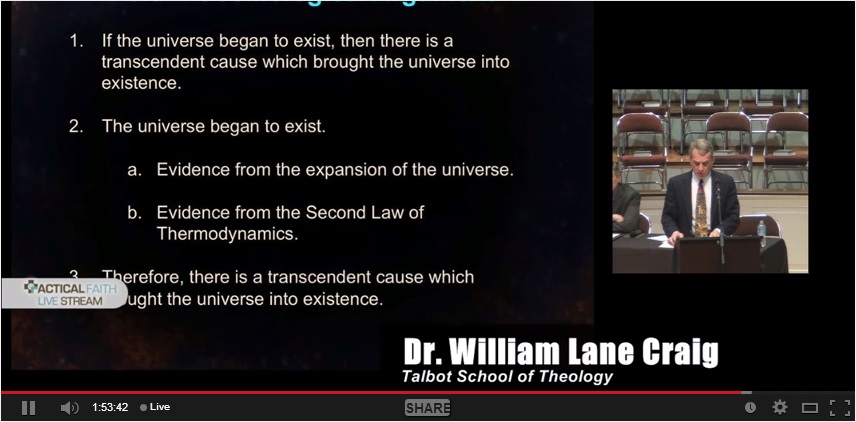
Dr. Craig slide #1 of 2

Slide 2 of 2:

Dr. Craig slide #2 of 2

Quick summary: (this is not complete, because I couldn’t get everything they were saying noted)

Dr. Craig defended two arguments: 1) the kalam cosmological argument and the fine-tuning argument.

Dr. Craig supported the origin of the universe with 1) the expansion of the universe and 2) the second law of thermodynamics.

Dr. Craig said that the BGV theorem supports a beginning for the universe.

Dr. Craig said that the consensus of scientists did not accept Carroll’s naturalistic cosmology, quoting Stephen Hawking in support.

Dr. Craig said that multiverse models fall victim to the Boltzmann brain problem, where we should observe Boltzmann brains coming into existence and then phasing out again far more probably than embodied minds. But we observe embodied minds, and no Boltzmann brains.

Dr. Carroll said that science cannot study metaphysical questions.

Dr. Carroll said that science is about making models that may or may not be consistent with the experimental data.

Dr. Carroll said that the BGV theorem does not support a beginning for the universe.

Dr. Carroll proposed 17 alternative cosmologies, but did not provide a shred of scientific evidence for any of them, the way that Craig did for the standard model.

Dr. Carroll refuted Dr. Craig’s citation of Stephen Hawking, and Craig yielded the point.

Dr. Carroll speculated that science might progress to the point where the fine-tuning can be explained without an intelligent cause, and he gave an example of where that happened (inflation).

Dr. Craig argued that all 17 of the models suggested by Carroll either conflicted with evidence, had serious problems or did require a beginning.

Dr. Craig argued that Carroll’s own model required a beginning.

Dr. Craig argued that Carroll’s own model fell victim to the Boltzmann brain problem.

Dr. Craig argued that Carroll’s own model violated the second law of thermodynamics.

Dr. Craig re-stated his point that the baby universe spawning in Carroll’s model was speculative and incomplete, and cited Christopher Weaver’s work.

Dr. Carroll denied that things that pop into being out of nothing require a transcendent cause.

Dr. Carroll reiterated that science can only make naturalistic models, and that he did not have to answer questions about ultimate causes.

Dr. Carroll showed a photo of Alan Guth expressing his opinion that the universe is “probably” eternal. No evidence was given for this assertion.

Dr. Carroll said that the fine-tuning was not done in an optimal way, because one fine-tuned value was lower than it needed to be, and it should be exactly what it needed to be if God did it.

Dr. Carroll said that a finely-tuned universe is more probably in naturalism than in theism, because God can do anything he wants and doesn’t need a fine-tuned universe.

Dr. Carroll said he would stop defending his model now, and would instead defend Aguirre-Gratton.

Dr. Craig gave three reasons why the universe popping into being out of nothing requires a transcendent cause.

First, he said that nothing cannot cause anything to happen, because nothing is nothing.

Second, he said that if things pop into being out of nothing, then why don’t we see it happening all the time with other things.

Third, he said that we have no reason to dismiss the causal principle, especially when it is the basis of scientific inquiry and has been so fruitful in the progress of science.

Dr. Craig reiterated that baby universes in Carroll’s model would be dominated by Boltzmann brains, and we don’t observe that.

Dr. Craig said that even on the quantum gravity models that Carroll mentioned, there would still be a beginning.

Dr. Carroll said that Craig mustn’t say “popped into being” but instead that “there was a first moment of time”.

Dr. Carroll said that his model does indeed violate the second law of thermodynamics “YES!”.

At this point Carroll stopped talking about the topic of the debate and started expressing personal opinions about religion. It’s funny how often atheists do this in debates.

Dr. Carroll said that most theists don’t believe in God because of cosmology, but because of community and feelings.

Dr. Carroll said that science had learned a lot in the last 2000 years, so theism was false.

Dr. Carroll said that most philosophers don’t think that God exists, so theism was false.

Dr. Carroll said microscopes and telescopes were absent 2000 years ago, so theism was false.

Dr. Carroll said that religion should be about community and feelings, not about what is true.

Conclusion:

My conclusion was that Carroll lost because he is just satisfied to throw theories out and not to argue that they are true by citing evidence. Carroll never seemed to be interested in finding out what is true, but instead he just wanted to tell a story that didn’t include God, and assert that by Occam’s Razor, his story was a better explanation. I am not impressed with theoretical speculations, although the layperson might be. I kept waiting for him to respond to Craig’s points about how his model was falsified by experimental evidence and observations, e.g. – the Boltzmann brains or the baby universe generation, and he never cited the evidence I wanted him to cite. Craig did have some evidence for his views, but he could have been stronger in making his case. He could have shown the e-mail from Vilenkin that stated that he had understood the BGV theorem, and was using it correctly, for example.

For me the winning side comes down to evidence. The standard model is the standard model because of scientific evidence. Until that evidence is overturned, then speculative models are of no interest to anyone who is evidence-driven. Speculations are not science. A philosophical presupposition of metaphysical naturalism is not science.

If you want to see a good lecture on scientific evidence related to cosmology, then there is the particle physicist Michael Strauss lecture on cosmology and fine-tuning at Stanford University and his more recent lecture at the University of Texas. Note that Strauss is an experimental physicist, not a theoretical physicist like Carroll.

Here’s another review of the debate by Randy Everist of Possible Worlds blog. He explains the back-and-forth over Boltzmann brains and the BGV theorem in more detail.

Awakening the “moral sense” of the public in the abortion debate


Young pro-life women protest Planned Parenthood

Scott Klusendorf linked to this article from the Public Discourse. The article talks about the need to augment logical arguments in other ways in order to awaken the moral sense of the public so that they will support the pro-life cause and vote to repeal pro-abortion laws.

Excerpt:

In a manner similar to the case of slavery as outlined by Douglass, there are two simple points that, once admitted, join to condemn clearly the practice of abortion: (1) the embryo is a human being from the moment of conception, and (2) all human beings have a natural right to life.

The second point, as in the case of the natural right to liberty, doesn’t require serious argument on the level of ordinary judgment, even though many pro-choice philosophers have tried to argue that only persons have a right to life, and the unborn, in their view, aren’t persons. To make such arguments, however, requires choosing an arbitrary cut-off point for personhood, as pro-life philosophers such as George, Tollefsen, and Lee have shown.

The first point is more often chosen as promising ground for challenges, but it too is plainly obvious to the unbiased mind.

Once conception occurs, the embryo is something other than the woman who carries it. The fact that the embryo requires the mother’s body to live is no argument against this—dependence does not exclude otherness, otherwise none of us would be distinguishable from everyone and everything else in the world upon which we depend in innumerable ways. The embryo is obviously something other than a part of the mother, but what is it?

This is where it gets easy, despite the messy, abstract philosophical arguments. The more appropriate version of the question is the following: What else could it be besides a human being? Is there a single example in natural history of sexual intercourse between two individuals of the same species resulting in something other than another individual of that species? Is it plausible to guess that sexual intercourse between two human beings might result in a fish, at least initially? Or maybe a frog? Such speculation is entirely fanciful and runs directly contrary to our experience of the world since the beginning of recorded history.

It should be obvious to anyone that the two points hold, and that the embryo is a human being possessing a natural right to life from the moment of its conception. The problem is that the younger and less developed the embryo is, the less it excites what some have called our “moral sense,” our sympathy with it as another human being like us. And as Hume correctly notes, human beings tend to be moved more by their passions and feelings, including the so-called “moral sense,” than by their intellectual understanding of the world when determining their actions. Even if our reason and common sense tell us clearly—as they undoubtedly do—that the embryo is a human being with the right to life, our moral sense or sympathy lets us off the hook.

So where does this leave pro-life advocates? How can we bridge the Humean—and human—gap between intellectual understanding and actual practice in our nation? The answer lies in the parallel between the issue of abortion and those of slavery and subsequent civil rights. The pro-life movement needs to model more closely in its organization and practices the antebellum abolition movement and the civil rights movement in order to achieve similar success in ending the evil of abortion. It needs to take up the mantle of these causes in a manner beyond rhetorical parallel or intellectual analogy and be prepared to undergo similar hardships before achieving its goals.

Both of these historical movements ultimately succeeded not by winning arguments, but by awakening the moral sense or conscience of a majority of the nation. Legislation relating to the provision of an ultrasound prior to an abortion, currently in place in some form in more than twenty states, is very well suited to this purpose. The dissemination of graphic images relating to abortion procedures, though controversial in pro-life circles, is also highly appropriate to this purpose.

The civil rights movement was driven forward significantly by television and photographic coverage of the inhuman treatment of protestors, as well as the publication of vivid written reports of racially motivated cruelties. Moral senses or sympathies are sparked most effectively by distasteful, unsettling, and shocking information; and when intellectual argument has had its day in trying to awaken consciences and has shown itself insufficient, recourse must be had to the level of moral sense and feeling.

There can be no doubt that pro-lifers are the abolitionists of this generation, urging the powerful not to take advantage of the powerless.

This reminds me about the story of Emmett Till. Have you heard of that? Here it is explained in a letter from Gregg Cunningham of CBR, a pro-life group.

Excerpt:

Many pro-lifers have heard about Emmett Till, the fourteen-year-old black boy from Chicago who, while visiting relatives in Mississippi, was tortured to death, allegedly for whistling at a white woman (or bidding her farewell with a flippant “bye baby” – accounts vary). But this tragic civil rights story offers more lessons for effective pro-life activism than is generally understood.

BlackPressUSA.com, August 27, 2001, reported in a story entitled “1955 – Emmett Till Killed in Mississippi” that Emmett’s mother “had insisted that the casket be opened when it arrived in Chicago, although it had been sealed when it left Mississippi.” There was a reason that authorities in Mississippi did not want the world to see the body of Emmett Till.

The Washington Post, August 28, 2005, published a story on the legacy of Emmett Till entitled “Dead End,” with a subhead which read “On the Trail of a Civil Rights Icon, Starting Where He Did”:

…Ahmed A. Rayner Sr., … prepared Emmett’s body for services after it was pulled from the Tallahatchie River – with a cotton-gin fan tied around his neck with barbed wire. Tortured and bruised, with most of his teeth missing, his remains were returned in a sealed box on a train to Chicago.

Ahmed Rayner is dead and the family-owned funeral home is run by his granddaughter [Pamela Rayner].

[…]‘I remember him saying that he had to do something because the way that he [Emmett] was brought up here, he looked so bad that it would probably scare most of the people,’ says Rayner. There was the eye that her grandfather had to put back into Till’s head and the fixing of his swollen tongue that hung out of his mouth – the stitching and patchwork to make the boy presentable in a glass-covered casket.

There was also a reason that Emmett’s mother demanded the unsealing of the crate in which the condition of her son’s body had been hidden:

‘After the body arrived I knew I had to look and see and make sure it was Emmett. That was when I decided that I wanted the whole world to see what I had seen. There was no way I could describe what was in that box. No way. And I just wanted the world to see.’ (BlackPressUSA.com, February 21, 2001, ‘A Disturbing Picture’)

Sounds a lot like abortion: no way it can be described; vital that we show the world how horrifying it looks.

I think the right approach is to give the arguments and the evidence first, and then to show the ultrasound images or the graphical images second (warning people to look away if they are squeamish, first). This is the way that moral people have always argued against injustices. If it worked to change minds then, then it will probably work to change minds now, too. For my own part, I’ve chose not to engage in sexual behavior at all until I am in a position where I can welcome a child into the world. I want to give my future children a safe environment with a committed mother and father. And if I have to give up short-term recreation in order to avoid putting myself in a situation where abortion might be a temptation, then that’s what I’m going to do. It’s called acting responsibly.

Four ways the Earth is fine-tuned for life, and one more

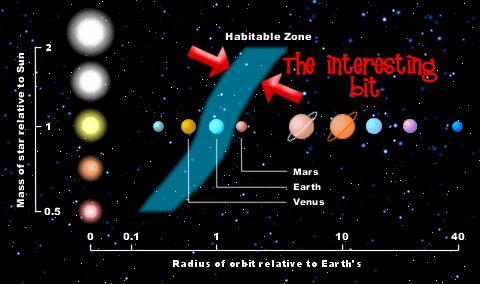
Circumstellar Habitable Zone

This is a post from J. Warner Wallace, over at Cold Case Christianity.

Let’s see his four ways first, then I’ll add one that I know.

He writes:

  1. The Earth’s Relationship to the Sun Is Favorable to Life
  2. The Earth’s Atmospheric Conditions Are Favorable to Life
  3. The Earth’s Terrestrial Nature Is Favorable to Life
  4. The Earth’s Relationship to the Moon Is Favorable to Life

I’ve blogged about the moon and plate tectonics before, so we won’t pick #3 and #4 to look at. And I blogged about the stellar habitable zone before, so we won’t pick #1, either.

Let’s look at #2:

The Earth’s Atmospheric Conditions Are Favorable to Life:
The surface gravity of Earth is critical to its ability to retain an atmosphere friendly to life. If Earth’s gravity were stronger, our atmosphere would contain too much methane and ammonia. If our planet’s gravity were weaker, Earth wouldn’t be able to retain enough water. As it is, Earth’s atmosphere has a finely calibrated ratio of oxygen to nitrogen—just enough carbon dioxide and adequate water vapor levels to promote advanced life, allow photosynthesis (without an excessive greenhouse effect), and to allow for sufficient rainfall.

Ok, that’s very good.

Now here is one from me… well, it’s from Science Daily, but I found it. Actually, ECM found it. But he told me.

Excerpt:

They suggest that the size and location of an asteroid belt, shaped by the evolution of the Sun’s protoplanetary disk and by the gravitational influence of a nearby giant Jupiter-like planet, may determine whether complex life will evolve on an Earth-like planet.

This might sound surprising because asteroids are considered a nuisance due to their potential to impact Earth and trigger mass extinctions. But an emerging view proposes that asteroid collisions with planets may provide a boost to the birth and evolution of complex life.

Asteroids may have delivered water and organic compounds to the early Earth. According to the theory of punctuated equilibrium, occasional asteroid impacts might accelerate the rate of biological evolution by disrupting a planet’s environment to the point where species must try new adaptation strategies.

The astronomers based their conclusion on an analysis of theoretical models and archival observations of extrasolar Jupiter-sized planets and debris disks around young stars. “Our study shows that only a tiny fraction of planetary systems observed to date seem to have giant planets in the right location to produce an asteroid belt of the appropriate size, offering the potential for life on a nearby rocky planet,” said Martin, the study’s lead author. “Our study suggests that our solar system may be rather special.”

So, that’s 5 ways that the Earth and our solar system are fine-tuned to be habitable for complex, embodied minds. Somebody is looking out for you, so be thankful and recognize.

Actually, I was thinking about this today (Wednesday). At lunch, I was thinking about this girl I know who is very disrespectful of me, of what I’ve achieved, and she won’t take my advice in the areas where I am experienced – education, career, saving, investing. I was fretting about it as I was about to start eating my lunch and suddenly it struck me that I don’t give God enough credit for the many blessings I get from him. I don’t mean things that “go my way”, I mean big things like habitability, and so on. So I said a longer grace than normal today at lunch. I wonder if he sent me that rebellious girl so that I would know how he feels when I don’t recognize and respect him, and just complain about the things he doesn’t do for me.

Anyway, I hope this habitability post will give you something to be thankful for. Our God is an awesome God.