
Tag Archives: Age

American health care: does it cause poor life-expectancy and high infant mortality?

Probably one of the best health care policy experts writing today is Avik Roy, who writes for Forbes magazine.

Here is his latest column, which I think is useful for helping us all get better at debating health care policy. (H/T Matt from Well Spent Journey)

Excerpt:

It’s one of the most oft-repeated justifications for socialized medicine: Americans spend more money than other developed countries on health care, but don’t live as long. If we would just hop on the European health-care bandwagon, we’d live longer and healthier lives. The only problem is it’s not true.

[…]If you really want to measure health outcomes, the best way to do it is at the point of medical intervention. If you have a heart attack, how long do you live in the U.S. vs. another country? If you’re diagnosed with breast cancer? In 2008, a group of investigators conducted a worldwide study of cancer survival rates, called CONCORD. They looked at 5-year survival rates for breast cancer, colon and rectal cancer, and prostate cancer. I compiled their data for the U.S., Canada, Australia, Japan, and western Europe. Guess who came out number one?

Here is the raw data:
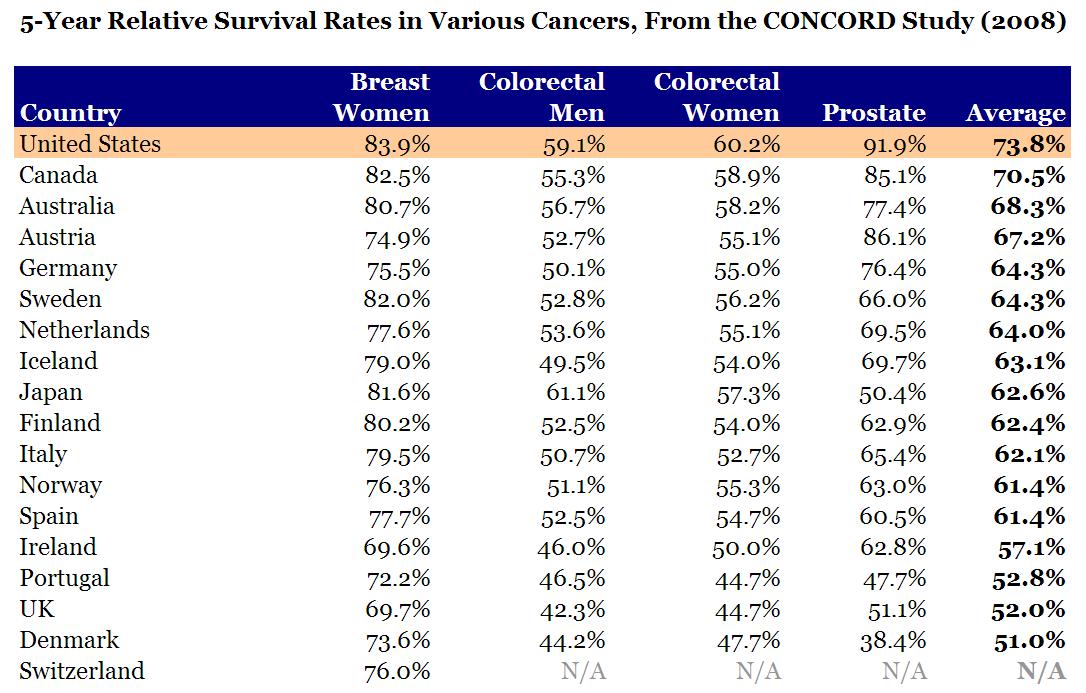
Health care outcomes
Health care outcomes by country and type of treatment

Click here to see the larger graph.

So, what explains this?

The article continues:

Another point worth making is that people die for other reasons than health. For example, people die because of car accidents and violent crime. A few years back, Robert Ohsfeldt of Texas A&M and John Schneider of the University of Iowa asked the obvious question: what happens if you remove deaths from fatal injuries from the life expectancy tables? Among the 29 members of the OECD, the U.S. vaults from 19th place to…you guessed it…first. Japan, on the same adjustment, drops from first to ninth.

It’s great that the Japanese eat more sushi than we do, and that they settle their arguments more peaceably. But these things don’t have anything to do with socialized medicine.

Finally, U.S. life-expectancy statistics are skewed by the fact that the U.S. doesn’t have one health-care system, but three: Medicaid, Medicare, and private insurance. (A fourth, the Obamacare exchanges, is supposed to go into effect in 2014.) As I have noted in the past, health outcomes for those on government-sponsored insurance are worse than for those on private insurance.

To my knowledge, no one has attempted to segregate U.S. life-expectancy figures by insurance status. But based on the data we have, it’s highly likely that those on private insurance have the best life expectancy, with Medicare patients in the middle, and the uninsured and Medicaid at the bottom.

I know that my readers who like to dig deep into economics and policy will love the links at the bottom of the article:

For further reading on the topic of life expectancy, here are some recommendations. Harvard economist Greg Mankiw discusses some of the confounding factors with life expectancy statistics, citing this NBER study by June and Dave O’Neill comparing the U.S. and Canada. (Mankiw calls the misuse of U.S. life expectancy stats “schlocky.”) Chicago economist Gary Becker makes note of the CONCORD study in this blog post. In 2009, Sam Preston and Jessica Ho of the University of Pennsylvania published a lengthy analysis of life expectancy statistics, concluding that “the low longevity ranking of the United States is not likely to be a result of a poorly functioning health care system.”

The funniest thing I have found when talking to people from countries with socialized health care systems, like Canada and the UK, is that they are woefully uninformed about American health care. They literally do not know about free emergency room care, which is free for anyone regardless of insurance – including illegal aliens. They do not know about our expensive Medicaid program, which helps people who cannot afford health insurance. And our very very expensive Medicare program, which provides health care to the elderly – including prescription drugs. I get the feeling that foreign critics of American health care are getting their views from amateur documentaries produced by uneducated Hollywood propagandists, or maybe from TV shows on the Comedy Channel. They certainly are not getting their information from peer-reviewed studies by credentialed scholars from top universities, like the ones cited above.

I have literally spoken to Canadians who think that people in the USA without insurance do not get treatment and just die in the streets from stab wounds. They don’t know about the emergency room rule, or about charity care, or about Medicaid and Medicare. There is a lot of ignorance up there – wilful ignorance, in some cases. And keep in mind that the average Canadian household is paying over $11,000 a year for this substandard health care! They are paying more for less, and that’s not surprising since a large chunk of the taxes that are collected for health care go to overpaid unionized bureaucrats. Naturally, when their left-wing politicians need treatment, the first place they go is to the United States, where they pay out of pocket for the better health care. But that doesn’t stop them from denouncing American health care when they are talking to voters.

Higher infant mortality rates?

One of the other common arguments you hear from uninformed people outside the USA is the higher infant mortality rates argument.

Here’s an article by Stanford University professor Scott Atlas to explain why the argument fails.

Excerpt:

Virtually every national and international agency involved in statistical assessments of health status, health care, and economic development uses the infant-mortality rate — the number of infants per 1,000 live births who die before reaching the age of one — as a fundamental indicator. America’s high infant-mortality rate has been repeatedly put forth as evidence “proving” the substandard performance of the U.S. health-care system.

[…]n a 2008 study, Joy Lawn estimated that a full three-fourths of the world’s neonatal deaths are counted only through highly unreliable five-yearly retrospective household surveys, instead of being reported at the time by hospitals and health-care professionals, as in the United States. Moreover, the most premature babies — those with the highest likelihood of dying — are the least likely to be recorded in infant and neonatal mortality statistics in other countries. Compounding that difficulty, in other countries the underreporting is greatest for deaths that occur very soon after birth.

[…]The United States strictly adheres to the WHO definition of live birth (any infant “irrespective of the duration of the pregnancy, which . . . breathes or shows any other evidence of life . . . whether or not the umbilical cord has been cut or the placenta is attached”) and uses a strictly implemented linked birth and infant-death data set. On the contrary, many other nations, including highly developed countries in Western Europe, use far less strict definitions, all of which underreport the live births of more fragile infants who soon die. As a consequence, they falsely report more favorable neonatal- and infant-mortality rates.

[…]Neonatal deaths are mainly associated with prematurity and low birth weight. Therefore the fact that the percentage of preterm births in the U.S. is far higher than that in all other OECD countries — 65 percent higher than in Britain, and more than double the rate in Ireland, Finland, and Greece — further undermines the validity of neonatal-mortality comparisons.

You can listen to a podcast with Dr. Atlas here, from the Library of Economics web site.

If you want to read more about how American health care compares with health care in socialized systems, read this article by Stanford University professor of medicine Dr. Scott Atlas. And you can get his book “In Excellent Health: Setting the Record Straight on America’s Health Care” from Amazon.

To marry and have children, it’s important to make a realistic plan

This is a guest post by Mathetes entitled “The Road That Was Taken”.  You can find his last post here.

The Daily Mail is the gift that keeps on giving. And usually the gifts are a witness to the outcomes of bad choices. Previously, we discussed how to live your worst life. Unfortunately, some people serve as stark examples. Enter Megan, and her story that is told in “It’s NOT my fault that I missed the chance to become a mother”.

The story is familiar: a gal lamenting that she has no man or children. But in a world where women have the ability to define and achieve any of their goals, where does this lament come from?

Playing with her nieces one day, Megan burst into tears because “I couldn’t bring myself to articulate the truth — that, at the age of 38, I realised I’d probably never watch my own child doing somersaults on a summer’s day.”

But how did this come about for someone with children as a goal?

“I wasn’t childless for medical reasons, or out of choice. The right man had just never come along.

As a writer living in London, with a fulfilling career and a great social life, I was a doting aunt to Harry, Jack, Emily and Freya.”

This sounds so strange. In a world where women are go-getters, here we have a lady who just sat around waiting for a man to mysteriously “come along”. I don’t believe the incongruence struck her – she has a career in which she is fulfilled, but she probably didn’t devote as much time to finding her man as she did to getting her career in order.

We come to the problem a little later on:

“I’d just assumed I’d address the subject of having children when I met the right partner with whom to confront it later in life. But I never did.”

Wintery often states that it’s important to have a plan for your life. This unfortunate lass didn’t have one, and the result is typical.

Or maybe she did have a plan. Because a plan is a restricted range of choices that is meant to lead you to a particular goal. So how did Megan’s choices influence her life? We read:

“I lived with a long-term boyfriend throughout my 20s, but we were young, and parenthood seemed a long way away. In my early 30s, I entered into a relationship that was so unstable, I knew we would never have children. He was a commitment-phobic poet, and while my friends urged me to finish the relationship and find one in which children might be an option, I didn’t long for a family enough to give him up. At 35, I finally accepted that we were never going to work out. Other relationships came and went, but none turned into something more permanent.”

So here was Megan’s plan:

  • Step 1: Live with boyfriend throughout her 20’s
  • Step 2: Enter an unstable relationship in her early 30’s, where she knew she’d never have children
  • Step 3: After a few year break up with a man who was unsuitable material for a husband

So Megan’s goal was to find a mate and have kids. And her plan was constructed to achieve the exact opposite result.

Maybe after her mid-30’s Megan figured this out. With age comes wisdom, so they say. So what did Megan set about to do:

“I began to think more about having children when I was in my late 30s, but didn’t start sizing up potential fathers on first dates because I didn’t want to rush into having children with someone I wasn’t certain about. “

So let’s add another step.

  • Step 4: Date men but don’t evaluate them for spousal quality

Though Megan made some bad choices, she does see what’s necessary for a child, and she should be commended for this:

“Nor did I want to become a single parent by choice. I’d seen how hard it was to bring up children even with a partner, thanks to my sisters, and I’d witnessed at first hand the struggles of a close friend who had unexpectedly become a single parent.

I just didn’t think I could tough it out by myself. I wanted to share parenting, and never dreamed of becoming ‘accidentally’ pregnant. I wasn’t going to trick anyone, or short-change myself.”

This is to be commended, and I mean this in all seriousness.

But getting back to her choices, Megan was warned:

“A friend who had been ambivalent about children until she was 39, and became a mother at 41, warned me that I would go through a grieving process if I didn’t become a mother. I laughed it off, but my friend was right.”

And here we read the unfortunate result when dreams and aspirations collide with the harsh wall of reality.

“… it dawned on me that I was fast approaching 40 — the age at which it seemed that if I hadn’t had my own child, I probably never would. My feelings of panic grew.”

“Feelings of resentment began to build inside me when, in the space of a year, five of my closest girlfriends told me they were pregnant. I felt happy for them, and increasingly sad for myself.“

“I tried to hide my feelings. I bought baby gifts and picked up newborns with a smile fixed on my face, even as my heart sank when I thought of the children I might never have.”

“Panic flooded over me every time I read a celebrity talking about how their little Petula/Tommy/Isabella was the best thing that had ever happened to them.”

“More and more, I felt weighed down by all the judgments — some proffered, some unspoken — about single and childless women. From being too picky to be satisfied by a partner, to just too career-orientated and selfish, the judgments are endless. In my experience, they’re generally inaccurate, too.“

This is an object lesson in the internal psychic dissonance that takes place when one’s goals collide with their choices.

Perhaps enlightenment at this stage is the best that can be hoped for. Mature adults come to accept that the choices they’ve made have resulted in the position they are in. Thus, we are able reflect and see where we went wrong and how to grow from this. Perhaps Megan will take responsibility for her choices and her current situation.

Not entirely.

“When I analysed the reasons why they and I were in this position, I came to one conclusion: bad luck, bad choices or bad timing. Not selfishness.”

Her choices she can control. But luck and timing? Perhaps, but not as likely, given her focus on career and relationships. And her choices? Doesn’t that imply that she is choosing?

And why blame luck or timing at all?

The reason for this is simple: it’s very hard to realize that you are responsible for your position. This isn’t a hard rule, but you usually got where you’re at because you followed your own path.

And she’s not alone. Other women share her plight:

“‘One of them is that more and more women are childless through circumstance. They are grieving for something few people acknowledge they have the right to grieve for, and many of them don’t even realise that’s what’s happening to them.

‘Some of them are losing some of the most powerful and productive years of their lives as they get stuck in their grief.’

I know what you’re thinking. Now, at last, maybe Megan realizes the way out. She can decide to make sure she dates in the right way. That she won’t waste time on things that take away from her goal. Even if she can’t have kids, she should still be able to find a mate and adopt. So there are possibilities for her.

The question is: where does she go from here?

And the answer is:

Morocco!

“I was determined not to lose some of the best years of my life in this way. I’d written eight books, had a life full of friends and family, and yet I felt like a failure. I had to do something.

So I did. I bought a plane ticket to Marrakesh in Morocco — a place I’d visited just once for a long weekend.”

“If I wasn’t going to have the rhythms and responsibilities of parenthood, I could make the most of my freedom.”

Megan is educated and has a successful career. She’s enjoying her freedom. But there’s still her life-long goal of having children.  How do these diverging paths reconcile with each other?

And here we come to the end. The need to rationalize, and downplay what others have, so that one’s situation is more palatable.

“I’d spent months thinking that motherhood was the answer, but I now began to realise that it wasn’t an instant passport to growth. Just look at the one-track minds some mothers have about their children.”

“You have to be open to change, and that’s possible with or without being a mother. Each side of the coin loses and gains.”

“For all I’d envied about the lives of mothers I knew, they’d envied what I had — freedom, time and the ability to nurture other relationships in a way I never would if I was a parent.”

“More importantly, I realised I wasn’t childless. I had my sisters’ children, my godchildren and a gaggle of girlfriends who were all generous with theirs.”

“For now I am splitting my time between England and Morocco, enjoying the best of both worlds. I no longer feel weighed down in England, just happy to visit.

“And while our lives might be different to the ones we envisaged when we were young, they are just as complete.”

And so Megan’s rationalization takes us full circle. Megan actually is a mother. She is completely free. She can do what she wants with her life. Her friends with children envy her. She is more open than her friends, who have one-track minds. And she, of course, realizes that motherhood was never the answer. It wasn’t a passport to growth. Her life is complete.

As I walked the halls of my work a few months ago I found a notice on a door that showed someone in an uncomfortable situation. The caption said: Sometimes the purpose of someone’s life is to be a lesson to others.

Megan, of course, may never be able to grapple with the repercussions of the feminist lies she bought into. She followed them, despite consciously knowing her choices were not leading her to the life she wanted.

But we can observe and know how to act. Let her story be a lesson to you if you are contemplating her path. Find out what you want, and live with this in mind.

Why do some people disagree with the gay lifestyle?

Here’s an article from the liberal New York Times that explains one practical reason why social conservatives disagree with the gay lifestyle and prefer not to celebrate it. (H/T Neil)

Here’s the set up:

BOB BERGERON was so relentlessly cheery that people sometimes found it off-putting. If you ran into him at the David Barton Gym on West 23rd Street, where he worked out nearly ever morning at 7, and you complained about the rain, he would smile and say you’d be better off focusing on a problem you could fix.

That’s how Mr. Bergeron was as a therapist as well, always upbeat, somewhat less focused on getting to the root of his clients’ feelings than altering behavior patterns that were detrimental to them: therapy from the outside-in.

Over the last decade, he built a thriving private practice, treating well-to-do gay men for everything from anxiety to coping with H.I.V. Mr. Bergeron had also begun work as a motivational speaker, giving talks at gay and lesbian centers in Los Angeles and Chicago. In February, Magnus Books, a publisher specializing in gay literature, was scheduled to print a self-help guide he had written, “The Right Side of Forty: The Complete Guide to Happiness for Gay Men at Midlife and Beyond.”

It was a topic he knew something about. Having come out as gay in the mid-1980s, Mr. Bergeron, 49, had witnessed the worst years of the AIDS epidemic and emerged on the other side. He had also seen how few public examples there were of gay men growing older gracefully.

He resolved to rewrite the script, and provide a toolbox for better living.

“I’ve got a concise picture of what being over 40 is about and it’s a great perspective filled with happiness, feeling sexy, possessing comfort relating to other men and taking good care of ourselves,” Mr. Bergeron said on his Web site.  “This picture will get you results that flourish long-term.”

But right around New Year’s Eve, something went horribly wrong. On Jan. 5, Mr. Bergeron was found dead in his apartment, the result of a suicide that has left his family, his friends and his clients shocked and heartbroken as they attempt to figure out how he could have been so helpful to others and so unable to find help himself.

Look:

To his friends, Mr. Bergeron maintained a positive tone. He went on vacation, dated some, visited museums.

Still, he privately expressed misgivings about what the future held. Olivier Van Doorne, a patient of Mr. Bergeron and the creative director of SelectNY, a fashion advertising firm, recalled Mr. Bergeron telling him that every gay man peaks at one point in his life.

“He said a number of times: ‘I peaked when I was 30 or 35. I was super-successful, everyone looked at me, and I felt extremely cool in my sexuality.’ ”

Mr. Siegel, the therapist who supervised Mr. Bergeron in the early days of his career, said: “Bob was a very beautiful younger man, and we talked a lot about how that shapes and creates a life. The thesis of his book is based very much on his own personal experience with that. And the book also emphasized what to do when you’re not attractive or you no longer have the appeal you once had. The idea was to transcend that and expand your sexual possibilities.”

And:

With the book about to be printed, Mr. Bergeron became convinced that he’d written too much about the shame and isolation involved with hooking up online; that people weren’t even really doing that anymore, now that phone apps like Grindr and Scruff had come along.

His book, he felt, had become antiquated before it even came out.

[…]Though some of his friends, Mr. Rappaport among them, wondered whether drugs were involved, leading to a crash Mr. Bergeron did not anticipate, the suicide seemed to have been carried out with methodical precision. On an island in the kitchen, Mr. Bergeron had meticulously laid out his papers. There was a pile of folders with detailed instructions on top about whom to call regarding his finances and his mortgage. Across from that he placed the title page of his book, on which he also wrote his suicide note. In it he told Mr. Sackheim and Mr. Rappaport that he loved them and his family, but that he was “done.”

As his father remembered it, Mr. Bergeron also wrote, “It’s a lie based on bad information.”

An arrow pointed up to the name of the book.

The inference was clear. As Mr. Bergeron saw it at the end of his life, the only right side of 40 was the side that came before it.

What’s the problem?

I think that the problem is that in the gay lifestyle, you have a typically male emphasis on physical appearance, sex and pleasure. There is none of the moderating influence of women, which tends to push men into commitments, responsibility and stability.

According to the research, the gay lifestyle is very different than the traditional heterosexual courting approach:

The 2003-2004 Gay/Lesbian Consumer Online Census surveyed the lifestyles of 7,862 homosexuals. Of those involved in a “current relationship,” only 15 percent describe their current relationship as having lasted twelve years or longer, with five percent lasting more than twenty years.[4]

A study of homosexual men in the Netherlands published in the journal AIDS found that the “duration of steady partnerships” was 1.5 years.[6]

In his study of male homosexuality in Western Sexuality: Practice and Precept in Past and Present Times, Pollak found that “few homosexual relationships last longer than two years, with many men reporting hundreds of lifetime partners.”[7]

And:

The Dutch study of partnered homosexuals, which was published in the journal AIDS, found that men with a steady partner had an average of eight sexual partners per year.[12]

In their study of the sexual profiles of 2,583 older homosexuals published in the Journal of Sex Research, Paul Van de Ven et al. found that “the modal range for number of sexual partners ever [of homosexuals] was 101-500.” In addition, 10.2 percent to 15.7 percent had between 501 and 1,000 partners. A further 10.2 percent to 15.7 percent reported having had more than one thousand lifetime sexual partners.[14]

A survey conducted by the homosexual magazine Genre found that 24 percent of the respondents said they had had more than one hundred sexual partners in their lifetime. The magazine noted that several respondents suggested including a category of those who had more than one thousand sexual partners.[15]

And:

Even in those homosexual relationships in which the partners consider themselves to be in a committed relationship, the meaning of “committed” or “monogamous” typically means something radically different than in heterosexual marriage.

A Canadian study of homosexual men who had been in committed relationships lasting longer than one year found that only 25 percent of those interviewed reported being monogamous.” According to study author Barry Adam, “Gay culture allows men to explore different…forms of relationships besides the monogamy coveted by heterosexuals.”[16]

[…]In their Journal of Sex Research study of the sexual practices of older homosexual men, Paul Van de Ven et al. found that only 2.7 percent of older homosexuals had only one sexual partner in their lifetime.[19]

In the gay lifestyle, men seem to have the most value when they are younger and more good-looking. The whole thing seems to be very much about appearance and sex – having as much sex as possible with as many different men as possible. (See, for example, the popular Grindr application on the iPhone, which allows gays to find other gays for anonymous hook-up sex)

This is really sad, because it means that as the gay men get older and their looks fade, they lose value in the area that counts the most to many of them: sexuality. This is different than in a traditional heterosexual marriage, where the man retains his value longer since he can perform his traditional male roles as a husband and father even after he gets older and loses his looks. In fact, his ability to protect, provide and lead on moral and spiritual issues can actually get better as he gets older – so his self-esteem goes up. Now it’s true that he can get depressed when he retires, but by then he’s probably around 65! And at least he will have a wife there to take care of them, and probably children to support, too. My Dad, for example, does lots of things to help me even though he is retired.

I think this NYT article sheds light on why people with traditional values tend to disagree with homosexuality and also to refrain from celebrating and affirming the gay lifestyle. We treat the gay lifestyle as if it were similar to smoking. It’s permissible, but not to be encouraged. We are not trying to make anyone feel badly just for the sake of being mean to them. If a certain lifestyle is not fulfilling, then it is a good thing to say to people “you should think twice about getting involved in this”. It’s not loving to tell people that harmful things are not really harmful. Telling someone that something unfulfilling or unhealthy is actually good for them doesn’t help them any. It’s not loving to tell a child that touching a hot stove won’t burn them – the loving thing to do is to tell the truth and then let them choose.

Here’s my previous post outlining a secular case against gay marriage.