I have been puzzled by the extent of the media coverage of some crank’s prediction that the world would come to an end today. People are always predicting the end of the world. So far they have always been wrong. Was there something about this particular prediction that was newsworthy? Did any significant number of people expect to wake up this morning and see graves opening and people ascending into Heaven? This morning, there were news stories to the effect that the world still exists. Really! Did reporters expect their readers to be surprised? Why, in short, was this silliness a major media event?
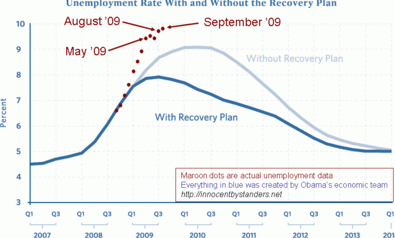
I wish reporters would pay as much attention to a more important failed prediction: the Obama administration’s assurance that its policies, including the “stimulus,” would foster job creation and prevent unemployment from reaching 8 percent.
And here are some charts from John’s post.
Community organizer Obama predicted that his $800 billion dollar stimulus program would keep unemployment below 8%:
Stimulus Job Creation Prediction
Ooops! Never send a community organizer to do an economist’s job.
How about all that spending? Surely ALL the spending must have created more jobs?
This should be the end of the belief that government spending creates jobs, but it won’t be, because the university is not committed to teaching what gets results, but what produces feelings of superiority. The secular elites feel that they should be allowed to redistribute the wealth created by businesses and workers. This feeling of entitlement to control and distribute is best put into practice with large-scale taxation, spending and redistribution of wealth. The professors think that their good feelings (subjective) will somehow, mysteriously, cause good effects in the real world (objective). The chart proves their mysticism wrong, but the university is insulated from feedback from the real world.
That is why we need to elect business owners like Michele Bachmann or Herman Cain.
Most of my readers are familiar with William Lane Craig and J.P. Moreland – they are two of the most famous Christian apologists out operating today. They both cite a person named “J. Gresham Machen”, and today I want to tell you more about this person.
William Lane Craig quotes him in this chapel address to Wheaton College students. (I am adding some context to Craig’s citation: Craig started the quote at “False ideas…” and ended it at “…harmless delusion”)
We are all agreed that at least one great function of the Church is the conversion of individual men. The missionary movement is the great religious movement of our day. Now it is perfectly true that men must be brought to Christ one by one. There are no labor-saving devices in evangelism. It is all hard-work.
And yet it would be a great mistake to suppose that all men are equally well prepared to receive the gospel. It is true that the decisive thing is the regenerative power of God. That can overcome all lack of preparation, and the absence of that makes even the best preparation useless. But as a matter of fact God usually exerts that power in connection with certain prior conditions of the human mind, and it should be ours to create, so far as we can, with the help of God, those favorable conditions for the reception of the gospel. False ideas are the greatest obstacles to the reception of the gospel. We may preach with all the fervor of a reformer and yet succeed only in winning a straggler here and there, if we permit the whole collective thought of the nation or of the world to be controlled by ideas which, by the resistless force of logic, prevent Christianity from being regarded as anything more than a harmless delusion.
I was actually in the audience when he gave this speech – I was there for the philosophy conference.
So Craig is citing J. Gresham Machen. What about Moreland?
He cites he exact same passage by J. Gresham Machen, as well, only he starts his citation at “God usually exerts…”.
So that’s Craig and Moreland. Citing the same passage, by the same writer. Interesting.
So who is this J. Gresham Machen anyway?
Here’s the bio:
J. Gresham Machen was professor of New Testament at Princeton Theological Seminary before becoming one of the founders of Westminster Theological Seminary and the Orthodox Presbyterian Church (OPC). This address on The Scientific Preparation of the Minister, was delivered September 20, 1912, at the opening of the one hundred and first session of Princeton Theological Seminary, and in substance (previously) at a meeting of the Presbyterian Ministers’ Association of Philadelphia, May 20, 1912. It was first published in The Princeton Theological Review, Vol. 11, 1913.
And Craig and Moreland are citing this essay, which you can read online for free. If you want to know what makes the Wintery Knight the Wintery Knight, this is the place to find your answers.
The essay was published in the Princeton Theological Review in 1913. The essay explains what the church should have done, but didn’t. And the only way out of the mess we are in now is to go back to the fork in the road and make the right turn this time.
You really need to read the essays I linked to by Craig, Moreland and Machen. It will open your eyes and show you how there can be so many Christians attending church on Sundays, and yet they have so little impact on the culture as a whole.
Autobiographical note
When I was a young man, I was exposed to the writings of William Lane Craig, J.P. Moreland, Walter L. Bradley, Greg Koukl, Hugh Ross, and Philip E. Johnson – and they changed my life. It really does make a big difference to young people when they are engaged at an intellectual level, with logic and evidence. I had no other connections to the church at that time. No one in my family, and none of my friends, were religiously inclined. I had no felt needs for religion. But approaching Christianity as knowledge worked for me. Before my conversion, I never attended the feminized church. And I was never told that Christianity was opposed to logic and evidence. Imagine my surprise to see what was being taught in the church compared to the public, testable claims to knowledge in the Bible, and the public, testable claims to knowledge that Christians scholars made in their books.
This passage from R.C. Sproul and John Gerstner in their otherwise useless book on Christian apologetics was formative for me, as well:
Secularism, on the other hand, is a post-Christian phenomenon carrying in its baggage, a conscious rejection of the Christian world view. It supplants the Christian consensus with its own structured view of reality. Less barbaric on the surface than paganism, secularism adopts a benevolent paternalism toward the not yet enlightened Christian who continues the practice of an anachronistic faith. Wearing a benign mask, the secularist loudly proclaims his commitment to religious tolerance on behalf of those weak-minded souls who still cannot bear to face a hostile, or worse, an indifferent universe, without the narcotic effect of ecllesiastical opium. The church is safe from vicious persecution at the hands of the secularist, as educated people have finished with stake-burning circuses and torture racks. No martyr’s blood is shed in the secularist West – so long as the church knows her place and remains quietly at peace on her modern reservation. Let the babes pray and sing and read their Bibles, continuing steadfast in their intellectual retardation; the church’s extinction will come not by sword of pillory, but by the quiet death of irrelevance. It will pass away with a whimper not a bang. But let the church step off the reservation, let her penetrate once more the culture of the day and the Janus-face of secularism will change from benign smile to savage snarl.
This is the problem we are facing today. We have changed Christianity into “faith” instead of KNOWLEDGE.
Discrimination is always high on the agenda at the Society for Personality and Social Psychology’s conference, where psychologists discuss their research on racial prejudice, homophobia, sexism, stereotype threat and unconscious bias against minorities. But the most talked-about speech at this year’s meeting, which ended Jan. 30, involved a new “outgroup.”
It was identified by Jonathan Haidt, a social psychologist at the University of Virginia who studies the intuitive foundations of morality and ideology. He polled his audience at the San Antonio Convention Center, starting by asking how many considered themselves politically liberal. A sea of hands appeared, and Dr. Haidt estimated that liberals made up 80 percent of the 1,000 psychologists in the ballroom. When he asked for centrists and libertarians, he spotted fewer than three dozen hands. And then, when he asked for conservatives, he counted a grand total of three.
“This is a statistically impossible lack of diversity,” Dr. Haidt concluded, noting polls showing that 40 percent of Americans are conservative and 20 percent are liberal. In his speech and in an interview, Dr. Haidt argued that social psychologists are a “tribal-moral community” united by “sacred values” that hinder research and damage their credibility — and blind them to the hostile climate they’ve created for non-liberals.
“Anywhere in the world that social psychologists see women or minorities underrepresented by a factor of two or three, our minds jump to discrimination as the explanation,” said Dr. Haidt, who called himself a longtime liberal turned centrist. “But when we find out that conservatives are underrepresented among us by a factor of more than 100, suddenly everyone finds it quite easy to generate alternate explanations.”
[…]The politics of the professoriate has been studied by the economists Christopher Cardiff and Daniel Klein and the sociologists Neil Gross and Solon Simmons. They’ve independently found that Democrats typically outnumber Republicans at elite universities by at least six to one among the general faculty, and by higher ratios in the humanities and social sciences. In a 2007 study of both elite and non-elite universities, Dr. Gross and Dr. Simmons reported that nearly 80 percent of psychology professors are Democrats, outnumbering Republicans by nearly 12 to 1.
And yet all we ever hear from the academic left is how open-minded they all are – how they love to celebrate diversity. What diversity? They’re more bigoted and segregated than the Ku Klux Klan. At least the Klan isn’t taxpayer-funded by the very people who are being discriminated against!


 WINTERY KNIGHT