Tag Archives: Academia

Another looming debt crisis: law school students racking up $100,000+ in debt

Consider this scary article from the Competitive Enterprise Institute. (H/T Hans)

Excerpt: (links removed)

Federal financial aid policies haveencouraged law students to borrow increasing amounts to attend law school, despite the glut of lawyers (oddly, government policies encourage more people to go to law school, driving up law schooltuition, even as the Obama administration seeks to cut back on vocational education aimed at training the skilled blue-collar workers who are in desperately short supply in much of the country). The result, says law professor Brian Tamanaha, is a “Quickly Exploding Law Graduate Debt Disaster” in which most recent graduates of many law schools will never be able to pay off their staggering student loan debt. At the liberal Balkinization blog, Tamanaha notes that the average student has over $100,000 in debt just from law school at many schools…

[…]As one commenter noted earlier, federal financial aid and student loans have driven up law school tuition and student loan debt: “education loans . . . often have implicit government guarantees,” even those not explicitly backed by the government. As a result, “like the GSE’s, the supply of credit for education loans has continued to expand. So in a way colleges and universities, public and private have been in a bubble akin to the housing bubble. The benefits to the institutions are irresistible and so there is no way they will try to reign in costs and thus tuition. Not as long as students are willing and able to borrow.” When the bubble pops, taxpayers will be on the hook for countless billions of dollars (many graduates already are not repaying their student loans). “Why is college so expensive? A new study points to a disconcerting culprit: financial aid,” notes Paul Kix on page K1 of the March 25 Boston Globe. I and professors and education experts commented earlier on that study at Minding the Campus. Other studies also have concluded that increased federal financial aid, such as student loans, drives up college tuition, and you can find links to some of them here.

[…]When law school graduates are unable to pay off their student loans, lenders will come after their elderly parents who co-signed for the loans.  As the Washington Post notes, “Americans 60 and older still owe about $36 billion in student loans . . . Many have co-signed for loans with their children or grandchildren to help them afford ballooning tuition.”

According to the liberal New York Times, law schools do a woeful job of preparing students to practice law.

Excerpt:

The lesson today — the ins and outs of closing a deal — seems lifted from Corporate Lawyering 101.

“How do you get a merger done?” asks Scott B. Connolly, an attorney.

There is silence from three well-dressed people in their early 20s, sitting at a conference table in a downtown building here last month.

“What steps would you need to take to accomplish a merger?” Mr. Connolly prods.

After a pause, a participant gives it a shot: “You buy all the stock of one company. Is that what you need?”

“That’s a stock acquisition,” Mr. Connolly says. “The question is, when you close a merger, how does that deal get done?”

The answer — draft a certificate of merger and file it with the secretary of state — is part of a crash course in legal training. But the three people taking notes are not students. They are associates at a law firm called Drinker Biddle & Reath, hired to handle corporate transactions. And they have each spent three years and as much as $150,000 for a legal degree.

What they did not get, for all that time and money, was much practical training. Law schools have long emphasized the theoretical over the useful, with classes that are often overstuffed with antiquated distinctions, like the variety of property law in post-feudal England. Professors are rewarded for chin-stroking scholarship, like law review articles with titles like “A Future Foretold: Neo-Aristotelian Praise of Postmodern Legal Theory.”

So, for decades, clients have essentially underwritten the training of new lawyers, paying as much as $300 an hour for the time of associates learning on the job. But the downturn in the economy, and long-running efforts to rethink legal fees, have prompted more and more of those clients to send a simple message to law firms: Teach new hires on your own dime.

“The fundamental issue is that law schools are producing people who are not capable of being counselors,” says Jeffrey W. Carr, the general counsel of FMC Technologies, a Houston company that makes oil drilling equipment. “They are lawyers in the sense that they have law degrees, but they aren’t ready to be a provider of services.”

[…]Consider, for instance, Contracts, a first-year staple. It is one of many that originated in the Langdell era and endures today. In it, students will typically encounter such classics as Hadley v. Baxendale, an 1854 dispute about financial damages caused by the late delivery of a crankshaft to a British miller.

Here is what students will rarely encounter in Contracts: actual contracts, the sort that lawyers need to draft and file. Likewise, Criminal Procedure class is normally filled with case studies about common law crimes — like murder and theft — but hardly mentions plea bargaining, even though a vast majority of criminal cases are resolved by that method.

[…]“We should be teaching what is really going on in the legal system,” says Edward L. Rubin, a professor and former dean at the Vanderbilt Law School, “not what was going on in the 1870s, when much of the legal curriculum was put in place.”

Not only that, but the marketplace is saturated with lawyers already. When supply increases and demand decreases, prices fall. The new batch of lawyers are not going to be able to command the same salaries as the old batch.

Has Obama succeeded in spreading the wealth around?

Obama Economic Record November 2011

From Investors Business Daily.

Excerpt:

According to an IBD review of various economic data, while corporations and Wall Street investors have made significant gains under Obama’s economic leadership, average Americans have seen their fortunes steadily decline.

Since the start of the Obama administration, corporate profits have climbed 68% (about 59% after inflation), and are now 19% above their pre-recession peak, according to the latest Commerce Department data out Tuesday morning.

Meanwhile, companies are sitting on a pile of cash that’s grown 38% from Q1 2009 to Q2 2011, according to the Federal Reserve’s quarterly “Flow of Funds” report.

And since Obama’s inauguration, the Dow Jones Industrial Average has climbed 45%.

However, these solid gains haven’t translated into prosperity down the economic ladder.

Since Obama took office, median weekly earnings have dropped almost 5% after inflation, according to the Bureau of Labor Statistics. Home prices are below their January 2009 levels; unemployment is higher, as is the inflation rate. Gas prices alone have more than doubled since January 2009.

[…]Household income: Since the recovery started, household income has fallen 6.7%, according to a study by former Census Bureau officials. That’s a bigger decline than during the 18-month recession, when income fell 3.2%.

Jobs: Despite job growth since the recession ended, there are still 1.4 million fewer private sector jobs today than when Obama was sworn in, according to the Bureau of Labor Statistics. And the pace of growth — 1.6 million new jobs over the past two years — is far below what’s needed just to keep up with growth in the labor force.

Income inequality: After remaining essentially flat under President Bush, the gap between rich and poor has climbed in each of Obama’s first two years, according to the Census Bureau.

Consumer confidence: The Consumer Confidence Index dropped to 39.8 in October, down almost 10 points from when the recession ended, and almost right where it stood when Obama took office.

Misery Index: This index, which combines the unemployment rate with the inflation rate and is meant as a proxy of middle class pain, is 60% higher than when Obama took office, and it’s at a level not seen since mid-1983.

Home prices: The median price for existing home sales has dropped 4.6% since January 2009, according to monthly National Association of Realtors data. And the number of underwater mortgages is up, according to Core Logic.

Union membership: The share of private sector workers who belong to a union fell to 6.9% in 2010, compared with 7.6% the year before Obama took office, according to the Bureau of Labor Statistics.

The article explains why Obama’s rhetoric differs from reality – it turns out that the very policies he enacted created the poverty he claims he was going to reduce. Because he’s not an economist. He’s trying to do things that sound good so that people will like him. But those things don’t work.

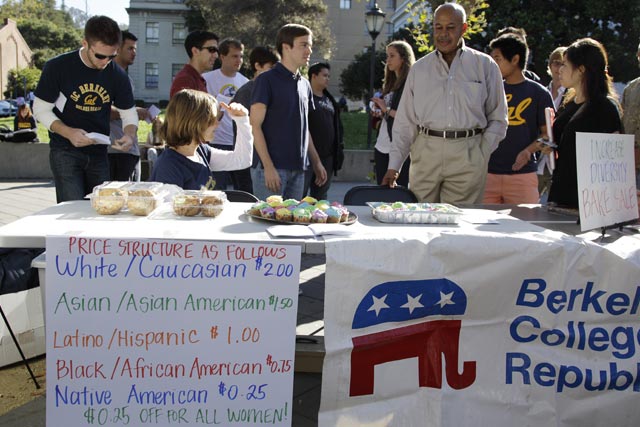
Berkeley College Republicans hold affirmative action bake sale

Berkeley College Republicans affirmative action bake sale

From the NY Daily News.

Excerpt:

A controversy over cupcakes is heating up at UC Berkeley in California, where campus Republicans are planning to hold an affirmative action bake sale on Tuesday.

At the sale, white men will be charged $2 for a baked good, Asians will pay $1.50, Latinos $1, African-Americans 75 cents and 25 cents for Native Americans, KGO-TV reported.

Women will get a 25 cent discount.

“The pricing structure is there to bring attention, to cause people to get a little upset,” Campus Republican president Shawn Lewis told the TV station. “But it’s really there to cause people to think more critically about what this kind of policy would do in university admissions.”

The Campus Democrats immediately slammed the sale, which Lewis said is meant to take a stand against an affirmative action-like bill for the University of California system that is awaiting Gov. Jerry Brown’s signature.

On Friday, the student newspaper reported that the student government could vote to defund the Republican group over the bake sale. A hearing is scheduled for Sunday on the fiery issue.

So the response of the left is to censor the people who offend their feelings. But that’s not all.

Look at the emotional language from the opposition in this CNN article.

Excerpt:

ASUC President Vishalli Loomba said many students who attended a community meeting Monday night expressed disgust that the bake sale would take place.

As a woman of color, when I first saw the event, I was appalled someone would post something like this on the Internet — not only a different pay structure, but also to rank the races,” she said. “It trivializes the struggles that people have been through and their histories.”

Now, for anyone who wants the research on affirmative action, and why it hurts minorities, I recommend two books by my favorite economist Thomas Sowell. (I also have to mention that he’s black, because otherwise the secular leftist commenters will cry racism, which is all they learn to do in four years of college). The first book is “Inside American Education” and the second book is “Affirmative Action Around the World: An Empirical Study“, published by Yale University Press. I only recommend the best to my readers. The first book is better for beginners, the second is more academic. Sowell’s conclusion? Affirmative action certainly doesn’t help minorities, and in many cases it actually hurts minorities. You can read a summary of Sowell’s findings here.

So on the one hand, you have the whiny secular left woman expressing real racism and sexism (“woman of color”), whining, blaming, and being disgusted and appalled. And on the other hand, you have Hoover Institute economist Thomas Sowell and the Yale University Press.

How Vanderbilt persecutes Christian groups on campus

But there’s more! I notice that the secular left is becoming increasingly bold about censoring Christians as well. (H/T Wes from Reason to Stand)

Excerpt:

Is Vanderbilt University flirting with the suppression of religion? Yes, according to Carol Swain, a professor at Vanderbilt’s Law School.

Specifically, Swain is referring to four Christian student groups being placed on “provisional status” after a university review found them to be in non-compliance with the school’s nondiscrimination policy.

Vanderbilt says the student organizations cannot require that leaders share the group’s beliefs, goals and values. Carried to its full extent, it means an atheist could lead a Christian group, a man a woman’s group, a Jew a Muslim group or vice versa.

If they remain in non-compliance, the student organizations risk being shut down.

So what’s behind this? Flashback to last fall. An openly gay undergrad at Vanderbilt complained he was kicked out of a Christian fraternity. The university wouldn’t identify the fraternity, but campus newspaper the “Hustler” reported it was Beta Upsilon Chi. As a result, the school took a look at the constitutions of some 300 student groups and found about a dozen, including five religious groups to be in non-compliance with Vanderbilt’s nondiscrimination policy. All were placed on provisional status.

Among the groups threatened with shut down is the Christian Legal Society. It ran afoul with this language from its constitution. “Each officer is expected to lead Bible studies, prayer and worship at chapter meetings.” CLS President Justin Gunter told me, “We come together to do things that Christians do together. Pray, and have Bible studies.”

[…]Vanderbilt officials refused to be interviewed, and instead released a statement saying in part “We are committed to making our campus a welcoming environment for all of our students.” In regard to the offending student organizations, officials said they “continue to work with them to achieve compliance.”

Some people who are Christians give money to Vanderbilt, and other universities. But they shouldn’t do that. The only two colleges worth giving money to are Hillsdale College and Grove City College.