
Tag Archives: Abortion

When women consent to have an abortion, is it an informed consent?

Here’s an interesting article from the Ottawa Citizen by McGill University ethicist Margaret Somerville. (H/T Laura Welch)

Excerpt:

Anna explained, “Everyone in Quebec thinks that abortion is normal; nothing to fuss or be upset about; the obvious and easy solution to an unplanned pregnancy.” But, when she unexpectedly found herself pregnant, she didn’t feel that way and sought support to continue the pregnancy. Everyone told her, however, to “get on with it” – have an abortion.

Anna, first, asked her mother whether she would help her, if she had the baby. Her mother flatly refused, saying, “I do not want to waste my life babysitting.” Her male partner said he “wasn’t interested in a kid” and their relationship has since broken up. She tried to get an appointment with her gynecologist to discuss her options, but the first available one was two months away. She then contacted an abortion clinic, which gave her an appointment in two weeks, at which time Anna was nine weeks pregnant. She said, “I went to them to get information on abortion, to know more about my options, the consequences of an abortion. I was open to getting an abortion, because that was what everyone around me recommended I do. I saw abortion as an option, but was really not sure. I was hoping for some answers.”

Anna met, first, with a nurse for a “consent interview.” She said, “The nurse told me that at this stage of the pregnancy the fetus is just a bunch of cells. I also asked her if the abortion would have any impact on my health, my future pregnancies, and so on. She said abortions had no impact at all, no consequences at all, that all that I had read (to the contrary) were myths. The nurse said, ‘In two weeks, it will be as if all this never happened’.”

Anna changed into a hospital gown and was taken into an examination room where a technician proceeded to do an ultrasound. Anna asked what the fetus looked like and could she see the ultrasound. She said, “The technician told me she was not allowed to show me the images and I was unable to see the screen,” which showed the fetus. At nine weeks gestation, it would have had a beating heart. The technician then picked up the printout of the ultrasound, but dropped it on the floor. She scrambled to gather it up quickly, saying, “You don’t want to see this.” But that’s exactly what Anna did want.

Anna says she was left “waiting alone in a little room in the blue gown,” before a nurse took her to the operating room, “where they gave me the sedative injection. At that point I was just crying, I was just thinking of all the reasons people told me I had to get the abortion, and that I did not have any help anyways, so I was crying. The doctor asked me if I was here on my own will and I said, ‘Yes’, while crying. So they gave me a double dose of sedative to calm me down. At that point, I felt it was pointless to protest further and that I couldn’t back out at that stage and would just have to go ahead.” So, she closed her eyes and let the abortion proceed.

Do you think that this woman was informed about what she was doing? If not, then how was she able to give her informed consent?
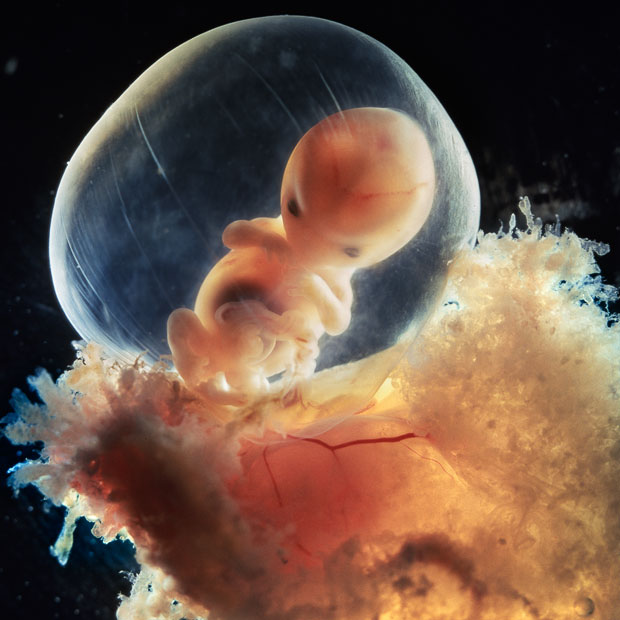
A secular case against legalized abortion

Unborn baby scheming about being only two months old

Note: this post has a twin! Its companion post on a secular case against gay marriage is here.

Now, you may think that the view that the unborn deserve protection during pregnancy is something that you either take on faith or not. But I want to explain how you can make a case for the right to life of the unborn, just by using reason and evidence.

To defend the pro-life position, I think you need to sustain 3 arguments:

  1. The unborn is a living being with human DNA, and is therefore human.
  2. There is no morally-relevant difference between an unborn baby, and one already born.
  3. None of the justifications given for terminating an unborn baby are morally adequate.

Now, the pro-abortion debater may object to point 1, perhaps by claiming that the unborn baby is either not living, or not human, or not distinct from the mother.

Defending point 1: Well, it is pretty obvious that the unborn child is not inanimate matter. It is definitely living and growing through all 9 months of pregnancy. (Click here for a video that shows what a baby looks like through all 9 months of pregnancy). Since it has human DNA, that makes it a human. And its DNA is different from either its mother or father, so it clearly not just a tissue growth of the father or the mother. More on this point at Christian Cadre, here. An unborn child cannot be the woman’s own body, because then the woman would have four arms, four legs, two heads, four eyes and two different DNA signatures. When you have two different human DNA signatures, you have two different humans.

Secondly, the pro-abortion debater may try to identify a characteristic of the unborn that is not yet present or developed while it is still in the womb, and then argue that because the unborn does not have that characteristic, it does not deserve the protection of the law.

Defending point 2: You need to show that the unborn are not different from the already-born in any meaningful way. The main differences between them are: size, level of development, environment and degree of dependence. Once these characteristics are identified, you can explain that none of these differences provide moral justification for terminating a life. For example, babies inside and outside the womb have the same value, because location does not change a human’s intrinsic value. More at Stand to Reason, here.

Additionally, the pro-abortion debater may try to identify a characteristic of the already-born that is not yet present or developed in the unborn, and then argue that because the unborn does not have that characteristic, that it does not deserve protection, (e.g. – sentience). Most of the these objections that you may encounter are refuted in this essay by Francis Beckwith. Usually these objections fall apart because they assume the thing they are trying to prove, namely, that the unborn deserves less protection than the already born.

Finally, the pro-abortion debater may conceded your points 1 and 2, and admit that the unborn is fully human. But they may then try to provide a moral justification for terminating the life of the unborn, regardless.

Defending point 3: I fully grant that it is sometimes justifiable to terminate an innocent human life, if there is a moral justification. Is there such a justification for abortion? One of the best known attempts to justify abortion is Judith Jarvis Thomson’s “violinist” argument. This argument is summarized by Paul Manata, one of the experts over at Triablogue:

Briefly, this argument goes like this: Say a world-famous violinist developed a fatal kidney ailment and the Society of Music Lovers found that only you had the right blood-type to help. So, they therefore have you kidnapped and then attach you to the violinist’s circulatory system so that your kidneys can be used to extract the poison from his. To unplug yourself from the violinist would be to kill him; therefore, pro-lifers would say a person has to stay attached against her will to the violinist for 9 months. Thompson says that it would be morally virtuous to stay plugged-in. But she asks, “Do you have to?” She appeals to our intuitions and answers, “No.”

Manata then goes on to defeat Thomson’s proposal here, with a short, memorable illustration, which I highly recommend that you check out. More info on how to respond to similar arguments is here.

The best book for beginners on the pro-life view is this book:

For those looking for advanced resources, Francis Beckwith, a professor at Baylor University, published the book Defending Life, with Cambridge University Press, 2007.

Learn about the pro-life case

And some posts motivating Christians and conservatives to take abortion seriously:

China selling pills made of human babies to South Koreans

From the UK Daily Mail.

Excerpt:

Thousands of pills filled with powdered human flesh have been discovered by customs officials in South Korea, it was revealed today.

The capsules are in demand because they are viewed as being a medicinal ‘cure-all’.

The grim trade is being run from China where corrupt medical staff are said to be tipping off medical companies when babies are aborted or delivered still-born.

The tiny corpses are then bought, stored in household refrigerators in homes of those involved in the trade before they are removed and taken to clinics where they are placed in medical drying microwaves.

Once the skin is tinder dry, it is pummelled into powder and then processed into capsules along with herbs to disguise the true ingredients from health investigators and customs officers.

[…]According to customs agents, 35 smuggling attempts have been made since August last year involving more than 17,000 capsules disguised as ‘stamina boosters’.

Hospitals and abortion clinics in China reportedly pass the remains onto drugs companies when a baby is stillborn or aborted, the South Korean SBS documentary team reported last year.

The San Francisco Times reported that tests carried out on the pills confirmed they were made up of 99.7 per cent human remains.

The tests were successfully able to establish the genders of the babies used.

There is a huge demand for the pills which are thought to enhance stamina. Microwave-dried placenta is also sought after for its alleged ‘medicinal’ benefits.

However, in reality the human flesh capsules contain super-bacteria and other harmful ingredients.

My previous post about China’s disregard for human life is here.