
Robin Collins and atheist Peter Millican discuss the fine-tuning of the universe for life

British Spitfire and German Messerschmitt Me 109 locked in a dogfight

You might remember Peter Millican from the debate he had with William Lane Craig. I ranked that debate as one of the 3 best I have ever seen, along with the first Craig  vs Dacey debate and the second Craig vs Sinnott-Armstrong debate.

Details:

Science has revealed that the fundamental constants and forces of the cosmos appear to be exquisitely fine-tuned to allow a universe in which life can develop. Is God the best explanation of the incredibly improbable odds of the universe we live in being a life-permitting one?

Robin Collins is a Christian philosopher and a leading advocate of the argument for God from cosmic design. Peter Millican is an atheist philosopher at Oxford University. They debate the issues.

From ‘Unbelievable?’ on ‘Premier Christian Radio’, Saturday 19th March 2016.

The debate:

As usual when the atheist is an expert, there is no snark or paraphrasing in the summary.

Summary

Brierley: What is the fine-tuning argument?

Collins: the fine-tuning is structure of the universe is extremely precisely set to allow the existing of conscious, embodied agents who are capable of moral behavior. There are 3 kinds of fine-tuning: 1) the laws of nature (mathematical formulas), 2) the constants of physics (numbers that are plugged into the equations), 3) the initial conditions of the universe. The fine-tuning exists not just because there are lots of possibilities, but there is something special about the actual state of affairs that we see. Every set of laws, parameters and initial conditions is equally improbable, but the vast majority of permutations do not permit life. The possible explanations: theism or the multiverse.

Brierley: How improbable are the numbers?

Collins: Once case is the cosmological constant (dark energy density), with is 1 part in (10 raised to 120th power). If larger, the universe expands too rapidly for galaxies and stars to form after the Big Bang. If smaller, the universe collapses in on itself before life could form. Another case is the initial distribution of mass energy to give us the low entropy we have that is necessary for life. The fine-tuning there is 1 part in (10 raised to the 10th power raised to the 123rd power).

Brierley: What do you think of the argument?

Millican: The argument is worth taking very seriously. I am a fan of the argument. The other arguments for God’s existence such as the ontological and cosmological arguments are very weak. But the fine-tuning argument has the right structure to deliver the conclusion that theists want. And it is different from the traditional design argument tended to focus on biological nature, which is not a strong argument. But the fine-tuning argument is strong because it precedes any sort of biological evolution. Although the design is present at the beginning of the universe, it is not visible until much later. The argument points to at least deism, and possibly theism. The argument is not based on ignorance, it is rooted in “the latest results from the frontiers of science” (his phrase).

Brierley: Is this the best argument from natural theology?

Collins: The cosmological argument makes theism viable intuitively, but there are some things that are puzzling, like the concept of the necessary being. But the fine-tuning argument is decisive.

Brierley: What’s are some objections to the fine-tuning argument?

Millican: The argument is based on recent physics, so we should be cautious because we maybe we will discover a natural explanation.

Brierley: Respond to that.

Collins: The cosmological constant has been around since 1980. But the direction that physics is moving in is that there are more constants and quantities being discovered that need to be fine-tuned, not less. Even if you had a grand unified theory, that would have to be have the fine-tuning pushed into it.

(BREAK)

Millican: Since we have no experience of other laws and values from other universes, we don’t know whether these values can be other than they are. Psychologically, humans are prone to seeing purpose and patterns where there is none, so maybe that’s happening here.

Brierley: Respond to that.

Collins: It is possible to determine probabilities on a single universe case, for example using multiple ways of calculating Avogadro’s number all converging on the same number makes it more probable.

Millican: Yes, I willing to accept that these constants can take on other values, (“principle of indifference”). But maybe this principle be applied if the improbability were pushed up into the theory?

Collins: Even if you had a grand theory, selecting the grand theory from others would retain the improbability.

Brierley: What about the multiverse?

Millican: What if there are many, many different universes, and we happen to be in the one that is finely-tuned, then we should not be surprised to observe fine-tuning. Maybe a multiverse theory will be discovered in the future that would allow us to have these many universes with randomized constants and quantities. “I do think that it is a little bit of a promissary note”. I don’t think physics is pointing to this right now.

Brierley: Respond to that.

Collins: I agree it’s a promissary note. This is the strongest objection to the fine-tuning argument. But there are objections to the multiverse: 1) the fine-tuning is kicked back up to the multiverse generator has to be set just right to produce universes with different constants, 2) the multiverse is more likely to produce a small universe with Boltzmann brains that pop into existence and then out again, rather than a universe that contains conscious, embodied intelligent agents. I am working on a third response now that would show that the same constants that allow complex, embodied life ALSO allow the universe to be discoverable. This would negate the observer-selection effect required by the multiverse objection.

Brierley: Respond to that.

Millican: I don’t see why the multiverse generator has to be fine-tuned, since we don’t know what the multiverse generator is. I’m not impressed by the Boltzmann brains, but won’t discuss. We should be cautious about inferring design because maybe this is a case where we are seeing purpose and design where there is none.

Brierley: Can you negate the discoverability of the universe by saying that it might be psychological?

Collins: These things are not psychological. The selected value for the cosmic microwave background radiation is fine-tuned for life and for discoverability. It’s not merely a discoverability selection effect, it’s optimal for discoverability. If baryon-photon value were much smaller, we would have known that it was not optimal. So that judgment cannot be explained by

Millican: That’s a very interesting new twist.

Brierley: Give us your best objection.

Millican: I have two. 1) Even if you admit to the fine-tuning, this doesn’t show a being who is omnipotent and omnisicient. What the fine-tuning shows is that the designer is doing the best it can given the constraints from nature. If I were God, I would not have made the universe so big, and I wouldn’t have made it last 14 billion years, just to make one small area that supports life. An all-powerful God would have made the universe much smaller, and much younger. 2) The fine-tuning allows life to exist in other solar systems in other galaxies. What does this alien life elsewhere mean for traditional Christian theology? The existence of other alien civilizations argues against the truth of any one religion.

Brierley: Respond to those.

Collins: First objection: with a finite Creator, you run into the problem of having to push the design of that creature up one level, so you don’t really solve the fine-tuning problem. An unlimited being (non-material, not composed of parts) does not require fine-tuning. The fine-tuning is more compatible with theism than atheism. Second objection: I actually do think that it is likely that are other universes, and life in other galaxies and stars, and the doctrine of the Incarnation is easily adaptable to that, because God can take on multiple natures to appear to different alien civilizations.

Other resources (from WK)

If you liked this discussion, be sure and check out a full length lecture by Robin Collins on the fine-tuning, and a shorter lecture on his very latest work. And also this the Common Sense Atheism podcast, featuring cosmologist Luke Barnes, who answers about a dozen objections to the fine-tuning argument.
Good news: more parents pulling their kids out of schools to homeschool them

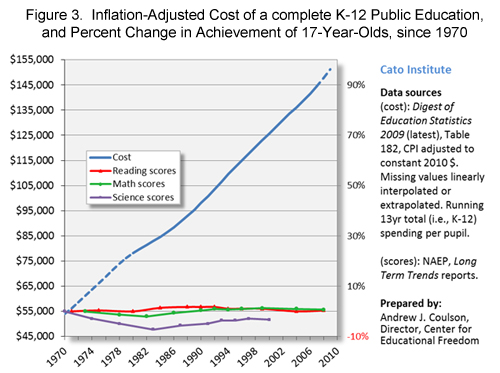
Education spending has tripled since 1970

Homeschooling is definitely NOT an easy thing to do. First, parents still have to pay taxes for the failing schools they don’t want to use. Second, one parents has to give up a salary to stay home, although this is offset by not having to pay for daycare. But more parents are starting to choose homeschooling for a variety of reasons. This news article from Washington Times lays out one that I had never heard of before.

Excerpt:

After a gunman opened fire on students in Parkland, Florida, the phones started ringing at the Texas Home School Coalition, and they haven’t stopped yet.

The Lubbock-based organization has been swamped with inquiries for months from parents seeking safer options for their kids in the aftermath of this year’s deadly school massacres, first in Parkland and then in Santa Fe, Texas.

“When the Parkland shooting happened, our phone calls and emails exploded,” said coalition president Tim Lambert. “In the last couple of months, our numbers have doubled. We’re dealing with probably between 1,200 and 1,400 calls and emails per month, and prior to that it was 600 to 700.”

[…]Brian D. Ray, president of the National Home Education Research Institute in Salem, Oregon, who has conducted homeschool research for 33 years, said school safety has increasingly become an issue for parents looking at teaching their kids at home.

It’s definitely true that homeschooling is a better choice for parents seeking to pass on their worldview to their children. And I think it’s a real question whether public school administrators are doing everything possible to make schools safe. Although metal detectors and armed guards are sure ways to prevent violence, public school teachers and administrators simply don’t want to do what works. And there’s no question about what works. I recently had to renew my plates in a new county and accidentally wandered into the City Hall building. The nice armed guard standing in front of the metal detector was nice enough to point me in the right direction. That was good security.

The trouble with the schools is that, under the Obama administration, schools lost a lot of their power to remove dangerous students from the schools. This article by David French at National Review explains.

Excerpt:

Yesterday Paul Sperry of RealClearInvestigations published a comprehensive report that reached an explosive conclusion:

Despite committing a string of arrestable offenses on campus before the Florida school shooting, Nikolas Cruz was able to escape the attention of law enforcement, pass a background check and purchase the weapon he used to slaughter three staff members and 14 fellow students because of Obama administration efforts to make school discipline more lenient.

[…]In 2013, the Broward County school board entered into an agreement with multiple law-enforcement agencies — including the Broward County sheriff — designed to limit the number of on-campus arrests.

Obama education secretary Arne Duncan even highlighted Broward County’s efforts to reduce out-of-school suspensions and try alternative forms of discipline. Broward County was reportedly “one of 53 major school districts” to adopt Obama-administration guidelines designed in part to limit law-enforcement involvement in school discipline.

Sperry quoted Peter Kirsanow, a conservative member of the Commission on Civil Rights:

Broward County adopted a lenient disciplinary policy similar to those adopted by many other districts under pressure from the Obama administration to reduce racial “disparities” in suspensions and expulsions. . . . In many of these districts, the drive to “get our numbers right” has produced disastrous results, with startling increases in both the number and severity of disciplinary offenses, including assaults and beatings of teachers and students.
Sperry also wrote a comprehensive essay for the New York Post in December outlining how lax discipline policies where enabling a wave of violence against teachers and students. He detailed incidents across the country, including mass resignations of teachers after escalating assaults.

In local news reports at least one former Broward school-resource officer has spoken bluntly about the pressure not to arrest students and said that the number of resource officers was cut in half.

The point is that it’s not by accident that schools have suddenly become unsafe. It’s a result of Democrat policies which favor law-breakers over student’s safety. Sound familiar? That’s right, it’s the same leniency that Democrats show to illegal aliens who commit crimes. Remember how Nancy Pelosi defended the violent criminals in the MS-13 gang? This is normal Democrat behavior. They try to feel good about themselves and show everyone how “compassionate” they are by defending criminals while endangering the taxpayers who pay their salaries. Don’t ask me why, it makes no sense to me.

Anyway, I have a cute homeschooling story about an Alabama family to from the Christian Post, which shows how good homeschooling can work.

Excerpt:

An impressive seven of 10 homeschooled children from a Christian family in Montgomery, Alabama, which now boasts a doctor and New York City architect among them, all started college by the time they were 12; and now their parents have written a book about how they managed to pull off such staggering academic success.

The parents of the 10 children, Mona Lisa and Kip Harding, are described as high school sweethearts on a website dedicated to The Brainy Bunch Book.

“After four kids, they decided to turn to homeschooling, and their success paved the way for their children to start college by the age of 12, and go on to great careers in medicine, engineering, architecture and more,” explaines the website.

Hannah, 26, is the oldest Harding child. She earned her bachelor of science in mathematics from Auburn University Montgomery and a master’s degree in mathematics by the time she was 19. She is now working on a PhD in material science.

Rosanna, 24, is now an architect in New York City and became the youngest member in the American Institute of Architects at age 23. Serena, 22, earned her bachelor’s degree in biology from Huntingdon College at 17, and became one of America’s youngest female doctors at 22. She is now a resident at the Naval Hospital in Bethesda.

Their brother Heath, 17, has an master’s in computer science. He earned a BA in English at 15, and he is currently working at building his tutoring and online computer business. Keith, who is 15, is pursuing a bachelor’s in music at Faulkner University. Seth, just 13, is a history major at Huntingdon College, while Katrinnah, 10, is a student at Faulkner University. Their other siblings, Mariannah, 8; Lorennah, 5, and Thunder, 3, are still being homeschooled.

In an interview with KSL Kip and Mona Lisa noted that their children aren’t geniuses. They simply found a way to accelerate their learning by making it fun. One-on-one sessions with the mother who is working on her bachelor’s degree at home also helped immensely.

“One teacher has 30 students on average,” said Kip. “We can do better than that. Kids get left behind in a classroom. … This is where homeschooling really takes off because those kids are getting extra attention. And who’s more loving than a mom and dad teaching them things?”

I think you would certainly detect problems much faster in your children’s educations if you are the one teaching them.

What is the best scientific theory to explain the origin of life on Earth?

Christianity and the progress of science

Evolution News talks about a new peer-reviewed science paper which re-caps the current origin of life situation:

…the dominant biological paradigm — abiogenesis in a primordial soup. The latter idea was developed at a time when the earliest living cells were considered to be exceedingly simple structures that could subsequently evolve in a Darwinian way. These ideas should of course have been critically examined and rejected after the discovery of the exceedingly complex molecular structures involved in proteins and in DNA. But this did not happen. Modern ideas of abiogenesis in hydrothermal vents or elsewhere on the primitive Earth have developed into sophisticated conjectures with little or no evidential support.

…independent abiogenesis on the cosmologically diminutive scale of oceans, lakes or hydrothermal vents remains a hypothesis with no empirical support…

The conditions that would most likely to have prevailed near the impact-riddled Earth’s surface 4.1–4.23 billion years ago were too hot even for simple organic molecules to survive let alone evolve into living complexity…

The requirement now, on the basis of orthodox abiogenic thinking, is that an essentially instantaneous transformation of non-living organic matter to bacterial life occurs, an assumption we consider strains credibility of Earth-bound abiogenesis beyond the limit.

The transformation of an ensemble of appropriately chosen biological monomers (e.g. amino acids, nucleotides) into a primitive living cell capable of further evolution appears to require overcoming an information hurdle of superastronomical proportions, an event that could not have happened within the time frame of the Earth except, we believe, as a miracle. All laboratory experiments attempting to simulate such an event have so far led to dismal failure.

Before the extensive sequencing of DNA became available it would have been reasonable to speculate that random copying errors in a gene sequence could, over time, lead to the emergence of new traits, body plans and new physiologies that could explain the whole of evolution. However the data we have reviewed here challenge this point of view. It suggests that the Cambrian Explosion of multicellular life that occurred 0.54 billion years ago led to a sudden emergence of essentially all the genes that subsequently came to be rearranged into an exceedingly wide range of multi-celled life forms — Tardigrades, the Squid, Octopus, fruit flies, humans — to name but a few.

…the complexity and sophistication of life cannot originate (from non-biological) matter under any scenario, over any expanse of space and time, however vast.

What is the explanation of the origin of life, then, according to true-believing atheists?

Richard Dawkins explains:

Got that? The origin of life on Earth is best explained as a result of higher aliens seeding the Earth with life. And where did those aliens come from? They evolved by chance. And can we observe or test the hypothesis that they evolved by chance? No.

Lest you think that this “aliens did it” explanation is a trick of video editing, consider this article from Scientific American.

Excerpt:

Francis Crick (who co-discovered the structure of DNA with James Watson) and Leslie Orgel once proposed that life on Earth was the result of a deliberate infection, designed by aliens who had purposely fled mother nature’s seed to a new home in the sun.

[…]The origins of life remains an unresolved mystery. I argue that Crick and Orgel’s paper was meant both as a serious and plausible scientific alternative and as a means to criticize concurrent origins of life.

Previously, I’ve laid out the evidence for cosmic fine-tuning, so that we could understand how slight changes to the constants and quantities given at the Big Bang would make complex, embodied life in the universe impossible. The smallest of changes has massive effects: only hydrogen, no hydrogen, no stars, universe re-collapses into a hot fireball, etc. The atheistic response to this evidence, which has been documented in the most prestigious academic presses and peer-reviewed journals, is to either deny the evidence, or assert that there is an untestable, unobservable multiverse. As if this were not bad enough, the multiverse generator itself requires fine-tuning.

Similarly with the origin of the universe. The best atheistic responses to the origin of space, time, matter and energy from nothing, about 14 billion years ago, has been to either assert that nothing exists (Peter Atkins) or that the nothing that preceded the universe was actually something (Lawrence Krauss) or to introduce a speculative theoretical model that is disproved by observations (Sean Carroll).

So, let’s take stock. We have evidence for the origin of the universe, like the cosmic microwave background radiation and the light element abundance observations. Atheist answer: either nothing exists right now, or the nothing causally prior to the universe was really something, or here is a disproved speculative theory. We have evidence of cosmic fine-tuning to allow the existence of complex, embodied intelligence. Atheist answer: the unobservable, untestable multiverse did it. We have evidence that origin of life was almost immediate after the cooling of the Earth, and that the problem is best explained by an intelligence sequencing amino acids and proteins, similar to the way that humans write code and blog posts. Atheist answer: unobservable, untestable aliens who evolved did it.  This is not even to mention the Cambrian explosion. The last article I saw argued that the introduction of oxygen was the best naturalistic explanation for that. Does oxygen write genetic code?

I’ll leave it to you to decide which side likes science, and which side likes science fiction. Personally, I would not be comfortable being an atheist at this time in history. We’ve just made too much scientific progress to still believe in stone-age mythology. I understand that atheists find Star Wars and Star Trek comforting and entertaining. I understand that real peer-reviewed science papers are boring and dull compared to science fiction. I’m not saying that we can’t believe in atheism when we are children, and still reading comic books. But there comes a time when we need to grow up and be more responsible about adjusting our worldviews to match the progress of science. A child who believes in Santa Claus is cute, but it’s not the same thing when a grown-up does it.

Positive arguments for Christian theism