
How will Elizabeth Warren pay for her $52 trillion government-run health care plan?

So, in yesterday’s post, we talked about our current budget of $4 trillion dollars, our $3 trillion of revenues, our $1 trillion annual budget deficit, and our $23 trillion in accumulated national debt. We also talked about how Elizabeth Warren’s health care plan would add $5.2 trillion to our annual budget, and how we only get about $2 trillion in revenue if we take almost everything the wealthiest taxpayers earn.

Warren likes to talk about how her plan will reduce health care costs. She thinks that government workers (think of the DMV and the post office) will be more efficient about increasing quality and reducing costs than the private sector (think of Apple and Amazon) is. Is she correct?

Let’s take a look at this article from Reason:

Warren and her defenders will likely try to shift the discussion back to total costs, but that’s just a way of repeating the dodge that has dogged her campaign for much of the year. Warren will no doubt claim that costs would go down under her plan, but there are reasons to doubt this, including an analysis from health care economist Kenneth Thorpe finding that under a Sanders-style plan, more than 70 percent of people who currently have private insurance would see costs increase, as well as an Urban Institute analysis projecting that single-payer plans would raise national health care spending by $7 trillion over a decade.

There isn’t any magic in Warren’s plan that would lover the costs to the point where the middle class would not have to pay for her spending:

Indeed, much of Warren’s plan is based on unlikely, and at times outright fantastical, assumptions about what sort of additional revenue could be raised, what health care costs could be contained, and what might be politically feasible. Among other things, she proposes raising $400 billion by passing comprehensive immigration reform, which, given the politics of immigration policy, is only a little more realistic than planning to pay off your mortgage by winning the lottery. The Washington Examiner‘s Philip Klein has published a useful roundup of Warren’s less plausible ideas; the takeaway is that even if Warren somehow managed to raise the enormous amounts of tax she proposes, it probably would still not be anywhere close to enough to finance her plan. (More on this in a future post.)

In some ways, Warren’s plan amounts to a list of technically sophisticated magic asterisks. It is as much an attempt to obscure the economic and political feasibility of passing and implementing a single-payer health care plan as a good-faith attempt to describe what it would practically require.

Yet in another way, it reveals something about both Warren and the economic reality of single-payer: Despite running a campaign based on wonky academic credentials and detail-oriented policy chops, Warren has, until now, repeatedly refused to directly answer questions about precisely how she would finance Medicare for All and whether she would foist new taxes on the middle class. Turns out she didn’t dodge the question because the answer was complex or hard to explain. She dodged it because the answer was so simple it could be expressed in a single word: yes.

So, let’s just state the obvious. We’re talking about a person who pretended to be an Indian in order to get into Harvard, and who lied about being fired from her teaching job for being pregnant. If we’re looking at her education, we don’t find any evidence that she understands health care policy, or even basic economics. If we’re looking at her work experience, there’s no evidence there that she was ever able to produce results in health care administration. There are people who have been able to reform health care in a way that reduces costs, reduces taxes, improves quality of care, and covers more people. But not Elizabeth Warren.
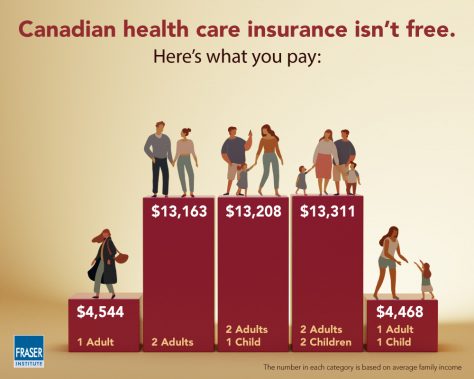
Price of healthcare per Canadian household (Source: Fraser Institute)

Price of healthcare per Canadian household (Source: Fraser Institute)

What about Canada?

I think it’s worth remembering how much government-run health care costs in countries that have adopted “Medicare for All” plans.

I found two interesting studies from Canada’s Angus Reid Institute describing single payer health care in Canada. I’m very interested in find out what things are like in countries that have true government-run health care. A typical Canadian family pays $13,000+ per year per household for healthcare, or about $585,000 over their working lives. What are they getting for all that money?

Here is the first Angus Reid article:

The study finds more than 2 million Canadians aged 55 and older face significant barriers when accessing the health care system in their province, such as being unable to find a family doctor or experiencing lengthy wait-times for surgery, diagnostic tests, or specialist visits.

Moreover, most Canadians in this age group have at least some difficulty getting the care they want or need in a timely manner.

The study focuses on the health care experiences of older Canadians, as well as their assessments of the quality of care they receive.

According to the article, 31% of respondents (aged 55 and older) rated access to the government’s healthcare system as “easy”. 48% had “moderate” problems with access, and 21% had “major” problems with access.

The second Angus Reid article explains:

This second part of the study finds one-in-six Canadians (17%) in the 55-plus age group – a figure that represents upwards of 1.8 million people – say that they or someone else in their household have taken prescription drugs in a way other than prescribed because of cost.

One-in-ten (10%) have decided to simply not fill a prescription because it was too expensive, and a similar number (9%) have decided not to renew one for the same reason. One-in-eight (12%) have taken steps to stretch their prescriptions, such as cutting pills or skipping doses.

Some 17 per cent of Canadians 55 and older have done at least one of these things, and that proportion rises among those who have greater difficulty accessing other aspects of the health care system.

In a previous blog post, I reported on how Canadians have to wait in order to see their GP doctor. If that doctor refers them to a specialist, then they have to wait to see the specialist. And if that specialist schedules surgery, then they have to wait for their surgery appointment. The delays can easily go from weeks to months and even years. The MEDIAN delay from GP referral to treatment is 19.5 weeks.
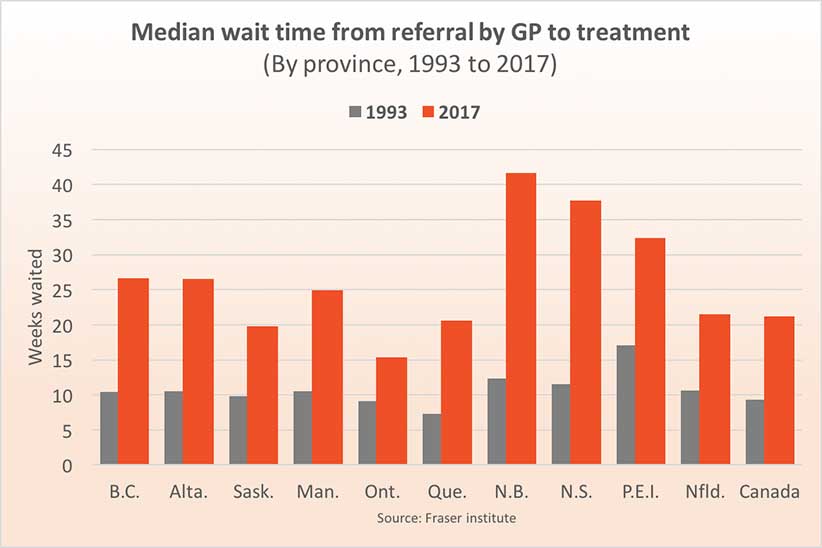
Wait times in weeks (Source: Maclean's magazine)
Wait times in weeks (Source: Maclean’s magazine)

Also, the Canadian system does NOT cover prescription drugs.

Please share this article and yesterday’s because we have an election coming up, and votes need to know the facts.

Elizabeth Warren’s health care plan: how much will it cost, how much will your taxes rise?

Elizabeth Warren seems to be the likely Democrat nominee, so it it makes sense for us to take a look at her policy proposals and count the cost. Her signature proposal is a plan to outlaw private health insurance and move everyone to government-run health care, paid for though mandatory taxation. How much will that cost, and how much will the taxes on the middle class go up in order to pay for it?

Before we go too far with that, take a look at the budget numbers. I got these from the web site of the Democrats in the House of Representatives:

The 2019 federal budget, according to House Democrats

According to the House Democrats budget web site, the 2019 federal budget has $3.451 trillion in revenue, $4.411 trillion in spending, for an annual deficit of $-960 billion. And keep in mind that we are $23 trillion in debt already. This would be like saying that your annual income is $34, 510. You’re spending $44, 110 per year. You are adding $9,600 to your debt every year. And you are already $230,000 in debt (and paying interest on that).

In other words, America is in no position to be spending more money. We’re already in debt, and adding to the debt each year. So how much more money would you have to spend for Elizabeth Warren’s health care plan?

For months, Sen. Elizabeth Warren (D—Mass.) has hedged on the question of whether she would raise middle class taxes to pay for Medicare for All, the single-payer health care plan she says she supports. Warren has stuck with a talking point about total costs, saying that the middle class would pay less, while critics, political rivals, and even liberal economists friendly to single payer have argued that the enormous additional government spending required by such a plan would inevitably hit the middle class.

Today, Warren released a plan to finance Medicare for All at a total price tag of nearly $52 trillion, including about $20 trillion of new government spending (an estimate that is probably low). Although her plan declares that no middle-class taxes will be necessary to finance the system, it includes what is effectively a new tax on employers that would undoubtedly hit middle-class Americans.

So , Warren admits that the total cost of her plan is $52 trillion over 10 years. Warren needs to come up with $5.2 trillion per year to pay for her plan. Is there that much money available by taxing only the wealthy?

The wealthiest Americans don’t have enough money to cover even $2 trillion in additional spending – assuming they continue to work in America as much as they did before the government took MOST of their earnings:

CRFB reinforced their prior work indicating that taxes on “the rich” could at best fund about one-third of the cost of single payer. Their proposals include $2 trillion in revenue from raising tax rates on the affluent, another $2 trillion from phasing out tax incentives for the wealthy, another $2 trillion from doubling corporate income taxes, $3 trillion from wealth taxes, and $1 trillion from taxes on financial transactions and institutions.

Several of the proposals CRFB analyzed would raise tax rates on the wealthiest households above 60 percent. At these rates, economists suggest that individuals would reduce their income and cut back on work, because they do not see the point in generating additional income if government will take 70 (or 80, or 90) cents on every additional dollar earned. While taxing “the rich” might sound publicly appealing, at a certain point it becomes a self-defeating proposition—and several proposals CRFB vetted would meet, or exceed, that point.

So, Warren is going to have to lean on the middle class for the remaining $3.2 trillion, even if the rich hold still while the government takes 70-90 percent of what they earn. (Unlikely)

Warren likes to tell everyone that her plan will make costs go down. I guess she thinks that government oversight of health care will be more efficient than private sector oversight of health care. Maybe she believes that people in government are more careful about spending taxpayer money than people in private businesses are about spending their own money? In any case, studies from centrist and center-left think tanks disagree with Warren:

Warren and her defenders will likely try to shift the discussion back to total costs, but that’s just a way of repeating the dodge that has dogged her campaign for much of the year. Warren will no doubt claim that costs would go down under her plan, but there are reasons to doubt this, including an analysis from health care economist Kenneth Thorpe finding that under a Sanders-style plan, more than 70 percent of people who currently have private insurance would see costs increase, as well as an Urban Institute analysis projecting that single-payer plans would raise national health care spending by $7 trillion over a decade.

All we have right now to weight against these studies is Warren’s own words, as a candidate wanting to win a popularity contest.

Warren herself says that there would be enormous job losses in the health care industry:

Democratic Massachusetts Sen. Elizabeth Warren admitted Wednesday that Medicare for All could result in two million lost jobs.

In an interview with New Hampshire Public Radio, the Democratic presidential contender said she concurs with a study from the University of Massachusetts-Amherst that said socialized medicine would probably have a devastating impact on the those working in the current private health care industry.

This would create similar health care shortages and waiting lists (with people dying on waiting lists) that we see in single-payer systems such as Canada and the Veteran’s Affairs health care system. Except far worse.

And keep in mind that the middle class pays for health care in Canada:

Socialized medicine in Canada anything but free. The [Fraser Institute] think-tank reported that the average Canadian family spends over $12,000 in taxes on government-funded health care.

That is how single-actually works. We need to look at how single-payer health care works in reality, and not form our opinions of it based on a candidate’s WORDS during an ELECTION CAMPAIGN. Let’s look at evidence, and not just vote for things that sound good and make us feel good and make our friends like us.

How do LGBT activists respond to free speech discussions of LGBT issues?

What should we think about LGBT activists?

I like to have some diversity in my Twitter feed, so I follow some people who disagree with me. One of those people is Andy Ngo, who is gay. I started to follow Andy because he does a good job reporting on the secular leftist fascist movement in America (Antifa), fake hate crimes and false accusations. The tweet above is from Andy, and after I read the story he linked, I decided to write about it.

Here’s the story from The Post Millennial.

Word spread quickly on social media this evening that Simon Fraser University has backed out of its decision to host the event entitled “#GIDYVR: How Media Bias Shapes the Gender Identity Debate” on November 2nd.

In addition to Vancouver feminist Meghan Murphy, the event was slated to feature Quillette Canadian editor Jonathan Kay and The Post Millennial contributor Anna Slatz, and was co-organized by Mark Collard, an SFU professor of anthropology, Amy Eileen Hamm, Holly Stamer, and GIDYVR. Free speech activist Lindsay Shepherd was set to moderate.

Collard, who had originally sponsored the event and assisted in booking the venue at SFU’s Harbour Centre campus, decided to withdraw his support for the event after speaking to senior director of campus public safety, Tim Marron. Marron explained that there was a high risk of violence as a result of the event.

[…]The Post Millennial also reached out to Meghan Murphy, who told us, “We are still going to fight this. GIDYVR is in touch with our lawyer, Jay Cameron, from the Justice Centre for Constitutional Freedoms in order to put pressure on SFU to keep our booking. Apparently, there was a meeting involving a trans activist group, and security determined that there was a viable threat of violence from this group.

The article notes that Marron thought that after meeting with the trans activist group, that on a scale of 1 to 10, the probability of violence was an 11.

It looks like it would be a pretty interesting event. I’ve blogged about Meghan Murphy before. She’s a feminist, so I don’t agree with her on many things. And I blogged about Lindsay Shepherd, and I don’t agree with her on many things. But I wouldn’t stop them from speaking in public. I don’t see why in a free country that people can’t get together on campus to debate and disagree about something controversial. Unless it’s not a free country at all?

One thing is clear. If I were presenting my views to other people, and their response was that my disagreement with them would cause them to kill themselves, then I would really wonder about whether their views were able to be defended rationally and evidentially. And if they said that their response to disagreeing views was to resort to vandalism, fake hate crimes, lawsuits, death threats, violence and even attempted murder (e.g. – the domestic terrorism attack by the gun-wielding gay activist Floyd Lee Corkins II against the Family Research Council headquarters), then I would just lump that person in with the other fascists in history, like Hitler, Stalin, Mao, Pol Pot, etc. All on the secular left, notice.

Here is a good rule that applies to everyone: If you can’t make your case for your views using reason and evidence, but must instead use threats of violence to cancel out free speech that offends you, then you’re a fascist, no different than any other fascist, except that maybe you lack the means at this time to achieve the results they did in a society that still is running on the fumes of Judeo-Christian moral standards. As a conservative, I am fine with free speech that disagrees with me. I don’t use threats, coercion and violence against those who disagree with me. Think what you want. Say what you want. It ought to be like that in a free country.