
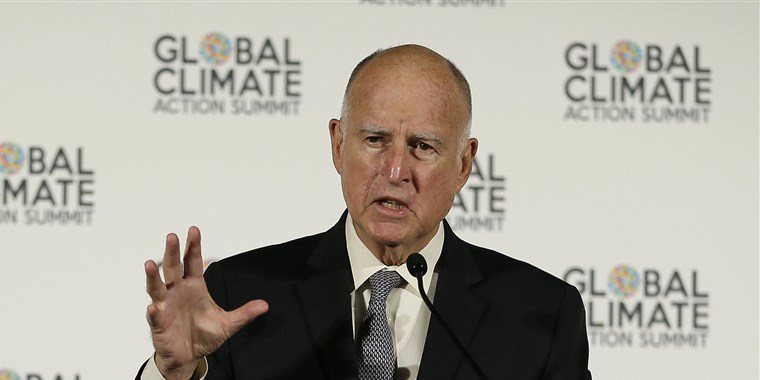
We can see how Democrat presidential candidates would govern from Democrat-run states

California's ignorant Democrat governor Jerry Brown keeps failing
California’s ignorant Democrat governor Jerry Brown keeps failing

A lot of low-information voters decide who they are going to vote for based on the words the candidates speak, and how those words make them feel, and what their peers will think of them. They see their vote as membership in a club, not as a way to get policies that will actually produce real-world results. Thankfully, we can know what results Democrats produce by looking at Democrat-run states.

Let’s start with the Democrat-dominated state of California, which has pursued some of the most aggressive Green New Deal policies in recent years. The prediction from Democrats is that Green New Deal energy policies will lower the cost of energy and produce abundant energy to fuel economic growth. Is that what happened?

Consider this article from National Review:

More than 2 million people are going without power in Northern and Central California, in the latest and biggest of the intentional blackouts that are, astonishingly, California’s best answer to the risk of runaway wildfires.

[…]The same California that has boldly committed to transitioning to 50 percent renewable energy by 2025 — and 100 percent renewable energy by 2045 — can’t manage its existing energy infrastructure.

[…]California governor Gavin Newsom, who has to try to evade responsibility for this debacle while presiding over it, blames “dog-eat-dog capitalism” for the state’s current crisis. It sounds like he’s referring to robber barons who have descended on the state to suck it dry of profits while burning it to the ground. But Newsom is talking about one of the most regulated industries in the state — namely California’s energy utilities, which answer to the state’s public utilities commission.

So, what happened? What happened is that the Democrats pursued a pretty standard play book in which they regulated the energy industry, forcing them to focus on green energy. And the result of that policy was higher electricity prices, higher gas prices and blackouts. By the way, the utility company has filed for bankruptcy, which is certainly not going to help matters.

They really should have known that this would happen, because other countries, like Germany and Canada for example, tried it first. And the results are the same: higher electricity prices and rotating blackouts. Is it any wonder that business owners are fleeing the state, or outsourcing their operations to areas that are more reality-based?

But that’s not all. What else do environmentalists do? They block the thinning out of forests which prevents forest fires. So what happened next?

Meanwhile, California has had a decades-long aversion to properly clearing forests. The state’s leaders have long been in thrall to the belief that cutting down trees is somehow an offense against nature, even though thinning helps create healthier forests. Biomass has been allowed to build up, and it becomes the kindling for catastrophic fires.

As Chuck DeVore of the Texas Public Policy Foundation points out, a report of the Western Governors’ Association warned of this effect more than a decade ago, noting that “over time the fire-prone forests that were not thinned, burn in uncharacteristically destructive wildfires.”

In 2016, then-governor Jerry Brown actually vetoed a bill that had unanimously passed the state legislature to promote the clearing of trees dangerously close to power lines.

The result of their environmentalist policies? Massive wild fires. California already has a homeless epidemic going on, and the wildfires will only make that problem worse.

But that’s not all, there’s more failure to achieve in other areas:

Californians know that having tens of thousands of homeless in their major cities is untenable. In some places, municipal sidewalks have become open sewers of garbage, used needles, rodents, and infectious diseases.

Yet no one dares question progressive orthodoxy by enforcing drug and vagrancy laws, moving the homeless out of cities to suburban or rural facilities, or increasing the number of mental hospitals.

Taxpayers in California, whose basket of sales, gasoline, and income taxes is the highest in the nation, quietly seethe while immobile on antiquated freeways that are crowded, dangerous, and under nonstop makeshift repair.

Gas prices of $4 to $5 a gallon—the result of high taxes, hyper-regulation, and green mandates—add insult to the injury of stalled commuters. Gas tax increases ostensibly intended to fund freeway expansion and repair continue to be diverted to the state’s failing high-speed rail project.

Residents shrug that the state’s public schools are among the weakest in the nation, often ranking in the bottom quadrant in standardized test scores. Elites publicly oppose charter schools, but often put their own kids in private academies.

Californians know that to venture into a typical municipal emergency room is to descend into a modern Dante’s Inferno. Medical facilities are overcrowded. They can be as unpleasant as they are bankrupting to the vanishing middle class that must face exorbitant charges to bring in an injured or sick child.

No one would dare to connect the crumbling infrastructure, poor schools, and failing public health care with the non-enforcement of immigration laws, which has led to a massive influx of undocumented immigrants from the poorest regions of the world, who often arrive without fluency in English or a high school education.

Stores are occasionally hit by swarming looters. Such Wild West criminals know how to keep their thefts under $950, ensuring that such “misdemeanors” do not warrant police attention. California’s permissive laws have decriminalized thefts and break-ins. The result is that San Francisco now has the highest property crime rate per capita in the nation.

Nothing is working. It’s a complete disaster. And it has to be blamed on Democrats, because they have super-majorities in the state House and state Senate, not to mention the Democrat governor.

Although Democrats like to present themselves as science-based and intelligent, the best way to measure scientific understanding and intelligence is by comparing intentions to results. Smart, reality-based people achieve what they tell others they will achieve. If a Democrat claims that they will get X result (e.g. – you can keep your doctor, you can keep your health plan, your health insurance premiums will go down) and they get opposite results across the board, then you know that they are not scientifically-literate or intelligent.

The best way to get the results you want is to elect people with a record of achieving results. That’s why we look at a candidate’s resume and references before hiring them – at least in the private sector. Democrat voters should know better than to hire candidates based on appearances and words and feelings. We need to learn from their failures.

New study: virgins have happiest marriages, more sex partners means more unhappiness

Although we live in a culture that is dominated by the thoughts and opinions of secular leftists, science provides useful information for those who want defend Biblical morality. Consider the issue of sexuality and marriage. Secular leftists claim that sex outside of marriage is natural, and produces happiness. Bible believing Christians and Jews say chastity is best. Who is right?

Here is the latest study authored by Dr. Nicholas Wolfinger, a sociologist at the University of Utah. His previous book on relationships was published by Oxford University Press. In his analysis of the data, Wolfinger controlled for divorce rates, religiosity, and socioeconomic status.

Here’s the most important graph:

Study: virgins have the happiest marriages, more partners means less happiness

Other factors that increased marital happiness: having a 4-year college degree (5%), having a salary > 78K (5%), regular church attendance (6%). Notice that women are more dissatisfied with marriage (in general) than men are, and they tend to blame the spouse they freely chose for that unhappiness.

The Federalist also reported on previous research relevant to this study:

Psychologists Galena K. Rhoades and Scott M. Stanley found that women who have had sex with someone other than their husband report statistically significant drops in marital quality over those who don’t. A 2004 study by sociologist Jay Teachman showed that intimate premarital activities such as cohabitation and intercourse increased the rate of marital dissolution by anywhere between 28 and 109 percent, depending on the activity.

Wolfinger also noted in a previous study that only 5% of women were virgins when they married.

Wolfinger noted that a possible explanation for the link between promiscuity and unhappiness is that people look back on their past partners and compare their spouse unfavorably to them. This is especially the case with women. My concern about this is that feminism has taught women to try to increase their social standing by having hook-up sex with attractive bad boys. If those women ever marry, they do it when they are older, less fertile, and less attractive. The husband they eventually “settle” for will (in their minds) always compare unfavorably to the hot bad boys they had sex with when they were younger and prettier. This, I believe, is what leads to their unhappiness with the man they chose to marry.

More partners also means more marital instability

In a previous post, I blogged about several studies linking virginity to marital stability. Couples who don’t have sex before marriage, or even who delayed it, reported better communication, higher satisfaction, better quality sex, and a lower chance of divorce.

Men ought to be aware of this research when they are choosing a spouse. Obviously, you want a virgin, for the increased happiness and increased stability. For marriage-friendly character, you want to avoid women who are promiscuous thrill-seekers. You want to avoid women who run up debt doing easy non-STEM degrees and traveling. You want to avoid women who hook up with hot bad boys aren’t serious about commitment. Women who choose fun and thrills in their teens and 20s are setting a pattern of using sex as a way to get happiness in the moment. Later on, they’ll continue that pattern of seeing relationships as commodities that are designed to make them feel good, moment by moment. They’ll look at marriage as a way to fulfill their needs. They’ll have internalized the view that relationships are not commitments to invest in self-sacrificially. The pattern will be: “if it doesn’t make me feel happy right now, then it should be ended”. Men who aren’t serious about evaluating the character of the women for the marriage enterprise are running the risk of divorce, it’s that simple.

The best way to make sure that you have a clear head when evaluating a woman is to stay sober, and keep her hands off of you. When a man refuses to let a woman cloud his judgment with sex, then she is forced to learn how to love him, help him, and submit to his leadership. Male chastity encourages women who have been influenced by feminism to abandon selfishness, fun-seeking, and thrill-seeking, so that they learn to care for others. Male chastity also helps a man to resist older women who chose bad boys in their teens and 20s and want to get married to a good provider in their 30s. The studies discussed above clearly show that such women are more likely to be unhappy, and their future marriages are more likely to be unstable. Avoid them.

William Lane Craig explains how Christianity explains evil and suffering

A long journey through the night

A lot of people in the West complain too much about any little suffering they have to experience. But sometimes, when a very harsh suffering is felt by someone who has tried to follow Jesus, an explanation is necessary. I found something very good on the Reasonable Faith web site, written by Dr. William Lane Craig.

He makes the following points:

  1. We are not in a good position to assess the probability of whether God has morally sufficient reasons for the evils that occur.
  2. The Christian faith entails doctrines that increase the probability of the co-existence of God and evil.
  3. Relative to the full scope of the evidence, God’s existence is probable.

I’ve written before about point #1, in which Dr. Craig’s describes the limitations of human knowledge that make it hard for us to know for certain that a specific evil or suffering does not have a good reason for God to allow it. And I’ve written about #3, in which Dr. Craig makes some arguments for God’s existence. But #2 might be new to some of you, so let’s look at that.

He makes four sub points in section 2 about Christian doctrines that make the existence of evil and suffering more reasonable.

  • 2. a)The chief purpose of life is not happiness, but the knowledge of God.
  • 2. b) Mankind is in a state of rebellion against God and His purpose.
  • 2. c) The knowledge of God spills over into eternal life. 
  • 2. d) The knowledge of God is an incommensurable good.

My favorite one is 2. a), so let’s look at that one. He says:

2. a. The chief purpose of life is not happiness, but the knowledge of God. One reason that the problem of evil seems so puzzling is that we tend to think that if God exists, then His goal for human life is happiness in this world. God’s role is to provide comfortable environment for His human pets. But on the Christian view this is false. We are not God’s pets, and man’s end is not happiness in this world, but the knowledge of God, which will ultimately bring true and everlasting human fulfillment. Many evils occur in life which maybe utterly pointless with respect to the goal of producing human happiness in this world, but they may not be unjustified with respect to producing the knowledge of God. Innocent human suffering provides an occasion for deeper dependency and trust in God, either on the part of the sufferer or those around him. Of course, whether God’s purpose is achieved through our suffering will depend on our response. Do we respond with anger and bitterness toward God, or do we turn to Him in faith for strength to endure?

You know, I always get confused when I see Christians trying to follow the script of the world and trying to make themselves feel good with consumer purchases, travel, fun experiences, showing off to others, etc. When I read the story of Jesus, it’s pretty clear that the normal Christian life, if the person is following Jesus at all, is about suffering the disapproval and opposition of non-Christians while you remain faithful and obedient to God. Today, there’s probably no better example of this than defending unborn children from adult selfishness. Although, defending born children from selfish adults who seek to deprive children of their biological mother and father is pretty bad, too. Nobody is going to like you for restricting their fun (i.e. – abortion, divorce, adultery, homosexuality, etc.), but being willing to take the heat from non-Christians for the sake of promoting what God thinks is right is true Christianity. It’s what Jesus would do.

Anyway, the one I’ve been thinking about more lately is 2. d), where Dr. Craig writes this:

2. d) The knowledge of God is an incommensurable good. To know God, the source of infinite goodness and love, is an incomparable good, the fulfillment of human existence. The sufferings of this life cannot even be compared to it. Thus, the person who knows God, no matter what he suffers, no matter how awful his pain, can still say, “God is good to me,” simply by virtue of the fact that he knows God, an incomparable good.

I sometimes feel pretty stressed out about Americans who were born in conservative states, raised by two married Christian parents, attended Christian schools and youth groups, and then abandoned their faith for atheism as soon as they hit college. It really bothers me how people who had all these advantages turned their backs on God, and they’re ungrateful for all their blessings. They show no curiosity about God – they don’t want to know him. But when you read the gospels to see what Jesus has to say about these sorts of people, it’s very comforting. He really sees the problem, and he is on the side of the little guy who has to struggle to be faithful and obedient to God. The Bible has nothing to say to people who are able to feel happy and successful apart from God. It speaks to people who are struggling to follow God. Even when things are difficult, Jesus speaks to the problem of being an alien and a stranger in a world that turns its back on him.