Can a person be a committed Christian while ignoring apologetics?

Ratio Christi event at Ohio State University featuring Frank Turek

I would like to describe a situation that arises frequently that concerns me. The situation I describe below brings out a flaw I see in the way that rank-and-file Christians respond to criticisms of Christianity in the public square.

Here is the situation

Eve is busy programming away at her desk, rushing to check in her unit tests so she can spend her lunch hour reading the latest Stephenie Meyer novel, or check on the schedule for her local sports team, “the Vicariouses” (she has tickets for Thursday). Suddenly Eve hears Alice talking to Bob on the other side of her cubicle. She stops typing to listen to the following unencrypted conversation.

Alice: I was watching a documentary on the Discovery Channel last night that said that the universe has always existed, so there is no God!

Bob: I was watching a documentary on PBS last night showing simulations of how the first life started on Earth! God didn’t do it!

Alice: I saw “Inherit the Spin” on the weekend! The only reason people oppose evolution is because of the Bible! Not because of science!

Bob: I’m going to see “The Va Dinci Code” this weekend! It says that the Gospels are unreliable and that Jesus didn’t even die on the cross!

Alice: I just bought the latest Dichard Rawkins book “Christians Should Be Fed to Lions and the Bible Should Be Burned”!

Bob: I will read that as soon as I finish Histopher Chritchens’ book “Why God is the Evilest, Stupidest Person in the World”!

Eve double-majored in business and computer science at the Indian Institute of Technology, and has an MBA from the London School of Economics. She has spent a ton of time, effort and money studying very difficult subjects for her job, and she even publishes research papers. She works full-time and runs her own business part-time, and teaches night classes for a well-known university. She earns about 200K per year. She lives in a huge house, drives an expensive car, and goes on vacation abroad to all the best vacation spots.

Eve thinks she is a Christian. She has attended church since childhood, her husband is a church elder and she sings in the church choir. She reads the Bible and prays every night, because it helps her to get sleepy before bed. She gives lots of money to the poor. She teaches Sunday school to very small children.  She has even read all of the Narnia novels five times! She even has a calendar filled with nature scenes and itsy-bitsy, teeny-weeny Bible verses posted on her office wall at work! Judging from all of these facts, you might expect Eve to get in on that conversation with Alice and Bob, and set them straight.

But she won’t. Why not?

Why won’t Eve stand?

I am wondering if anyone can explain to me why it is that most church Christians are not able or not willing to make a public defense when God’s reputation is called into question. It seems to me that there are two bad effects that follow from Eve’s unwillingness to stand up and invite Alice and Bob to lunch so that she can address their questions and concerns.

  1. God’s reputation is being trashed by Alice and Bob on the basis of lies they’ve swallowed from pop culture. These lies about God’s existence and character could be easily corrected with a minimal amount of study, which Eve is capable of – she is a genius and has amazing entrepreneurial skills.  If someone said similar lies about her husband or children, she would speak up, but she won’t speak up for God.
  2. Alice and Bob are bound for Hell unless someone cares enough to correct their mistaken beliefs, which, along with their sinfulness, is what is keeping them from a relationship with God that would go on in Heaven. If Eve’s husband or children were mistakenly about to drink poison thinking it was Aspirin, then Eve would speak up. But to save her co-workers from Hell, she won’t speak up.

Eve is capable of studying to defend the faith, because of her great success in other areas where so much time and effort were required to master difficult material. So why has she not applied herself to answering public challenges to her Christian faith from her professors, teachers, actors, the media, politicians, scientists, historians, etc.? She’s heard these questions about God’s existence and character all through high school and into university and then now in her career. Doesn’t she believe the Bible when it says to prepare a defense? Doesn’t she believe the Bible when it says to acknowledge God before men? Doesn’t she believe the Bible when it says that all authentic believers in Jesus will suffer a little for their faith?

It seems to me that if she did spend some time studying, and then made her defense to her co-workers, then two good things would follow:

  1. Eve would be demonstrating her love for God and her friendship with God by protecting his reputation when it is called into question by unbelievers in public settings. That’s what friends do – if Eve wanted to be God’s friend, she would care that no one believed lies about him and told lies about him in public settings.
  2. Eve would be demonstrating her love for her neighbor if she was able to correct some of these false beliefs, such as that the universe is eternal, or that a historical case cannot be made for the resurrection, or that evil is not compatible with theism. It’s important for Alice and Bob to know that Christianity is not stupid.

So why is it that Eve is able to go to church for 20 years, sing in the choir, read the Bible, read the Narnia stories, pray on her knees, and yet still be unwilling to do the best thing for God and the best thing for her neighbor? If a Christian is smart enough to know how to get a degree and how to hold down a job, then that intelligence should also be used to defend God’s reputation when it is called into question. I don’t see how it is possible to claim that you love God, but then not apply your mind to defending him when you apply your mind to other things like education and work.

Members of another UK-based Middle Eastern men sex-trafficking ring sentenced

UK police can't investigate sex-trafficking because it's racist
UK police can’t investigate sex-trafficking because it’s racist

I’ve blogged before about many of the different sex-trafficking rings run by men of Middle Eastern origin in the UK. The UK is a socialist country where the government has been taken over by “compassion” as the core value. As a result, the leaders are anxious to expose their citizens to higher taxes and crime as they take in more and more low-skilled immigrants from the Middle East.

Sky News reports:

Six men have each been jailed for up to 15 years over the rape of young girls in Huddersfield, West Yorkshire.

Usman Ali, 34, Gul Riaz, 43, Banaras Hussain, 39, Abdul Majid, 36, and two others who could not be named for legal purposes were jailed for a combined 55-and-a-half years on Wednesday.

They were found guilty of a total of nine counts of rape and two counts of indecent assault of two girls in the Huddersfield area between 1995 and 2011.

The victims… were aged 13 and 14 when the “insidious and persistent” abuse began…

It was the sixth trial related to West Yorkshire Police’s Operation Tendersea investigation – a probe into child grooming gangs in Huddersfield.

A total of 34 men have been convicted in the investigation, with prison sentences now totalling 377-and-a-half years.

As you know, about a dozen similar gangs have been found in the UK. What’s interesting is that the same UK police force that investigates offensive speech on social media isn’t interested in prosecuting older men who rape teenage girls and traffic them to other men. That’s because the same political correctness / compassion that makes offensive free speech bad also makes sex-trafficking by Middle Eastern men good. It would be racism to charge these men for raping teens.

And there won’t be any change in these priorities.

The far-left UK Independent reports:

The government is refusing to release official research on the characteristics of grooming gangs, claiming it is not in the “public interest”.

Survivors accused ministers of making “empty promises”, while a man who prosecuted abusers in Rochdale called for the Home Office to “show some courage and publish” its findings.

It comes after The Independent revealed that almost 19,000 suspected child sexual exploitation victims were identified by local authorities in just one year, sparking renewed calls for prevention efforts.

Sajid Javid promised the review as home secretary in July 2018, pledging that there would be “no no-go areas of inquiry”.

“I will not let cultural or political sensitivities get in the way of understanding the problem and doing something about it,” he said at the time.

“We know that in these recent high profile cases, where people convicted have been disproportionately from a Pakistani background.

“I’ve instructed my officials to explore the particular contexts and characteristics of these types of gangs.”

But the government has made no further announcements on the review following Mr Javid’s move to the Treasury last year.

Oh well. I guess 19,000 victims of child sexual exploitation is no big deal to the Labour Party politicians who arranged for the immigration of the men who raped them. But look on the bright side! At least these low-skilled immigrants vote overwhelmingly for socialism. So there’s that.

Canada’s single payer health care: pay up front, take a number and wait until you die

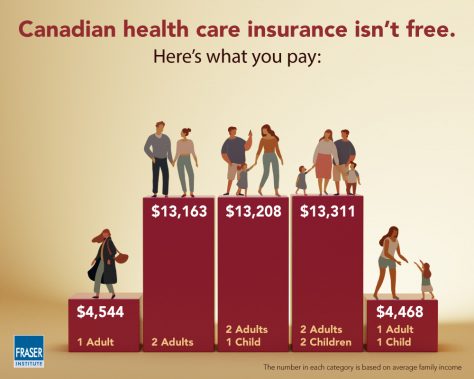
Price of healthcare per Canadian household (Source: Fraser Institute)

I post a lot of research from Canada’s Fraser Institute, but they are not the only think tank that publishes research on the efficiency and costs of single payer health care in Canada. This time, I found a report from the Heritage Foundation, where they go over quality of care, taxes, out of pocket costs, coverage, rationing, waiting lists, staff shortages, substandard equipment, and outdated drugs.

Here’s the report from the Heritage Foundation. I’ll focus on the differences.

Canadians pay slightly less in out of pocket costs:

The OECD calculates that Canadians spend 1.6 percent of GDP on out-of-pocket health spending, compared to 1.9 percent in the U.S.

[…]While these numbers are very close, they are actually getting closer. Since 1970, U.S. out-of-pocket spending as a percentage of total medical spending has been falling steadily, from 33 percent in 1970 to about 10 percent in 2017.19

Meanwhile, Canadian out-of-pocket spending has been falling much slower, so that by 2016 it totaled 15 percent of total medical spending—a higher proportion than in the U.S.20

 As a result, Statistics Canada warned in early 2020 that the percentage of Canadians experiencing large out-of-pocket burdens is growing, writing that “[b]etween 1998 and 2009…the percentage of households spending more than 10% of their total after-tax income on health care rose by 56%.”

Canadians pay more in federal and state taxes:

Federal taxation excluding social security contributions, then, comes to 28 percent of GDP in Canada, compared to just 19 percent in the U.S.—meaning 51 percent more.

[…]This excess taxation is largely a result of health spending, which has bloated provincial budgets to nearly three times the taxes of U.S. states.

Provincial taxes have grown to nearly the same level as federal taxation. Meanwhile, provincial health costs have risen to fully 37 percent of provincial budgets in 2016—up from 33 percent in 1993 – —and range as high as 42 percent.

Canada’s Fraser Institute has estimated this excess tax burden from public health costs at roughly $9,000 for a household of two adults with or without children or $750 per month in additional taxes.

When I wanted an MRI I was scheduled the same week

Canadians wait far longer for treatment than Americans:

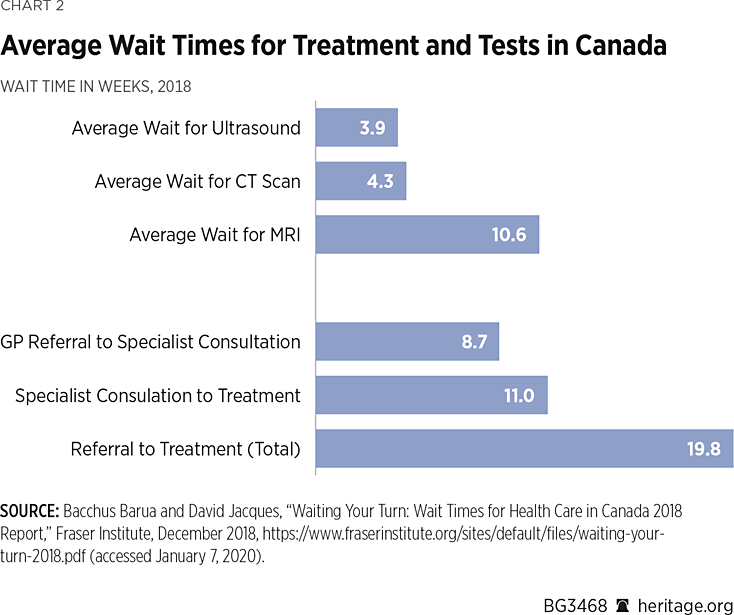
Medical waiting times have become a national crisis in Canada, and continue to worsen. The average wait time for medically necessary treatment between referral from a general practitioner and a consultation with a specialist was 8.7 weeks in 2018, 136 percent longer than in 1993. Patients then have to wait again between seeing the specialist and the actual treatment, another 11 weeks on average, 97 percent longer than in 1993.

From referral to treatment, then, it takes an average of 19.8 weeks (see Chart 2) to be treated, in addition to the original wait to see the family doctor in the first place—this for “medically necessary” treatment, not cosmetic surgery.

In contrast, nearly 77 percent of Americans are treated within four weeks of referral, and only 6 percent of Americans report waiting more than two months to see a specialist.

As for appointments, a 2017 survey of American physicians in the 15 largest U.S. cities found that it took just 24 days on average to schedule a new-patient physician appointment, including 11 days for an orthopedic surgeon and 21 days for a cardiologist.

As a result of these long waits, by one recent estimate, at any given moment, over one million Canadians—3 percent of the entire population—are waiting for a medical treatment.

These lists can average six months, and often much longer in rural areas, which tend to suffer from doctor shortages so severe that many do not even have a family doctor. Overall, 15 percent of Canadians did not have a regular health care provider in 2017.

The shortages ripple through the system; one doctor in Ontario called in a referral to the local hospital, only to be told there was a four-and-a-half year wait to see a neurologist.

In Canada, people die or become inoperable on waiting lists:

A Montreal man was finally called for his long-delayed urgent surgery two months after he had died. One 16-year-old boy in British Columbia waited three years for an “urgent” surgery, during which time his condition deteriorated so much that he became a paraplegic.

Canadians have to travel abroad to countries with functioning health care systems in order to be treated:

These cases are, unfortunately, not isolated; a survey of specialists found that average wait times exceed what is deemed clinically “reasonable” for fully 72 percent of conditions in Canada. The situation continues to worsen every year: In 1994, the average gap between clinically reasonable delay and actual delay was only four days, and by 2018 had grown to 23 days.

[…]With one million waiting, many Canadians turn in desperation to U.S. health care—the very system some U.S. policymakers propose to transform. In 2017 alone, Canadians made 217,500 trips to other countries for health care, of which 52,500 were to the U.S., paying out of pocket to skip the waiting.

Outdated equipment, outdated drugs, staff shortages:

 While the average employer-sponsored private insurance plan in Canada covers between 10,000 and 12,000 drugs, most public plans in Canada only cover 4,000. Canada has 35 percent fewer acute care beds than the U.S., and only one-fourth as many magnetic resonance imaging (MRI) units per capita—indeed, it has fewer MRI units per capita than Turkey, Chile, or Latvia.

[…]Some common treatments are simply unavailable to Canadians. For new pharmaceuticals, for example, Canada’s policy of forcing down prices so that American consumers essentially pay for Canada’s research and development has led to years-long delays for Canadian patients.

[…]Cutting corners on facilities and using outdated drugs show up in Canadian mortality rates. Thirty-day in-hospital mortality rates in Canada are 20 percent higher than in the U.S. for heart attacks, and nearly three times the U.S. level for strokes. Cancer age-standardized mortality is 10 percent higher in Canada than in the U.S.—despite far healthier lifestyles.

[…]When it comes to personnel, Canada underspends on medical staff and doctors, ranking 29th out of 33 among high-income countries for doctors per 1,000 population, accounting for a large part of those wait times. Canada has half as many specialist physicians per capita as the U.S.

[…]With such shortages and waiting lists, Canadian emergency rooms are packed. So packed that Canadians sometimes just give up and go home. Of Canadian ER visitors who are seen, 29 percent report wait times of over four hours, three times the U.S. level.

[…]Canadian seniors are 65 percent more likely to have visited the emergency room (ER) four or more times in the past year than American seniors.

Ultimately, nearly 5 percent of Canadian ER visitors end up leaving without ever being treated, giving up on a medical system that is perennially “free” but out of stock at the moment. In one study at two ERs in Alberta, 14 of the 498 walkaways were subsequently hospitalized, and one died within the week.

And keep in mind how things work in a single payer system. You pay up front through your taxes. The harder you work, the more you pay into the system. When you want treatment, you just get in line behind people who never paid one dime into the system – like all those low-skill refugees that Canada imports from Middle Eastern countries to build up the socialist voting bloc.