
New study finds that young people value marriage and hope to marry

From the National Post. (H/T Andrew)

Excerpt:

Young adults still tend to view marriage as an important life commitment to which they aspire, results of a new U.S. study suggest.

The findings appear to contradict public and academic anxiety over the state of marriage, and surprised even the researchers.

“What was so striking about what the young people said is that no one really described rejecting marriage,” said lead author Maria Kefalas, a sociology professor at Saint Joseph’s University in Philadelphia. “I had a category all written -marriage rejector -and we couldn’t find any. There was no one who said, ‘Marriage is meaningless and I don’t want to get married.’ ”

The researchers uncovered a divide between rural and urban young adults after examining interviews with 424 people aged 21 to 38 who lived in New York, San Diego and Minneapolis/St. Paul or rural Iowa.

Young adults in small towns and rural areas -dubbed “marriage naturalists” -generally have a 1950s view toward marriage, they found, seeing it as the inevitable “next step” in a long-term relationship.

“It was like a time capsule,” Ms. Kefalas said. “Marriage was expected. It wasn’t fretted about, there was very little hand-wringing about it. A lot of the pressure for marriage was external in terms of social expectation that that’s what you do.”

In contrast, urban young adults -dubbed “marriage planners” by the researchers -had high standards for potential marriage partners and a strong sense that marriage was something they had to be “ready for.”

[…]Ms. Kefalas said she believes declining marriage rates in Canada and the United States are due to a shifting economic landscape that makes it more difficult for young adults in the Millennial cohort born in the 1980s and 1990s to get the education, career, housing and general stability they feel they need before saying “I do” -not a lack of interest in the institution itself.

“One of the great myths has been that young people, in particular millennials, are saying, ‘We don’t want to get mar-ried and marriage is irrelevant to us,’ and that’s not true,” Ms. Kefalas said.

The paper is to be published in the Journal of Family Issues.

I think the problem I see, and this is something for Christians to research, and for churches to get serious about – is that we need to help young people to translate these aspirations to marry into a solid plan for how to get married well. That means telling them how to prepare themselves to be married, how to find and evaluate another person for marriage, and how to court another person in a way that will result in a stable, loving marriage. Young people need to understand things that social scientists know – like the fact that chastity is good for marital stability, and that cohabitation is bad for marital stability. We need to study these factors and then inform the young people in winsome ways.
 

Poll: Canadians becoming more conservative

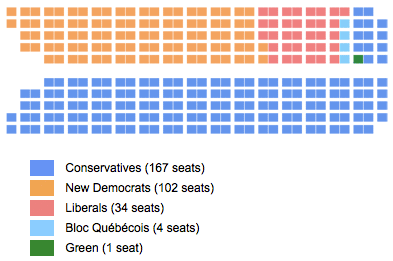
Canada 2011 Federal Election Seats
Canada May 2011 Federal Election Results

Consider this story from the Vancouver Sun. (H/T Andrew)

Excerpt:

Canadian ideals are shifting to the right, being taken over by a “unique strain of conservatism,” a poll from Preston Manning’s Calgarybased think-tank shows, the former Reform party leader said Wednesday.

This was the second year the Manning Centre for Building Democracy conducted the poll, which asked Canadians about their attitudes toward values and policies generally ascribed to Conservatives. Last year’s results indicated similar movements, with more people saying they don’t want government peddling grand views and having its hands in all aspects of society.

The only exception to this opinion is public safety and security policies, Manning said in an interview Tuesday.

Of those surveyed, 65 per cent said government should focus on current issues, and 67 per cent said government should decrease in size to do more.

Canada, it seems, has arrived at a point where its citizens have shifted their expectations for government, said Allan Gregg, the head of Harris Decima, which helped with the polling.

“(Government) is no longer the grand designer,” he said.

But the national shift isn’t necessarily being ascribed to Stephen Harper, who has been prime minister for slightly more than five years.

“This can’t be traced back the last two or three or four years,” said Andre Turcotte, president of Feedback Research Centre, which also helped with polling and interpreting the results. Instead, he said, this is something that has been happening since the late 1980s -around the same time the Reform Party began its rise.

Turcotte couldn’t speculate to whether it was by design or surprise, but he said that in 2008, Harper tapped into what many wanted out of government -being smaller and more focused on specific issues.

“As these conservative values become mainstream values, people will less and less identify them with Conservatives. People will just say these are Canadian values,” Manning said.

The poll was conducted from May 4 to 11, almost immediately after the election. A total of 1,000 interviews were conducted with randomly selected Canadians, resulting in a margin of error of 3.1 percentage points 19 times out of 20.

I blogged recently about how Canada’s economic numbers are vastly superior to the American numbers. I think the Canadians are learning what works by comparing what they’ve been doing (e.g. – corporate tax cuts down to half of our rate) compared to what we’ve been doing, (e.g. – massive bailouts and government spending). They know that they are better off than we are, and they know that conservative policies work – they’ve lived through it. That’s why a country that used to be liberal is now trending conservative. Prime Minister Stephen Harper gave them a five-year economics course and they gave him rave reviews as a professor, and a BIG promotion.

Coward A.C. Grayling and chicken Dawkins flee debate with William Lane Craig

Sing with me:

Brave Sir Grayling ran away
Bravely, ran away…away…
When danger reared its ugly head
He bravely turned his tail and fled
Yes, brave Sir Grayling turned about
And gallantly he chickened out
Bravely taking to his feet
He beat a very brave retreat
Bravest of the brave, Sir Grayling

He is packing it in and packing it up
And sneaking away and buggering off
And chickening out and pissing off home,
Yes, bravely he is throwing in the sponge.

From BeThinking.org’s web site.

Excerpt:

For years, ‘New Atheist’ Professors Anthony Grayling and Richard Dawkins have made money and gained publicity out of God.  But now, the courage of their convictions seems to be running dry: they have both refused to debate one of the world’s leading defenders of the Christian Faith, Professor William Lane Craig.

While Professor Dawkins has set himself up as the ‘scourge’ of the Church, Professor Grayling has offered his latest attack on Christianity by publishing The Good Book – a secular bible in the year the Church celebrates the 400th anniversary of the translation of the King James Bible.

While Dawkins and Grayling have refused to debate the existence of God, Grayling has also refused to debate the foundations of the morality on which his ‘Good Book’ rests. These point-blank refusals to engage in public discussions with Professor Craig will undermine their credibility, not only among Christians but also amongst fellow academics.

Professor Craig, Research Professor of Philosophy at Talbot School of Theology, California, is arguably the world’s foremost defender of historic Christianity. He has debated with many top academics and leading atheists across the world, including Peter Atkins, Daniel Dennett, Anthony Flew, Christopher Hitchens, Lewis Wolpert and, most recently, Sam Harris.

Craig visited the UK in 2007 and received national media coverage for his debate at Westminster Central Hall with Professor Lewis Wolpert, chaired by Radio 4’s Today presenter, John Humphrys. This debate has now been seen by thousands of people on YouTube. Professor Craig, who has two Ph.Ds, has written over thirty books and published some 200 academic papers. He is returning to the UK from 17-26 October in a tour sponsored by the Universities and Colleges Christian Fellowship, Damaris Trust and Premier Christian Radio.

Having been invited to debate Craig, Professor Grayling replied:

“I am not interested in debating Professor Craig, though if he would like to co-opt me for the publicity for his tour – I would be happy to debate him on the question of the existence of fairies and water-nymphs. But as for the very uninteresting matter of whether there is just one god or goddess and that it can be debated despite the claim that it is transcendently ineffable and unknowable – that is an empty prospect, hence my declining the invitation.”

Justin Brierley, who presents Premier Radio’s highly-rated discussion programme, Unbelievable?, comments:

“It looks insulting and worryingly narrow minded when an invitation to defend such views against a top-flight Christian academic such as Dr. Craig is dismissed in these terms. Grayling is seen as a key proponent of rationalism and atheism in the UK. It will therefore come as a surprise to many that he is so unwilling to defend the rational grounds for atheism against a major opponent.”

Brian Auten of Apologetics 315 tweeted this, earlier:

If you would like the see how well atheists do in debates with Craig, you can watch this:

William Lane Craig vs. Christopher Hitchens:

No wonder Grayling and Dawkins are soiling their knickers at the thought of facing him. It’s easy to impress your students when you are grading their papers AFTER they’ve paid their tuition. But a formal debate in a neutral venue would not be safe.

Previous story on Dawkins’ refusal to debate is here.

Craig’s UK tour schedule is here.