A stop not scheduled during the president’s third visit to the battleground state in four weeks was a coal-mining operation near Brilliant, Ohio, run by Ohio American Energy Inc., a subsidiary of Murray Energy Corp. The operation employed 239 workers at its peak but will be closing as the result of President Obama’s environmental policies.
Regulatory actions by President Obama and his appointees and followers were cited as the entire reason in the press release that announced the closing. “Mr. Obama has already destroyed 83,000 megawatts of coal-fired electricity generation in America,” said Michael T.W. Carey, vice president of government affairs for Murray Energy. “Electric prices in the recent PJM Interconnection monthly auction were bid up 800% for 2015-16 because of this,” he added.
PJM Interconnection, the company that operates the electric grid for 13 states, including Ohio, recently held its 2015 capacity auction. This gave the first real indication of just how drastic the effects of Obama’s war on coal will be. The market-clearing price for new 2015 capacity was $136 per megawatt.
That’s eight times higher than the price for 2012, which was just $16 per megawatt. In Pennsylvania, the new market price is $167 per megawatt — 10 times higher. In northern Ohio, which is suffering from more forced coal-plant retirements than the rest of the region, the 2015 price is an astounding $357 per megawatt.
This is one campaign promise President Obama has kept. In 2008, candidate Obama promised a system under which “if somebody wants to build a coal-powered plant, they can; it’s just that it will bankrupt them because they’re going to be charged a huge sum for all that greenhouse gas that’s being emitted.”
I’m sure that some of the people who lost their jobs voted for Obama. Maybe they were even familiar with that quote of his. But they just didn’t put two and two together to make four. Will you do that in November? I think that the one thing you want to do in life is to NOT hurt yourself with your own actions. Never vote to take away your own job.
The Coalition of African American Pastors (CAAP) announced at the National Press Club on Tuesday that the grassroots group – comprised of the more than 3,000 members – is a launching a national campaign to support marriage between one man and one woman and to oppose the Obama administration’s efforts to advance same-sex marriage.
“The time has come for a broad-based assault against the power that be that wants to change our culture to one of men marrying men and women marrying women,” CAAP President William Owens said at the press conference, held to announce the Marriage Mandate campaign, which includes a petition seeking 100,000 signatures pledging support for traditional marriage.
“Mr. President, I’m not going to stand with you, and there are thousands of others across this country that are not going to stand with you with this foolishness,” Owens said.
In a press release announcing the campaign, Owens encouraged black pastors and the black community to “withdraw their support for [Obama].”
“Today we will be launching a nationwide campaign rallying black pastors and African Americans to voice their opposition to the president’s position on same-sex marriage, and withdraw their support from him,” said Owens, who told reporters he voted for Obama in the 2008 presidential election.
“We will see that the black community is informed that the president is taking them for granted while pandering to the gay community,” Owens said.
Bishop Janice Hollis, presiding Prelate of the Covenant of International Fellowship of Churches, called Obama’s support of gay marriage a “travesty” and said it reflects the “disorder in the highest office in the land.”
Owens said CAAP sent a letter to Obama and Attorney General Eric Holder in May asking for a meeting to discuss the gay marriage issue.
“We wrote the president and Mr. Holder May the second, requesting an audience with him to discuss this very issue,” Owens said. “He has not given us the courtesy of any reply.
“The Coalition of African American Pastors (CAAP) consists of 3,742 African American pastors, and he has totally ignored us,” Owens said.
He said Obama is ignoring the black community “because he feels that he has us in his pocket.”
“Well, we are not in his pocket,” Owens said.
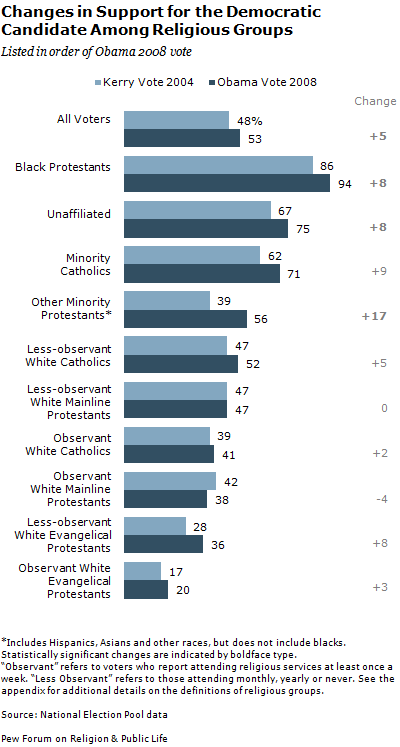
In the 2008 election, black Protestants voted overwhelmingly for the pro-abortion and pro-gay-marriage Obama. (He had a radical pro-abortion record and had come out for gay marriage earlier, so this was all known then).
I actually believed, based on this voting data, that American black Protestant churches were officially pro-abortion and pro-gay-marriage. I just considered them to be apostate denominations the same way that denominations like the Episcopal Church and the Presbyterian Church United States of America are apostate. (Note: this does not apply to non-American black churches, which are conservative).
These voting numbers confirm my experiences. For example, I remember one African American woman at work who was interested in me who could not understand why I would not join her in working on The United Way workplace partnership initiative. I took her aside in the hallway and told her that the United Way supported abortion and opposed the Boy Scouts, and she was like “So what?“. She attended church weekly and she supported Barack Obama. So I just figured based on these voting numbers and my personal experiences that most African-American churches were pro-abortion, pro-gay-marriage, pro-socialism, etc.
This action by the 3,742 black African-American pastors shocks me as much as if those gay bishops in the Episcopal church had suddenly came out in favor of defending traditional marriage. Maybe these 3,742 pastors will be able to begin to educate their flocks about what the Bible actually says on these issues so that these voting numbers change. I did know about the good African-American pastors like Harry Jackson and Ken Hutcherson who are pro-life and pro-marriage, but I just thought that there were only a handful of faithful black pastors. I guess I was wrong, at least on the marriage issue, and that’s a good thing. Color me surprised.
For during recent years its swimmers and coaches have been caught cheating so many times it is difficult to keep count – and it has modelled its draconian training system on precisely that which produced Schneider and other turbo-charged East Germans before the Iron Curtain fell.
It began in the Eighties when, determined to end the nation’s perennial humiliation at major athletics and swimming championships, China’s Communist regime decreed that a generation of future champions must be harvested and honed.
To that end, school teachers were ordered to scrutinise their pupils for signs of natural sporting ability and report any child with obvious potential to regional coaches who would install them in one of 3,000 new state training camps.
According to her mother, Qing Dingyi, as quoted by the Chinese state media, little Ye ‘expressed a wish to become a swimmer at the tender age of seven’.
In truth, she was picked out because she had an unusually masculine physique with extremely large hands and long limbs: attributes at first thought best suited to a career in track and field.
After being whisked away from her modest two-bedroom apartment, in Hangzhou, a city of 6.2 million, and installed into the Chen Jingluin sports school, however, it was decided she would be best suited to swimming, and by 11 she had won her first major junior championship.
Her mother insists she and her husband, a manual worker, had always impressed on her that ‘results are not important, but you should always enjoy the taking part’. One doubts she dares voice this opinion in the presence of her daughter’s coaches.
In swimming, as in most other Olympic sports, they enforce a regime so relentlessly harsh that it has been compared, by those few Western observers who have managed to penetrate the obsessive secrecy with which it is guarded, to that in some 19th-century prisons.
Indeed, after being shown how China’s child gymnasts are trained some years ago, in his capacity as an Olympic observer, Britain’s Olympic gold-winning oarsman Sir Matthew Pinsent – a man who knows a thing or two about pushing the human body to its limits – pronounced it a ‘pretty disturbing experience’.
Children who our own sports authorities would deem far too young even to countenance focusing seriously on one sport, let alone be taken away from their parents and billeted in these boot-camps, had been driven so hard that they wept, and one claimed to have been beaten by his coach.
The International Olympic Committee promised then to investigate his claims but seven years on there is no evidence that anything has remotely changed.
Only last January harrowing photographs were posted on the internet showing Chinese children crying in pain as they were put to work.
In case they had forgotten why they were there, a large sign on the wall reminded them. ‘GOLD’ it said simply.
What a tragedy. This is why I boycott the Olympics. To me there is nothing more important than having everything child welcomed into the world by his or her biological parents, and then having a stable loving environment to grow up in. I reject both the selfishness of adults and the fascist ideologies of socialist states. There is nothing more important to children than their parents. Children are more important than anti-family ideologies like feminism and socialism.
I recommend clicking through and reading the full article, and look at the pictures, too. This is what happens when the state takes precedence over individuals and families. We need to make sure that secularism and socialism do not dominate here, like they do in China.