
Climate change: is global cooling the emerging consensus view of scientists?

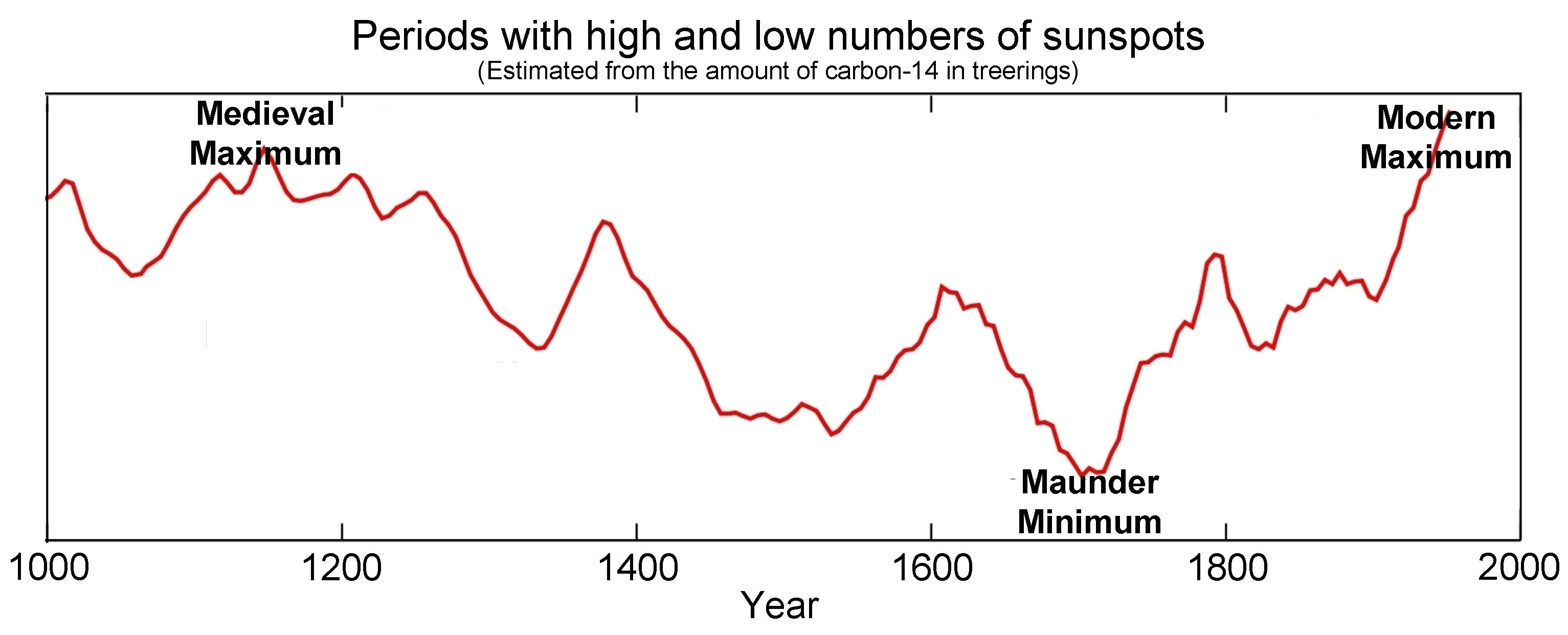
Graph of solar events (Source: GSU.edu)
Graph of solar activity (Source: GSU.edu)

Source: Department of Geosciences, Georgia State University
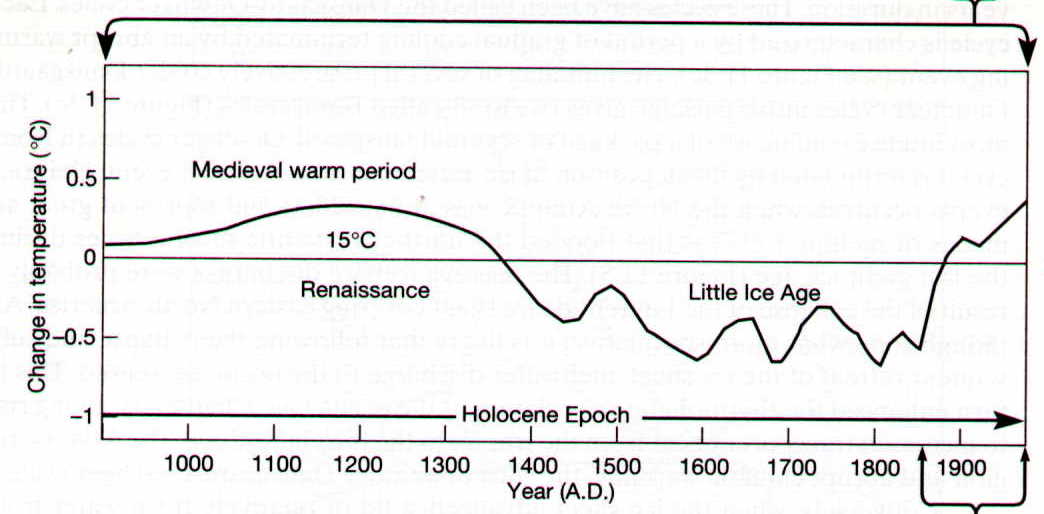
Global temperature (Source: USC.edu)

Source: Department of Earth Sciences, University of Southern California

Now, the consensus view among skeptics of global warming has generally been that naturally-occurring solar cycles are responsible for cooling and warming trends. In the medieval era, global temperatures were higher than today, and that cannot have been caused by the emission of greenhouse gases. It makes more sense to attribute that warming period to the sun than to human behaviors. If that’s the case, then it’s possible that solar cycles could also cause us to go into a cooling period.

Here’s an article about global cooling from the Financial Post, a Canadian newspaper that is part of the National Post.

Excerpt:

In the 1960s and 1970s, a growing scientific consensus held that the Earth was entering a period of global cooling. The CIA announced that the “Western world’s leading climatologists have confirmed recent reports of detrimental global climatic change” akin to the Little Ice Age of the 17th and 18th centuries, “an era of drought, famine and political unrest in the western world.” President Jimmy Carter signed the National Climate Program Act to deal with the coming global cooling crisis. Newsweek magazine published a chilling article entitled “The Cooling World.”

In the decades that followed, as temperatures rose, climate skeptics mocked the global cooling hypothesis and a new theory emerged — that Earth was in fact entering a period of global warming.

Now an increasing number of scientists are swinging back to the thinking of the 1960s and 1970s. The global cooling hypothesis may have been right after all, they say. Earth may be entering a new Little Ice Age.

“Real risk of a Maunder Minimum ‘Little Ice Age,’” announced the BBC this week, in reporting startling findings by Professor Mike Lockwood of Reading University. “Professor Lockwood believes solar activity is now falling more rapidly than at any time in the last 10,000 years [raising the risk of a new Little Ice Age] from less than 10% just a few years ago to 25-30%,” explained Paul Hudson, the BBC’s climate correspondent. If Earth is spared a new Little Ice Age, a severe cooling as “occurred in the early 1800s, which also had its fair share of cold winters and poor summers, is, according to him, ‘more likely than not’ to happen.”

[…]Scientists at the Climate and Environmental Physics and Oeschger Centre for Climate Change Research at the University of Berne in Switzerland back up theories that support the Sun’s importance in determining the climate on Earth. In a paper published this month by the American Meteorological Society, the authors demolish the claims by IPCC scientists that the Sun couldn’t be responsible for major shifts in climate. In a post on her website this month, Judith Curry, Chair of the School of Earth and Atmospheric Sciences at the Georgia Institute of Technology, all-but mocked the IPCC assertions that solar variations don’t matter. Among the many studies and authorities she cited: the National Research Council’s recent report, “The Effects of Solar Variability on Earth’s Climate,” and NASA, former home of global warming guru James Hansen.

The Daily Caller picked up on this article and added more: (H/T Letitia)

Earlier this year, Professor Cliff Ollier of the School of Earth and Environmental Studies at the University of Western Australia presented a study that posited that the sun was a major controller of the climate.

“There is a very good correlation of sunspots and climate,” Ollier wrote. “Solar cycles provide a basis for prediction. Solar Cycle 24 has started and we can expect serious cooling. Many think that political decisions about climate are based on scientific predictions but what politicians get are projections based on computer models.”

Last year, Russian scientists also posited that from next year onward the world could expect the start of the another Little Ice Age.

“After the maximum of solar cycle 24, from approximately 2014 we can expect the start of deep cooling with a Little Ice Age in 2055,” wrote Habibullo Abdussamatov of the Russian Academy of Science.

The “Little Ice Age” occurred during the 1600s when winters were harsh all across Europe. The continent-wide cold weather coincided with an inactive sun, called the Maunder solar minimum.

You’re not likely to hear about the Medieval Warming Period or the Maunder minimum in public schools, but they are there in the data.

Of course, if the majority of people begin to understand that the sun is causing cycles of warming and cooling, then we don’t really need government to regulate job creators and control our consumption. What would happen then? So my suspicion is that the government-funded scientific consensus will try to get us to believe that we have always been fighting against global cooling, not global warming. That way, the massive taxation and regulation of private companies and private individuals can continue.

This reminds me of Oceania’s war with Eastasia or Eurasia in the famous distopian novel 1984: (description from leftist Wikipedia)

In 1984, there is a perpetual war among Oceania, Eurasia and Eastasia, the super-states which emerged from the atomic global war. “The book”, The Theory and Practice of Oligarchical Collectivism by Emmanuel Goldstein, explains that each state is so strong it cannot be defeated, even with the combined forces of two super-states—despite changing alliances. To hide such contradictions, history is re-written to explain that the (new) alliance always was so; the populaces accustomed to doublethink accept it. The war is not fought in Oceanian, Eurasian or Eastasian territory but in the arctic wastes and a disputed zone comprising the sea and land from Tangiers (northern Africa) to Darwin (Australia). At the start, Oceania and Eastasia are allies combatting Eurasia in northern Africa and the Malabar Coast.

That alliance ends and Oceania allied with Eurasia fights Eastasia, a change which occurred during the Hate Week dedicated to creating patriotic fervour for the Party’s perpetual war. The public are blind to the change; in mid-sentence an orator changes the name of the enemy from “Eurasia” to “Eastasia” without pause. When the public are enraged at noticing that the wrong flags and posters are displayed they tear them down—thus the origin of the idiom “We’ve always been at war with Eastasia”…

I wonder if we are coming to the point when the global warming alarmists will switch their pro-socialism narrative so that the threat we face is global cooling.

The neat thing about that article is that it’s the Canadians who are among the most skeptical of global warming. Previously, officials in the Canadian government have been extremely critical of the man-made global warming hypothesis. Consider the comments of Conservative MP Joe Oliver and Conservative MP Peter Kent – they are all for developing energy resources and creating jobs. Canadians are practical on the issue of climate change – they would rather have jobs than feelings of moral superiority. But down here in Obamaland, there’s no critical thinking at all on the issue. If you doubt global warming, then you need to be called names, intimidated, fired or worse.

Gay activist inside IRS leaked names of pro-marriage donors to Human Rights Campaign

The American Spectator reports. (H/T Robert Stacy McCain)

Excerpt:

Last year’s illegal leak of confidential non-profit donor information by the Internal Revenue Service has been linked to a 2007 Harvard University graduate who was a member of a gay activist group within Bain and Co.

IRS rules prevent congressional investigators from publicly naming the tax agency employee who leaked the information about donors to the National Organization for Marriage (NOM),Eliana Johnson of National Review reports, however, that the person to whom the information was leaked was former Bain and Co. employee Matthew Meisel. A 2007 graduate of Harvard, Meisel was active in an employee organization called Bain Gay and Lesbian Association for Diversity (BGLAD), Meisel’s activism on behalf of gay-oriented diversity hiring programs has been trumpeted in the Harvard Crimson and Yale Herald.

Johnson’s National Review report cites investigators with the House Ways and Means Committee for how the information about donors to NOM (which opposes the legalization of same-sex marriage) was leaked from the IRS, revealing GOP presidential candidate Mitt Romney’s private contributions to the organization:

[A]n IRS agent working in the Exempt Organizations Division — the same division that, until May, was under the direction of Lois Lerner, who retired under duress last month — leaked NOM’s Schedule B to Matthew Meisel, a former employee of Bain & Company… . After he obtained NOM’s donor list from the IRS employee, the committee says, Meisel then turned it over to the Human Rights Campaign. Neither Meisel nor the Human Rights Campaign returned calls seeking comment.

So what you have here is a gay activist giving information to the Human Rights Campaign. The Human Rights Campaign is a group that had previously condemned the Family Research Council as a hate group. This is the same Family Research Council that was later attacked by a convicted domestic terrorist / gay activist. After the attack, the HRC continued to denounce the FRC as a hate group.

Not the first time

Remember Private Bradley Manning, who leaked top secret military information? He was also a gay activist.

Here’s the story from the UK Telegraph.

Excerpt:

Bradley Manning, the prime suspect in the leaking of the Afghan war files, raged against his US Army employers and “society at large” on his Facebook page in the days before he allegedly downloaded thousands of secret memos, The Daily Telegraph has learnt.

The US Army intelligence analyst, who is half British and went to school in Wales, appeared to sink into depression after a relationship break-up, saying he didn’t “have anything left” and was “beyond frustrated”.

In an apparent swipe at the army, he also wrote: “Bradley Manning is not a piece of equipment,” and quoted a joke about “military intelligence” being an oxymoron.

Mr Manning, 22, who is currently awaiting court martial, is suspected of leaking more than 90,000 secret military documents to the Wikileaks website in a security breach which US officials claim has endangered the lives of serving soldiers and Afghan informers.

[…]Mr Manning, who is openly homosexual, began his gloomy postings on January 12, saying: “Bradley Manning didn’t want this fight. Too much to lose, too fast.”

[…]Pictures on Mr Manning’s Facebook page include photos of him on school trips during his time in Wales and at a gay rights rally, where he is holding up a placard demanding equality on “the battlefield”.

The story a detailed look at his family history, and his troubled relationship with his father after his parents divorced.

Why is this interesting?

The troubling thing about abortion activists and gay activists is how easy they find it to overrule and destroy the basic human rights of those who disagree with them about sexual morality. That’s the real concern that traditional religious people have about abortion rights and gay rights activists. Some of them seem very willing to break the law and infringe on the rights of others in their crusades.

See below for some more examples of radical left-wing activists breaking laws in order to push their socially liberal agenda.

Related posts

Does a commitment to naturalism undermine rational thought and textual meaning?

Dr. William Lane Craig had a formal debate with an atheist philosopher named Alex Rosenberg a few months back that brought up an interesting idea. Rosenberg is a strong naturalist and he suggests all kinds of counterintuitive outworkings of naturalism in his book. Dr. Craig brought up a bunch of those strange views in his debate, and I listed them out in my summary of the debate as follows:

  1. The argument from the intentionality (aboutness) of mental states implies non-physical minds (dualism), which is incompatible with naturalism
  2. The existence of meaning in language is incompatible with naturalism, Rosenberg even says that all the sentences in his own book are meaningless
  3. The existence of truth is incompatible with naturalism
  4. The argument from moral praise and blame is incompatible with naturalism
  5. Libertarian freedom (free will) is incompatible with naturalism
  6. Purpose is incompatible with naturalism
  7. The enduring concept of self is incompatible with naturalism
  8. The experience of first-person subjectivity (“I”) is incompatible with naturalism

We are concerned with #1 and #2 in this post.

Now I was visiting my parents last week in my home town and Dad and I went to church on Sunday. He wanted to listen to some weird sing-song-voiced pastor on the drive there, but I plugged in my smartphone and we listened to these three podcasts by William Lane Craig instead.

Dr. Craig was explaining in part 3 (I think) about how he went on the offensive with the 8 points, and Dad asked me why Dr. Rosenberg wrote that if naturalism is true, then nothing written down is meaningful. He also wanted to know why Dr. Rosenberg would write a book if his worldview entailed that nothing written down is meaningful.

The solution has to do with Rosenberg’s denial of “intentionality”, which is the idea that something can be about something else. For example, I can think about what I had for breakfast today on the way to church (two apples and coffee) or I can think about the sermon today in my home church and how good it was. A naturalist believes that the whole universe is made up of pure matter alone, and matter cannot be about anything. So Rosenberg denies this common sense view of “intentionality” or “aboutness” because there is no room for it on his naturalistic / materialistic / physicalist view of reality.

Here is a post by Bill Valicella on Maverick Philosopher blog that answers Dad’s questions.

First, Rosenberg’s own view from his book.

A single still photograph doesn’t convey movement the way a motion picture does. Watching a sequence of slightly different photos one photo per hour, or per minute, or even one every 6 seconds won’t do it either. But looking at the right sequence of still pictures succeeding each other every one-twentieth of a second produces the illusion that the images in each still photo are moving. Increasing the rate enhances the illusion, though beyond a certain rate the illusion gets no better for creatures like us. But it’s still an illusion. There is noting to it but the succession of still pictures. That’s how movies perpetrate their illusion. The large set of still pictures is organized together in a way that produces in creatures like us the illusion that the images are moving. In creatures with different brains and eyes, ones that work faster, the trick might not work. In ones that work slower, changing the still pictures at the rate of one every hour (as in time-lapse photography) could work. But there is no movement of any of the images in any of the pictures, nor does anything move from one photo onto the next. Of course, the projector is moving, and the photons are moving, and the actors were moving. But all the movement that the movie watcher detects is in the eye of the beholder. That is why the movement is illusory.

The notion that thoughts are about stuff is illusory in roughly the same way. Think of each input/output neural circuit as a single still photo. Now, put together a huge number of input/output circuits in the right way. None of them is about anything; each is just an input/output circuit firing or not. But when they act together, they “project” the illusion that there are thoughts about stuff. They do that through the behavior and the conscious experience (if any) that they produce. (Alex Rosenberg,The Atheists’ Guide to Reality: Enjoying Life Without Illusions.  The quotation was copied from here.)

And here is what Bill says about that:

Rosenberg is not saying, as an emergentist might, that the synergy of sufficiently many neural circuits gives rise to genuine object-directed thoughts.    He is saying something far worse, something literally nonsensical, namely, that the object-directed thought that thoughts are object-directed is an illusion.  The absurdity of Rosenberg’s position can be seen as follows.

  1. Either the words “The notion that thoughts are about stuff is illusory”  express a thought — the thought that there are no object-directed thoughts — or they do not.
  2. If the latter, then the words are meaningless.
  3. If the former, then the thought is either true or false.
  4. If the thought is true, then there there are no object-directed thoughts, including the one expressed by Rosenberg’s words, and so his words are once again meaningless.
  5. If the thought is false, then there are object-directed thoughts, and Rosenberg’s claim is false.

Therefore:

  • Rosenberg’s claim is either meaningless or false.  His position is self-refuting.

As for the analogy, it is perfectly hopeless, presupposing as it does genuine intrinsic intentionality.  If I am watching a movie of a man running, then I am under an illusion in that there is nothing moving on the movie screen: there is just a series of stills. But the experience I am undergoing is a perfectly good experience that exhibits genuine intrinsic intentionality: it is a visual experiencing of a man running, or to be perfectly punctilious about it: a visual experiencing AS OF a man running.  Whether or not the man depicted exists, as would be the case if the movie were a newsreel, the experience exists, and so cannot be illusory.

To understand the analogy one must understand that there are intentional experiences, experiences that take an accusative.  But if you understand that, then you ought to be able to understand that the analogy cannot be used to render intelligible how it might that it is illusory that there are intentional experiences.

What alone remains of interest here is how a seemingly intelligent fellow could adopt a position so manifestly absurd.  I suspect the answer is that he has stupefied himself  by  his blind adherence to scientistic/naturalistic ideology.

If you want to sort of double check the details, then go ahead and watch the debate or read my summary or listen to the debate audio, and then listen to Dr. Craig’s three podcasts that I linked above.

I know a lot of you are thinking right now “Hey! You cheater! That’s a presuppositional argument! You said they were bad!” Well, I didn’t say they were bad, I said that the epistemological view of presuppositionalism was bad. Presuppositional arguments are good. See below for a few posts about them. Use them all you can, but use the good scientific and historical evidence, too.

Positive arguments for Christian theism