
In 2008, Sarah Palin predicted that if Barack Obama were elected, Russia would invade Ukraine

Radically leftist CNN reports. (H/T Letitia)

Excerpt:

In 2008, when she was the GOP vice presidential nominee, Palin questioned in a speech whether then-Sen. Barack Obama would have the foreign policy credentials to handle a scenario in which Russian President Vladimir Putin invaded Ukraine.

“After the Russian army invaded the nation of Georgia, Senator Obama’s reaction was one of indecision and moral equivalence – the kind of response that would only encourage Russia’s Putin to invade Ukraine next,” she said in Reno, Nevada on October 21, 2008.

The former Alaska governor was happy to highlight her prediction on Friday and scold those who criticized her 2008 comments.

[…]On Facebook, Palin continued to explain how she anticipated a growing crisis between Russia and Ukraine, where there has now been an uncontested arrival of Russian military forces by air at a Russian base in Ukraine’s Crimea region. They are believed to be Russian land forces, according to a U.S. assessment.

Now let’s review the events that caused Putin to believe that Obama would do nothing to stop his aggression.

Why is Russia so aggressive?

Russia learned from repeated failures by Obama that there would be no price to pay for aggression.
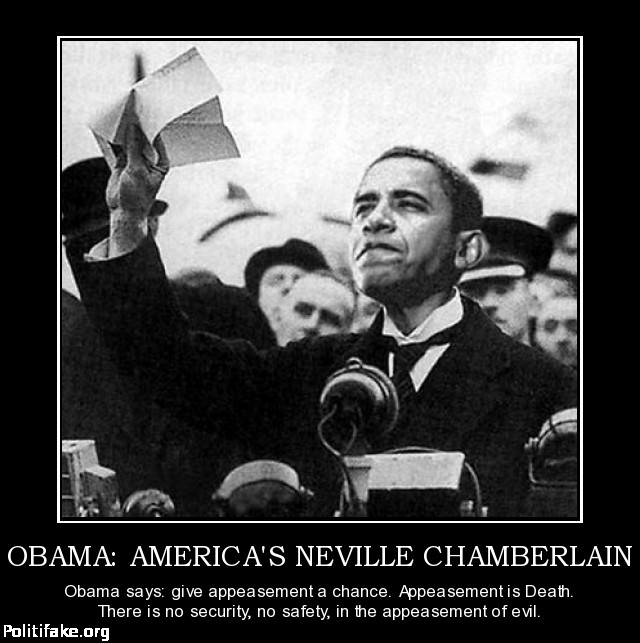
Neville Chamberlain Obama: peace in our time

Let’s make a list of failures, just off the top of my head.

Investors Business Daily documents more of Obama’s 5 years of foreign policy weakness.

Even the leftist Washington Post agrees

That’s not just me saying that, it’s the radically leftist Washington Post!

Excerpt: (links removed)

For five years, President Obama has led a foreign policy based more on how he thinks the world should operate than on reality. It was a world in which “the tide of war is receding” and the United States could, without much risk, radically reduce the size of its armed forces. Other leaders, in this vision, would behave rationally and in the interest of their people and the world. Invasions, brute force, great-power games and shifting alliances — these were things of the past. Secretary of State John F. Kerry displayed this mindset on ABC’s “This Week” Sunday when he said, of Russia’s invasion of neighboring Ukraine, “It’s a 19th century act in the 21st century.”

That’s a nice thought, and we all know what he means. A country’s standing is no longer measured in throw-weight or battalions. The world is too interconnected to break into blocs. A small country that plugs into cyberspace can deliver more prosperity to its people (think Singapore or Estonia) than a giant with natural resources and standing armies.

Unfortunately, Russian President Vladimir Putin has not received the memo on 21st-century behavior. Neither has China’s president, Xi Jinping, who is engaging in gunboat diplomacy against Japan and the weaker nations of Southeast Asia. Syrian president Bashar al-Assad is waging a very 20th-century war against his own people, sending helicopters to drop exploding barrels full of screws, nails and other shrapnel onto apartment buildings where families cower in basements. These men will not be deterred by the disapproval of their peers, the weight of world opinion or even disinvestment by Silicon Valley companies. They are concerned primarily with maintaining their holds on power.

[…]The urge to pull back — to concentrate on what Mr. Obama calls “nation-building at home” — is nothing new, as former ambassador Stephen Sestanovich recounts in his illuminating history of U.S. foreign policy, “Maximalist.” There were similar retrenchments after the Korea and Vietnam wars and when the Soviet Union crumbled. But the United States discovered each time that the world became a more dangerous place without its leadership and that disorder in the world could threaten U.S. prosperity.

[…]Military strength, trustworthiness as an ally, staying power in difficult corners of the world such as Afghanistan — these still matter, much as we might wish they did not. While the United States has been retrenching, the tide of democracy in the world, which once seemed inexorable, has been receding. In the long run, that’s harmful to U.S. national security, too.

As Mr. Putin ponders whether to advance further — into eastern Ukraine, say — he will measure the seriousness of U.S. and allied actions, not their statements. China, pondering its next steps in the East China Sea, will do the same. Sadly, that’s the nature of the century we’re living in.

Everyone admits that Obama’s weakness has caused these foreign policy problems. We elected someone who wants our influence abroad to decline. The people who elected him just did not understand foreign policy and national security concerns, and now Ukrainians are going to pay with their freedom, and possibly with their lives, because of our inability to project power abroad. This is the high cost of isolationism for our peace-loving, pro-democracy, pro-capitalism allies.

What should we do now?

Speaking of Politico, they published an 8-point plan for responding to Putin’s invasion of Ukraine, authored by moderate Republican Senator Marco Rubio.

Here are numbers two, seven and eight:

Second, President Obama should dispatch Secretary of State John Kerry and Defense Secretary Chuck Hagel to Kiev to show U.S. support for Ukraine’s transitional government, and urge our allies in the European Union and NATO to send representatives there as well. The United States should convene an emergency meeting of NATO to develop a strong united response from the trans-Atlantic alliance. And we should send high-level delegations to our allies in Central and Eastern Europe to reinforce the fact that we are standing by them. As part of this work with our allies, we should develop a series of economic and security assurance measures to help the transitional government in Kiev remain stable and carry out a democratic transition.

[…]Seventh, the Obama administration should immediately add more Russian officials to the Magnitsky list, which places travel bans and other sanctions on them – something President Obama failed to do in December. Living in Miami, I have seen in recent years the wave of Russian tourists coming to our city and state to spend money and buy property. Many are government officials or allies whose wealth stems from allegiance to Putin, and we should limit their ability to travel here.

Finally, in the Senate, Majority Leader Harry Reid should immediately halt his effort to force a Senate vote on Rose Gottemoeller next week to be under secretary of state for arms control and international security. As I, Sens. John Cornyn and Jim Risch said yesterday, we shouldn’t even be thinking about arms-control negotiations with Russia anytime soon. And especially not negotiations led by a State Department official, such as Ms. Gottemoeller, who has tried to play down and potentially kept information from Congress and our allies about Russian violations of arms-control agreements.

But we have no reason to expect that Obama will do any of these things. Why? Because the real enemy we face is global warming.

John Kerry: global warming is “a weapon of mass destruction”

Meanwhile, John Kerry gave a speech in which he asserted that among the biggest threats to national security was global warming – “the world’s most fearsome weapon of mass destruction”.

I fully expect Kerry to blame global warming for Russia’s invasion of Ukraine. The Obama administration has already blamed our record cold temperatures on global warming. 17 years without significant warming, according to the UN IPCC, and yet that’s what our government is focused on. Behold, the superstition and credulity of the secular left.
Arthur Brooks: why is the American public shifting from optimism to envy?

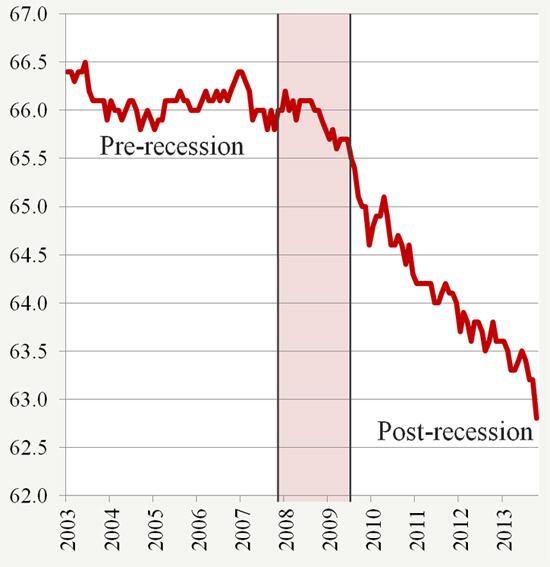
Labor Force Participation down to 62.8%

An editorial by Arthur Brooks appeared today in the leftist New York Times. His topic is the shift from optimism to envy, why it is happening, and whether envy makes us happier than optimism.

Excerpt: (links removed)

The Irish singer Bono once described a difference between America and his native land. “In the United States,” he explained, “you look at the guy that lives in the mansion on the hill, and you think, you know, one day, if I work really hard, I could live in that mansion. In Ireland, people look up at the guy in the mansion on the hill and go, one day, I’m going to get that bastard.”

[…]Unsurprisingly, psychologists have found that envy pushes down life satisfaction and depresses well-being. Envy is positively correlated with depression and neuroticism, and the hostility it breeds may actually make us sick. Recent work suggests that envy can help explain our complicated relationship with social media: it often leads to destructive “social comparison,” which decreases happiness. To understand this, just picture yourself scrolling through your ex’s wedding photos.

My own data analysis confirms a strong link between economic envy and unhappiness. In 2008, Gallup asked a large sample of Americans whether they were “angry that others have more than they deserve.” People who strongly disagreed with that statement — who were not envious, in other words — were almost five times more likely to say they were “very happy” about their lives than people who strongly agreed. Even after I controlled for income, education, age, family status, religion and politics, this pattern persisted.

It’s safe to conclude that a national shift toward envy would be toxic for American culture.

Unfortunately, in the wake of the Great Recession, such a shift may well be underway, given the increasing anxiety about income inequality and rising sympathy for income redistribution. According to data from the General Social Survey, the percentage of Americans who feel strongly that “government ought to reduce the income differences between the rich and the poor” is at its highest since the 1970s. In January, 43 percent of Americans told the Pew Research Center that government should do “a lot” to “reduce the gap between the rich and everyone else.”

Why the shift? The root cause of increasing envy is a belief that opportunity is in decline. According to a 2007 poll on inequality and civic engagement by the Maxwell School of Citizenship and Public Affairs at Syracuse University, just 30 percent of people who believe that everyone has the opportunity to succeed describe income inequality as “a serious problem.” But among people who feel that “only some” Americans have a shot at success, fully 70 percent say inequality is a major concern.

People who believe that hard work brings success do not begrudge others their prosperity. But if the game looks rigged, envy and a desire for redistribution will follow.

This is the direction we’re heading. According to Pew, the percentage of Americans who feel that “most people who want to get ahead” can do so through hard work has dropped by 14 points since about 2000. As recently as 2007, Gallup found that 70 percent were satisfied with their opportunities to get ahead by working hard; only 29 percent were dissatisfied. Today, that gap has shrunk to 54 percent satisfied, and 45 percent dissatisfied. In just a few years, we have gone from seeing our economy as a real meritocracy to viewing it as something closer to a coin flip.

There is a good lesson in this for people who want what is best for the poor. Simply receiving money from others is not going to make poor people happy. What we need to focus on is providing the poorest people with opportunities. For example, we need to reduce barriers that employers face to hire them, and we need to make the school system focus more on skill-building and less on indoctrination in leftist ideology.

Democrats like to give lots of speeches on income inequality, stoking the fires of envy, while doing nothing to help people learn useful skills in school and to help employers hire people more easily, setting them on the path of lifelong independence. For example, Democrats oppose school choice, as when they killed the D.C. voucher program that helped poor black students. Less school choice helps public schools to be insulated from competition, so that they can focus on what they want (bigger government, so they get paid more) rather than what parents want (bad teachers fired, students to learn useful skills, more male teachers in the classroom, a focus on vocational skills rather than ideology). Just this past week, the ultra-leftist mayor of New York city kicked charter schools out of the city. Why? Because if children learn useful skills in better schools, then they will be less dependent on government, and less responsive to “envy rhetoric”.

Democrats also passed Obamacare, which punishes businesses with taxes if they allow part-time workers to work for more than 30 hours a week. Many jobs were lost because of this, and many people are now struggling to pay higher premiums for plans with higher deductibles and co-pays. Now the Democrats are talking about raising the minimum wage, which is going to put even more pressure on employers to lay off workers, because they can’t afford to pay them more for the same work. For Democrats, this is all to the good, though. Because if the poor don’t have jobs, or can’t work enough hours, they start to see the economic game as “rigged” and they are more responsive to “envy rhetoric”.

What we need to see is that it’s not the Democrats’ objective to help people find jobs. They gain when people become more envious, like in European countries, and start to vote to grow the size and power of government to redistribute wealth. Speeches about income inequality never have the goal of giving people jobs. None of Obama’s policies aim to do that. That’s why he won’t build the Keystone XL pipeline, or boost domestic energy development here at home. Instead, they want to extend unemployment benefits and pass the costs on to the next generation. Their goal is to get you unemployed or on disability or on welfare, so that you will vote for the government to continue to take your neighbor’s money. That manufactured envy is what keeps the Democrats in power.

Physicist Victor Stenger debates William Lane Craig: Does God Exist?

This debate took place on March 1, 2010 at Oregon State University.

In this debate, Victor Stenger does affirm his belief that the universe could be eternal in his second rebuttal (1:02:30), thus denying the standard Big Bang cosmology. He also denies the law of conservation of energy and asserts that something can come from nothing in his concluding speech (1:33:50). He also caused the audience to start laughing when he said that Jesus was not moral and supported slavery. There is almost no snark in this summary. Instead, I quoted Dr. Stenger verbatim in many places. I still think that it is very entertaining even without the snarky paraphrasing.

The debate includes 30 minutes of Q&A with the students.

Here is the MP3 file for the audio.

Here’s the video of the debate:

Dr. Craig’s opening speech:

  • The ontological argument
  • The contingency argument
  • The cosmological argument
  • The moral argument
  • The resurrection of Jesus (3-fact version)
  • Religious experience

Dr. Stenger’s opening speech:

  • There is no scientific evidence for God’s existence in the textbooks
  • There is no scientific evidence for God acting in the universe
  • God doesn’t talk to people and tell them things they couldn’t possibly know
  • The Bible says that the Earth is flat, etc.
  • There is no scientific evidence that God answers prayers
  • God doesn’t exist because people who believe in him are ignorant
  • Human life is not optimally designed and appears to be the result of a blind, ad hoc evolutionary process
  • The beginning of the universe is not ordered (low entropy) but random and chaotic
  • It’s theoretically possible that quantum tunneling explains the origin of the universe
  • The laws of physics are not objectively real, they are “our inventions”
  • Regarding the beginning of the universe, the explanation is that something came from nothing*
  • Nothing* isn’t really nothing, it is “the total chaos that we project existed just before the big bang”
  • If something has no structure, then “it is as much nothing as nothing can be”
  • Consciousness is explainable solely on the basis of material processes
  • There are well-informed, rational non-believers in the world and God would not allow that

Dr. Craig’s first rebuttal:

Stenger’s argument that there is no objective evidence for God’s existence:

  • First, it is not required that God rely only on objective evidence in order to draw people to himself (Alvin Plantinga)
  • Second, God is not required to provide evidence to everyone, only to the people who he knows would respond to him
  • Third, Craig gave lots of objective evidence, from science, history and philosophy
  • Stenger asks for certain evidence (answered prayers, prophecy, etc.), but Craig presented the evidence we have

Stenger’s argument that the balance of energy is zero so “nothing” exists:

  • if you have the same amount of assets and liabilities, it doesn’t mean that nothing exists – your assets and liabilities exist
  • Christopher Isham says that there needs to be a cause to create the positive and negative energy even if they balance
  • the quantum gravity model contradicts observations
  • the vacuum is not the same as nothing, it contains energy and matter
  • the BVG theorem proves that any universe that is expanding must have a beginning

Stenger’s argument that mental operations can be reduced to physical operations:

  • mental properties are not reducible to physical properties
  • epiphenomenalism: is incompatible with self-identity over time
  • epiphenomenalism: is incompatible with thoughts about other things
  • epiphenomenalism: is incompatible with free will
  • substance dualism (mind/body dualism) is a better explanation for our mental experience
  • God is a soul without a body
Dr. Stenger’s first rebuttal:

Craig’s cosmological argument:

  • Craig’s premise is “everything has a cause”, but quantum mechanics has causeless events
  • There are speculative theories about how something could have come into being uncaused out of nothing
  • “I don’t know of a single working cosmologist today who believes there was a singularity prior to the Big Bang”
  • “If there wasn’t a singularity then there’s no basis for arguing that time began at that point”
  • “There’s no reason from cosmology that we know of that the universe can’t be eternal”
  • “When I talk about an eternal universe, I mean a universe that has no beginning or end”
  • The Hartle-Hawking model doesn’t have a beginning
  • “There was no violation of energy conservation by having a universe coming from nothing”
  • “The universe could have come from a previous universe for example or even just from a region of chaos”
  • The paper by Vilenkin is counteracted by other papers (he doesn’t specify which ones)

Craig’s moral argument:

  • Dr. Craig is arguing from ignorance
  • But morality can be decided by humanity just like governments pass laws, and that’s objective
  • Dr. Craig has too little respect for the human intellect
  • I don’t need to tell me that slavery is wrong
  • The Bible supports slavery
  • Atheists can behave as good as theists
  • Morality just evolved naturally as an aid to survival

Craig’s resurrection argument:

  • No Roman historians wrote about the execution of Jesus but none of them did
  • The empty tomb is doubtful because it is only mentioned in the gospels, not by Paul
  • John Dominic Crossan says there was no empty tomb
  • Christianity only survived because the Roman empire thought that they were useful

Dr. Craig’s second rebuttal:

Craig’s cosmological argument:

  • There is no reason to prefer an indeterministic interpretation of quantum mechanics
  • Dr. Stenger himself wrote that deterministic interpretations of quantum mechanics are possible
  • The vacuum in quantum mechanics is not nothing
  • The quantum vacuum he proposes cannot be eternal
  • The cosmological argument does not require a singularity
  • The Hartle-Hawking model is from 1983
  • Hawking says that there is a beginning of space and time after that model
  • The Hartle-Hawking model does still have a beginning of time – the model is not eternal
  • The BVG theorem that requires a beginning for expanding universes is widely accepted among cosmologists

Craig’s moral argument:

  • Stenger redefined objective to mean that most people agree with it – but that’s not what objective means
  • Objective means right and wrong whether anyone accepts it or not
  • Richard Dawkins himself says that on atheism there is “no evil and no good” – why is he wrong?
  • Even Dr. Stenger says that morality is the same as passing laws – it’s arbitrary and varies by time and place
  • But on his view, right and wrong are the same as deciding which side of the road to drive on
  • But somethings really are right and some things are really wrong

Craig’s resurrection argument:

  • Josephus is a Roman historian and he wrote about Jesus, for example
  • There were four biographies of Jesus are the best sources for his life
  • The scholars that Stenger mentioned are on the radical fringe

Dr. Stenger’s second rebuttal:

Knowledge and the burden of proof:

  • Dr. Craig has to bear the burden of proof, not me – because his claim is more “extravagant”
  • “I don’t have to prove that a God was not necessary to create the universe”
  • “I don’t have to prove that a God did not design the universe and life”
  • “I don’t have to prove that the universe did not have a beginning”
  • “I don’t have to prove that God did not provide us with our moral sense”
  • There are a lot of books written about how morality evolved naturally
  • “I don’t have to prove that the events surrounding the supposed resurrection of Jesus did not take place”
  • Bart Ehrman says that the gospels are generally unreliable (Note: Ehrman accepts all 3 of Craig’s minimal facts)
  • Just because people are willing to die for a cause, does not make their leader God, e.g. – the Emperor of Japan

Aesthetic concerns about the universe:

  • I don’t like dark matter and I wouldn’t have made the universe with dark matter
  • I don’t like the doctrine of penal substitution
  • I don’t like the doctrine of original sin
  • I don’t like the heat death of the universe

Dr. Craig’s conclusion:

The case for atheism:

  • Dr. Stenger had two arguments and he has to support his premises
  • Dr. Craig addressed his two arguments and each premise and Dr. Stenger never came back on it

The contingency argument:

  • Dr. Stenger has dropped the refutation of this argument

The cosmological argument:

  • The theoretical vacuum he proposes cannot be eternal

The moral argument:

  • He asserts that things are wrong, but there is no grounding for that to be objective on atheism

The resurrection of Jesus:

  • There are surveys of scholars on the empty tomb and 75% of them agree with it
  • Bart Ehrman agrees with all 3 of the minimal facts that Dr. Craig presented
  • Ehrman’s objection to the resurrection is not historical: he’s an atheist – he thinks miracles are impossible

Religious experience:

  • No response from Dr. Stenger

Dr. Stenger’s conclusion

The cosmological argument:

  • “I argued that we have very good physical reasons to understand how something can come from nothing”
  • “There is a natural tendency in the universe… to go from.. simpler thing to the more complicated thing”
  • The transition from a vapor to a liquid to ice shows how something could come from nothing
  • “It cannot be proven that the universe had a beginning”

The moral argument:

  • Objective morality, which is independent of what people think, could be developed based on what people think
  • “Jesus himself was not a tremendously moral person… he had no particular regard for the poor… he certainly supported slavery… he was for the subjugation of women” (audience laughter)

The resurrection argument:

  • Bart Ehrman says that the majority of the gospels are unreliable

Religious experience:

  • I don’t see any evidence that there is anything more to religious experience than just stuff in their heads

God’s purpose of the world should be to make people feel happy:

  • God could have made people feel happier
  • God could have made people not die
  • God could could have made the universe smaller: it’s too big
  • God could have made it possible for humans to live anywhere “even in space”