
Has the Creator of the universe ever spoken to us?

Has God every reached out to humanity?

People often ask the question, “why must I believe in Jesus and only Jesus in order to be rightly related to God?”

Indeed. Why should we care about the teachings of Jesus more than any other religious leader. Well, we know from scientific evidence that the universe had a beginning, and hence a Creator. We know from the fine-tuning argument that there is a Designer of the cosmos, as well. So the question becomes, has there ever been a human being who could give us accurate information about who the Creator and Designer is?

It turns that there is such a person, and we know it because we have evidence that this person rose from the dead – a feat only possible if the Creator and Designer wanted to draw attention to this person, and to his teachings. The account of this is recorded in a collection of ancient writings called the New Testament, which can be investigated using the ordinary rules of ancient historiography. Although much of what is written in the New Testament cannot be proven historical, a few facts that are reported there pass the mainstream historical tests. From those facts, we can infer that God was putting his stamp of approval on the teachings of a very important person.

The man who returned from the dead

Dr. Craig’s famous minimal facts case for the resurrection has been posted at the Christian Apologetics Alliance. He presents 4 facts admitted by the majority of New Testament historians, and then he supplies multiple pieces of evidence for each fact.

Here are the four facts:

  • FACT #1: After his crucifixion, Jesus was buried in a tomb by Joseph of Arimathea. 
  • FACT #2: On the Sunday following the crucifixion, Jesus’ tomb was found empty by a group of his women followers.
  • FACT #3: On multiple occasions and under various circumstances, different individuals and groups of people experienced appearances of Jesus alive from the dead.
  • FACT #4: The original disciples believed that Jesus was risen from the dead despite their having every predisposition to the contrary.

He shows how each fact is supported reasons which pass the standard historical rules used by ancient historians.

Here’s the detail on fact #3, the post-mortem appearances.

FACT #3: On multiple occasions and under various circumstances, different individuals and groups of people experienced appearances of Jesus alive from the dead.

This is a fact which is almost universally acknowledged among New Testament scholars, for the following reasons:

1. The list of eyewitnesses to Jesus’ resurrection appearances which is quoted by Paul in I Cor. 15. 5-7 guarantees that such appearances occurred. These included appearances to Peter (Cephas), the Twelve, the 500 brethren, and James.

2. The appearance traditions in the gospels provide multiple, independent attestation of these appearances. This is one of the most important marks of historicity. The appearance to Peter is independently attested by Luke, and the appearance to the Twelve by Luke and John. We also have independent witness to Galilean appearances in Mark, Matthew, and John, as well as to the women in Matthew and John.

3. Certain appearances have earmarks of historicity. For example, we have good evidence from the gospels that neither James nor any of Jesus’ younger brothers believed in him during his lifetime. There is no reason to think that the early church would generate fictitious stories concerning the unbelief of Jesus’ family had they been faithful followers all along. But it is indisputable that James and his brothers did become active Christian believers following Jesus’ death. James was considered an apostle and eventually rose to the position of leadership of the Jerusalem church. According to the first century Jewish historian Josephus, James was martyred for his faith in Christ in the late AD 60s. Now most of us have brothers. What would it take to convince you that your brother is the Lord, such that you would be ready to die for that belief? Can there be any doubt that this remarkable transformation in Jesus’ younger brother took place because, in Paul’s words, “then he appeared to James”?

Even Gert Ludemann, the leading German critic of the resurrection, himself admits, “It may be taken as historically certain that Peter and the disciples had experiences after Jesus’ death in which Jesus appeared to them as the risen Christ.”3

Yes, Gerd Ludemann is actually an atheist new Testament historian, and he has even debated Dr. Craig on the resurrection – not once, but twice. That’s the kind of evidence Dr. Craig uses in his case.

So, if you are undertaking an investigation to see if the God who creates and designs the universe has anything to say to you, a good place to start is seeing what this guy Jesus had to say to you. No faith required.
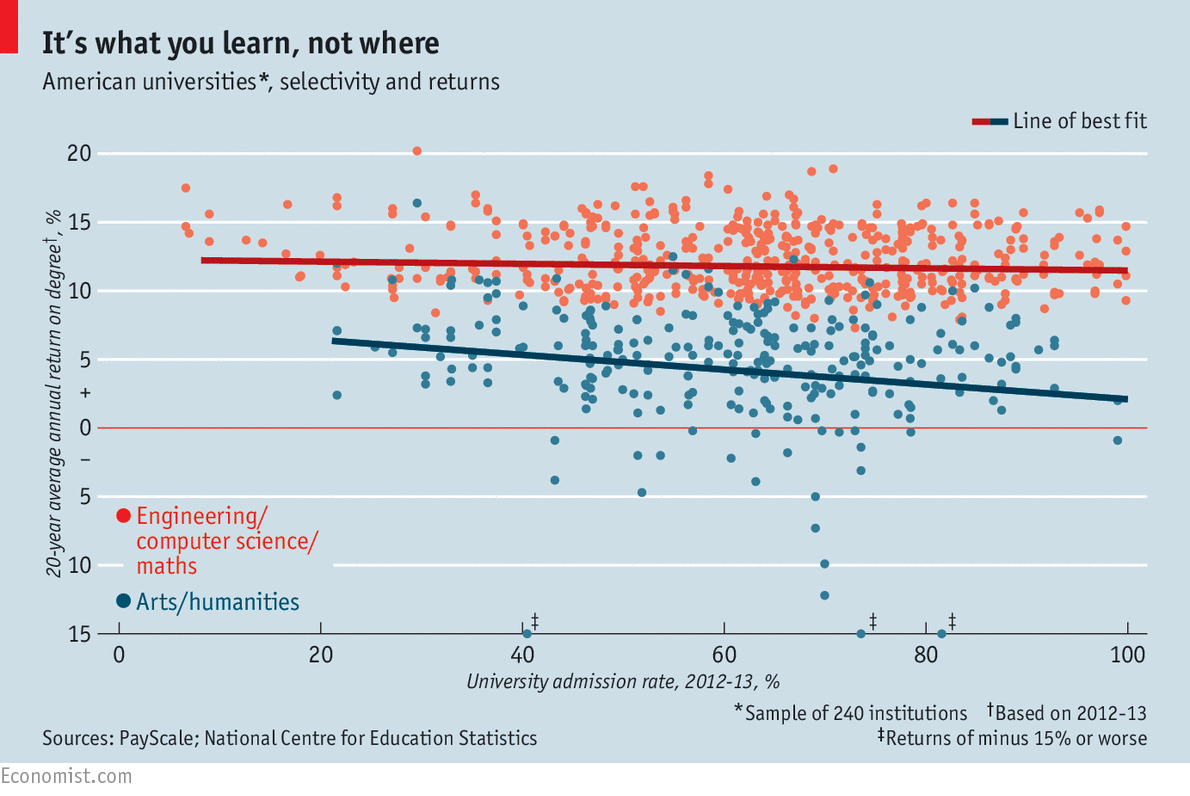
New study: what you study in college matters more than where you go to college

What you study matters more
What you study matters more (click for larger image)

This study was reported by the leftist The Economist.

They write:

A new report from PayScale, a research firm, calculates the returns to a college degree. Its authors compare the career earnings of graduates with the present-day cost of a degree at their alma maters, net of financial aid. College is usually worth it, but not always, it transpires. And what you study matters far more than where you study it.

Engineers and computer scientists do best, earning an impressive 20-year annualised return of 12% on their college fees (the S&P 500 yielded just 7.8%). Engineering graduates from run-of-the-mill colleges do only slightly worse than those from highly selective ones. Business and economics degrees also pay well, delivering a solid 8.7% average return. Courses in the arts or the humanities offer vast spiritual rewards, of course, but less impressive material ones. Some yield negative returns. An arts degree from the Maryland Institute College of Art had a hefty 20-year net negative return of $92,000, for example.

I think if you are looking for a great way to be out of debt before you are 30, it’s a great idea to do your first few years at community college, get rid of all your generic prerequisite courses, then move on to college/university to do your computer science/engineering courses, and then graduate.

Here is the nightmare scenario: you go study a non-stem major at an expensive university, come out with a ton of debt and NO JOB in your field. A much better solution is to go to a less-expensive, less-presitigious school that has a good STEM program in the area you want, and then get in and get out as quickly as possible. Make sure that you either do internships or work in the summer in your field. At this point, you should be willing to pay your employer for letting you work for them, or volunteer – you want to get a company name on your resume, and a name added to your references before you graduate and start looking for a real full-time job. Any pay they give you should be considered a bonus – that’s how important it is to work in your field before graduating. The before-graduation work experience will help you to know what skills are in demand, too – which will improve your course selection. You might even be able to get a mentor from the company you work for to advise you.

The longer you go without working related to your field, the harder it is to be competitive in the job market.  It’s very important to get debt paid off – especially now, because interest rates are going to be rising soon. You definitely want to start investing as soon as possible, so you can use that interest rate in your favor as you head towards retirement. It’s a rocky road ahead with an $18.5 trillion debt, a demographic challenge from the large number of retirees, and the decline of marriage and family. It makes sense to focus on financial issues as early as possible, and have a good plan.

Brookings Institution: a $1.2 billion social program that doesn’t work

This is a surprising article coming from the leftist Brookings Institution.

They write:

Afterschool programs, or out-of-school time programs, burst into view in the late 1990s. The federal government—flush with budget surpluses of hundreds of billions—began spending more on the 21st Century Community Learning Centers (CCLC) program. The program was created by the 1994 Improving America’s Schools Act and had languished as an obscure provision to promote schools as community resources. Initially, the program received no appropriation, until Congress appropriated $40 million for it in 1998.

Spending exploded after the program pivoted to support afterschool programs. By 2002, the program’s appropriation was $1 billion. For a federal program to grow from $40 million to $1 billion in a few years happens rarely. The agency overseeing the program, the U.S. Department of Education, partnered with the Charles Stewart Mott Foundation to underwrite conferences and technical assistance for program providers, pumping millions more into the program.

In 1999, the Department of Education contracted with Mathematica Policy Research to evaluate the 21st Century program. The evaluation had elements that were both rigorous and representative. The elementary school part of the study was designed as an experiment; the middle school part was designed as a random sampling of programs around the country, with students participating in the program matched with students in neighboring schools (or the same school, in rural areas) that were not participating in the program. The evaluation collected data on a wide range of outcomes including grades, test scores, attendance, and behavior.[1]

Ultimately, the evaluation reported on how the program affected outcomes. In a series of reports released between 2003 and 2005 (here, here, and here), the answers emerged: the program didn’t affect student outcomes. Except for student behavior, which got worse. And small samples were not an issue explaining why findings were insignificant. The national evaluation included about 2,300 elementary school students and 4,400 middle school students. The results were insignificant because the estimates of program effects hovered around zero.

In the face of these results, one course of action would have been to at least reduce program spending, if not eliminate the program altogether. The Bush administration proposed a reduction of $400 million in the program budget, advocates rallied to the cause, Arnold Schwarzenegger got involved, and ultimately Congress left program spending unchanged. To this day, the program spends more than a billion dollars each year.

If the national evaluation was thought to be unreliable or errant, a sensible next step would be to do another, possibly with different focuses or features. That hasn’t happened. Or perhaps the evaluation findings were dismissed because other research has shown that afterschool programs are effective. It hasn’t. Echoing a previous 2006 review by Zief, Lauver, and Maynard, a 2015 review of dozens of studies that were published up to 2014 concluded that “mean effects were small and non-significant for attendance and externalizing behaviors.”[2](This is how researchers say the evidence shows that after school programs do not improve attendance or behavior.)

Two other pieces of evidence add to this picture. First, the U.S. Department of Education continues to collect and summarize the program’s annual performance reports (each state reports on its programs to the Department). Its most recent summary noted that ‘nearly all of the performance targets for the 2009-2010 reporting period were not reached.’ Second, a recent federal study of supplemental services programs found no effects on academic outcomes. The study examined programs that are required to be offered by schools that do not meet target levels of adequate yearly progress under No Child Left Behind. They are tutoring and academic support service programs offered outside the regular school day that have a stronger academic focus than the 21st Century programs (which can offer snacks, recreation, and youth development activities), and yet they still did not improve academic outcomes.

I am linking to this because I want people to understand that not every problem has to be solved by the government. It is possible that when politicians tell us that they want to solve a problem by taxing us and spending our money, it’s possible that what they spend our money on does not work. Normally, when it comes to government spending on children,it’s very hard to cut spending because compassionate people do not want to take money away “from the children”. Most Democrat voters do not even realize that money spent by the government either comes from taxation or borrowing from the next generation does not work, it can be very hard to cut funding for those those programs, because the powerful pro-government party has no interest in cutting government spending in any area. They get contributions from people who are very interested in big government.