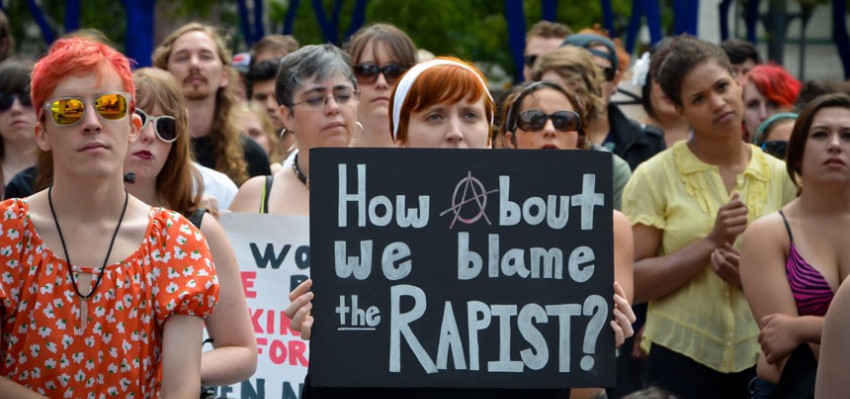
A four-month police investigation into an alleged gang rape at the University of Virginia that Rolling Stone magazine described in graphic detail produced no evidence of the attack and was stymied by the accuser’s unwillingness to cooperate, authorities said Monday.
The article, titled “A rape on campus,” focused on a student identified only as “Jackie” who said she was raped at the Phi Kappa Psi fraternity more than two years earlier.
It described a hidden culture of sexual violence fueled by binge drinking at the college. Police said they found no evidence of that either.
[…][Police chief] Longo said Jackie’s first mention of an alleged assault came without key details, during a meeting she had with a dean about an academic issue in May 2013. The dean brought in police, but the case was dropped because Jackie didn’t want them to investigate, Longo said.
In any case, the “sexual act” she described that year was “not consistent with what was described” in the Rolling Stone article.
Almost immediately, news organizations found discrepancies that prompted the magazine to print an apology.
University of Virginia President Teresa Sullivan asked police to investigate, and they called Jackie in for another interview. She showed up with a lawyer and again refused to talk.
[…]Investigators spoke to about 70 people, including friends of the accuser and fraternity members, and spent hundreds of hours on the investigation, Longo said. None provided any evidence supporting the claim of a gang rape at the Phi Kappa Psi house. They gathered ample evidence casting doubt on Jackie’s claims, he said.
[…]The fraternity called the article defamatory and said it was exploring its legal options.
§ 18.2-209. False publications.
Any person who knowingly and willfully states, delivers or transmits by any means whatever to any publisher, or employee of a publisher, of any newspaper, magazine, or other publication or to any owner, or employee of an owner, of any radio station, television station, news service or cable service, any false and untrue statement, knowing the same to be false or untrue, concerning any person or corporation, with intent that the same shall be published, broadcast or otherwise disseminated, shall be guilty of a Class 3 misdemeanor.
Code 1950, § 18.1-407; 1960, c. 358; 1975, cc. 14, 15; 1978, c. 359.
I blogged previously on the three UVA students who challenged the original Rolling Stone story.
reason: Clarify what’s the difference between a legitimate gripe and whining?
Paglia: Well, in my point of view, no college administration should be taking any interest whatever in the social lives of the students. None! If a crime’s committed on campus, it should always be reported to the police. I absolutely do not agree with any committees investigating any charge of sexual assault. Either it’s a real crime, or it’s not a real crime. Get the hell out. So you get this expansion of the campus bureaucracy with this Stalinist oversight. But the students have been raised with helicopter parents. They want it. The students of today—they’re utterly uninformed, not necessarily at my school, the art school, I’m talking about the elite schools.
reason: So it’s those kids over at that other school.
Paglia: It’s the grade grubbers, the bright overachievers. I’m not at that kind of school [here at University of the Arts in Philadelphia] . I’m at a school of arts and communication where people already have a vocational trend. To be admitted here, you have to already have demonstrated a vocational aptitude. I’m talking about the Ivy League. Now, I’ve encountered these graduates of Harvard, Yale, the University of Pennsylvania, and Princeton, I’ve encountered them in the media, and people in their 30s now, some of them, their minds are like Jell-O. They know nothing! They’ve not been trained in history. They have absolutely no structure to their minds. Their emotions are unfixed. The banality of contemporary cultural criticism, of academe, the absolute collapse of any kind of intellectual discourse in the U.S. is the result of these colleges, which should have been the best, have produced the finest minds, instead having retracted into caretaking. The whole thing is about approved social positions in a kind of misty, love of humanity without any direct knowledge of history or economics or anthropology.
reason: Maybe the university is not the place where that sort of stuff is happening anymore. So, for instance, you have think tanks that do a lot of economic or policy work. You have popular historians who are not academic. Fiction and poetry, even as there’s been a rise in for decades now of creative writing programs and what not. Nobody looks to the university to be cutting edge on almost anything really, so maybe it’s just that you picked the wrong hors. Maybe you should have followed the campus radicals’ suggestion and not gone into academia?
Paglia: [As a] writer of cultural criticism, I find that I’m happiest when I’m writing for the British press, and I write quite a bit for The Sunday Times magazine in London. I find that the general sense of cultural awareness means that I can have an authentic discourse about ideas with international journalists from Brazil or Germany or Italy or Norway or Canada even—somewhat, but they have a P.C. problem themselves. I can feel the vacuum and the nothingness of American cultural criticism at the present time. It is impossible—any journalist today, an American journalist, you cannot have any kind of deep discussion of ideas.
The students at the Ivy league universities are so insulated from “vocation” (working for money) and so indoctrinated in political correctness, that they cannot have a civil conversation about ideas. All they can do is state their own views, and if you disagree with them, then they call you names then retreat to “safe spaces”, where all unpleasant communication is blocked . They can’t even explain why they hold their own views except they have been taught to believe that all smart people believe them. They are traumatized by dissent, and they are not able to critically assess arguments and evidence.
Here’s a second article by Eleanor Taylor writing in the ultra-leftist New York Times.
She writes:
KATHERINE BYRON, a senior at Brown University and a member of its Sexual Assault Task Force, considers it her duty to make Brown a safe place for rape victims, free from anything that might prompt memories of trauma.
So when she heard last fall that a student group had organized a debate about campus sexual assault between Jessica Valenti, the founder of feministing.com, and Wendy McElroy, a libertarian, and that Ms. McElroy was likely to criticize the term “rape culture,” Ms. Byron was alarmed. “Bringing in a speaker like that could serve to invalidate people’s experiences,” she told me. It could be “damaging.”
Ms. Byron and some fellow task force members secured a meeting with administrators. Not long after, Brown’s president, Christina H. Paxson, announced that the university would hold a simultaneous, competing talk to provide “research and facts” about “the role of culture in sexual assault.” Meanwhile, student volunteers put up posters advertising that a “safe space” would be available for anyone who found the debate too upsetting.
The safe space, Ms. Byron explained, was intended to give people who might find comments “troubling” or “triggering,” a place to recuperate. The room was equipped with cookies, coloring books, bubbles, Play-Doh, calming music, pillows, blankets and a video of frolicking puppies, as well as students and staff members trained to deal with trauma. Emma Hall, a junior, rape survivor and “sexual assault peer educator” who helped set up the room and worked in it during the debate, estimates that a couple of dozen people used it. At one point she went to the lecture hall — it was packed — but after a while, she had to return to the safe space. “I was feeling bombarded by a lot of viewpoints that really go against my dearly and closely held beliefs,” Ms. Hall said.
Safe spaces are an expression of the conviction, increasingly prevalent among college students, that their schools should keep them from being “bombarded” by discomfiting or distressing viewpoints. Think of the safe space as the live-action version of the better-known trigger warning, a notice put on top of a syllabus or an assigned reading to alert students to the presence of potentially disturbing material.
I have had the opportunity to interact with people who went through the college system in non-STEM programs. The combination of binge-drinking, hooking-up, co-habitating, and indoctrination in secular leftist ideologies like feminism, postmodernism, moral relativism really seems to break down their ability to reason calmly with someone who disagrees with them. They become very brittle and defensive when their indoctrinated views are confronted with critical thinking. I think the indoctrinated views were accepted largely because of emotions, intuitions and peer-pressure, so any kind of questioning using reason, evidence, wisdom and experience are met with this fight-or-flight response. People who are wiser and more experienced aren’t allowed to speak in the “safe space”.
There are two ways I see this playing out. On the one hand, any attempt to lead the thinking of an indoctrinated person is going to be met with insults. For example, trying to teach basic economics is going to be called “manipulation”. Or, trying to tell them to that they have an obligation to behave a certain way towards others is going to be dismissed because others have to take “personal responsibility”. These are just smokescreens that cover the fact that indoctrinated millenials cannot be reasoned with, cannot be led, cannot be told to do the right thing. When challenged, they block all communication and retreat to a “safe space” where their similarly indoctrinated friends are there to reassure them. Unfortunately for them, reality has a way of breaking through the illusions in the long run.
The Obama administration’s calculated gamble during the past three years in Yemen has crumbled in recent days, leaving the country on the brink of a civil war with U.S. troops involved in counterterror operations withdrawing amid intense fighting.
What happened in Yemen, according to descriptions by current and former officials and experts, was a miscalculation about the changes unleashed by the Arab Spring revolutions. It involved an overreliance by Washington on a promising new leader who ultimately was unable to hold off rival forces and tensions, they said.
As a result, a country President Barack Obama last year cited as a model of American counterterrorism success has now descended into chaos, with U.S. influence and drone strikes no match for at least four sides at war with one another.
“In many ways, this is all the Thanksgiving Dinner from hell,” said Jon Alterman, a former State Department official and director of the Middle East program at the Center for Strategic and International Studies. “It is people who have been dealing with each other for a long time, none are satisfied, and the fight has broken out. And the first thing is figuring out who the different sides are.”
The U.S. and allies such as Yemen’s neighbor Saudi Arabia had tried to take advantage of the Arab Spring revolution in Yemen in 2011. They supported a new, friendly regime led by President Abed Rabbo Mansour Hadi.
The White House hailed Mr. Hadi’s leadership and—with his cooperation—carried out dozens of drone strikes against the country’s al Qaeda offshoot. Meanwhile, they collected intelligence and training Yemeni forces to battle the terrorist group al Qaeda in the Arabian Peninsula, or AQAP.
But the Obama administration limited its involvement with others in Yemen, and was largely removed from numerous tribal leaders and the rising rebel group known as the Houthis, according to former U.S. officials and foreign policy experts. The success of the White House’s involvement with Yemen relied largely on Mr. Hadi staying in power, they said, adding that the White House had few alternatives. That is why the U.S. approach was upended last month when Shiite-linked Houthi rebels, believed to be backed by Iran, seized control of Yemen’s capital and forced Mr. Hadi to flee. Forces loyal to Mr. Hadi are now warring against the Houthis, and U.S. officials believe, against his predecessor, Ali Abdullah Saleh.
The Yemeni president has asked Gulf countries to intervene militarily against the Houthis as they advance toward his base in the southern city of Aden, according to Saudi media reports quoting Mr. Hadi’s foreign minister. Over the past few days, the Houthis have been advancing southward into the major southern city of Taiz, where they have encountered resistance and large street protests against them. Houthi gunmen fired live ammunition and tear gas on Monday into crowds of demonstrators in the city, wounding at least seven people. Meanwhile, militants claiming allegiance to Islamic State carried out dramatic suicide attacks in an area that had traditionally been the safe haven for rival AQAP, which some believe could trigger competitive jihadist attacks.
The Houthis had already taken over the airport and some government buildings in Taiz and erected checkpoints in the southern city when the violence flared, said local government officials and protest organizers, who reported the casualties.
[…]Before political chaos erupted earlier this year, the U.S. had everything invested in Mr. Hadi. Central Intelligence Agency Director John Brennan was a key liaison to the country when he served as a top White House counterterrorism aide in the first years of the Obama administration. His replacement, Lisa Monaco, had kept in constant contact with Mr. Hadi since then.
In September, President Obama hailed Yemen as a success story in its counterterrorism approach, saying the country’s aggressive pursuit of terrorists would prevent the spread of Islamic State.
Look at the stupidity of Samantha Power:
Samantha Power, the U.S. ambassador to the United Nations, said Sunday that all parties in Yemen should agree to U.N.-backed negotiations and “refrain from any further unilateral and offensive military actions.”
“We are supporting all the right [United Nations] resolutions, but most of the people in Yemen could care a flying fig for a U.N. resolution,” said Barbara Bodine, who was U.S. Ambassador to Yemen at the time of the USS Cole attack.
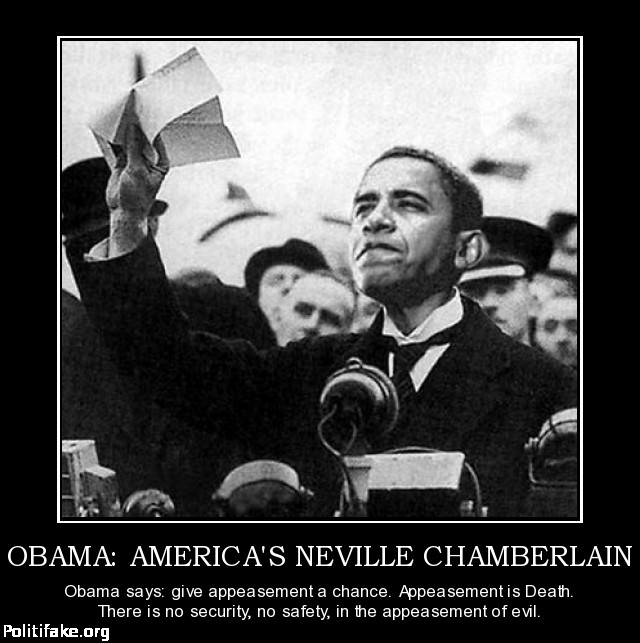
The Obama administration simply cannot take evil seriously – they keep thinking that everyone in the world is like them, and it’s killing our foreign policy. Obama keeps making promises that him and his party of amateurs and academics cannot keep.
Neville Chamberlain Obama: peace in our time
If you like your doctor, you can keep your doctor. If you like your health plan, you can keep your health plan. If you like your IRS e-mails, you can keep your IRS e-mails. If you like your Tea Party charitable status, you can keep your Tea Party charitable status. If you like your Ukraine, you can keep your Ukraine. If you like your traditional marriage, you can keep your traditional marriage. If you like your State Department transparency, you can keep your State Department transparency. If you like your European missile defense, you can keep your European missile defense. If you like your 12 carrier strike groups, you can keep your 12 carrier strike groups. If you like your full-time work week, you can keep your full-time work week. If you like your health care for veterans, you can keep your health care for veterans. If you like your $8 trillion dollar debt, you can keep your $8 trillion dollar debt. If you like your coal plant, you can keep your coal plant. If you like your race relations, you can keep your race relations. If you like your freedom to not buy others abortion drugs, you can keep your freedom to not buy others abortion drugs. If you like your F-22 stealth fighter, you can keep your F-22 stealth fighter. If you like your Israel, you can keep your Israel.
We can fix the spending, we can fix the laws, we can fix the fraud, we can fix the corruption, we can repeal Obamacare… but the foreign policy blunders will be very, very hard to fix.


 WINTERY KNIGHT