Virginia shooter background includes gay rights activism and anti-white racism

Let’s just pull up some quotations from mainstream news sources and learn about what the Virginia reporter shooter believed.

First, the UK Telegraph on the shooter’s home.

Gay pride flag and sex toys:

[…]In a raid on the apartment on Wednesday, police reportedly confiscated a gay pride flag. They also found “many” sex toys, which may have “human material” on them, the source told this newspaper.

Victim mindset and gay prostitution:

In a “suicide note” sent to ABC news, Flanagan said he was discriminated against in life for being gay and said he had sometimes worked as an escort for money.

Here’s another UK Telegraph article.

His motive was revenge against whites:

In a 23-page document faxed to ABC News two hours after the shooting,Flanagan apparently said that the Charleston shooting in June of nine black people was his “tipping point”.
He said the church shooting by racist Dylann Roof in South Carolina “sent me over the top”, after which he immediately bought a gun.

“Why did I do it? I put down a deposit for a gun on 6/19/15. The Church shooting in Charleston happened on 6/17/15,” he wrote.

“What sent me over the top was the church shooting,” he wrote. “And my hollow point bullets have the victims’ initials on them.”

“As for Dylann Roof? You —-! You want a race war —-? BRING IT THEN YOU WHITE —-!!!”

Why was Alison his target?

On his Twitter account, which has since been suspended, he wrote after the shooting that “Alison made racist comments” and “Adam went to (human resources) on me after working with me one time!!!”

And, of course, he is a Democrat:

He was also apparently reprimanded for wearing a sticker supporting President Barack Obama while reporting on the 2012 US presidential election.

And his Twitter feed confirms his frustration with the lack of punishment for Alison’s “racism”:

Alison made
Alison made “racist” comments, he says

I had to go to the UK mainstream media to get the full story – the US mainstream media isn’t reporting a thing. Why?

PJ Media reports that ABC News still has not released the full text of his 23-page manifesto.

The same article mentions that CBS News is covering up his anti-white racist motives:

A CBS report never mentioned the shooter’s racial comments at all. The piece did tiptoe around the shooter’s problems with race in two paragraphs, but never actually stated his race rhetoric seen in the explicit terms revealed in his manifesto.

Then, a piece in the Chicago Tribune called the killer “off kilter” and “bizarre” but steered clear of fully reporting on his racist ideas.

One reporter, The Washington Post’s Dave Weigel, even took to Twitter to wring his hands over the reporting of Flanagan’s racist manifesto, saying to Breitbart’s John Nolte, “Do you worry at all that the ‘race war’ story does what the killer wanted?”

To be sure, Weigel was far less worried about stirring racial strife when he wrote a Bloomberg piece dissecting the racial motives of Charleston killer Dylann Roof.

I wonder why the media is covering up for him? Could it be that they basically agree with his values and motives straight down the line?

By the way, you probably hadn’t heard about this, but the driver of the Amtrak train was a gay rights activist, and he also felt that he was a victim of discrimination.

Excerpt:

[Brandon] Bostian is a gay-rights activist who previously lived in San Francisco before moving to New York. In 2012, he was interviewed by the Midtown Gazette, which covers parts of Manhattan, during the campaign for marriage equality.

He said: ‘It’s kind of insulting to have to beg people for my right to marry. I feel like we shouldn’t even have to have this fight.’

You probably had no idea. That’s how the mainstream media works.

Related posts

Does reading science fiction predispose people to atheism?

A conflict of worldviews

My friend ECM thinks that science fiction that people read when they are younger causes them to believe that the religion is anti-science and that the progress of science always disproves religion. The stories they read colors their views of science and religion for life, before they ever get to assessing evidence. And that’s why when we produce evidence for them in debates, they will believe in speculations rather than go where the evidence leads. So they believe that maybe unobservable aliens caused the origin of life, and that maybe the untestable multiverse theory explains the fine-tuning of cosmological constants, and that maybe this universe has existed eternally despite the well-supported Big Bang theory which shows that the universe began to exist. Maybe, maybe, maybe. They seem to think that untestable speculations are “good enough” to refute observational evidence – and maybe it’s because of all the science fiction that they’ve read.

Here’s an article in the American Spectator that talks a bit about it.

Excerpt:

A magazine I frequently write for (not this one) recently published a review of a book of essays advocating atheism. The reviewer pointed out with some enthusiasm that a large number of the contributors were science-fiction writers.

This left me somewhat nonplussed. I publish a good deal of science fiction myself, I have also read quite a lot of it, and I am quite unable to see why writing it should be held to particularly qualify anyone to answer the question of whether or not there is a God.

[…]Historically the contribution of the Catholic Church to astronomy was massive and unequalled. Without it astronomy might very well never have grown out of astrology at all. Cathedrals in Bologna, Florence, Paris, Rome and elsewhere were designed in the 17th and 18th centuries to function as solar observatories. Kepler was assisted by a number of Jesuit astronomers, including Father Paul Guldin and Father Zucchi, and by Giovanni Cassini, who had studied under Jesuits. Cassini and Jesuit colleagues were eventually able to confirm Kepler’s theory on the Earth having an elliptical orbit. J.L. Heilbron of the University of California has written:

The Roman Catholic Church gave more financial aid and social support to the study of astronomy over six centuries, from the recovery of ancient learning during the late Middle Ages into the Enlightenment, than any other, and, probably, all other, institutions.

Science fiction is, by definition, fiction, that is, it deals with things which are the product of a writer’s imagination and are not literally true. In any event, what is and what is not science fiction is hard to define. Simply to say it is about science is meaningless, and while some science-fiction writers are qualified scientists, many are not. Probably even fewer are trained theologians.

Science fiction makes the mysteries of the universe seem easy to an atheist. Everything can be easily explained with fictional future discoveries. Their speculations about aliens, global warming and eternal universes are believed without evidence because atheists want and need to believe in those speculations. In the world of science fiction, the fictional characters can be “moral” and “intelligent” without having to bring God or the evidence for God into the picture. That’s very attractive to an atheist who wants the feeling of being intelligent and moral without having to weight actual scientific evidence or ground their moral values and behavior rationally. The science fiction myths are what atheists want to believe. It’s a placebo at the worldview level. They don’t want cosmic microwave background radiation – they want warp drives. They don’t want WMAP satellite confirmation of nucleosynthesis – they want holodecks.

Why do people become atheists?

My theory is mainly that atheists adopt atheism because they want pleasure, especially sexual pleasure, without any restraints or guilt. They want to believe that sex without commitment has no consequences, especially a consequence like God judging them for it. Another contributing factor may be that atheists want to be thought of as smart by “the right people” – to sort of blindly accept whatever the “smart people” accept without really searching out reasons or dissenting views. They do this so that they are able to look down at some other group of people so they can feel better about themselves and be part of the right group – without actually having to weigh the evidence on both sides. And lastly, atheism may also be caused by weak fathers or abandoning fathers. But I think that ECM’s science fiction theory has merit, as well. I think that all four of these factors help to explain why atheists believe in a discredited worldview in the teeth of scientific progress.

I wonder if my readers would take some time out to investigate whether their atheist friends have been influenced by reading science fiction and whether they still read it.

In Ohio, faithful Jews and Christians can no longer serve as judges

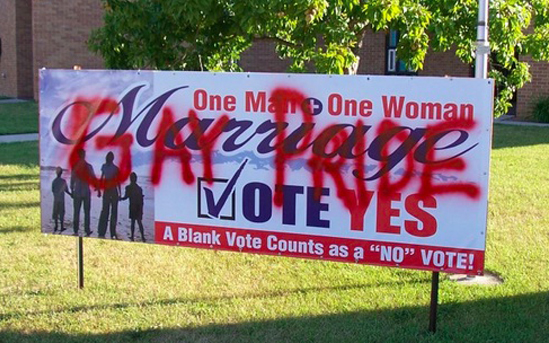
Gay activist vandalizes pro-marriage sign

For the past few decades, we have been able to see what happens when the Christian church decides that piety and feelings are more important than truth and evidence. Gradually, pastors decided to eliminate any discussion of apologetics as well as any integration between the Christian worldview and other areas of knowledge, e.g. – economics, politics, science. What were the consequences of this emotionalization of Christianity? Well, we basically handed the commanding heights of the culture to the secular left – including furnishing them with new soldiers from our own pious families.

Consider this article in The Stream about a recent decision by the Ohio Supreme Court.

It says:

The court’s Board of Professional Conduct was responding to a request submitted by several lawyers and judges, including C. Allen McConnell, a municipal court Judge whose predicament we addressedin “The ‘Soft’ Beginning of the Post-Obergefell Persecution.”

Judge McConnell said that as a Christian, he could not officiate at same-sex weddings. The Board of Professional Conduct of the Ohio Supreme Court said he must. In other words: Christians, check your faith at the bench or you may not serve as a judge in the state of Ohio.

It is helpful to go through the board’s opinion because it reveals how they will treat complaints filed against judges in the future. If a judge is the subject of a complaint filed by a lawyer, fellow judge or member of the public, the board reviews the complaint. They will apply the strained analysis of this opinion in determining whether to sanction, suspend or remove the judge from the bench.

In Ohio, judges are elected by the people, at every level, municipal, circuit court, appeals court or state Supreme Court. In many other states they are appointed. Where they are appointed there are growing efforts to weed out Christians. This advisory opinion presents a new way of removing Christians from the bench after the people have elected them to office.

In this seven-page opinion the Board claimed that there is a “self-evident principle that the personal, moral and religious beliefs of a judicial officer should never factor into the performance of any judicial duty.” In other words, Christians must check their faith at the bench if they serve as a judge in the state of Ohio.

So what we have now is a kind of “religious test” for judges. If you are a devout Christian or a devout Jew, then you can’t be a judge in Ohio. Only people reject the Judeo-Christian ethics that founded this country can be judges.

So, if we go back 50 years, what were the churches doing to stop this? Were they educating people in apologetics? Were they encouraging people to stay married? Were they educating people about feminism, the sexual revolution and no-fault divorce? Were they paying attention to cosmology and fine-tuning discoveries and making them known to the flock? Were they teaching people about how to think Christianly about economics, foreign policy, free enterprise, and so on? Were they steering young people towards areas that are related to apologetics? Were they steering young people towards careers that would place them in positions of influence? No. We had other priorities – making people feel good, and avoid controversy and conflict.

Brett Kunkle, who works for Stand to Reason, posted an interesting commentary that I tweeted earlier this week. He talks about grilling a bunch of Christian parents by pretending to be an atheist professor.

He writes this:

There was no surprise factor. The parents knew who I was and the Christian organization I represented. Indeed, I told the audience what I was about to do, turned my back on them for just a moment, and then turned round again in full atheist character. I jumped into my role and they jumped into theirs, attempting to defend the faith against atheist professor “Dr. Kunkle.” Sadly, they were ill-equipped to handle my challenges. I was glad to see their fighting spirit, but their responses were only vigorous in style, not substance. After half an hour, many parents were exasperated and I ended the role-play.

“How was that for you?” I asked. “Extremely frustrating,” was the immediate parental consensus.

“Why was it so frustrating?” I pressed. One mom blurted out, “Because I didn’t have any good answers.” As soon as the words left her mouth, tears began streaming down her cheeks. It was a painful recognition of her own inadequacy and she knew what was at stake. As I glanced around the room, other parents were nodding in agreement, eyes moist with their own tears.

Caught off guard, I began to tear up, too. I felt such compassion for these good-hearted yet unequipped parents. Quickly gathering my emotions, I looked that mom in the eyes and gently replied, “I know exactly how you feel. I felt that way, too, when Dr. David Lane was dismantling my Christianity in front of my peers, in my college philosophy class.” I told the parents my story and encouraged them to prepare themselves so, in turn, they can prepare their own kids.

Afterward, parent after parent thanked me. They expressed their deep appreciation for the wake-up call, despite the accompanying painful realizations. And the mom who burst into tears? She walked up and gave me a big hug. Then she shared how her 21-year-old son, a student at Duke University, had turned his back on Christ while at college. She was convicted to begin a dialogue with him, as well as with her second son, a junior at Village Academy. I encouraged her, shared some resources, and gave her my email address with an open invitation to contact me anytime.

Christian parents: we need to do what it takes so that OUR sons and daughters get on the Ohio Supreme Court. We need to be the ones making these decisions, not the people on the secular left. If you send your kid off to Duke University unprepared, you’re not doing a good job at parenting.