Note that this talk is given by a very conservative evangelical Christian who is speaking to Christians. So this is not intended for a non-Christian audience. However, non-Christians are free to tune in if you want to hear a really passionate, fire-breathing conservative evangelical go non-linear over the superficial turn that the evangelical church has taken. If you are familiar with J.P. Moreland’s view that spiritual warfare is really about disputing speculations and falsehoods using logic and evidence, then you’ll know the meaning of the term “spiritual warfare” he has in mind. When he says spiritual warfare, he means apologetics: knowledge and preparation.
I would really caution you not to listen to this if you are not passionate about defending God’s honor. It will overwhelm and upset you. Having said that, this lecture reflects my convictions about the churches need to drop anti-intellectualism and take up apologetics. And not pre-suppositional apologetics, which I think is ineffective, but evidential apologetics. Evidential apologetics is effective, which is why everyone in the Bible used it.
Simon Brace is the Director of Evangelism of Southern Evangelical Seminary. Simon was born in Zimbabwe and grew up in South Africa. Simon has a construction background and has lived in a number of countries and travelled extensively. He has a MA in Apologetics and BA in Religious Studies and is currently working on an MA in Philosophy at SES. Simon leads TEAM which is the missions program of SES on local, national, and international trips. In addition, Simon has worked with Ratio Christi at SES, and has an extensive knowledge of Ratio Christi’s history and operation. Simon currently resides in North Carolina with his wife Nel and children, Eva and Olivia.
I liked the second part of the lecture more than the first part, so there is less summarizing of the first part.
Topics:
What does the New Testament say about spiritual warfare in Ephesians?
Christian slogans about spiritual warfare sound pious, but they are mistaken
Today, Christianity is focused on piety and zeal, not on study and knowledge
The result is that Christianity in the West is in a state of erosion and decline
What we are doing about spiritual warfare is not working to stop the decline
Preaching, publishing, programs, retreats, etc. are not very useful for spiritual warfare
Enthusiasm and passion without knowledge are not very useful for spiritual warfare
The Church has a theoretical understanding of spiritual warfare, but no real capability
Doesn’t work: trying to make Christianity seem popular and cool
Doesn’t work: making Christian music and art that non-Christians will like
Doesn’t work: pastors trying to be relevant by having cool clothes and cool haircuts
Doesn’t work: fundamentalists getting angry about peripheral issues
Doesn’t work: not read things apart from the Bible and sound foolish when speaking in the public square
Doesn’t work: church leaders think that careful exegesis and expository preaching is a good answer to skeptics
What works: we need to train people who are prepared and willing to defend the truth of the Christian faith
Evangelicalism has a deep suspicion of reading things outside the Bible, so they are unable to refute anything
Evangelicals are hyper-spiritualized and hysterical, focusing on demons, prophecy and end-times, etc.
Evangelicals have a pagan view of using their minds to alter reality, which is irrational and superstitious
Evangelicals like conservative celebrity preachers who do nothing to correct anti-intellectualism in the church
Evangelicals are focused on their personal relationships with Jesus instead of their whole worldview
Evangelicals focus too much on homeschooling and not enough on how to impact the secular universities
Church programs for youth are about “strumming guitars and eating pizza once a week”, not apologetics
Evangelicals have an over-inflated view of the effectiveness of their (non-intellectual) evangelism methods
The primary focus and primary responsibility in spiritual warfare is not dealing with supernatural evil
The real focus and responsibility in spiritual warfare is specified in 2 Cor 10:3-5
What we ought to be doing is defeating speculations (false ideas), using logical arguments and evidence
Defending the faith is not memorizing Bible verses and throwing them out randomly
Defending the faith is not just preaching the gospel
Demolishing an argument requires understanding arguments: premises, conclusions, the laws of logic
We should exchange our pious Bible memorizing skills and the like for a class in critical thinking
The New Testament requires that elders be capable of refuting those who oppose sound doctrine (Titus 1:9)
It is not enough to preach a good sermon, elders have to be able to defend the Christian faith as well
People who run conservative seminaries do not mandate that M.Div graduates study apologetics
Famous pastors like Driscoll, Begg, etc. need to teach other pastors to emphasize apologetics in church
People in church won’t engage the culture unless they have reasons and evidence to believe Christianity is true
We need a balance of both piety and intellectual engagement
We need to make our evangelism rooted in the intellect in order to have an influence at the university
Mission organizations also have a responsibility to defend the faith and not merely preach (1 Peter 3:15)
And here is his closing quote from C.S. Lewis:
To be ignorant and simple now not to be able to meet the enemies on their own ground would be to throw down our weapons and to betray our uneducated brethren who have, under God, no defense but us against the intellectual attacks of the heathen. Good philosophy must exist, if for no other reason, because bad philosophy needs to be answered.
I was really humbled by this, because I sort of knew that the church was anti-intellectual, but I didn’t really reflect on how everyone else in society thinks that we are anti-intellectual. It’s troubling. The quickest way to make Biblical Christianity respectable again is to hit the books and defeat all comers in intellectual disputations. Are we ready to make the sacrifices to do that?.
Dr. Graham Oppy, the moderator, is a well-known atheist philosopher. He let Dr. Krauss speak for 21 minutes and 40 seconds, which is why my summary of Krauss is so long.
The video:
Summary
After careful consideration, I decided not to be snarky at all in this summary. What you read below is what happened. There may be some small mistakes, but I will fix those if people tell me about them. I also included some quotes and timestamps for the more striking things that Dr. Krauss said.
The debate itself starts at 4:50 with Dr. Craig’s opening speech. He does use slides to show the structure of his arguments.
Dr. Craig’s opening speech. (4:50)
The kalam cosmological argument:
God is the best explanation of the origin of the universe
The Borde Guth Vilenkin theorem supports the absolute beginning of the universe
Even if our universe is part of a multiverse, the multiverse itself would have to have an absolute beginning
Speculative cosmologies try to challenge the Big Bang theory, but none of them – even if true – can establish that the past is eternal
Only two types of things could explain the origin of spece, time, matter and energy – either abstract objects or minds
Abstract objects do not cause effects, but minds do cause effects (we do it ourselves)
A mind is the best explanation for the origin of the universe
The unreasonable effectiveness of mathematics:
The underlying structure of nature is mathematical – mathematics is applicable to nature
Mathematical objects can either be abstract objects or useful fiction
Either way, there is no reason to expect that nature should be linked to abstract objects or fictions
But a divine mind that wants humans to understand nature is a better explanation for what we see
The cosmic fine-tuning for the existence of intelligent life
There are two kinds of finely-tuned initial conditions: 1) cosmological constants and 2) quantities
These constants and quantities have to be set within a narrow range in order to permit intelligent life
There are three explanations for this observation: law, chance or design
Law is rejected because they are put in at the beginning or matter – they don’t emerge from matter
Chance must be rejected, because they odds are just too long unless you appeal to a world-ensemble
We do not observe what the world ensemble hypothesis predicts that we should observe
Design is the best explanation for finely-tuned constants and quantities
The existence of objective moral values and duties
Our experience of morality (values and duties) is that it is objectively real and incumbent on us
When someone goes into a classroom and shoots at innocent children, that is objectively wrong
On naturalism, moral values and moral duties do not exist – they are conventional and variable by time and place
The best explanation for the existence of objective moral values and duties is that God exists
The historicity of the resurrection of Jesus
There are three widely-accepted facts that are best explained by the resurrection hypothesis
1) the empty tomb, 2) the post-mortem appearances, 3) the early church’s belief in the resurrection
Naturalistic attempts to explain these 3 boilerplate facts fail
The best explanation of the 3 minimal facts is that God raised Jesus from the dead
The immediate experience of God
Belief in God is a “properly basic” belief – rational even without arguments because of experience of God
Seems to be saying that logical arguments can prove false things “it’s nonsense”
Dr. Craig distorted a podcast that some group made on pain receptors
Dr. Craig’s faith is so strong that it causes him to distort what this group said
Discussion: (44:35)
I will not be summarizing everything that was said, just a few main points.
The segment from 52:18 to 57:12 about the Vilenkin e-mail on the BVG theorem is a must-see. Krauss is standing up and gesticulating while Craig is calmly trying to quote a paper by Vilenkin that shows that Krauss is misrepresenting Vilenkin. Krauss constantly interrupts him. After a while, when Craig exposes him as having misrepresented Vilenkin and gets him to admit that all current eternal models of the universe are probably wrong, he quietens down and can’t even look at Craig in the face.
Cosmological argument:
Craig: The e-mail says any universe that is expanding, on average, requires a beginning
Craig: There are two models – Aguirre & Gratton and Carroll & Chen – where there is a period of contraction before the expansion
Craig: The two models are the ones cited in the e-mail that Dr. Krauss showed
Craig: In the very paper by Vilenkin that I cited, he says that both of those models don’t work
Krauss: (agitated and interrupting) Vilenkin said that they have to make an assumption about entropy that they have no rationale for
(as Craig starts to talk Krauss makes an exaggerated, disrespectful gesture and sits down in a huff)
Craig: Yes, an unwarranted assumption means that they don’t have EVIDENCE for their theories being correct
Krauss: (agitated and interrupting) “All the evidence suggests that the universe had a beginning but WE DON’T KNOW!!!!!!!” (raising his voice)
Craig: I’m not saying that we know that the universe had a beginning with certainty
Craig: I am saying that the beginning of the universe is more probably true than false based on the evidence we have
Craig: And you agree with me about that – you think the universe had a beginning
Krauss: (agitated and interrupting) (Unintelligible)
Moderator: One at a time
Craig: In your Vilenkin e-mail slide, at the end of the paragraph where the two models are mentioned that Vilenkin specifically shows…
(I am guessing that Craig is going to ask why so much of what Vilenkin wrote has been cut out of the e-mail that Krauss showed)
Krauss: (agitated and interrupting) Because it was technical…
Moderator: Lawrence! Hang on a sec!
Craig: He specifically shows that these models are not past eternal, and that they require a beginning just like the others…
Krauss: (agitated and interrupting) We can do the math if you want
Craig: Now wait. I couldn’t help notice that there on your slide there was a series of ellipsis points indicating missing text…
Krauss: (agitated and interrupting) “Yeah, because it was technical!”
Craig: “I wonder what you deleted from the original letter”
Krauss: (agitated and interrupting) “I just told you!”
Craig: “Now wait. Could it have been something like this: (reads a quote from Vilenkin) ‘You can evade the theorem by postulating that the universe was contracting prior to some time. This sounds as if there is nothing wrong with having contraction prior to expansion. But the problem is that a contracting universe is highly unstable. Small perturbations would cause it to develop all sorts of messy singularities, so it would never make it to the expanding phase.’
Craig: “That’s Vilenkin.”
Krauss: “In this paper, that’s absolutely right”
Krauss: But it’s ok for theories to assume things that we know are wrong – they are still good theories – it’s unknown
(Craig turns away and looks through his papers)
Craig: “Isn’t it true that the only viable quantum gravity models on order today involve a beginning – have a finite past?”
Krauss: “No”
Craig: “Well, can you give us one then”
Krauss: (talks about a variety of possible eternal models) “In my experience in science, all of them are probably wrong”
Krauss: “You know most theories are wrong, which is why, you know, it’s hard”
Craig: “Right”
I noticed that a huge number of atheist web sites are taking the Vilenkin quote that Krauss used out of context, like this one and this one. There are probably a lot more of them like that, which I think is interesting. That’s why we have these debates, I guess. To set the record straight about who accuses people of being dishonest, and who is actually dishonest.
Fine-tuning:
Krauss tried to argue that he had explained the fine-tuning with the Higgs particle, but Dr. Craig said that only applied to the cosmological constant, not all the other examples of fine-tuning. Krauss said that it wasn’t impressive that this universe permitted life and that “It would have been much more surprising if we evolved in a universe in which we couldn’t live”. Krauss argued the fine-tuning was only for “Life like us”. But Dr. Craig explained that the fine-tuning is what allows us to have the basics of any kind of life, like slow-burning stars, chemical diversity, etc. – things that are required for basic minimal life functions in any living system. Craig said that he was working with the current physical laws of this universe (F = ma, etc.) and that he was looking at what changed if we changed those even slightly. Krauss tried to say that if he changed things like the mass of particles then the strength of forces would change. (But the forces aren’t laws!) Krauss argued that the cosmological constant would be even better for life if it was zero, and Craig said that the life permitting range did include zero, but that the range of life-permitting values was narrow.
Jesus’ existence:
Craig reponded to the mystery religions charge, the charge that the evidence for the minimal facts is too late/too weak, the charge that grief visions explained the evidence better, and Hume’s argument against miracles. Craig brought up the early creed from 1 Cor 15:3-7 and explained to Krauss that it was 5 years after the events, and that Jewish standards of oral transmission were strong enough to ensure that the creed was reliable, and most of the eyewitnesses would still have been alive.
Audience Q and A: (1:21:09)
The first topic is the grounding of morality. Krauss agrees that there is no objective morality and no objective moral oughts. He also said that that standards of behavior are arbitrary, and that they change over time and they are adopted for promoting social order. Dr. Craig pressed the point that science itself would collapse without ethical values. It assumes them, but cannot ground them.
The next topic was free will. Krauss is a determinist. Craig asked him how he could reconcile moral responsibility with determinism.
The next topic was the effectiveness of mathematics. Krauss didn’t have an explanation for it and didn’t think it needed one. Then they got into whether the Genesis has been verified by science and whether it is meant to be taken literally.
The next topic was whether philosophy makes any progress. Craig gave the example of verificationism being rejected as too narrow, and self-refuting. Krauss: “I’m going to come to the defense of philosophy for the first time”. Craig: “That’s amazing!” Krauss said that science provides new knowledge. Craig said there were some things that could be known apart from science.
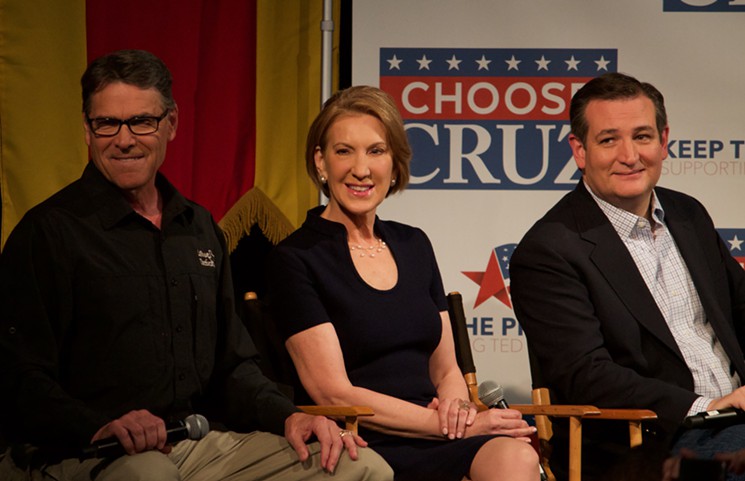
Rick Perry, Carly Fiorina and Ted Cruz appear on Fox News with Sean Hannity
Ted Cruz was on Fox News yesterday for a one-hour townhall meeting in Arizona with Sean Hannity, a Trump supporter.
I noted that the Republican National Committee posted that video on Youtube. Is that a sign the establishment is coming over to support the rebel candidate?
Summary:
Should Ohio Governor John Kasich drop out of the race?
What will happen if no one gets 1,237 delegates before the GOP convention to choose the nominee?
What is a brokered convention?
What is a contested convention?
Is Donald Trump going to get to 1,237 delegates before the GOP convention?
Is Ted Cruz going to get to 1,237 delegates before the GOP convention?
Why does the establishment refuse to get behind candidates who are strong on legal immigration and border security?
What did Ted Cruz see on the border with Mexico?
Why aren’t Republicans concerned about border security?
What would Ted Cruz do about sanctuary cities?
What would Ted Cruz do about e-verify?
What would Ted Cruz do about tracking entry / exit of people who are given visas?
What would Ted Cruz do about welfare benefits given to illegal immigrants?
If Donald Trump is tough on border security, then why did he donate so much money to open borders / pro-amnesty Democrats?
Has Donald Trump released the New York Times tape where he explained that his real views on border security are much more moderate than he tells the public?
What would Ted Cruz do to encourage job creators to create more jobs, and rein in government spending?
What would Ted Cruz do to fix the regulations that are stifling small businesses?
What would Ted Cruz do to make health care more affordable?
Surprise guest: why does former CEO of Hewlett-Packard Carly Fiorina support Ted Cruz for President?
Surprise guest: why does former Governor of Texas Rick Perry support Ted Cruz for President?
Leftist Politico reports that the Cruz Campaign is not wasting any time going after Marco Rubio supporters:
In Utah, his leadership team moved to lock down the Florida senator’s lengthy list of legislative endorsements before next Tuesday’s caucus. Cruz is planning to meet with Gov. Gary Herbert Saturday at a campaign kickoff event for Utah Sen. Mike Lee, another Cruz ally. In Washington, several of Rubio’s national security advisers signed on with Cruz — after, in part, courting from [Victoria] Coates. And nationally, Cruz’s money team is making the case to Rubio’s former donors that Cruz’s time has come.
Their message: The party is running out of time to stop Donald Trump — and Cruz is the only one who can do it.
[…]The broad-based, national effort comes as Cruz seeks to consolidate the anti-Trump wing of the GOP behind his campaign. He lags well behind Trump in delegates, but his team is hopeful that with a united party behind him, he’ll turn that deficit into a lead by the time the he heads to the Republican National Convention in July. They insist he could do even better: assemble enough delegates to score an outright win — though that’s a path that has narrowed dramatically and remains a long-shot for Cruz.
A win in Utah on Tuesday, however, would be a significant first step toward catching up in the delegate count, and Cruz enjoyed a boost toward that goal Friday when former GOP presidential candidate Mitt Romney—whom Cruz has frequently criticized– said he would vote for Cruz in Utah over Trump and over Ohio Gov. John Kasich.
“A vote for Governor Kasich in future contests makes it extremely likely that Trumpism would prevail,” Romney wrote in a Facebook post, echoing Cruz’s argument. “I will vote for Senator Cruz and I encourage others to do so as well, so that we can have an open convention and nominate a Republican.”
Leftist USA Today reports that Marco Rubio effectively endorsed Ted Cruz earlier this week:
Marco Rubio hasn’t endorsed Ted Cruz, but he seemed to come awfully close during a conference call with supporters this week.
Cruz is “the only conservative left in the race,” Rubio told supporters in Minnesota, according to a tape obtained by the Twin Cities Pioneer Press.
Meanwhile, leftist CNN reports that even liberal RINO Lindsey Graham is throwing his support behind Ted Cruz:
In a sign of just how much the Republican presidential primary has turned the party on its head, Sen. Lindsey Graham will headline a fundraiser on Monday in support of Ted Cruz.
[…]Support for Cruz is an about-face for the South Carolina senator, who compared nominating GOP front-runner Donald Trump or Cruz to being shot or poisoned. He recently mocked Cruz’s unpopularity among his colleagues, saying earlier this month: “If you killed Ted Cruz on the floor of the Senate, and the trial was in the Senate, nobody would convict you.”
“He’s certainly not my preference, but he’s a reliable Republican, conservative, which I’ve had many differences with,” the South Carolina Republican said.
When asked about his dramatic change in stance toward Cruz, Graham admitted that his Senate colleague is “not well liked,” but said, “I have doubts about Mr. Trump, I don’t think he’s a Republican, I don’t think he’s a conservative, I think his campaign’s built on xenophobia, race-baiting and religious bigotry, I think he’d be a disaster for our party and as Senator Cruz would not be my first choice, I think he is a Republican conservative who I could support.”
On specific issues, Graham said he believes Cruz would be a reliable partner for Israel, would build the Keystone XL pipeline extension, would repeal and replace Obamacare and would nominate a true conservative to be on the Supreme Court.
Still, Graham said he believes that the third remaining Republican candidate for president, Ohio Gov. John Kasich, would be “the most viable general election candidate,” but that he does not see how Kasich can win the primary.
The move is also a sign that Cruz might be starting to gain traction with his colleagues in the Senate.
Cruz picked up his first Senate endorsement from Utah Sen. Mike Lee last week.
I think it’s amazing that Ted Cruz has actually gotten the liberal Republican establishment to come over and support him, and all without compromising a thing. In my lifetime, I’ve witnessed the slide of the Republican party to the moderate middle. I never thought I would see the day when the moderate middle had to come over to the conservative right. And yet here we are! I pray it’s not too late.