
Category Archives: Videos

Trump gets 5% in straw poll of informed voters at Values Voters Summit

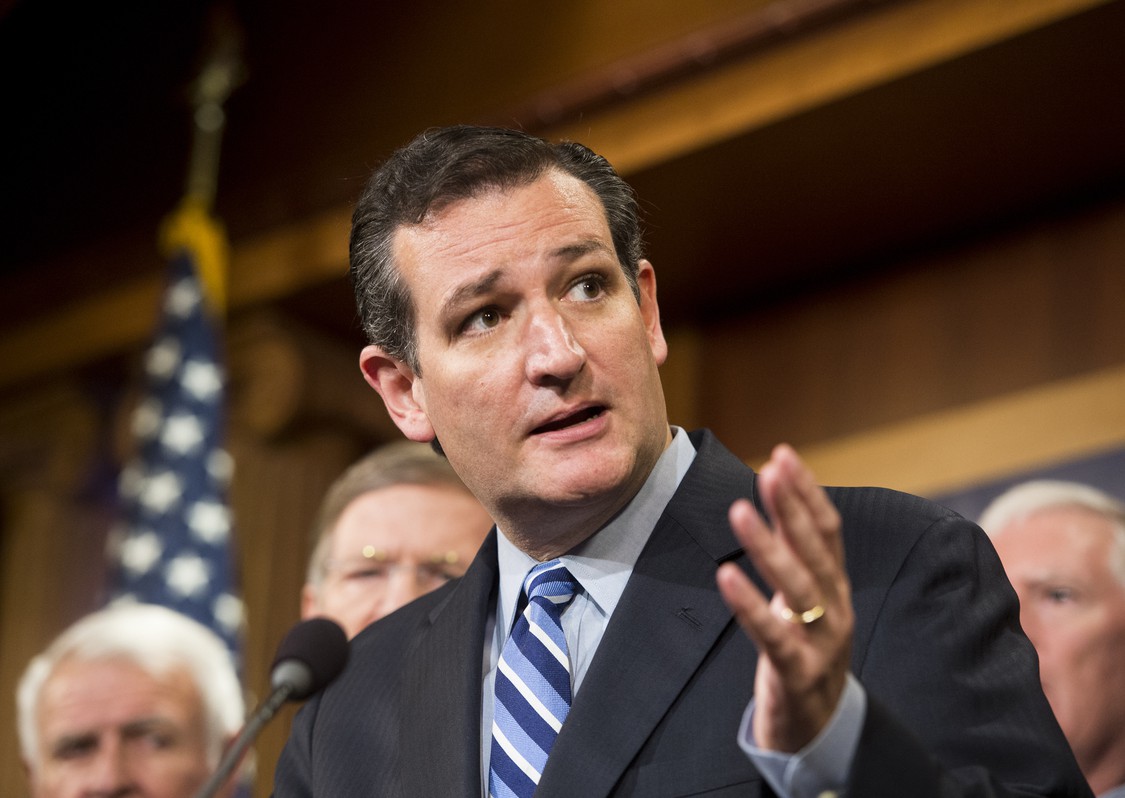
Texas Senator Ted Cruz

I was actually thinking of going to this annual Washington conference of value voters, because the speakers line up so closely with my values. You might think that it’s all social conservatism, but this is actually a really good place to find good talks on the free market system, as well as peace through strength foreign policy.

Anyway, they took a poll of the values voters, and Ted Cruz won:

Sen. Ted Cruz won the Values Voter Summit straw poll for the third year in a row on Saturday, a strong showing of support from evangelical voters for his 2016 presidential bid.

The firebrand Texas senator won a whopping 35 percent in the poll of summit-goers, ahead of runner-up Ben Carson’s 18 percent. That margin is significantly wider than last year, where he edged out Carson by just 5 percentage points.

Former Gov. Mike Huckabee (Ark.) took third with 14 percent, followed by Sen. Marco Rubio (Fla.) with 13 percent. Real estate magnate Donald Trump finished a distant fifth with 5 percent.

Carson won the event’s poll for vice president, his second consecutive win for that category.

Family Research Council Action president Tony Perkins announced the results Saturday afternoon to applause from the conference’s attendees. Perkins’ group organized the three-day event.

Eight GOP presidential candidates took to the summit stage in order to make their case to the religious conservative audience—Cruz, Carson, Trump, Rubio, Huckabee, as well as Sens. Lindsey Graham (S.C.) and Rand Paul (Ky.), and Gov. Bobby Jindal (La.).

The results confirm Cruz, Carson and Huckabee’s strength among religious conservative voters. Each rely on the voting bloc as a core piece of their electorate, but the huge win for Cruz is likely encouraging considering recent polls showing the senator outside of the top tier with evangelicals.

But the figures are surprising for both Rubio and Trump. Rubio’s finish shows him continuing to make gains with religious conservative voters as he rises in national polling. But the result is a disappointment for Trump, who had led with evangelicals in two recent polls.

The Values Voter Summit though is Cruz country and several conference-goers mentioned his name first as the person they trust most on issues important to social conservatives when interviewed by The Hill during the event.

[…]A handful of candidates didn’t attend the summit—Jeb Bush, Govs. Chris Christie (N.J.), John Kasich (Ohio) and Carly Fiorina.

The ones that didn’t attend are, not surprisingly, the same ones I marked as social moderates. Better than a Democrat, not as good as real conservatives like Jindal or Cruz.

Anyway, Cruz’s speech was awesome:

And his list of Day One promises was also amazing.

Sample:

Sen. Ted Cruz (R-Texas) electrified conservatives at the Values Voters Summit in Washington on Friday as he laid out plans for his first day in the White House.

Cruz vowed to rescind all of President Obama’s “illegal and unconstitutional executive actions,” said he would order the Department of Justice to prosecute Planned Parenthood, instruct the DOJ and Internal Revenue Service to end religious persecution of citizens, “rip to shreds” the Obama administration’s nuclear deal with Iran and move the U.S. embassy in Israel to Jerusalem.

Upon each declaration, Cruz received huge applause and a standing ovation.

“That’s just day one,” Cruz said. “There are 365 days in the year, four years in a presidential term, four years in a second term. By the end of eight years, this ballroom is going to be a whole lot bigger. By the end of eight years, there will be a whole lot of reporters and journalists who have checked themselves into therapy.”

And if the idea of connecting with socially conservative voters is appealing to you, be sure to go to FRC.org and subscribe the daily and weekend podcasts. These podcasts are my favorites, along with The Weekly Standard podcast.

My original list of favorite candidates in the 2016 GOP primary:

  1. Walker
  2. Jindal
  3. Perry
  4. Cruz
  5. Rubio

I really hope Jindal, Cruz or Rubio can take this thing, because I don’t want to have to be promoting someone I am not excited about.

Stephen C. Meyer lectures on intelligent design and the origin of life

A MUST-SEE lecture based on Dr. Stephen C. Meyer’s book “Signature in the Cell“.

You can get an MP3 of the lecture here. (30 MB)

I highly recommend watching the lecture, and looking at the slides. The quality of the video and the content is first class. There is some Q&A (9 minutes) at the end of the lecture.

Topics:

  • intelligent design is concerned with measuring the information-creating capabilities of natural forces like mutation and selection
  • Darwinists think that random mutations and natural selection can explain the origin and diversification of living systems
  • Darwinian mechanisms are capable of explaining small-scale adaptive changes within types of organisms
  • but there is skepticism, even among naturalists, that Darwinian mechanisms can explain the origin of animal designs
  • even if you concede that Darwinism can account for all of the basic animal body plans, there is still the problem of life’s origin
  • can Darwinian mechanisms explain the origin of the first life? Is there a good naturalistic hypothesis to explain it?
  • there are at least two places in the history of life where new information is needed: origin of life, and Cambrian explosion
  • overview of the structure of DNA and protein synthesis (he has helpful pictures and he uses the snap lock blocks, too)
  • the DNA molecule is composed of a sequence of bases that code for proteins, and the sequence is carefully selected to have biological function
  • meaningful sequences of things like computer code, English sentences, etc. require an adequate cause
  • it is very hard to arrive at a meaningful sequence of a non-trivial length by randomly picking symbols/letters
  • although any random sequence of letters is improbable, the vast majority of sequences are gibberish/non-compiling code
  • similarly, most random sequences of amino acids are lab-proven (Doug Axe’s work) to be non-functional gibberish
  • the research showing this was conducted at Cambridge University and published in the Journal of Molecular Biology
  • so, random mutation cannot explain the origin of the first living cell
  • however, even natural selection coupled with random mutation cannot explain the first living cell
  • there must already be replication in order for mutation and selection to work, so they can’t explain the first replicator
  • but the origin of life is the origin of the first replicator – there is no replication prior to the first replicator
  • the information in the first replicator cannot be explained by law, such as by chemical bonding affinities
  • the amino acids are attached like magnetic letters on a refrigerator
  • the magnetic force sticks the letters ON the fridge, but they don’t determine the specific sequence of the letters
  • if laws did determine the sequence of letters, then the sequences would be repetitive
  • the three materialist explanations – chance alone, chance and law, law alone – are not adequate to explain the effect
  • the best explanation is that an intelligent cause is responsible for the biological explanation in the first replicator
  • we know that intelligent causes can produce functional sequences of information, e.g. – English, Java code
  • the structure and design of DNA matches up nicely with the design patterns used by software engineers (like WK!)

There are some very good tips in this lecture so that you will be able to explain intelligent design to others in simple ways, using everyday household items and children’s toys to symbolize the amino acids, proteins, sugar phosphate backbones, etc.

Proteins are constructed from a sequence of amino acids:

A sequence of amino acids forming a protein

Proteins sticking onto the double helix structure of DNA:

Some proteins sticking onto the sugar phosphate backbone

I highly, highly recommend this lecture. You will be delighted and you will learn something.

Here is an article that gives a general overview of how intelligent design challenges. If you want to read something more detailed about the material that he is covering in the lecture above related to the origin of life, there is a pretty good article here.

There is a good breakdown of some of the slides with helpful flow charts here on Uncommon Descent.

Positive arguments for Christian theism

N.T. Wright lectures on the resurrection of Jesus: did Jesus rise from the dead?

Sherlock Holmes and John Watson: let's take a look at the facts
Sherlock Holmes and John Watson: let’s take a look at the facts

Here’s a lecture from N.T. Wright, whose multi-volume case for the historicity of the bodily resurrection of Jesus seems to be getting a lot of respect from the other side, (although I strongly disagree with his economic and political views, which are naive at best). Wright has taught at Cambridge University, Oxford University, Duke University, McGill University, and lectured on dozens of prestigious campuses around the world. He’s published 40 books.

Here’s a video of his case for the resurrection:

N.T. Wright’s historical case for the bodily resurrection of Jesus

Wright basically argues that the resurrection cannot have been a myth invented by the early Christian community, because the idea of the Messiah dying and being bodily resurrected to eternal life was completely unexpected in Jewish theology, and therefore would not have been fabricated.

In Judaism, when people die, they stay dead. At the most, they might re-appear as apparitions, or be resuscitated to life for a while, but then die again later. There was no concept of the bodily resurrection to eternal life of a single person, especially of the Messiah, prior to the general resurrection of all the righteous dead on judgment day.

Wright’s case for the resurrection has 3 parts:

  • The Jewish theological beliefs of the early Christian community underwent 7 mutations that are inexplicable apart from the bodily resurrection of Jesus
  • The empty tomb
  • The post-mortem appearances of Jesus to individuals and groups, friends and foes

Here’s the outline of Wright’s case:

…the foundation of my argument for what happened at Easter is the reflection that this Jewish hope has undergone remarkable modifications or mutations within early Christianity, which can be plotted consistently right across the first two centuries. And these mutations are so striking, in an area of human experience where societies tend to be very conservative, that they force the historian… to ask, Why did they occur?

The mutations occur within a strictly Jewish context. The early Christians held firmly, like most of their Jewish contemporaries, to a two-step belief about the future: first, death and whatever lies immediately beyond; second, a new bodily existence in a newly remade world. ‘Resurrection’ is not a fancy word for ‘life after death’; it denotes life after ‘life after death’.

And here are the 7 mutations:

  1. Christian theology of the afterlife mutates from multiples views (Judaism) to a single view: resurrection (Christianity). When you die, your soul goes off to wait in Sheol. On judgment day, the righteous dead get new resurrection bodies, identical to Jesus’ resurrection body.
  2. The relative importance of the doctrine of resurrection changes from being peripheral (Judaism) to central (Christianity).
  3. The idea of what the resurrection would be like goes from multiple views (Judaism) to a single view: an incorruptible, spiritually-oriented body composed of the material of the previous corruptible body (Christianity).
  4. The timing of the resurrection changes from judgment day (Judaism) to a split between the resurrection of the Messiah right now and the resurrection of the rest of the righteous on judgment day (Christianity).
  5. There is a new view of eschatology as collaboration with God to transform the world.
  6. There is a new metaphorical concept of resurrection, referred to as being “born-again”.
  7. There is a new association of the concept of resurrection to the Messiah. (The Messiah was not even supposed to die, and he certainly wasn’t supposed to rise again from the dead in a resurrected body!)

There are also other historical puzzles that are solved by postulating a bodily resurrection of Jesus.

  1. Jewish people thought that the Messiah was not supposed to die. Although there were lots of (warrior) Messiahs running around at the time, whenever they got killed, their followers would abandon them. Why didn’t Jesus’ followers abandon him when he died?
  2. If the early Christian church wanted to communicate that Jesus was special, despite his shameful death on the cross, they would have made up a story using the existing Jewish concept of exaltation. Applying the concept of bodily resurrection to a dead Messiah would be a radical departure from Jewish theology, when an invented exaltation was already available to do the job.
  3. The early church became extremely reckless about sickness and death, taking care of people with communicable diseases and testifying about their faith in the face of torture and execution. Why did they scorn sickness and death?
  4. The gospels, especially Mark, do not contain any embellishments and “theology historicized”. If they were made-up, there would have been events that had some connection to theological concepts. But the narratives are instead bare-bones: “Guy dies public death. People encounter same guy alive later.” Plain vanilla narrative.
  5. The story of the women who were the first witnesses to the empty tomb cannot have been invented, because the testimony of women was inadmissible under almost all circumstances at that time. If the story were invented, they would have invented male discoverers of the tomb. Female discovers would have hampered conversion efforts.
  6. There are almost no legendary embellishments in the gospels, while there are plenty in the later gnostic forgeries. No crowds of singing angels, no talking crosses, and no booming voices from the clouds.
  7. There is no mention of the future hope of the general resurrection, which I guess they thought was imminent anyway.

To conclude, Wright makes the argument that the best explanation of all of these changes in theology and practice is that God raised Jesus (bodily) from the dead. There is simply no way that this community would have made up the single resurrection of the Messiah – who wasn’t even supposed to die – and then put themselves on the line for that belief.

And remember, the belief in a resurrected Jesus was something that the earliest witnesses could really assess, because they were the ones who saw him killed and then walking around again after his death. They were able to confirm or deny their belief in the resurrection of Jesus based on their own personal experiences with the object of those beliefs.