

Category Archives: Podcasts

Debating forgiveness: must a person admit wrongdoing before being forgiven?

Two horses fight it out, may the best horse win!

I’ve listened to this debate three times because I liked it so much. I even ordered Chris’ book for my friend Dina. She has listened to the debate, and is currently split between the two debaters. I am in firm agreement with the pastor Chris, although Remy has some useful things to say that I agree with.

Here’s a link to the debate page on Moody Bible Institute’s “Up For Debate” program with Julie Roys.

Details:

Should Christians Forgive No Matter What?

Should Christians forgive someone even if he’s not sorry?  Or does true forgiveness require repentance and a desire to reconcile?  This Saturday, on Up For Debate, Julie Roys will explore this issue with Chris Brauns, a pastor who believes forgiveness requires repentance, and Remy Diederich who believes it does not.

Although I disagree with Remy, I only disagree with him about whether the guilty person must admit guilt and feel remorse and make restitution (depending on the severity of the offense). I agree with him on other things like no revenge, attitude of love, expressing willingness to forgive and be reconciled, etc. I also disagree with Remy on “forgiving God”, which I think is just crazy, because when God is engineering a person’s salvation, he never fails. I think that God is the Great General, and his strategies never fail to achieve the outcomes he desires (while still respecting free will). Whatever suffering or inadequacy or longing that you experience as a Christian is not some sort of mistake, horrible as it may be for you at the time. God is not your cosmic butler, although a lot of people these days seem to think that he is, and then they get disappointed.

Anyway, please listen to that debate and comment on it about who you think is right. I think my view (and Chris’ view) is in the minority in the church, because the church is so utterly dominated by feelings and radical feminism. I think my view (and Chris’ view) is the masculine view – the view that upholds moral standards, sets moral boundaries and defends the rightness of making moral judgments.

Below, I have pasted in some of my other thoughts on forgiveness from a previous post.

I think this is the key passage – Luke 17:3-4:

Be on your guard! If your brother sins, rebuke him; and if he repents, forgive him.

And if he sins against you seven times a day, and returns to you seven times, saying, ‘I repent,’ forgive him.”

That’s Jesus speaking, there.

Also, I was having a debate with someone who disagrees with all this, and while debating with her, I thought of another example.

Luke 18:9-14:

And He also told this parable to some people who trusted in themselves that they were righteous, and viewed others with contempt:

10 “Two men went up into the temple to pray, one a Pharisee and the other a tax collector.

11 The Pharisee stood and was praying this to himself: ‘God, I thank You that I am not like other people: swindlers, unjust, adulterers, or even like this tax collector.

12 I fast twice a week; I pay tithes of all that I get.’

13 But the tax collector,standing some distance away, was even unwilling to lift up his eyes to heaven, but was beating his breast, saying, ‘God, be merciful to me, the sinner!’

14 I tell you, this man went to his house justified rather than the other; for everyone who exalts himself will be humbled, but he who humbles himself will be exalted.”

So again, no forgiveness without repentance.

Forgiveness is what happens when someone who is sinned against treats the sinner as if he had never sinned. It is not on the balance sheet. It is not brought to mind. It is not held against them in the future. The forgiver trusts the sinner again as if the previous sin had never happened.

In divine (vertical) forgiveness, there is no forgiveness without repentance. There are Bible verses above to show that.

My argument is twofold. First, there is a clear teaching of Jesus explaining the sequence of sin and forgiveness. Repentance precedes forgiveness, between humans (Luke 17:3). The verses cited by the forgive without repentance crowd don’t show the mechanics of how to forgive, they are making the point that if you want God to forgive you, you should forgive others. The parable in Luke 18:9-14 affirms this again – repentance always precedes forgiveness.

Second, we have an obligation to imitate God, and that means imitating the way he forgives those who sin against him. When I raise that with the unconditional forgiveness crowd, they want to insist that there is a difference, that the word “forgive” means different things. I’m not convinced.

Finally, I do think that forgiving someone is obligatory if they sincerely repent, and even if they screw up again and again. So long as the repentance is sincere, (like if there is restitution and a genuine effort to show an understanding how the sin affected the wronged party in writing), then forgiveness should be automatic. Depending on how bad the sin is, there maybe be more to do than just say “I’m sorry”. If the repentance is genuine, then I think the person who is sinned against must forgive, if they expect to be forgiven by God for the things they repent of.

Alan E. Kurschner adds one final point about the unconditional forgiveness view. He argues that there is serious textual doubt about the originality of Luke 23:34a, a text used by the pro-unconditional-forgiveness crowd. He has a journal article coming out on it, but a synopsis of his argument is here.

He also wrote this in a comment on this blog:

Second, on Matt 6:15, this is what I have to say. Notice the then-clause: “neither will your Father forgive your sins.” This would require universalism on the Father’s part according to the unconditional interpretation given the first half: “But if you do not forgive others their sins.” Since everyone has wronged the Father is the Father required to forgive everyone even if they are not seeking forgiveness?

So I think the case for the forgiveness being conditional on repentance is pretty strong, especially when serious harm has been caused.
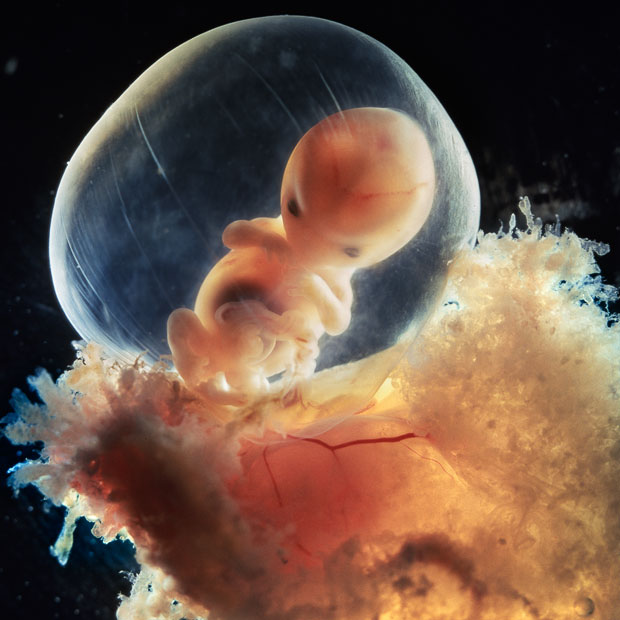

If unborn babies don’t have consciousness or don’t feel pain, may we kill them?

Unborn baby scheming about pro-life apologetics

Was having a conversation by e-mail yesterday with a pro-abortion atheist, and he gave two reasons why he supported abortion in the first and second trimester. First, he said that unborn babies can’t feel pain, so it’s OK to kill them. Second, he said that unborn babies don’t have consciousness, so it’s OK to kill them. I thought it might be useful to link to something that answers both of these objections.

Frank Beckwith is the author of “Defending Life: A Moral and Legal Case Against Abortion Choice“, which was published by Cambridge University Press, a top academic press. But before Cambridge University Press, Beckwith wrote four easy-to-understand essays for the Christian Research Journal. Part IV is the one that has the response to the two questions raised by my atheist friend.

Part I. The Appeal to Pity

Part II. Arguments from Pity, Tolerance, and Ad Hominem

Part III. Is The Unborn Human Less Than Human?

Part IV. When Does a Human Become a Person?

Excerpt:

Some ethicists argue that the unborn becomes fully human sometime after brain development has begun, when it becomes sentient: capable of experiencing sensations such as pain. The reason for choosing sentience as the criterion is that a being that cannot experience anything (i.e., a presentient unborn entity) cannot be harmed. Of course, if this position is correct, then the unborn becomes fully human probably during the second trimester and at least by the third trimester. Therefore, one does not violate anyone’s rights when one aborts a nonsentient unborn entity. [13]

There are several problems with this argument. First, it confuses harm with hurt and the experience of harm with the reality of harm. [14] One can be harmed without experiencing the hurt that sometimes follows from that harm, and which we often mistake for the harm itself. For example, a temporarily comatose person who is suffocated to death “experiences no harm,” but he is nevertheless harmed. Hence, one does not have to experience harm, which is sometimes manifested in hurt, in order to be truly harmed.

Second, if sentience is the criterion of full humanness, then the reversibly comatose, the momentarily unconscious, and the sleeping would all have to be declared nonpersons. Like the presentient unborn, these individuals are all at the moment nonsentient though they have the natural inherent capacity to be sentient. Yet to countenance their executions would be morally reprehensible. Therefore, one cannot countenance the execution of some unborn entities simply because they are not currently sentient.

Someone may reply that while these objections make important points, there is a problem of false analogy in the second objection: the reversibly comatose, the momentarily unconscious, and the sleeping once functioned as sentient beings, though they are now in a temporary state of nonsentience. The presentient unborn, on the other hand, were never sentient. Hence, one is fully human if one was sentient “in the past” and will probably become sentient again in the future, but this cannot be said of the presentient unborn.

There are at least three problems with this response. First, to claim that a person can be sentient, become nonsentient, and then return to sentience is to assume there is some underlying personal unity to this individual that enables us to say that the person who has returned to sentience is the same person who was sentient prior to becoming nonsentient. But this would mean that sentience is not a necessary condition for personhood. (Neither is it a sufficient condition, for that matter, since nonhuman animals are sentient.) Consequently, it does not make sense to say that a person comes into existence when sentience arises, but it does make sense to say that a fully human entity is a person who has the natural inherent capacity to give rise to sentience. A presentient unborn human entity does have this capacity. Therefore, an ordinary unborn human entity is a person, and hence, fully human.

Second, Ray points out that this attempt to exclude many of the unborn from the class of the fully human is “ad hoc and counterintuitive.” He asks us to “consider the treatment of comatose patients. We would not discriminate against one merely for rarely or never having been sentient in the past while another otherwise comparable patient had been sentient….In such cases, potential counts for everything.” [15]

Third, why should sentience “in the past” be the decisive factor in deciding whether an entity is fully human when the presentient human being “is one with a natural, inherent capacity for performing personal acts?” [16] Since we have already seen that one does not have to experience harm in order to be harmed, it seems more consistent with our moral sensibilities to assert that what makes it wrong to kill the reversibly comatose, the sleeping, the momentarily unconscious, and the presentient unborn is that they all possess the natural inherent capacity to perform personal acts. And what makes it morally right to kill plants and to pull the plug on the respirator-dependent brain dead, who were sentient “in the past,” is that their deaths cannot deprive them of their natural inherent capacity to function as persons, since they do not possess such a capacity.

These four essays are a very good introduction to common responses to pro-abortion arguments. I recommend that people get familiar with this, as once you look into it, you will see that the abortion issue can be debated with as much confidence as William Lane Craig defends Christian theism. You will have the same access to scientific evidence and rational arguments on this topic, and so you will have the upper hand. And that’s fun.

The best introductory book on the abortion / right to life issue is “The Case for Life” by pro-life debater Scott Klusendorf. The best comprehensive book is a tie between “The Ethics of Abortion” by Christopher Kaczor, and Frank Beckwith’s “Defending Life: A Moral and Legal Case Against Abortion Choice“.

Suzanne Venker interviews Dr. Stephen Baskerville about divorce and its beneficiaries

Marriage and family
Marriage and family

I am just LOVING the Suzanne Venker podcast. You should subscribe if you like discussions with experts about marriage, divorce, feminism, sex and relationships. Recent guests: Christina Hoff Sommers, Rollo Tomassi, Janice Fiamengo, Denise McAllister, Katy Faust, Helen Smith, Joy Pullmann, Heather Mac Donald, Mona Charen, Dr. Laura, Dennis Prager, Allison Armstrong, etc.

You can listen to the episode here.

And it came with a free summary:

Children of divorce are in desperate need of a relationship with both their parents. Sadly, far too many are reduced to having a relationship with only one parent: the mother.

Citing a principle called the “best interest of the child,” family courts award sole or primary custody of most children of divorced parents to mothers, thereby reducing fathers to occasional visitation and zero authority.

The silence on this issue is deafening, and this silence comes just as much from the right as it does from the left. It even comes from churches.

Making matters worse is that divorce is no longer fault-based. Unilateral divorce is now the law of the land, and three-fourths of divorces are initiated by wives. Women don’t have to allege any fault by the husband, and he has no right to oppose the divorce.

To address this monstrous social travesty, I could think of no one better than Stephen Baskerville, former Professor of Government at Patrick Henry College. Stephen is widely recognized as a leading authority on fatherhood, family policy, and sexual politics. He holds a Ph.D. from the London School of Economics and writes on political ideologies with an emphasis on religion, family policy, and sexuality. His books include The New Politics of Sex and Taken Into Custody: The War against Fathers, Marriage, and the Family.

Stephen serves on advisory boards to the Ruth Institute, the Men’s Health Network and other organizations. His website is http://www.stephenbaskerville.com.

IN THIS EPISODE:

5:00-8:00 How Stephen began writing on the “divorce industry,” the political dynamics involved and about no-fault divorce: why it disproportionately affects fathers.

8:00 How women are encouraged to get divorced and take the children, make false accusations against fathers etc.

10:24 How men are less likely to use children as weapons against the other spouse

10:45  The Myth of the Deadbeat Dad

14:00 What is no-fault divorce and why is it wrong, why is it a system of “chaos” and why we need to “enforce the constitution” when it comes to divorce

11:40 – 16:00  How the Bill of Rights is violated in many divorce cases and how basic constitutional rights are being violated.

17:00  How political correctness keeps ups from being able to address it and solve the problems with no-fault divorce and how both the left and right wing media both ignore it

19:00  How even Ronald Reagan admits he was deceived when he signed the first No Fault divorce legislation into action in CA. How there was also no public debate or discussion at the time it was enacted and throughout the years until now

19:45 How these laws have affected the social structure, including crime, fatherlessness in homes, etc.

20:49-22:50  What does Stephen tell and recommend for fathers as recourse for these issues?

24:35-30:30  Why the effects of the sexual revolution have led to the the West to brink of social and economic ruin (this includes sexual chaos, domestic violence, sexual harassment, etc.)

30:45 – Why feminism has not created a “utopia” for a women

33:00 – Stephen discusses single parent homes and the breakdown of the family

36:20 How the church not being involved in marriage has created a vacuum for the lawyers, social workers, judges and therapists to step in

37:45 Stephen talks about the idea of being “offended” and why men are responsible for stepping up and being leaders

For a virgin who has not and probably never will marry, I have had a lifelong interest in how to date and marry the right way – in order to get results and leave a legacy. So I know all these speakers, and have books my many of them (Dr. Laura, Janice Fiamengo, Helen Smith, Dr. Laura, Christina Hoff Sommers, Stephen Baskerville, etc.) in my house. I’m fascinated by these issues and know very much about what does and does not work in a marriage.