
Category Archives: Podcasts

Michael Behe and Keith Fox debate theistic evolution vs intelligent design

Michael Behe and Keith Fox debate evolution and intelligent design. (See below for link to MP3 file)

Details:

Michael Behe is professor of biochemistry at Lehigh University, Pennsylvania and the founder of the modern Intelligent Design movement. His book “Darwin’s Black Box” ignited the controversy 14 years ago when it claimed that certain molecular machines and biological processes are “irreducibly complex” and cannot be explained by Darwinian evolution.

His new book “The Edge of Evolution” takes his conclusions further, arguing that the Darwinian processes of random mutation and natural selection are incapable of producing the variation and complexity we see in most of life.

So can we conclude that life was intelligently designed by a creator?

Keith Fox is Professor of biochemistry at the University of Southampton and chairman of Christians in Science. As a theistic evolutionist he believes that Evolution is the best explanation going for the complexity we see and that ID is a blind scientific alley and theologically unappealing to boot.

They debate whether micromachines in the cell such as the “bacterial flagellum” could have evolved by a Darwinian process of evolution. When inference to design is and isn’t acceptable in science. Whether random mutation can mathematically stack up to complex life, and whether God is reduced to a divine “tinkerer” by ID.

I get the impression that Fox learned everything he knows about ID by reading Darwinists.

The MP3 file is here.

The summary below is rated VERY SNARKY.

Summary

Michael Behe:

  • ID is not Biblical creationism
  • ID is not religion
  • ID is a scientific research program
  • People refuse to discuss ID because of personal philosophical assumptions
  • ID is like the Big Bang – it is based on evidence, but it has broad religious implications

Keith Fox:

  • ID is not Biblical creationism, but it isn’t science

Michael Behe:

  • ID is compatible with common descent
  • ID is only opposed to unplanned, unguided evolution (Darwinism)
  • ID is not necessarily opposed to long periods of time

Behe’s first book – the bacterial flagellum

Keith Fox:

  • Here are a couple of papers that show how parts of the flagellum evolved
  • They are possible pathways

Michael Behe

  • No, those are studies that show that there are similarities between bacterial flagella in multiple organisms
  • Similarities of proteins between different organisms do not necessarily imply a developmental pathway
  • The problem of having the instructions to BUILD the flagellum still remains

Keith Fox:

  • Maybe parts of the flagellum had other functions before they were used in the flagellum
  • Maybe you can use the parts of the flagellum for other purposes
  • Maybe, one can imagine, it’s possible that!

Michael Behe:

  • No, parts have to be modified and re-purposed in order to be used for other functions

Keith Fox:

  • But maybe the proteins can be used in other systems for other things
  • I re-purpose parts from of designed things to other purposes in my house when I do maintenance

Michael Behe

  • Uh, yeah – but aren’t you an intelligent designer? What does your home maintenance have to do with Darwinian evolution?

Is ID another God-of-the-gaps argument?

Michael Behe:

  • Well consider the Big Bang… there was a build-up of scientific evidence for that theory
  • Just because a theory has religious implications, doesn’t mean that it isn’t true
  • You really have to look at the specific evidence for a theory, and not decide in advance

Keith Fox: (I’m paraphrasing/inventing/mocking from now on)

  • But the Big Bang is based on discoveries, and intelligent design is based on gaps in our scientific knowledge
  • What if I did have evidence of a step by step pathway (which I don’t right now)? Then I would win the argument – what would you do then?

Michael Behe:

  • Well, if tomorrow you do manage to find expiremental evidence of a pathway, which you don’t have today, then I would be wrong
  • ID is falsifiable by experimental evidence
  • But what about your your view? Is that falsifiable by experimental evidence?
  • What if someone goes into a lab (someone like Scott Minnich?) and performs gene knockout experiments, and publishes the results
  • You knock out a gene from the bacterial flagellum, you wait for a large number of generations, and it never develops the missing gene
  • You repeat this with every one of the 50 genes in the bacterial flagellum and it never recovers for any of the 50 genes
  • There is no pathway to build up even one of the 50 genes – according to actual experiments
  • What do Darwinists do with experimental evidence that falsifies Darwinism?

Keith Fox:

  • No, I would not accept that experimental evidence could falsify Darwinism
  • Just because known published experimental evidence that we have today falsifies Darwinism, it doesn’t mean Darwinism is false because it’s not falsifiable
  • We don’t know how Darwinism even works – it happened so long ago, and it’s not repeatable or testable, so how could lab ,experiments falsify it?
  • Darwinism is science and intelligent design is faith, though

Which side has the experimental evidence?

Michael Behe:

  • Consider the largest longest-running lab experiment of evolution, Richard Lenski’s experiments on e. coli
  • Lenski has presided over 50,000 generations, (millions of years of evolution)
  • The bacterium did evolve and they did get better but not by evolving features, but by disabling features

Keith Fox:

  • But those are just LAB EXPERIMENTS! What do lab experiments prove?
  • What if? What if? What if? You don’t know, it happened so long ago, and you weren’t there! You weren’t there!
  • (clutches Flying Spaghetti Monster idol tighter and sobs pitifully)

Michael Behe:

  • See, the thing is that I have actual experiements, and here’s some more evidence that just got published last week
  • So I’ve got evidence and then some more evidence and them some other evidence – experimental evidence
  • And all the evidence shows that adaptation is done losing traits not by gaining traits
  • And the published observations are what we see in nature as well

Keith Fox:

  • But doesn’t Darwinism explain some things that we observe?

Michael Behe:

  • Well, I am not saying that micro-evolution doesn’t explain some things – it explains bacterial resistance, and other micro-evolution
  • it just doesn’t explain macro-evolution, and that’s what the experiments show

Keith Fox:

  • But ID is a science stopper! It stops science! You can’t produce experimental evidence to falsify Darwinism – that would stop science!

Michael Behe:

  • Well, you have to understand that the Big Bang postulated a non-material cause to the entire physical universe and yet the experimental evidence was allowed to stand because it was testable and verifiable evidence, even if the theory does have religious implications
  • All explanations in science are design to settle a question and it stops rival explanations that are not as good at explaining the observations
  • Finding the best explanation stops further study because it is better than rival explanations

Keith Fox:

  • Well you have to come up with a materialist explanation because that’s the only kind that a functional atheist like me will allow

Michael Behe:

  • Well, what if the best explanation for an observed effect in nature is non-material, as with the Big Bang?

Keith Fox:

  • But I have to have a material explanation because I am a functional atheist! (i.e. – a theistic evolutionist = functional atheist)

Michael Behe:

  • Well what about the cosmic fine-tuning argument? Do you accept that?
  • That’s an inference to design based on the latest scientific discoveries

Keith Fox:

  • Well I do accept that argument, but I don’t accept design in biology
  • When you apply it to biology, somehow it’s bad and you can’t do that or you losing research money and get fired
  • Anyway, your argument is based on a gap in our current knowledge

Michael Behe:

  • No, back in Darwin’s time we had a gap in our knowledge – we didn’t know what the cell was – we thought it was jello
  • Now, we know what the cell is really like, it’s irreducibly complex, and you can’t build up those molecular machines in a step-wise manner
  • The inference to design is based on the progress of science revealing the increasing levels of complexity
  • In experiments, Darwinian mechanisms cannot build anything useful, instead genes are disabled or dropped
  • You guys don’t have the evidence to prove your view that naturalistic mechanisms can do the creating
  • You keep issuing promissory notes

Keith Fox:

  • Well, you’re just seeing design subjectively, because you are a non-scientist
  • I’m being objective when I tell you that we will discover a materialist explanation later on – really really soon now, maybe even tomorrow, yeah
  • You won’t accept my speculations and you insist on these published experiments
  • You’re subjective and I’m objective
  • Just give me more research money so I can hide the decline better

Michael Behe:

  • Uh, you’re the one who is subjective – I cited evidence, and you are the one who is speculating
  • You have arguments from credulity, and I’ve got the lab experiments
  • You refuse to be skeptical, I am the one who is being skeptical

Keith Fox:

  • Maybe, maybe, maybe! Maybe tomorrow! Maybe in a parallel universe! Maybe aliens from Planet X!
  • Who knows! I certainly don’t know! And that somehow means you don’t know either! See?

Michael Behe:

  • Well, to prove me wrong, go into the lab, and run experiments and evolve some new genes (using Darwinian mechanisms) that have new useful functionality

Are there limits to what evolution can do?

Michael Behe:

  • You need multiple changes in the genome to get a new helpful feature (let’s say two specific mutations)
  • One specific change is possible
  • the odds are against getting multiple beneficial changes are really really small – you need two SPECIFIC changes to occur in order

Keith Fox:

  • Well, lots of things are really unlikely – any permutation of dice rolls is as unlikely as any other

Michael Behe:

  • Well, we are talking about TWO SPECIFIC mutations that are needed to get a beneficial function – lots of other mutations are possible, but we are looking for a specific outcome that requires two SPECIFIC mutations out of the whole genome
  • You aren’t going to get useful outcomes unless you direct the mutations

Keith Fox:

  • But then why does God allow evil!!!!1!1!!one!!!
Brian Auten interviews pro-life debater Scott Klusendorf on pro-life apologetics

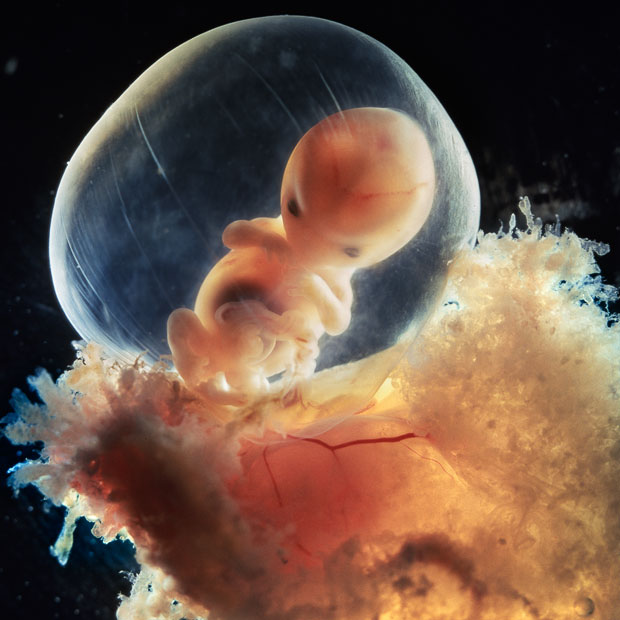
Unborn baby scheming about pro-life apologetics

Scott Klusendorf is the director of the excellent Life Training Institute, and he’s been interviewed by Brian Auten on Apologetics 315.

Details of the interview:

Today’s interview is with Scott Klusendorf, president of Life Training Institute. LTI is the first place to look for excellent resources to get better equipped to defend the pro-life position. Scott talks about defining abortion and its terms, the issue of the debate, the legal history of abortion, defending the pro-life view using science and philosophy, the four pillars of the pro-life argument, answering a litany of objections to the pro-life position, the right and wrong use of emotional appeals, taking on the right tone in the debate, how to get better equipped, and more.

Grab the MP3 file here at Apologetics 315.

The article Scott mentions “How to Defend Your Pro-Life Views in 5 Minutes or Less” is worth the read, and it’s a good summary of some of the points he makes in the lecture.

If you like this interview, please be sure and buy the best basic book on pro-life apologetics – Scott Klusendorf’s “The Case for Life“.

And there is actually a full transcript, and here’s an excerpt:

BA: Great stuff. Now I want you to go into these pillars if you will of defending the pro-life position with science and philosophy, and in your web site prolifetraining.com one of the things that you provide is sort of a four point acronym, some would say sled S-L-E-D. Can you lay out what those main pillars are and their relevance to the issue?

SK: Well as I mentioned a moment ago, pro-life advocates argue that elective abortion unjustly takes the life of a developing human being, and we defend that claim using science and philosophy. We use science to determine what kind of thing the unborn is, and we use philosophy to show that there’s no relevant deference between the embryos we once were and the adults we are today that would justify killing us at that earlier stage of development. Scientifically, as I mentioned just moments ago embryology text books worldwide indicate that from the very beginning you and I were distinct living whole human beings. You can’t see that I’m doing this right now, Brian, but at the moment I’m picking cells off the back of my hand. These cells, which we call somatic cells, contain my entire DNA and coding. But you don’t thing I just committed mass murder by sending a couple hundred of those puppies hurling to their deaths on the floor in front of me. And the reason is, you know that these cells though they contain my DNA and coding are merely part of a larger human being, me. They are not distinct whole living organisms the way that you were when you were an embryo. The way I was when I was an embryo. In other words, there is a difference in kind between each of our bodily cells and the embryonic human beings we once were. That’s what science teaches us; that’s what the science of embryology lays down for us.Philosophically, we argue using that SLED acronym that you mentioned a moment ago that there’s no difference between that embryo we once were and the adult we are today. The adults we are today that justify killing us at that earlier stage of development and as Steven Schwarz points out, the differences between that embryo and the adult that you are today are one of size, level of development, environment and degree of dependency. Think of the acronym SLED and you will remember those four differences. Size, yeah you were smaller as an embryo, but since when does body size determine the rights that you have. Shaquille O’Neal, the seven foot two basketball star with the Boston Celtics, is a foot taller than I am, but he doesn’t have a greater right to life simply because he’s bigger.

Level development? Sure, we were less developed as embryos but since when is a matter of principal does that mean we can kill you? Two-year-old girls are less developed than twenty-year-old young women. We don’t think though the two year old girl has less to a right to life simply because she can’t function at the level that the twenty year old can. Level of size, I should say level of development. What about environment; where you are located there is the letter “E” in that SLED acronym. You were once in the womb now you’re out but sense when does were you are determine what you are? When you walk from your living room into the studio to do this interview. You changed location but you didn’t stop being you. When I jump on an airplane and fly from Atlanta to London’s Heathrow airport. I get off the plane I’m in a new location, but I’m the same being as I was when I left Atlanta. If that’s true how does a journey of eight inches down the birth canal suddenly change me from non-human, non-valuable thing that we can kill? To a valuable human being that we can’t kill. And the answer is, if I wasn’t already human and valuable I’m not going to get there by changing my address. And then finally, degree of dependency—yes we depended on our mother for survival but sense when does dependency on another human being mean we can kill you? Conjoined twins depend on each other for survival and unless one of the twins is killing its partner we don’t go ahead and slit the throat of both twins simply because they can’t live independent of each other. Size, level of development, environment, degree of dependency, think “SLED” those are the only four differences between that embryo you once were and the adult you are today. And the pro-lifer would argue that not one of those four differences justifies killing you at that earlier stage.

You can see Scott in a debate about abortion right here.

And if you like that interview, I have some more things for you to read from Dr. Francis Beckwith.

Learn more by reading

Frank Beckwith is the author of “Defending Life: A Moral and Legal Case Against Abortion Choice“. He wrote that book for Cambridge University Press, a top academic press. But before Cambridge University Press, Beckwith wrote easy-to-understand essays for the Christian Research Journal.

Here are four essays that answer common arguments in favor of legalized abortion.

I have a copy of Dr. Beckwith’s previous book “Politically Correct Death”, which I read bit-by-bit on my lunch hours 10 years ago. Excellent stuff.

Audio, summary and review of William Lane Craig vs. Stephen Law debate

You can also download the audio at Apologetics 315.

Scorecard:

Craig’s case:

  • The origin of the universe: Law had no response.
  • The moral argument: Law denied that there are objective moral values.
  • The resurrection argument: Law told a story about a UFO sighting.

Law’s case:

  • The evidential argument from evil: Law later denied that evil existed, thus undermining his entire argument. Christian theists DON’T consider it evil when people suffer, if that suffering is necessary in order to get people to know God. We don’t agree with Law’s definition of evil that “people suffering” is automatically evil – because there can be a morally sufficient reason why that suffering is allowed by God to happen, since his goal is not our happiness but for us to know him. Law was not able to show how we know that God doesn’t have a morally sufficient reason to permit the evils we do see. And he has to prove that in order to assert (in his premise 1) that gratuitous evil exists. How does he know that? How does he know that some specific instance of evil is pointless for the purpose of improve the knowledge of God overall? The one good thing that Law did was to press Craig to defend his premise that if God doesn’t exist, then objective moral values also don’t exist. Craig did talk about how if there is no God, then morality is just a herd morality that evolves by accident, though.

Final score: 3 to 0 for Craig. Law was better than Craig’s average opponent though, for all the snarky things I might say about him, below.

Below is the snarky summary of the debate. I sometimes paraphrase entire sentences and insert commentary in order to explain what’s going on without the spin.

William Lane Craig opening speech:

Two contentions:

C1) There are good reasons to think that God exists.
C2) There are no good reasons to think that God does not exist.

Arguments for the existence of God.

A1) The origin of the universe

1. Whatever begins to exist requires a cause.
2. The universe began to exist.
3. Therefore, the universe requires a cause.

The beginning of the universe is confirmed by philosophy and science.

An actual infinite number of past events is impossible. The concept of an actual infinite is mathematically unintelligible for the operations of subtraction and division.

Cosmologists have now proven that any universe that is now in a state of expansion must have begun to exist, independent of any physical description of the model. Even speculative alternatives to the current Big Bang model require a beginning at some point.

The cause of the universe must be transcendent and supernatural. It must be uncaused, because there cannot be an infinite regress of causes. It must be eternal, because it created time. It must be non-physical, because it created space. There are only two possibilities for such a cause. It could be an abstract object or an agent. Abstract objects cannot cause effects. Therefore, the cause is an agent.

A2) The moral argument.

1. If God does not exist, then objective moral values do not exist.
2. Objective morality does exist.
3. Therefore, God exists.

Michael Ruse, an atheist philosopher agrees that if God does not exist, then there is only a “herd morality” that is determined by biological evolution and social evolution. There no objective moral standard, just different customs and conventions that vary by time and place. Anyone who acts against the herd morality is merely being unfashionable and unconventional.

Dr. Law affirms objective morality in his written work (but can he ground it on atheism?).

In order to be able to make a distinction between good and evil that is objective, there has to be a God to determine a standard of good and evil that is binding regardless of the varying customs and conventions of different people groups. Even when a person argues against God’s existence by pointing to the “evil” in the world, they must assume objective moral values, and a God who grounds those objective moral values, in order to make the charge. Therefore, it is impossible to complain about the evil in the world without assuming the existence of God.

A3) The resurrection of Jesus.

1. There are certain minimal facts that are admitted by the majority of historians, across the ideological spectrum; the empty tomb, the post-mortem appearances of Jesus, the early belief in the resurrection of Jesus.
2. Naturalistic attempts to explain these minimal facts fail.
3. The best explanation of these facts is that Jesus rose from the dead.

Craig’s opponent thinks that Jesus never existed, a position that virtually no historian holds.

Stephen Law’s opening statement:

A1) The evidential argument from evil

1. Gratuitous evil exists.
2. God would be able to remove evil, would know about the evil, and would want to remove gratuitous evil.
3. It is implausible that God exists.

There are moral evil actions committed by agents
There are natural evils like earthquake.

Animals suffer. e.g. – from being eaten by other animals.
Humans suffer, e.g. – from disease.

Craig’s cosmological argument does prove that a Creator exists, but the evidential argument from evil proves that this Creator is not good.

If the Creator really were good, then we would all be spared from all suffering, both physical and mental, because God has no morally sufficient reason for allowing anyone to suffer. God, if he existed, would prevent humans from committing moral evil by removing our free will. God would also prevent us from having any unhappy feelings caused by natural evil.

A2) Theodicies offered by Christians fail

Freedom Will Theodicy: An evil God might like to allow humans to have free will.

Laws of Nature: An evil God might like to have laws of nature to allow predictable consequences.

Afterlife compensation: An evil God might like an evil afterlife to make us suffer more.

Craig’s first rebuttal:

RA1) Law’s evidential argument from evil fails

The mere presence of evil is not a problem if God has morally sufficient reasons for permitting instances of evil. Since Dr. Law is making the claim that God would not allow the evil, then he has to bear the burden of proof for showing that there is no morally sufficient reason for God to permit evil and sufering.

The purpose of life on the Christian view is not merely to have happy feelings. The purpose of life on the Christian view is coming to know God and having a relationship with him. Many evils that are not good for giving us happy feelings may be good for getting us to think seriously about whether God is there and what to do to have a relationship with him.

Theists don’t infer the goodness of God because they survey the universe and find lots of good things. They infer the goodness of God based on the mere fact that they are aware of an objective moral standard of good and evil, and inalienable human rights, and they identify God as the source of that standard of Good and evil. Those things cannot exist unless there is a God to ground an objective standard of right and wrong. Since the source of the standard is God’s own unchanging nature, he cannot act in a way that is evil.

Moral evil actually proves the existence of God. If Dr. Law claims that there is moral evil, then he has to have an objective moral standard that allows the distinction between good and evil. The only way to make an objective distinction between good and evil is if there is a Design for the universe that determines what is good and evil. And a design for the universe requires a Designer of the universe.

With respect to animal suffering, any ecosystem require predators in order to control population. For example, in Canada, Canadians have had to reintroduce wolves into the ecosystem in order to cull the populations of caribou, which was de-stabilizing the ecosystem. Since humans depend on the existence of these animals, God has to allow these predators in order to balance the ecosystem.

Animals do not suffer pain the same way as humans do, research shows that although they suffer pain, they are not aware of that suffering in the way that humans are. Once you understand the biology of animals, you understand that they do not experience pain the same way as humans.

Law’s first rebuttal:

Craig thinks that you need an objective standard in order to judge things as objectively good or evil. But that’s false. I can use my subjective opinions to claim that some things are objective evil. If God doesn’t do what I like (prevent moral and natural evil), then he isn’t objectively good. I don’t need to buy into the notion of objective good and evil in order to say that something is good or evil. I can say that something is good or evil while denying the existence of objective good and evil. (IMPORTANT NOTE: DR. LAW HAS AT THIS POINT RETRACTED HIS SUPPORT FOR OBJECTIVE MORAL VALUES, WHICH MAKES IT IMPOSSIBLE TO EMPLOY THE EVIDENTIAL ARGUMENT FROM EVIL)

Dr. Craig says that I think that people determine the goodness or evilness of God by counting good things and evil things. But that’s false. My argument is that people determine the goodness or evilness of God by counting good things and evil things. It’s completely different!The presence of good things undermines the existence of evil God, and the existence of evil things undermines the existence of good God.

Craig’s second rebuttal:

Dr. Law has not yet responded to any of the 3 arguments for God’s existence.

A1) No response to the argument from the origin of the universe. How can you admit to a Creator of the universe and still be an atheist? His argument from evil doesn’t refute a supernatural cause of the universe.

A2) Dr. Law is now denying that objective moral values exist, contrary to his written work. This means that he is not able to use the terms “good” and “evil” intelligibly. He is merely expressing his subjective opinions, and therefore he cannot press the evidential argument from evil, because there is no such thing as evil, objectively speaking, on his view. It’s just his personal preference.

A3) No response to the argument concerning the resurrection.

RA1) He has to show that God doesn’t have morally sufficient reasons for permitting the evils we see. He admits that he can’t.

He says that the world is morally ambiguous and you can’t infer the goodness of God by counting the amount of evil and good in the world, just like you can’t infer the evilness of God by counting the amount of evil and good in the world. And that’s correct, and theists don’t infer God’s goodness by counting good and evil instances. The point is that if you can’t infer God’s goodness or evilness by counting instances of good or evil, then you can’t infer that God isn’t good, because you don’t know whether God has a morally sufficient reason for permitting the evils that we see. And it’s the atheist’s burden of proof to show that God DOESN’T have a morally sufficient reason, and Dr. Law is unable to do that.

Dr. Law says that you don’t need to have a standard of good and evil to press the problem of pain and suffering. But if you deny that there is any good or evil independent of pain and suffering, then you can’t impugn God’s goodness because you don’t have a standard in place to say that gratuitous pain and suffering is evil.

Any event that occurs in history can have effects far into the future or in another country. Physicists understand that small effects can trigger results that cannot be foreseen. And what this means is that humans are simply not in a position to know whether God has a moral sufficient reason for permitting specific instances of evil.

Finally, the purpose of life on the Christian view is not to have happy feelings and be free from suffering. God’s purpose for us is to know him and to be rightly related to him. Many instances of evil may be pointless for making people feel good, but may be effective for drawing people towards God.

Law’s second rebuttal:

RA2) The vast majority of philosophers reject the moral argument, for example Richard Swinburne. (No reasoning for the denial is explained, just the denial of the argument’s effectiveness by citing Richard Swinburne as an authority). This is a fallacy of arguing from an authority.

Dr. Craig has to prove that no atheistic account of morality can be given. He has disprove them all, even the ones that no one has thought of yet. It’s not my job, AS THE ATHEIST, to prove that I can give an account of objective truth of moral claims can be given ON ATHEISM. I don’t have to do anything except stand here and speculate about some possible account of morality on atheism and I win.

The existence of objective moral values is not obvious to me. I.e. – I don’t see anything objectively wrong with torturing babies for fun, it’s a matter of opinion. I also don’t see anything evil about those things that I said were evil in my first speech. I was just kidding, people, can’t you take a joke? It just seems to some people like Dr. Craig that there are objective moral values, but actually there aren’t. Dr. Craig merely wants to believe that evil is real, but actually it isn’t. Except when I want to argue that it is in in my evidential argument FROM EVIL.

RA3) Although the majority of ancient historians accept the historicity of the empty tomb because of the early sources, multiple attestation, enemy attestation etc., the tomb was not empty because of this story I’m going to tell about a UFO.

Although virtually all ancient historians accept the post-mortem appearances because of the early sources, multiple attestation, etc., the post-mortem appearances did not occur because of this story I’m going to tell about a UFO.

Although virtually all ancient historians accept the early belief that Jesus was bodily resurrected because of the early sources, multiple attestation, etc., the early belief that Jesus was bodily resurrected did not occur because of this story I’m going to tell about a UFO.

Craig’s final rebuttal:

A1) Dr. Law accepts that the universe was created by an eternal, non-material, uncaused being. What a strange sort of atheist, who admits that there exists a supernatural Creator of the universe.

A2) Dr. Law employed the fallacy of arguing from authority. But Dr. Craig can cite a much longer list of atheists who agree that if God does not exist, then objective moral values do not exist, e.g. – Nietzche, Russell, Sartre, Mackie, etc. Consistent atheists understand that if there is no God, there is no design for how the universe ought to be (natural evil), or how we ought to be (moral evil).

A3) We have to be careful when inferring a supernatural explanation and use objective criteria. All natural explanations fail to explain the full set of minimal facts that virtually all historians accept. In addition, the resurrection takes place within a religio-historical context where one might expect God to intervene if what Jesus was saying was true.

RA1) You can’t disprove God’s goodness by appealing to instances of evil, nor can you disprove God’s evilness by appealing to instances of good. This is because humans are not in a position to assess the ripple effects of permitting any instance of evil (good). It is therefore possible and inscrutable as to whether God has a morally sufficient reason for permitting any and all instances of apparent evil (good).

Dr. Law’s final rebuttal:

A2) There is a lot of pain and suffering in the history of the world. This is a challenge to God’s goodness because God’s purpose for us is to make us happy, and not at all for us to know him or for us to be related to him, as the Bible says.

Here’s my argument. Craig thinks that you can determine God’s goodness by counting instances of good and evil in the world, although he explicitly denies that. And I’ve actually done the counting and found that you can’t determine God’s goodness because there’s too much gratuitous evil. Never mind what Craig said about the ripple effect through time and space, or about chaos theory, or about morally sufficient reasons. These instances of gratuitous evil I’m telling you about have no morally sufficient reasons, in any time or in any place. Trust me, I looked everywhere and in the future, using my time machine.

Now, in my argument, when I said the word evil, I don’t really mean evil, because to use an objective standard of good and evil, I would have to have a moral lawgiver to ground that objective standard. So when I say moral and natural evil, I don’t mean moral and natural evil, I actually mean things that I don’t personally like. So I’m going to change my argument’s name to the Evidential Argument From Things That I Find Yucky.

Dr. Craig provided no justification for his premise that “if there is no God, there there are no objective moral values”. And it’s not my job to produce an atheistic theory about how objective moral values could exist, especially since my argument from evil relies on objective moral values.

A3) UFOs.