Category Archives: Podcasts

Michael Behe and Keith Fox debate theistic evolution vs intelligent design

Michael Behe and Keith Fox debate evolution and intelligent design. (See below for link to video)

Details:

Michael Behe is professor of biochemistry at Lehigh University, Pennsylvania and the founder of the modern Intelligent Design movement. His book “Darwin’s Black Box” ignited the controversy 14 years ago when it claimed that certain molecular machines and biological processes are “irreducibly complex” and cannot be explained by Darwinian evolution.

Keith Fox is Professor of biochemistry at the University of Southampton and chairman of Christians in Science. As a theistic evolutionist he believes that Evolution is the best explanation going for the complexity we see and that ID is a blind scientific alley and theologically unappealing to boot.

They debate whether micromachines in the cell such as the “bacterial flagellum” could have evolved by a Darwinian process of evolution. When inference to design is and isn’t acceptable in science. Whether random mutation can mathematically stack up to complex life, and whether God is reduced to a divine “tinkerer” by ID.

Here’s the debate:

Summary

Note: the following debate summary is rated “S” for Snarky. Reader discretion is advised.

Michael Behe:

  • ID is not Biblical creationism
  • ID is not religion
  • ID is a scientific research program
  • People refuse to discuss ID because of personal philosophical assumptions
  • ID is like the Big Bang – it is based on evidence, but it has broad religious implications

Keith Fox:

  • ID is not Biblical creationism, but it isn’t science

Michael Behe:

  • ID is compatible with common descent
  • ID is only opposed to unplanned, unguided evolution (Darwinism)
  • ID is not necessarily opposed to long periods of time

Behe’s first book – the bacterial flagellum

Keith Fox:

  • Here are a couple of papers that show how parts of the flagellum evolved
  • They are possible pathways

Michael Behe

  • No, those are studies that show that there are similarities between bacterial flagella in multiple organisms
  • Similarities of proteins between different organisms do not necessarily imply a developmental pathway
  • The problem of having the instructions to BUILD the flagellum still remains

Keith Fox:

  • Maybe parts of the flagellum had other functions before they were used in the flagellum
  • Maybe you can use the parts of the flagellum for other purposes
  • Maybe, one can imagine, it’s possible that!

Michael Behe:

  • No, parts have to be modified and re-purposed in order to be used for other functions

Keith Fox:

  • But maybe the proteins can be used in other systems for other things
  • I re-purpose parts from of designed things to other purposes in my house when I do maintenance

Michael Behe

  • Uh, yeah – but aren’t you an intelligent designer? What does your home maintenance have to do with Darwinian evolution?

Is ID another God-of-the-gaps argument?

Michael Behe:

  • Well consider the Big Bang… there was a build-up of scientific evidence for that theory
  • Just because a theory has religious implications, doesn’t mean that it isn’t true
  • You really have to look at the specific evidence for a theory, and not decide in advance

Keith Fox: (I’m paraphrasing/inventing/mocking from now on)

  • But the Big Bang is based on discoveries, and intelligent design is based on gaps in our scientific knowledge
  • What if I did have evidence of a step by step pathway (which I don’t right now)? Then I would win the argument – what would you do then?

Michael Behe:

  • Well, if tomorrow you do manage to find expiremental evidence of a pathway, which you don’t have today, then I would be wrong
  • ID is falsifiable by experimental evidence
  • But what about your your view? Is that falsifiable by experimental evidence?
  • What if someone goes into a lab (someone like Scott Minnich?) and performs gene knockout experiments, and publishes the results
  • You knock out a gene from the bacterial flagellum, you wait for a large number of generations, and it never develops the missing gene
  • You repeat this with every one of the 50 genes in the bacterial flagellum and it never recovers for any of the 50 genes
  • There is no pathway to build up even one of the 50 genes – according to actual experiments
  • What do Darwinists do with experimental evidence that falsifies Darwinism?

Keith Fox:

  • No, I would not accept that experimental evidence could falsify Darwinism
  • Just because known published experimental evidence that we have today falsifies Darwinism, it doesn’t mean Darwinism is false because it’s not falsifiable
  • We don’t know how Darwinism even works – it happened so long ago, and it’s not repeatable or testable, so how could lab ,experiments falsify it?
  • Darwinism is science and intelligent design is faith, though

Which side has the experimental evidence?

Michael Behe:

  • Consider the largest longest-running lab experiment of evolution, Richard Lenski’s experiments on e. coli
  • Lenski has presided over 50,000 generations, (millions of years of evolution)
  • The bacterium did evolve and they did get better but not by evolving features, but by disabling features

Keith Fox:

  • But those are just LAB EXPERIMENTS! What do lab experiments prove?
  • What if? What if? What if? You don’t know, it happened so long ago, and you weren’t there! You weren’t there!
  • (clutches Flying Spaghetti Monster idol tighter and sobs pitifully)

Michael Behe:

  • See, the thing is that I have actual experiements, and here’s some more evidence that just got published last week
  • So I’ve got evidence and then some more evidence and them some other evidence – experimental evidence
  • And all the evidence shows that adaptation is done losing traits not by gaining traits
  • And the published observations are what we see in nature as well

Keith Fox:

  • But doesn’t Darwinism explain some things that we observe?

Michael Behe:

  • Well, I am not saying that micro-evolution doesn’t explain some things – it explains bacterial resistance, and other micro-evolution
  • it just doesn’t explain macro-evolution, and that’s what the experiments show

Keith Fox:

  • But ID is a science stopper! It stops science! You can’t produce experimental evidence to falsify Darwinism – that would stop science!

Michael Behe:

  • Well, you have to understand that the Big Bang postulated a non-material cause to the entire physical universe and yet the experimental evidence was allowed to stand because it was testable and verifiable evidence, even if the theory does have religious implications
  • All explanations in science are design to settle a question and it stops rival explanations that are not as good at explaining the observations
  • Finding the best explanation stops further study because it is better than rival explanations

Keith Fox:

  • Well you have to come up with a materialist explanation because that’s the only kind that a functional atheist like me will allow

Michael Behe:

  • Well, what if the best explanation for an observed effect in nature is non-material, as with the Big Bang?

Keith Fox:

  • But I have to have a material explanation because I am a functional atheist! (i.e. – a theistic evolutionist = functional atheist)

Michael Behe:

  • Well what about the cosmic fine-tuning argument? Do you accept that?
  • That’s an inference to design based on the latest scientific discoveries

Keith Fox:

  • Well I do accept that argument, but I don’t accept design in biology
  • When you apply it to biology, somehow it’s bad and you can’t do that or you losing research money and get fired
  • Anyway, your argument is based on a gap in our current knowledge

Michael Behe:

  • No, back in Darwin’s time we had a gap in our knowledge – we didn’t know what the cell was – we thought it was jello
  • Now, we know what the cell is really like, it’s irreducibly complex, and you can’t build up those molecular machines in a step-wise manner
  • The inference to design is based on the progress of science revealing the increasing levels of complexity
  • In experiments, Darwinian mechanisms cannot build anything useful, instead genes are disabled or dropped
  • You guys don’t have the evidence to prove your view that naturalistic mechanisms can do the creating
  • You keep issuing promissory notes

Keith Fox:

  • Well, you’re just seeing design subjectively, because you are a non-scientist
  • I’m being objective when I tell you that we will discover a materialist explanation later on – really really soon now, maybe even tomorrow, yeah
  • You won’t accept my speculations and you insist on these published experiments
  • You’re subjective and I’m objective
  • Just give me more research money so I can hide the decline better

Michael Behe:

  • Uh, you’re the one who is subjective – I cited evidence, and you are the one who is speculating
  • You have arguments from credulity, and I’ve got the lab experiments
  • You refuse to be skeptical, I am the one who is being skeptical

Keith Fox:

  • Maybe, maybe, maybe! Maybe tomorrow! Maybe in a parallel universe! Maybe aliens from Planet 9 from Outer Space!
  • Who knows! I certainly don’t know! And that somehow means you don’t know either! See?

Michael Behe:

  • Well, to prove me wrong, go into the lab, and run experiments and evolve some new genes (using Darwinian mechanisms) that have new useful functionality

Are there limits to what evolution can do?

Michael Behe:

  • You need multiple changes in the genome to get a new helpful feature (let’s say two specific mutations)
  • One specific change is possible
  • the odds are against getting multiple beneficial changes are really really small – you need two SPECIFIC changes to occur in order

Keith Fox:

  • Well, lots of things are really unlikely – any permutation of dice rolls is as unlikely as any other

Michael Behe:

  • Well, we are talking about TWO SPECIFIC mutations that are needed to get a beneficial function – lots of other mutations are possible, but we are looking for a specific outcome that requires two SPECIFIC mutations out of the whole genome
  • You aren’t going to get useful outcomes unless you direct the mutations

Keith Fox:

  • But then why does God allow evil!!!!1!1!!one!!!
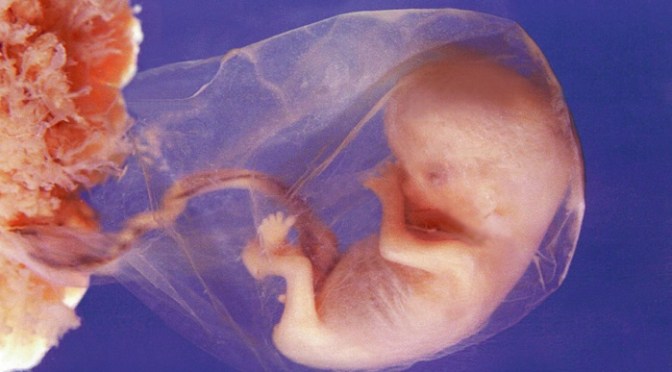
If unborn babies don’t have consciousness or don’t feel pain, may we kill them?

Was having a conversation by e-mail yesterday with a pro-abortion atheist, and he gave two reasons why he supported abortion in the first and second trimester. First, he said that unborn babies can’t feel pain, so it’s OK to kill them. Second, he said that unborn babies don’t have consciousness, so it’s OK to kill them. I thought it might be useful to link to something that answers both of these objections.

Frank Beckwith is the author of “Defending Life: A Moral and Legal Case Against Abortion Choice“, which was published by Cambridge University Press, a top academic press. But before Cambridge University Press, Beckwith wrote four easy-to-understand essays for the Christian Research Journal. Part IV is the one that has the response to the two questions raised by my atheist friend.

Part I. The Appeal to Pity

Part II. Arguments from Pity, Tolerance, and Ad Hominem

Part III. Is The Unborn Human Less Than Human?

Part IV. When Does a Human Become a Person?

Excerpt:

Some ethicists argue that the unborn becomes fully human sometime after brain development has begun, when it becomes sentient: capable of experiencing sensations such as pain. The reason for choosing sentience as the criterion is that a being that cannot experience anything (i.e., a presentient unborn entity) cannot be harmed. Of course, if this position is correct, then the unborn becomes fully human probably during the second trimester and at least by the third trimester. Therefore, one does not violate anyone’s rights when one aborts a nonsentient unborn entity. [13]

There are several problems with this argument. First, it confuses harm with hurt and the experience of harm with the reality of harm. [14] One can be harmed without experiencing the hurt that sometimes follows from that harm, and which we often mistake for the harm itself. For example, a temporarily comatose person who is suffocated to death “experiences no harm,” but he is nevertheless harmed. Hence, one does not have to experience harm, which is sometimes manifested in hurt, in order to be truly harmed.

Second, if sentience is the criterion of full humanness, then the reversibly comatose, the momentarily unconscious, and the sleeping would all have to be declared nonpersons. Like the presentient unborn, these individuals are all at the moment nonsentient though they have the natural inherent capacity to be sentient. Yet to countenance their executions would be morally reprehensible. Therefore, one cannot countenance the execution of some unborn entities simply because they are not currently sentient.

Someone may reply that while these objections make important points, there is a problem of false analogy in the second objection: the reversibly comatose, the momentarily unconscious, and the sleeping once functioned as sentient beings, though they are now in a temporary state of nonsentience. The presentient unborn, on the other hand, were never sentient. Hence, one is fully human if one was sentient “in the past” and will probably become sentient again in the future, but this cannot be said of the presentient unborn.

There are at least three problems with this response. First, to claim that a person can be sentient, become nonsentient, and then return to sentience is to assume there is some underlying personal unity to this individual that enables us to say that the person who has returned to sentience is the same person who was sentient prior to becoming nonsentient. But this would mean that sentience is not a necessary condition for personhood. (Neither is it a sufficient condition, for that matter, since nonhuman animals are sentient.) Consequently, it does not make sense to say that a person comes into existence when sentience arises, but it does make sense to say that a fully human entity is a person who has the natural inherent capacity to give rise to sentience. A presentient unborn human entity does have this capacity. Therefore, an ordinary unborn human entity is a person, and hence, fully human.

Second, Ray points out that this attempt to exclude many of the unborn from the class of the fully human is “ad hoc and counterintuitive.” He asks us to “consider the treatment of comatose patients. We would not discriminate against one merely for rarely or never having been sentient in the past while another otherwise comparable patient had been sentient….In such cases, potential counts for everything.” [15]

Third, why should sentience “in the past” be the decisive factor in deciding whether an entity is fully human when the presentient human being “is one with a natural, inherent capacity for performing personal acts?” [16] Since we have already seen that one does not have to experience harm in order to be harmed, it seems more consistent with our moral sensibilities to assert that what makes it wrong to kill the reversibly comatose, the sleeping, the momentarily unconscious, and the presentient unborn is that they all possess the natural inherent capacity to perform personal acts. And what makes it morally right to kill plants and to pull the plug on the respirator-dependent brain dead, who were sentient “in the past,” is that their deaths cannot deprive them of their natural inherent capacity to function as persons, since they do not possess such a capacity.

These four essays are a very good introduction to common responses to pro-abortion arguments. I recommend that people get familiar with this, as once you look into it, you will see that the abortion issue can be debated with as much confidence as William Lane Craig defends Christian theism. You will have the same access to scientific evidence and rational arguments on this topic, and so you will have the upper hand. And that’s fun.

The best introductory book on the abortion / right to life issue is “The Case for Life” by pro-life debater Scott Klusendorf. The best comprehensive book is a tie between “The Ethics of Abortion” by Christopher Kaczor, and Frank Beckwith’s “Defending Life: A Moral and Legal Case Against Abortion Choice“.

Six reasons why you should believe in non-physical souls

This podcast is a must-listen. Please take the time to download this podcast and listen to it. I guarantee that you will love this podcast. I even recommended it to my Dad and I almost never do that.

Details:

In this podcast, J. Warner examines the evidence for the existence of the mind (and inferentially, the soul) as he looks at six classic philosophical arguments. Jim also briefly discusses Thomas Nagel’s book, Mind and Cosmos and discusses the limitations of physicalism.

The MP3 file is here. (67 MB, 72 minutes)

Topics:

  • Atheist Thomas Nagel’s latest book “Mind and Cosmos” makes the case that materialism cannot account for the evidence of mental phenomena
  • Nagel writes in this recent New York Times article that materialism cannot account for the reality of consciousness, meaning, intention and purpose
  • Quote from the Nagel article:

Even though the theistic outlook, in some versions, is consistent with the available scientific evidence, I don’t believe it, and am drawn instead to a naturalistic, though non-materialist, alternative. Mind, I suspect, is not an inexplicable accident or a divine and anomalous gift but a basic aspect of nature that we will not understand until we transcend the built-in limits of contemporary scientific orthodoxy.

  • When looking at this question, it’s important to not have our conclusions pre-determined by presupposing materialism or atheism
  • If your mind/soul doesn’t exist and you are a purely physical being then that is a defeater for Christianity, so we need to respond
  • Traditionally, Christians have been committed to a view of human nature called “dualism” – human beings are souls who have bodies
  • The best way* to argue for the existence of the soul is using philosophical arguments

The case:

  • The law of identity says that if A = B’ if A and B have the exact same properties
  • If A = the mind and B = the brain, then is A identical to B?
  • Wallace will present 6 arguments to show that A is not identical to B because they have different properties

Not everyone of the arguments below might make sense to you, but you will probably find one or two that strike you as correct. Some of the points are more illustrative than persuasive, like #2. However, I do find #3, #5 and #6 persuasive.

1) First-person access to mental properties

  • Thought experiment: Imagine your dream car, and picture it clearly in your mind
  • If we invited an artist to come and sketch out your dream car, then we could see your dream car’s shape on paper
  • This concept of your dream car is not something that people can see by looking at your brain structure
  • Physical properties can be physically accessed, but the properties of your dream care and privately accessed

2) Our experience of consciousness implies that we are not our bodies

  • Common sense notion of personhood is that we own our bodies, but we are not our bodies

3) Persistent self-identity through time

  • Thought experiment: replacing a new car with an old car one piece at a time
  • When you change even the smallest part of a physical object, it changes the identity of that object
  • Similarly, your body is undergoing changes constantly over time
  • Every cell in your body is different from the body you had 10 years ago
  • Even your brain cells undergo changes (see this from New Scientist – WK)
  • If you are the same person you were 10 years ago, then you are not your physical body

4) Mental properties cannot be measured like physical objects

  • Physical objects can be measured (e.g. – use physical measurements to measure weight, size, etc.)
  • Mental properties cannot be measured

5) Intentionality or About-ness

  • Mental entities can refer to realities that are physical, something outside of themselves
  • A tree is not about anything, it just is a physical object
  • But you can have thoughts about the tree out there in the garden that needs water

6) Free will and personal responsibility

  • If humans are purely physical, then all our actions are determined by sensory inputs and genetic programming
  • Biological determinism is not compatible with free will, and free will is required for personal responsibility
  • Our experience of moral choices and moral responsibility requires free will, and free will requires minds/souls

He spends the last 10 minutes of the podcast responding to naturalistic objections to the mind/soul hypothesis.

*Now in the podcast, Wallace does say that scientific evidence is not the best kind of evidence to use when discussing this issue of body/soul and mind/brain. But I did blog before about two pieces of evidence that I think are relevant to this discussion: corroborated near-death experiences and mental effort.

You might remember that Dr. Craig brought up the issue of substance dualism, and the argument from intentionality (“aboutness”), in his debate with the naturalist philosopher Alex Rosenberg, so this argument about dualism is battle-ready. You can add it to your list of arguments for Christian theism along with all the other arguments like the Big Bang, the fine-tuning, the origin of life, stellar habitability, galactic habitability, irreducible complexity, molecular machines, the Cambrian explosion, the moral argument, the resurrection, biological convergence, and so on.