
Category Archives: News

Feminist explains how she chose to drink alcohol before recreational sex

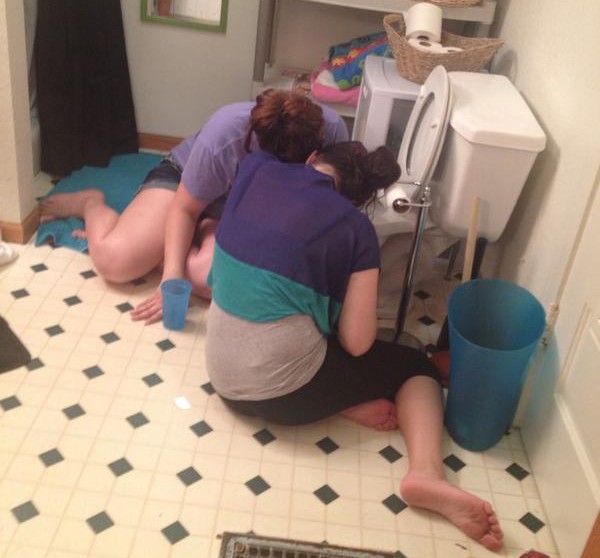
College students puking in toilet

Guess where I’m linking today? To a radical feminist web site named Jezebel, to an article written by a radical feminist who writes for the radically leftist Slate.

No, I’m not crazy. Just read it:

Much of the conversation around alcohol and sex has focused on assault—the line at which intoxication becomes incapacitation, for instance—but what we fail to mention is how haunted people can be by the sex they actually, technically consented to.

[…]I wonder what my sex life would even look like if alcohol hadn’t been there. Alcohol gave me comfort in my own body, and it allowed me to turn my erotic curiosity and hunger for experience into an action plan. I was tired of being the stuttering girl sucking in her stomach after the lights went out. I wanted to be the woman who roamed wild and free.

Alcohol also helped me cut the girlish strings on my heart, an action my college years demanded. Three months into my freshman year, I split a six pack with a dashing sophomore, and we wound up partially clothed on his bed, my bare legs wrapped around his waist, my hands around his neck. I pulled back slightly and asked him the question, the naive question of a girl who does not yet understand her fate: “What does this mean?”

He looked past me, into his studio apartment, and then back into my eyes. “It means that I’m a 19-year-old boy, and we’re having fun.”

What is interesting is that she didn’t see this man’s using her for fun after getting her drunk as any disqualification for a serious relationship. On the contrary, she believes that a serious relationship built on self-sacrificial love and commitment that lasts through difficulties can be found in a man who uses her for fun sex:

I’m not saying I didn’t enjoy that night with the dashing sophomore. I’m saying the fun part for me might have been turning our physical intimacy into a sustained attachment.

Amazing. She wasn’t looking for men with good educations, good jobs, lots of savings, who were sober and chaste – they would have made her unhappy with their bossy leading, and strict plans about courting and marriage. Nope, she wanted the drunken slut who didn’t ask her any questions or have any plan for her to develop into a wife and mother. That’s who she wanted. He was hawt! And he was free, easy and fun.

She is 35 now, and still single. I’m sure if you ask her, she would like to be married “some day”, but who could look at 20 years of drunken sex and say that this is good preparation for the challenges of marriage? Marriage is about self-sacrificial love, and endurance. To prepare for it, you learn self-denial and self-control. You learn how to accept expectations, obligations and responsibilities.

Anyway, back to the article by the drunken, promiscuous feminist. The point that I wanted to make is that she chose the alcohol herself, and that she did it for a very specific reason:

I wanted to have fun, too. And alcohol evened the score. I cared less about everything when I was drinking: What you thought of me, what I looked like in this dress, whether that taco was warm or cold when I stuffed it in my mouth. I don’t want to make it sound like I drank in order to have sex. I drank for a million reasons.

[…]Booze downshifted my intense body consciousness, and it revved up my bravado. Sex was scary—but alcohol made me feel safe.

She drank in order to have sex. Got it? She chose to get drunk in order to have sex. This is the part that permissive parents and pious pastors need to understand about their darling daughters. Many young women think that recreational sex with hot guys is a pathway to marriage. They drink in order to make progress towards the marriage they want – the marriage to the man who is fun. Not the man who is serious. They don’t want the serious man who makes plans and expects them to behave responsibly and honor obligations. They want the fun, hot man – the bad boy – and they expect to change him into a faithful, sober, responsible provider through the magical power of vagina. And if that doesn’t work, by threatening him with divorce.

Why are millenials acting like children into adulthood?

This reminds me of the Institute for American Values study. Despite their name, it is not a conservative organization

Look at this citation from p. 15:

A number of students noted that being drunk could later serve as your excuse for the hook up.

A Yale University student said, “Some people like hook up because they’re drunk or use being drunk as an excuse to hook up.”

A New York University student observed, “[Alcohol is] just part of an excuse, so that you can say, oh, well, I was drinking.”

A Rutgers University student commented, “If you’re drinking a lot it’s easier to hook up with someone… [and] drugs, it’s kind of like a bonding thing… and then if you hook up with them and you don’t want to speak to them again, you can always blame it on the drinking or the drugs.”

[…]A University of Chicago junior observed, “One of my best friends… sometimes that’s her goal when we go out. Like she wants to get drunk so I guess she doesn’t have to feel guilty about [hooking up].”

I think at this point you should assume that if your daughter is not passionate about chastity, natural marriage and pro-life, then she is probably somewhere on this drinking – recreational sex – cohabitation – abortion – no-fault divorce path. The more fun-loving and emotional a woman is, the more likely she is to fall into it, and some of them just work it together with Christianity. Once woman I know was living with a non-Christian man and praying fervently for God to make her career take off. God is there for hope and comfort, not to impose any sort of moral boundaries. And parents and pastors are oblivious – they just want to let women do whatever they want, and then blame men for not making it “work out”. Parents and pastors are not doing the job of explaining to women what their lives will really be like from age 40 to 90, and urging women to make a plan that provides lasting love and and security even as they experience declining youth, declining beauty, and declining fertility.

I hope that many of the men out there who refuse to hold women accountable for their own desires start to understand that not everything a woman wants is good, and not every plan a woman makes will work. Sometimes, you need to calmly and constructively challenge them about their priorities, plans and actions. It’s for their own good.

New study: first life pushed back earlier, leaving less time for naturalist magic

Christianity and the progress of science

Whenever you discuss origins with naturalists, it’s very important to get them to explain how the first living organism emerged without any help from an intelligent agent. The origin of life is an information problem. A certain minimal amount of biological information for minimum life function has to be thrown together by chance. No evolutionary mechanisms have the potential to work until replication is already in place.

Evolution News reports on a new study that makes the window for naturalistic forces to create the first self-replicating organism even smaller.

Excerpt:

A paper in Nature reports the discovery of fossil microbes possibly older, even much older, than any found previously. The lead author is biogeochemist Matthew Dodd, a PhD student at University College London. If the paper is right, these Canadian fossils could be 3.77 billion years old, or even as old as — hold onto your hat, in case you’re wearing one — 4.28 billion years.

From the Abstract:

Although it is not known when or where life on Earth began, some of the earliest habitable environments may have been submarine-hydrothermal vents. Here we describe putative fossilized microorganisms that are at least 3,770 million and possibly 4,280 million years old in ferruginous sedimentary rocks, interpreted as seafloor-hydrothermal vent-related precipitates, from the Nuvvuagittuq belt in Quebec, Canada. These structures occur as micrometre-scale haematite tubes and filaments with morphologies and mineral assemblages similar to those of filamentous microorganisms from modern hydrothermal vent precipitates and analogous microfossils in younger rocks. The Nuvvuagittuq rocks contain isotopically light carbon in carbonate and carbonaceous material, which occurs as graphitic inclusions in diagenetic carbonate rosettes, apatite blades intergrown among carbonate rosettes and magnetite–haematite granules, and is associated with carbonate in direct contact with the putative microfossils.

This new paper is interesting to compare with a paper from last year, Nutman et al., “Rapid emergence of life shown by discovery of 3,700-million-year-old microbial structures,” also in Nature, which found microbial structures that are a bit younger.

But the “microbial structures” from Nutman et al. 2016 are different from these new “microfossils” presented by Dodd et al. 2017. In Nutman et al., they only found stromatolite-type structures rather than actual microfossils. Some stromatolite experts were a bit skeptical that what they found were really stromatolites.

But the new paper by Dodd and his colleagues, “Evidence for early life in Earth’s oldest hydrothermal vent precipitates,” seems to offer potential bacteria-like microfossils. They are tiny black carbonaceous spheres and “hematite tubes” which the authors think are biogenically created. We’ve seen more convincing ancient microfossils, but these aren’t bad.

According to Dodd et al., these new finds would be the oldest known microfossils, if that is in fact what they are. Very interesting. If so, that just keeps pushing unquestionable evidence of life’s existence on Earth further and further back, which leaves less and less time for the origin of life to have occurred by unguided chemical evolution after Earth became habitable.

If they are in fact 4.28 billion years old, then that would mean there was life very, very early in Earth’s history — as Cyril Ponnamperuma said, it’s like “instant life.”

Instant life is “rational” for naturalistic fideists, but for evidence-driven people who understand the long odds on generating even a simple protein by chance, it’s irrationality.

Let’s recall exactly how hard it is to make even a simple protein without intelligent agency to select the elements of the sequence.

The odds of creating even a single functional protein

I’ve talked about Doug Axe before when I described how to calculate the odds of getting functional proteins by chance.

Let’s calculate the odds of building a protein composed of a functional chain of 100 amino acids, by chance. (Think of a meaningful English sentence built with 100 scrabble letters, held together with glue)

Sub-problems:

  • BONDING: You need 99 peptide bonds between the 100 amino acids. The odds of getting a peptide bond is 50%. The probability of building a chain of one hundred amino acids in which all linkages involve peptide bonds is roughly (1/2)^99 or 1 chance in 10^30.
  • CHIRALITY: You need 100 left-handed amino acids. The odds of getting a left-handed amino acid is 50%. The probability of attaining at random only L–amino acids in a hypothetical peptide chain one hundred amino acids long is (1/2)^100 or again roughly 1 chance in 10^30.
  • SEQUENCE: You need to choose the correct amino acid for each of the 100 links. The odds of getting the right one are 1 in 20. Even if you allow for some variation, the odds of getting a functional sequence is (1/20)^100 or 1 in 10^65.

The final probability of getting a functional protein composed of 100 amino acids is 1 in 10^125. Even if you fill the universe with pre-biotic soup, and react amino acids at Planck time (very fast!) for 14 billion years, you are probably not going to get even 1 such protein. And you need at least 100 of them for minimal life functions, plus DNA and RNA.

Research performed by Doug Axe at Cambridge University, and published in the peer-reviewed Journal of Molecular Biology, has shown that the number of functional amino acid sequences is tiny:

Doug Axe’s research likewise studies genes that it turns out show great evidence of design. Axe studied the sensitivities of protein function to mutations. In these “mutational sensitivity” tests, Dr. Axe mutated certain amino acids in various proteins, or studied the differences between similar proteins, to see how mutations or changes affected their ability to function properly. He found that protein function was highly sensitive to mutation, and that proteins are not very tolerant to changes in their amino acid sequences. In other words, when you mutate, tweak, or change these proteins slightly, they stopped working. In one of his papers, he thus concludes that “functional folds require highly extraordinary sequences,” and that functional protein folds “may be as low as 1 in 10^77.”

The problem of forming DNA by sequencing nucleotides faces similar difficulties. And remember, mutation and selection cannot explain the origin of the first sequence, because mutation and selection require replication, which does not exist until that first living cell is already in place.

Study: brain of child neglected by mother is smaller and underdeveloped

Dina sent me this article from the UK Daily Mail. In the past, I’ve written about how much children need their fathers, but this time I’m focusing on how much children need their mothers, especially in the first 5 years of development.

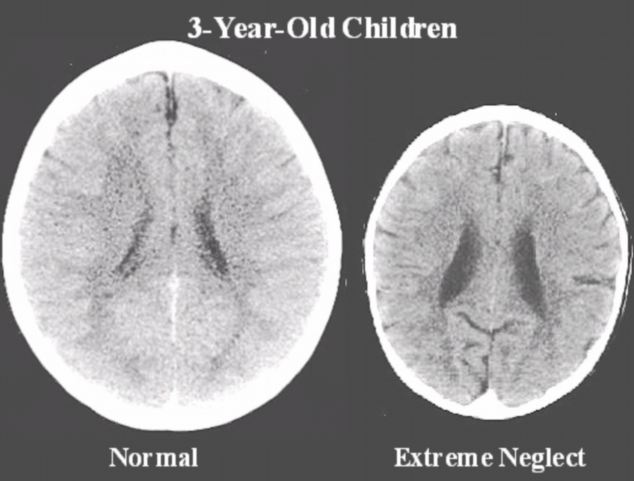
Here is two brain scans to compare:

Brain scans of 3-year old children: normal vs neglected

Excerpt:

Both of these images are brain scans of a two three-year-old children, but the brain on the left is considerably larger, has fewer spots and less dark areas, compared to the one on the right.

According to neurologists this sizeable difference has one primary cause – the way each child was treated by their mothers.

The child with the larger and more fully developed brain was looked after by its mother – she was constantly responsive to her baby, reported The Sunday Telegraph.

But the child with the shrunken brain was the victim of severe neglect and abuse.

According to research reported by the newspaper, the brain on the right worryingly lacks some of the most fundamental areas present in the image on the left.

The consequences of these deficits are pronounced – the child on the left with the larger brain will be more intelligent and more likely to develop the social ability to empathise with others.

But in contrast, the child with the shrunken brain will be more likely to become addicted to drugs and involved in violent crimes, much more likely to be unemployed and to be dependent on state benefits.

The child is also more likely to develop mental and other serious health problems.

Professor Allan Schore, of UCLA, told The Sunday Telegraph that if a baby is not treated properly in the first two years of life, it can have a fundamental impact on development.

He pointed out that the genes for several aspects of brain function, including intelligence, cannot function.

[…]The study correlates with research released earlier this year that found that children who are given love and affection from their mothers early in life are smarter with a better ability to learn.

The study by child psychiatrists and neuroscientists at Washington University School of Medicine in St. Louis, found school-aged children whose mothers nurtured them early in life have brains with a larger hippocampus, a key structure important to learning, memory and response to stress.

The research was the first to show that changes in this critical region of children’s brain anatomy are linked to a mother’s nurturing, Neurosciencenews.com reports.

The research is published online in the Proceedings of the National Academy of Sciences Early Edition.

Lead author Joan L. Luby, MD, professor of child psychiatry, said the study reinforces how important nurturing parents are to a child’s development.

My friend Katy tweeted this article from far-left NPR:

Parents do a lot more than make sure a child has food and shelter, researchers say. They play a critical role in brain development.

More than a decade of research on children raised in institutions shows that “neglect is awful for the brain,” says Charles Nelson, a professor of pediatrics at Harvard Medical School and Boston Children’s Hospital. Without someone who is a reliable source of attention, affection and stimulation, he says, “the wiring of the brain goes awry.” The result can be long-term mental and emotional problems.

The article goes on to talk about children who grow up without mothers in Romanian orphanages:

As the children grew older, the researchers were able to use MRI to study the anatomy of their brains. And once again, the results were troubling. “We found a dramatic reduction in what’s referred to as gray matter and in white matter,” Nelson says. “In other words, their brains were actually physically smaller.”

The scientists realized the cause wasn’t anything as simple as malnutrition. It was a different kind of deprivation — the lack of a parent, or someone who acted like a parent.

A baby “comes into the world expecting someone to take care of them and invest in them,” Nelson says. “And then they form this bond or this relationship with this caregiver.” But for many Romanian orphans, there wasn’t even a person to take them out of the crib.

“Now what happens is that you’re staring at a white ceiling, or no one is talking to you, or no one is soothing you when you get upset,” Nelson says. So areas of the brain involved in vision and language and emotion don’t get wired correctly.

I expect the woman I marry (if I marry) to have a college degree, and preferably a graduate degree, and a couple of years of employment. But I think to be fair to the research on child development, she has to stay home and invest in those children through the first five years at least. After that she can stay home or work as much as she thinks is beneficial to the family goals of impacting the university, the church and the public square – as well as continuing to raise those children.  I would take over more of the parenting as the children’s needs changed. When it comes to children, we work backward from their needs, and those needs create responsibilities and obligations on the grown-ups. That doesn’t mean the children are spoiled – it means that they get what they need.

Christian parents have to go even further

Here is a relevant post from Lindsay, a Christian mother who has a graduate degree in biology and was teaching biology before leaving her career to care for her children.

She writes:

Now, can a woman handle the logistics of the home, ensure her family is cared for, and still work outside the home? Perhaps, in some cases – especially if they do not yet have children. But no woman is Superwoman. We all have limitations. It’s just not possible for any woman to adequately care for children and home while holding down a full time job. The care of children and the home is primarily a woman’s responsibility in a way it isn’t for her husband. If there are no children, it may be possible for her to care for the home and her husband and still keep a job outside the home, but she must keep the home and her husband as her priority.

Once children arrive, it becomes pretty much impossible for her to work outside the home and still fulfill her duties at home. The funny thing about children is that they need constant care. One cannot care for children and work outside the home too. The choice once children come along is whether to outsource the care of the children to someone else or to do it yourself. I firmly believe that God entrusts children to a husband and wife because he wants them to be the primary influences in their children’s lives. That doesn’t happen if the children spend a majority of their waking hours in the care of someone else.

Children don’t just need food and shelter provided to them, they need love, teaching, discipline, a sense of security, and examples of how they are to live. All of those things are best done when the child spends time primarily with his or her parents. Daycare workers, school teachers, and even grandparents simply cannot provide them in the same way parents can. No one loves a child like his own parents do. No one has such a vested interest in ensuring that he grows up with the proper spiritual and moral training. Even if others care about the child, the responsibility for the training of a child belongs to his parents. Daycare workers and teachers and grandparents won’t answer to God for the soul of that child. His parents will.

For Christian parents, the stakes are even higher. Not only do they have to care about basic needs of child, but the higher spiritual needs as well. Men really need to be careful to pick a mother for their child who has demonstrated ability in caring for the needs of others, letting the needs of others override her own selfish desires.