Texas senator Ted Cruz, his wife Heidi Cruz and their two daughters
Many people today think that biological fathers are not essential for raising daughters. In fact, we even support this view by passing no-fault divorce laws, single-mother welfare laws, and by opposing shared parenting laws. The story goes that children do fine without their biological father in the home. Having children is something that women decide to do, and the man is superfluous. So I thought it might be a good idea to take a look at the research.
The dynamic between fathers and their daughters has been characterized by one expertas the most “fragile and unstable” when compared to other parent-child relationships.1 It can be further described as one of the most powerful and vital relationships to individuals, communities, and nations. For instance, fathers have a profound impact on their daughters’ body image,2 clinical depression, eating disorders,3 self-esteem, and life satisfaction,4 to name but a few.
But of all the unique contributions a father makes in his daughter’s life, perhaps there is none of greater significance than in the area of sexual development and activity and romantic relationships.
Numerous studies have discovered female pubertal timing occurs later in girls whose fathers are consistently present in their life.5
An extensive body of research has revealed that early pubertal maturation in girls is associated with a variety of negative biological, psychological, and social outcomes, including, mood disorders,6 substance abuse,7 adolescent pregnancy,8 and a variety of cancers of the reproductive system.9
Fatherless daughters are seven times more likely to become pregnant as teens.10
[…]The conditions in our culture of both rampant fatherlessness and sexual promiscuity are incompatible with forming secure and healthy relationships with boys and with establishing stable families for the next generation. A young girl’s sexual development can significantly outpace her neurological and emotional development—the very resources needed to guide her sexual choices.
Herein lies the danger. Much of our culture today promotes sexual activity but void of healthy attachment or true intimacy. There is a great deal of evidence to suggest that high levels of father involvement (regardless of dad’s marital status) are predictive of high levels of intimacy, commitment, and trust in young female adults’ romantic relationships; whereas low levels of father involvement are predictive of the opposite.11
And:
How a father treats both his daughter and her mother can help a young woman feel safe and secure in her relationships with the boys and men in her life, including her future husband. Family scientists and evolutionary psychologists have discovered that girls appear to be born with an emotional, relational, and evolutionary void that a father is designated to fill. If left vacant, girls will be more likely to seek to fill it in with other, unhealthier substitutes. The father-daughter relationship is the one that best teaches young women about true love and intimacy, self-worth, and respect.
Professor Linda Nielsen summarized this in one profound sentence: “[T]he father has the greater impact on the daughter’s ability to trust, enjoy, and relate well to the males in her life.”
So, a father’s love keeps her from getting into relationships with boys before the boys are ready to commit to her. By the way, I don’t think that boys should even be allowed to TALK to girls about a relationship, unless they have a STEM degree, and two years of private sector work experience. I really hate when unemployed, penniless boys waste a girl’s time when they can’t afford to commit to her. People think I am pretty rough on women, but I really am much meaner to men who don’t have STEM degrees and gapless resumes. (I guess a skilled trade would work as well, in place of the STEM degree – something like electrician, for example).
Anyway, back to the research. When a woman is deciding which men to have sex with, she has to be thinking of more than just her own needs. She has to choose a man who is going to stick around long enough to raise her daughters, so that they grow up with the confidence to resist the advances of boys who aren’t ready to commit. To be pro-woman means to be pro-daughter, and that means that women need to be persuaded to be careful about the choice of sex partner, and the timing of sexual activity. This is why people used to keep sex for marriage in the past: to protect children by making sure that they would get the stability and engagement they need from their parents.
Also, I have talked about the research about father-son bond in a different post.
If you want to do right for your children, then you need to control yourself and make wise choices. And if you’re struggling to make good choices, then don’t leave it up to your emotions and peer approval. Disregard your emotions. Disregard peer approval. Instead, let your decision-making be guided by your Christian convictions, and strengthened with scientific evidence. The Bible tells you not to have sex before you’re married, and science tells you why this is good policy. The Bible gives you the goals, and science tells you how to how the world works, so you know how to make plans that will make sure you are never in a place where you are pressured to do the wrong thing. The more science you pack into your head, the easier it will be for you to convince yourself to do the right thing, and to convince your partner to do the right thing. Science takes moral decision-making outside the realm of feelings and opinions.
And if your partner says “I don’t care about the needs of our future children”, then you have a good reason to dump them and move on. You can’t be in a relationship with someone who thinks that children’s needs are less important than adult desires. In fact, the whole design for relationships should start with what children need from the marriage and parents, and work backward from there to the obligations on the man and the woman. And men and women ought to discuss this. What are we trying to achieve with this relationship anyway? And what is the right way to achieve it? This is where the research comes in – it shows you how to do it right.
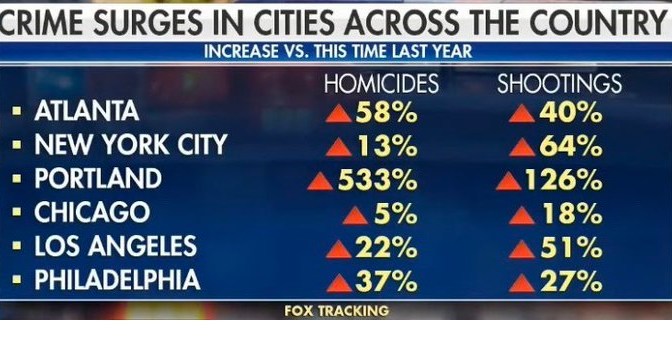
So, there is a narrative going around that the current surge in violent crime in Democrat-run cities is caused by law-abiding people purchasing more firearms legally. The news media say this surge in violent crime is NOT caused by Democrats defunding the police, nor by Black Lives Matters rioting and looting, nor by Antifa militias committing domestic terrorism. Let’s take a look at the evidence.
This was reported by the EXTREME FAR-left UK Guardian. And when I say extreme far-left, I mean you cannot go any further to the left – these people are Stalinists.
Excerpt:
Gun homicides surged across the United States during the coronavirus pandemic, in the same year that Americans bought a record-breaking number of guns.
But some of America’s leading gun violence researchers have concluded that what might seem like an obvious cause-and-effect – a surge in gun buying leads to a surge in gun violence – is not supported by the data.
Through July of last year, there was no clear association between the increase in firearm purchases and the increase in most interpersonal gun violence at the state level, according to a new study published in Injury Epidemiology, a peer-reviewed scientific journal.
The findings suggest that “we need to be looking at other factors, like job loss, economic change, the closure of schools and community organizations and nonprofits, and civil unrest,” in order to understand last year’s increase in gun violence, Julia Schleimer, the lead author of the new study, said.
There did appear to be some association between the increase in gun-purchasing and an increase in domestic violence gun injuries in April and May, but that correlation might also be explained by other factors, including increased substance abuse or the decreased access to domestic violence support services during the early months of lockdown, Schleimer said.
The results of the new study are an unexpected addition to the fierce political battle over how to explain last year’s estimated 25% increase in homicides, which experts say they expect will be the worst single-year increase in killings since the 1960s. While official government data is not yet available, experts are projecting that the US saw an additional 4,000 to 5.000 total homicides nationwide in 2020, and the nonprofit Gun Violence Archive recorded nearly 4,000 additional gun homicides last year compared with 2019.
I’ve noticed that leftists in the news media, social media and government want to ignore all the arson, theft, murders, rapes, and other crime caused by the Black Lives Matter movement and the Antifa militias. The entire edifice of federal law enforcement has been focused like a laser beam on those dangerous people who believe in the Constitution, get married, work full-time, and vote Republican. So, I hope that studies like this will help conservatives to engage with independents and counter that deluded narrative.
Gun ownership up, gun violence down
The peer-reviewed research
Whenever I get into discussions about gun control, I always mention two academic books by John R. Lott and Joyce Lee Malcolm.
Here is a paper by Dr. Malcolm that summarizes one of the key points of her book.
Excerpt:
Tracing the history of gun control in the United Kingdom since the late 19th century, this article details how the government has arrogated to itself a monopoly on the right to use force. The consequence has been a tremendous increase in violent crime, and harsh punishment for crime victims who dare to fight back. The article is based on the author’s most recent book, Guns and Violence: The English Experience (Harvard University Press, 2002). Joyce Malcom is professor of history at Bentley College, in Waltham, Massachusetts. She is also author of To Keep and Bear Arms: The Origins of an AngloAmerican Right (Harvard University Press, 1994).
And the result of the 1997 gun ban:
The result of the ban has been costly. Thousands of weapons were confiscated at great financial cost to the public. Hundreds of thousands of police hours were devoted to the task. But in the six years since the 1997 handgun ban, crimes with the very weapons banned have more than doubled, and firearm crime has increased markedly. In 2002, for the fourth consecutive year, gun crime in England and Wales rose—by 35 percent for all firearms, and by a whopping 46 percent for the banned handguns. Nearly 10,000 firearms offences were committed.
[…]According to Scotland Yard, in the four years from 1991 to 1995 crimes against the person in England‟s inner cities increased by 91 percent. In the four years from 1997 to 2001 the rate of violent crime more than doubled. The UK murder rate for 2002 was the highest for a century.
I think that peer-reviewed studies – from Harvard University, no less – should be useful to those of us who believe in the right of self-defense for law-abiding people. The book by economist John Lott, linked above, compares the crime rates of all U.S. states that have enacted concealed carry laws, and concludes that violent crime rates dropped after law-abiding citizens were allowed to carry legally-owned firearms. That’s the mirror image of Dr. Malcolm’s Harvard study, but both studies affirm the same conclusion – more legal firearm ownership means less crime.
British Spitfire and German Messerschmitt Me 109 locked in a dogfight
Here’s a debate with a well-qualified atheist and Dr. Craig.
Video:
Audio:
Description from the Youtube upload:
This debate on “Does God Exist?” took place in front of a capacity audience at the Great Hall, University of Birmingham. It was recorded on Friday 21st October 2011 as part of the UK Reasonable Faith Tour with William Lane Craig.
William Lane Craig is Research Professor of Philosophy at Talbot School of Theology, La Mirada, California and a leading philosopher of religion. Peter Millican is Gilbert Ryle Professor of Philosophy at Hertford College, University of Oxford and a noted scholar in studies of Hume.
The debate was hosted by the University of Birmingham Student Philosophy Society, and the debate was moderated by Professor Carl Chinn.
Dr. Millican proved to be an amazing debater, and that allowed Dr. Craig to show the full range of his talents in a way that he has never done before. This was a great debate – right up there with Craig’s two debates against Austin Dacey and Paul Draper. Dr. Millican is excellent at analytical philosophy, had studied cosmology and physics, and he came prepared to answer Craig’s arguments. There is NO SNARK in my debate summary below, out of respect for Dr. Millican. However, I haven’t proof-read it, so please do point out any errors. There is about 30 minutes of Q&A time at the end.
Dr. Craig’s opening speech:
There are good reasons to believe that God exists.
There are no good reasons to believe that God does not exist.
A1) The origin of the universe
The universe began to exist
If the universe began to exist, then the universe has a transcendent cause.
The universe has a transcendent cause.
The origin of the universe is confirmed by philosophical arguments and scientific evidence.
There cannot be an actual infinite number of past events, because mathematical operations like subtraction and division cannot be applied to actual infinities.
The Borde-Guth-Vilenkin (BGV) proof shows that every universe that expands must have a space-time boundary in the past. That means that no expanding universe, no matter what the model, cannot be eternal into the past.
Even speculative alternative cosmologies do not escape the need for a beginning.
The cause of the universe must be transcendent and supernatural. It must be uncaused, because there cannot be an infinite regress of causes. It must be eternal, because it created time. It must be non-physical, because it created space. There are only two possibilities for such a cause. It could be an abstract object or an agent. Abstract objects cannot cause effects. Therefore, the cause is an agent.
A2) The fine-tuning of the universe
The fine-tuning of the universe is either due to law, chance or design.
It is not due to law or chance.
Therefore, it is due to design.
The progress of science has revealed that the Big Bang was fine-tuned to allow for the existence of intelligent life.
Type 1: Constants like the gravitational constant are finely-tuned, and are not dependent on the laws of physics.
Type 2: Quantities like the amount of entropy in the universe, are not dependent on the laws of physics.
The range of life-permitting values is incredibly small compared to the possible values of the constants and quantities. (Like having a lottery with a million black balls and one white ball, and you pick the white ball. Even though each individual ball has the same tiny chance of being picked, but the odds are overwhelming that the whichever ball you pick will be black, and not white).
Not only are the numbers not due to laws, but they are not due to chance either. It’s not just that the settings are unlikely, it’s that they are unlikely and they conform to an independent pattern – namely, the ability to support complex life.
A3) The moral argument
If God does not exist, then objective moral values do not exist.
Objective morality does exist.
Therefore, God exists.
Objective moral values are values that exist independently of whether any humans believe them or not.
Michael Ruse, an atheist philosopher agrees that if God does not exist, then there is only a “herd morality” that is determined by biological evolution and social evolution. There no objective moral standard, just different customs and conventions that vary by time and place. Anyone who acts against the herd morality is merely being unfashionable and unconventional. On the atheistic view, there is nothing objective and binding about this evolved “herd morality”. However, people do experience objective moral values, and these cannot be grounded on atheism.
Furthermore, God must exist in order to argue that there is evil in the world. In order to be able to make a distinction between good and evil that is objective, there has to be a God to determine a standard of good and evil that is binding regardless of the varying customs and conventions of different people groups. Even when a person argues against God’s existence by pointing to the “evil” in the world, they must assume objective moral values, and a God who grounds those objective moral values.
A4) The resurrection of Jesus.
There are certain minimal facts that are admitted by the majority of historians, across the ideological spectrum: the empty tomb, the appearances and the early belief in the resurrection.
Naturalistic attempts to explain these minimal facts fail.
The best explanation of these facts is that Jesus rose from the dead.
A5) Religious experience
People can know that God exists through experience. In the absence of defeaters for these experiences, these experiences constitute evidence for God’s existence.
Dr. Millican’s opening speech:
Dr. Craig has the burden of proof because he claims that God exists.
The Christian God hypothesis:
An omnipotent, omniscient, omnibenevolent God created the universe.
This God cares about humans.
This God has acted in history though the life of Jesus of Nazareth.
This is a factual claim, and we are discussing the evidence for whether these claims are true or false. We are not interested in religious practice, or the consolation of religious belief, nor any other religions.
A1) Religious pluralism and epistemology
Human beings are purpose-finding creatures – we are prone to prefer explanations that involve purpose.
Human beings are pattern-finding animals – we tend to find designs in states of affairs.
Human beings have an interest in maintaining religious hierarchies because of the power it gives them.
Religious beliefs are not determined by rational considerations, but are determined by geographic location.
The same non-scientific method of generating religious beliefs (purpose-finding, pattern-finding, geographic location, parental teaching, charismatic speakers, praise songs and worship, religious education, ancient holy books) is being used in several religions, and it leads to different, contradictory truth claims. So at least some of those conflicting claims are false. And if the method is generating some false claims, then it’s not a good method, and it undermines all the religions that use those methods.
A2) Absence of evidence is evidence of absence
There is no scientific evidence for God.
A3) Mental processes depend on physical systems
There is no scientific evidence for a disembodied intelligence.
Our universal human experience is that intelligence and mental operations require a physical brain.
The quality of our thinking depends on physical conditions, like being tired or on drugs.
But Christian theists believe that mental processes can exist independently of an underlying physical reality, unimpaired by the death of the physical body and the brain.
R.A1) The origin of the universe
1. There is no evidence that whatever begins to exist requires a cause. All the evidence we have of things beginning to exist are when something is created from rearrangements of other things that already existed.
The closest analog we have to something coming into being from nothing is quantum particles coming into being from nothing, and that causation is random.
There is no evidence that thoughts can bring about physical effects, and Bill is arguing for a mental cause to the origin of the universe.
Even if things that begin to exist IN the universe have causes, it doesn’t hold for the universe as a whole. Bill is committing the fallacy of composition.
Time begins with the universe, but our experience of causation is that it is a temporal process. So if there is no time “prior to” the universe’s beginning, then how can there be a cause to the universe?
It’s possible that there could be something outside our universe that is eternal.
It’s also possible that the Big Bang could be wrong, and this universe could oscillate eternally and not require a beginning.
2. There are cosmological theories that avoid the beginning of the universe by positing a prior period of contraction prior to the Big Bang.
The beginning of this universe depends on general relativity, and that theory breaks down at the level of quantum mechanics.
3. There is no evidence that minds can exist without an underlying physical system. So even if there is a cause of the universe, then it is neither an abstract object nor a mind. It would have to be something else, and not something we are familiar with – we are just not in a position to speculate of what it could be.
R.A3) The moral argument
Atheists do believe in a standard of morality that is not based on what groups of humans believe.
Utilitarians think there is a standard of moral values that is objective, because the measure of human happiness (for the greatest number) is objective, even if people are mistaken about what promotes that happiness.
Kantians have a rational process for determining which moral imperatives should be universalized.
Humeans have a system that is rooted in natural human sentiment.
Dr. Craig’s first rebuttal:
I do not have the only burden of proof. The topic is “Does God Exist?”. If Dr. Millican answers “no” then he has a burden of proof, otherwise we are left with agnosticism.
R.A1) Religious pluralism and epistemology
First, there is no single common method of adopting a religion.
Second, MY method this evening is logic and evidence and personal experience – which is the same as his method. So his comments about how people in different religions adopt their religion through parents, church, singing, etc. have no bearing on the arguments I will be making.
R.A2) Absence of evidence is evidence of absence
Absence of evidence is only evidence of absence if we can reasonably expect that there should be some evidence that is not present. He would have to show that there should be more evidence for God’s existence that the 5 arguments that I already presented – something that we should expect to see that we don’t see.
R.A3) Mental processes depend on physical systems
No response by Dr. Craig. (but see below)
A1) The origin of the universe
1. He says that there are speculative cosmologies like the multiverse that escape the need for a beginning, but that’s false, the BGV proof applies to them, and they do need a beginning.
He says that you can escape BGV by positing a contraction prior to the expansion. However Vilenkin says that any contraction phase is unstable and would introduce additional singularities that would hamper any later expansion phase.
He says that we need a theory of quantum gravity in order to describe the early universe. But Vilenkin says that the BGV proof is independent of gravity as defined by general relativity.
He did not respond to the philosophical arguments for a beginning of the universe.
2. He says that we don’t have experience of things coming into being except from material causes. However, it would be even more difficult to explain the universe coming into being on atheism since you can’t appeal to a material cause nor to an efficient cause. Even Hume recognizes that things can’t pop into being without causes.
He talks about how in quantum physics virtual particles appear out of nothing. But that’s false, because the quantum vacuum in which virtual particles appear is not nothing, it is a sea of subatomic particles and energy. Quantum physics is not an exception to the idea that things that come into being require a cause.
He mentions the fallacy of composition. But I am not saying that everything in the universe has a cause, therefore the universe as a whole has a cause. I am saying that non-being has no capacity to bring something into being. Non-Being doesn’t even have the potential to bring something into being.
3. He says that there are no unembodied minds, so the cause of the universe can’t be an unembodied mind. But the argument concludes that there is a non-material cause, and it can’t be an abstract object, so it would have to be a mind.
In addition, we ourselves are unembodied minds. This is because physical objects cannot have the properties that minds have, like the property of having feelings.
Material conceptions of mind don’t explain identity over time.
Material conceptions of mind don’t explain free will.
Material conceptions of mind don’t explain intentional states (thinking about something).
Material conceptions of mind don’t explain mental causation.
The best explanation for our own first person experience of the mental realm is a substance dualism. We are non-material minds, and we can cause effects in the physical world. And God does the same thing. He is a mind, and he causes physical effects.
A2) He gave no response.
A3) He says that there are atheistic theories of morality that don’t depend on the opinions of groups. But these theories all depend on the idea that human beings have instrinsic value – that they are the sorts of things to which moral considerations apply. Naturalism cannot ground this moral value – human beings are no more valuable any other animal.
Also, there are no objective moral obligations in naturalist systems of morality, because there is no one in authority to command them. Moral prescriptions require moral prescribers.
A4) He gave no response.
A5) He gave no response.
Dr. Millican’s first rebuttal:
R.A2) The fine-tuning argument
We have to be careful not to judge what counts as finely-tuned through our intuitions.
We have to be careful about reasoning for a sample size of this one observable universe.
We don’t really know about the full range of possibilities for these constants and quantities.
There might be other universes that we can’t observe that aren’t fine-tuned, and we just happen to be in the one that is fine-tuned.
The fine-tuning might be solved by future discoveries, like the inflationary cosmology removed some of the fine-tuning.
There might be a multiverse that we don’t have evidence for right now.
We need to be careful about using science to prove God because science might change in the future.
The universe is very big and mysterious.
This argument doesn’t prove that God is good. He could be evil = anti-God.
God created the universe inefficiently if his goal was to produce life.
God created the universe too big.
God created the universe too old.
God created too many galaxies and stars that are not hospitable to life.
If the universe were fine-tuned for life, then there should be more aliens.
If the universe were fine-tuned for life, then there are probably lots of alien civilizations. But then Jesus would have to appear to all of the aliens too.
R.A1) The origin of the universe
2. It’s not a big deal that you can get multiple solutions to equations involving subtraction of actual infinities. For example, the equation 0 x y = 0 has many solutions for y, but that doesn’t mean that multiplication doesn’t work in the real world.
A2) Absence of evidence is evidence of absence
I would expect that there would be more evidence than there is.
R.A1) The origin of the universe
2. The BVG proof might be overturned by future scientific discoveries. We have no reason to be confident in current physics.
I agree that the quantum vacuum is something and not nothing, but it’s similar to nothing.
We don’t have any reason to believe that things that come into being require causes – except for our universal experience that this is always the case.
3. As to the cause of the universe coming into being, you said that it could only be an abstract object or a mind, and it can’t be an abstract object because they don’t cause effects, so it must be a mind. But there are all sorts of things we’ve never thought of that it could be other than a mind.
I agree that mental properties are not physical properties and that epiphenomenalism is incorrect. Physical objects can have “algorithmic properties” as well as physical properties, it doesn’t mean that computers have minds.
Dr. Craig’s second rebuttal:
R.A2) Absence of evidence is evidence of absence
He expressed his personal opinion that there should be more evidence, but that’s not an argument.
God knows how people will respond to getting more evidence or less evidence and he has to be careful not to take away their free will to disbelieve by piling them up with coercive evidence. God’s goal is not just to convince people that he exists. God’s goal is to have people respond to him and pursue him.
A1) The origin of the universe
2. He said that multiple answers to equations are no problem. But the problem is that you can’t translate multiple answers into a real world context.
The problem is that you are subtracting an identical number from an identical number and getting contradictory results, and that cannot be translated into the real world, where subtraction always gives a definite single result.
He talks about how you can get multiple answers with multiplication by 0. But 0 is not a real quantity, it is just the absence of something, and that cannot translate into the real world, because it has no being.
He says that I am only using evidence from current physics. But that is the point – the evidence of current physics and cosmology supports the beginning of the universe.
3. He said that an umembodied mind can’t be the cause, but we are minds and we cause effects on our physical bodies.
In addition, the design argument supports the idea that the cause of the universe is intelligent.
A2) The fine-tuning of the universe
He says we should be cautious. Of course.
He says the probabilities can’t be assessed. But you can just take the current value and perturb it and see that the resulting universe loses its ability to support life, and you can test an entire range around the current value to see that that vast majority of values in the range don’t permit life.
He says that the current physics is not well-established, but there are so many examples of fine-tuning across so many different areas of science that it is not likely that all of them will be overturned, and the number of finely-tuned constants and quantities has been growing, not shrinking.
He says it doesn’t prove that God is good, and he’s right – that’s what the moral argument is for.
He says that God isn’t efficient enough, but efficiency is only important for those who have limited time and/or limited resources. But God has unlimited time and resources.
He says that the universe is too old, but the large age of the universe is a requirement to support intelligent life – (i.e. – you need third generation stars to provide a stable source of energy to planets, and those stars require that two generations of stars are born and die).
He said what about aliens, and theists are open to that, and God can certainly provide for the salvation of those beings, if they have fallen into sin.
Dr. Millican’s second rebuttal:
R.A1) The origin of the universe
3. Just because epiphenominalism is false, it doesn’t mean that substance dualism is true.
The majority of philosophers of mind do not accept substance dualism.
R.A3) The moral argument
The majority of philosophers are moral realists, but a minority of philosophers are theists. So that means that there must be some way of justifying morality on atheism, which I will not describe right now.
Atheists can express their opinion that humans have intrinsic moral value.
He grants that atheists can perceive moral values. But if atheists can perceive moral values, then why is God needed to enable that?
Atheists can express their opinion that humans are special. We can be rational, and that makes us special.
Atheists can express their opinion that it is good to care about other humans because they are of the same species.
R.A4) The resurrection of Jesus
We don’t have any reasons to believe i the supernatural.
The gospels are written late for the purposes of evangelism.
The gospels are not independent, e.g. Matthew and Luke depend on Q.
John is the latest gospel, and the Christology of John is the highest of all.
The four gospels agree because the early church rejected other (unnamed) gospels that didn’t agree.
Matthew 27 – the earthquake and the raised saints – is not recorded in any other contemporary non-Christian source.
Dr. Craig’s final rebuttal:
A3) The moral argument
He says that human beings are rational, and that gives them value. But atheists like Sam Harris prefer the flourishing of sentient life. He includes non-rational animals as having moral value. So without God, we see that the choice of who or what has moral value is arbitrary. And where would objective moral duties come from if there is no moral lawgiver?
The fact that most atheists accept objective moral values doesn’t mean that they can rationally ground those values on their atheistic worldview. You can’t provide a basis for moral values on atheism by counting the number of atheists who accept objective morality. It’s not surprising that atheists can perceive objective moral values IF they are living in auniverse created by God who grounds these objective moral values and duties that atheists perceive.
A4) The resurrection of Jesus
He cites Geza Vermes and Bart Ehrman as authorities on the historical Jesus, but both of them accept all three of the facts that I presented as minimal facts. Ehrman doesn’t accept the resurrection of Jesus because he presupposes naturalism. He rejects the resurrection on philosophical grounds, not historical grounds.
Dr. Millican’s final rebuttal:
R.A5) Religious experience
Religious experience is an unreliable way to test the claims of a religion, because lots of religions have them and they make contradictory truth claims. In the future, we may discover naturalistic ways of explaining religious experience.
R.A4) The resurrection of Jesus
Even if you can make a case for the resurrection based on these3 minimal facts, there are other stories in the New Testament like Matthew 27 that are quite weird and they undermine the 3 minimal facts that even Geza Vermes and Bart Ehrman accept.
R.A1) The origin of the universe
Bill hasn’t shown that there is any reason for thinking that things don’t come into being, uncaused, out of nothing.
A4) The problem of evil
Theists can’t explain what God’s specific morally sufficient reasons are for permitting the apparently gratuitous evil that we see.




 WINTERY KNIGHT