Category Archives: News

Luke Barnes on the fine-tuning of the strong force and fine structure constant

By now, anyone who has had discussions about scientific evidence for the existence of God knows about the fine-tuning argument. In a nutshell, if the fundamental constants and quantities given in the Big Bang were even slightly other than they are, then the universe itself would not be hospitable for complex, embodied intelligent life.

Here is an article from The New Atlantis written by Australian cosmologist Luke Barnes.

Excerpt:

Today, our deepest understanding of the laws of nature is summarized in a set of equations. Using these equations, we can make very precise calculations of the most elementary physical phenomena, calculations that are confirmed by experimental evidence. But to make these predictions, we have to plug in some numbers that cannot themselves be calculated but are derived from measurements of some of the most basic features of the physical universe. These numbers specify such crucial quantities as the masses of fundamental particles and the strengths of their mutual interactions. After extensive experiments under all manner of conditions, physicists have found that these numbers appear not to change in different times and places, so they are called the fundamental constants of nature.

[…]A universe that has just small tweaks in the fundamental constants might not have any of the chemical bonds that give us molecules, so say farewell to DNA, and also to rocks, water, and planets. Other tweaks could make the formation of stars or even atoms impossible. And with some values for the physical constants, the universe would have flickered out of existence in a fraction of a second. That the constants are all arranged in what is, mathematically speaking, the very improbable combination that makes our grand, complex, life-bearing universe possible is what physicists mean when they talk about the “fine-tuning” of the universe for life.

Let’s look at an example – the strong force. Not only must the strong force be fine-tuned so we have both hydrogen and helium, but the ratio of the strong force must also be fine-tuned with the fine structure constant.

Barnes writes:

The strong nuclear force, for example, is the glue that holds protons and neutrons together in the nuclei of atoms. If, in a hypothetical universe, it is too weak, then nuclei are not stable and the periodic table disappears again. If it is too strong, then the intense heat of the early universe could convert all hydrogen into helium — meaning that there could be no water, and that 99.97 percent of the 24 million carbon compounds we have discovered would be impossible, too. And, as the chart to the right shows, the forces, like the masses, must be in the right balance. If the electromagnetic force, which is responsible for the attraction and repulsion of charged particles, is too strong or too weak compared to the strong nuclear force, anything from stars to chemical compounds would be impossible.

Here’s the chart he’s referencing:

Fine-tuning of the strong nuclear force and the fine structure constant

As you can see from the chart, most of the values that the constants could take would make complex, embodied intelligent life impossible.

We need carbon (carbon-based life) because they form the basis of the components of life chemistry, e.g. proteins, sugars, etc. We need hydrogen for water. We need chemical reactions for obvious reasons. We need the light from the stars to support plant and animal life on the surface of a planet. And so on. In almost every case where you change the values of these constants and quantities and ratios from what they are, you will end up with a universe that does not support life. Not just life as we know it, but life of any conceivable kind under these laws of physics. And we don’t have any alternative laws of physics in this universe.

By the way, just to show you how mainstream these examples of fine-tuning are, I thought I would link to a source that you’re all going to be familiar with: The New Scientist.

The fine-tuning of the force of gravity

So here is an article from the New Scientist about a different constant that also has to be fine-tuned for life: the force of gravity.

Excerpt:

The feebleness of gravity is something we should be grateful for. If it were a tiny bit stronger, none of us would be here to scoff at its puny nature.

The moment of the universe‘s birth created both matter and an expanding space-time in which this matter could exist. While gravity pulled the matter together, the expansion of space drew particles of matter apart – and the further apart they drifted, the weaker their mutual attraction became.

It turns out that the struggle between these two was balanced on a knife-edge. If the expansion of space had overwhelmed the pull of gravity in the newborn universe, stars, galaxies and humans would never have been able to form. If, on the other hand, gravity had been much stronger, stars and galaxies might have formed, but they would have quickly collapsed in on themselves and each other. What’s more, the gravitational distortion of space-time would have folded up the universe in a big crunch. Our cosmic history could have been over by now.

Only the middle ground, where the expansion and the gravitational strength balance to within 1 part in 1015 at 1 second after the big bang, allows life to form.

Notice how the article also mentioned “the universe’s birth”, which is part of mainstream science.

When I’m writing to you about things like the origin of the universe, or the cosmic fine-tuning, I’m not talking to you about things that pastors found in the Bible. These discoveries are known and accepted by mainstream scientists. It’s amazing that people are constructing their worldviews without having to account for the birth of the universe and this cosmic fine-tuning. We all, as rational individuals, have to bound our view of the universe with the findings of science. Right now, those findings support the existence of a Creator and a Designer. So why am I seeing so many atheists who are just plain ignorant about these facts? Maybe we should tell them about this evidence. Maybe we should ask them why they don’t account for scientific evidence when forming their beliefs.

Positive arguments for Christian theism

Are feminists right to think that gender-neutral marriage makes women happier?

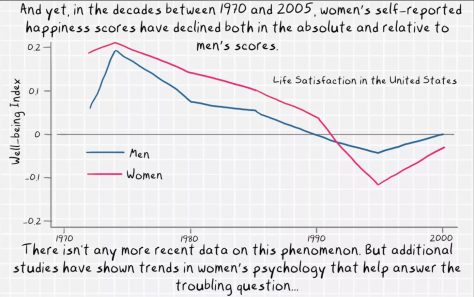
Male And Female Happiness After Feminism And Socialism
Male and female happiness throughout America’s adoption of radical feminism

I was reading this article by a feminist fiction writer on Vox, where she explains that although feminists have gotten what they wanted (careers, contraceptives, promiscuity, abortion, no-fault-divorce, daycare, etc. it hasn’t made them happier. So, what does this feminist fiction writer think would make feminists happier?

She gives two reasons why women women are still unhappy after feminism has been adopted by our society:

  • men don’t do enough housework
  • women are not as successful as men because they are discriminated against, the so-called “glass ceiling”

I think those complaints are pretty popular among feminists. Let’s take a look at some studies to see if her opinions are supported by peer-reviewed studies.

First study:

COUPLES who share housework duties run a higher risk of divorce than couples where the woman does most of the chores, a study has found.

The divorce rate among couples who shared housework equally was around 50 per cent higher than among those where the woman did most of the work.

“The more a man does in the home, the higher the divorce rate,” Thomas Hansen, co-author of the study entitled Equality in the Home, said.

Second study:

Researchers at the University of Illinois examined data on nearly 1,500 men and 1,800 women, aged between 52 and 60. Their well-being was evaluated through surveys.

The researchers first found that men’s well-being decreased once they had exited the workforce to become home-makers.

Meanwhile, the inverse was not so for women: Women’s psychological well-being was not affected by leaving their jobs to become stay-at-home mothers.

Third study:

A study called “Egalitarianism, Housework and Sexual Frequency in Marriage,” which appeared in The American Sociological Review last year, surprised many, precisely because it went against the logical assumption that as marriages improve by becoming more equal, the sex in these marriages will improve, too. Instead, it found that when men did certain kinds of chores around the house, couples had less sex. Specifically, if men did all of what the researchers characterized as feminine chores like folding laundry, cooking or vacuuming — the kinds of things many women say they want their husbands to do — then couples had sex 1.5 fewer times per month than those with husbands who did what were considered masculine chores, like taking out the trash or fixing the car. It wasn’t just the frequency that was affected, either — at least for the wives. The more traditional the division of labor, meaning the greater the husband’s share of masculine chores compared with feminine ones, the greater his wife’s reported sexual satisfaction.

Regarding the pay gap, that is entirely caused by women’s own choices. E.g. – the choice to study creative writing instead of petroleum engineering, the choice to work 35 hour weeks instead of 70 hour weeks, etc.

Fourth study:  (summarized by AEI economist)

When the [Bureau of Labor Statistics] reports that women working full-time in 2018 earned 81.4% of what men earned working full-time, that is very much different from saying that women earned 81.4% of what men earned for doing exactly the same work while working the exact same number of hours in the same occupation, with exactly the same educational background and exactly the same years of continuous, uninterrupted work experience, and with exactly the same marital and family (e.g., number of children) status. As shown above, once we start controlling individually for the many relevant factors that affect earnings, e.g., hours worked, age, marital status, and having children, most of the raw earnings differential disappears.

Fifth study:

This study leads to the unambiguous conclusion that the differences in the compensation of men and women are the result of a multitude of factors and that the raw wage gap should not be used as the basis to justify corrective action. Indeed, there may be nothing to correct. The differences in raw wages may be almost entirely the result of the individual choices being made by both male and female workers.

I think that women are entitled to make their own decisions, but they aren’t allowed to force the rest of us to subsidize their failures and celebrate their destructive outcomes.

I could go on, but I think enough has been said to show that research is very much at odds with feminist rhetoric. They feel they know what will make them happy and we gave them everything they asked for. They eliminated shaming of promiscuity with sex education. They get preferential treatment in the schools in a female-dominated education system.They are hired because of affirmative action quotas. They get expensive daycare, government schools, welfare and other programs. Taxes are raised to equalize outcomes for divorced women who choose men for feelings, and then nuke their own marriage enterprise. We have been on a long experiment of giving feminists everything they felt they wanted, at the expense of men’s rights and children’s rights, and it hasn’t even produced the results that feminists felt it would.

The social costs of feelings-based decision-making

Let’s look at two examples of policies that feminists asked for in the past, which didn’t work out the way they wanted.

I can understand why feminists would introduce sex education. They felt that “if everyone is having sex, then I won’t be the only one chasing attention from hot no-commitment bad boys by giving them recreational sex before marriage”.  They wanted to eliminate the standards of chastity and marriage-focused dating and normalize fun-focused drunken promiscuity. And they got that. But since they didn’t consult any research and evidence about how that would affect their future marriage stability and marriage happiness, they are even more unhappy than before.

How about no-fault divorce? No-fault divorce was brought in by a coalition of feminists, Marxists and trial lawyers. The Marxists want to destroy the family in order to increase dependence on the state. The trial lawyers wanted to make money. And the feminists thought that the standard approach to courting and marriage was just too much work. They didn’t want to be chaste. They didn’t want to be sober. They didn’t want to evaluate a man for traditional husband and father roles. The no-fault divorce laws gave them an escape from the messes caused by their own feelings-driven choices. But divorce just makes makes men and women much poorer, and passes the costs of supporting single mothers onto taxpayers.

And the costs of the failures of feminism are passed onto taxpayers.

Consider this study:

This paper examines the growth of government during this century as a result of giving women the right to vote. Using cross-sectional time-series data for 1870–1940, we examine state government expenditures and revenue as well as voting by U.S. House and Senate state delegations and the passage of a wide range of different state laws. Suffrage coincided with immediate increases in state government expenditures and revenue and more liberal voting patterns for federal representatives, and these effects continued growing over time as more women took advantage of the franchise. Contrary to many recent suggestions, the gender gap is not something that has arisen since the 1970s, and it helps explain why American government started growing when it did.

We are already $28 trillion in debt, partly because of feminism’s replacement of husbands and families with higher taxes and big government. Every time we transfer money from tax-paying men to feminists to fix their mistakes, it leaves less money in the hands of the men who actually want to get married. The declining value of marriage after feminism for men explains why marriage is being delayed, and why marriage rates are plunging.

Wintery Knight interviewed for the Apologetics 315 podcast

This is a re-post about the interview I did in April 2021.

I’ve met the two gentlemen who host the Apologetics 315 podcast in person (Brian Auten and Chad Gross) and they asked me to come on and talk about my experience doing apologetics online with an alias. I thought that I would link to them, and then add an important point that I wanted to say during the podcast, but I forgot to come back to it.

Anyway, you can listen to the episode here on their web site.

Here’s the description:

Today’s Show Notes:
Episode 016 – Christianity in the Public Square with Wintery Knight

In this episode, Brian Auten and Chad Gross interview Christian blogger Wintery Knight on the topics of Christian blogging, apologetics in the workplace and in the public square, how policy effects Christian freedoms, and more. www.winteryknight.com

1:30 – Discussing moral and ethical issues, having an alias, and observing the changers in culture.
8:00 – The conflict between the Happiness Quest and the Truth Quest.
10:00 – The difficulty getting apologetics into the church. The importance of a commitment to a truth quest.
13:00 – Doing apologetics on the internet.
17:30 – How to interact with skeptics, and what to do when the people you interact with become hostile.
20:00 – In-person interaction and discerning the right way to communicate in the workplace or public square.
25:20 – How can Christians be informed about what’s going on in culture and public policy? How does one become equipped? Resources for being equipped.
37:00 – “The Equality Act” and religious liberty issues.
43:00 – The speed of cultural change in the US, and the importance of religious freedoms.
52:45 – Christianity and politics.

If you’re looking for a great podcast on apologetics, these guys are interviewing a lot of my favorite people – Craig Hazen, Fazale Rana, and soon Stephen C. Meyer. If you like the interview, please leave a comment. If you have any questions about any of the resources or blog posts that I mentioned, please let me know.

Extra point

So, the extra point I wanted to make was about the question of how should Christians feel about the ascent of the woke people.

To start, consider this interesting article from Not The Bee, where they feature a whole bunch of moderates and classical liberals explaining why they walked away from the left because of the left’s descent into censorship and cancel culture.

Example:

In addition to that, there was an interesting survey about which group of people were more likely to self-report being diagnosed with a mental illness. It was the far-left people. And this data came from Pew Research, which skews to the left.

So, the point I wanted to make was this. The people on the left are only able to persist in being on the left, by exchanging reason and evidence for emotions and coercion. I admit that things look bad now, especially when you look at the powerful big corporations who are allying with the secular left mob. But I don’t think that people who are fixated on left-wing concerns are comfortable for moderate people to talk with. I think that secular leftism has left extreme leftists without the basic moral framework for respectful dialog. What’s more, I don’t think that secular leftists are very good at friendship, dating and especially marriage. You can’t marry someone who is lacks charity and self-control.

In view of this, I think that there is a tremendous opportunity to provide moderates and open-minded people with a safe place to express their views and seek truth. In order to be ready for them, I recommend that you prepare yourself to have respectful discussions by reading good books, and listening to good debates. The more you can stay calm while listening to different points of view, the more that people will want to speak to you. Please don’t rely on the church to train you. We’re not doing a very good job of training Christians about different points of view in the church. So, you’ll have to train yourself if you want to develop the ability to debate and disagree in a calm and respectful way.

Exciting news

By the way, I mentioned on the podcast that my Bible study partner and I are planning to start a podcast of our own. I explain what it will be about and about my co-host during the episode.

If you missed my previous appearance on Tim Stratton’s Free Thinking Ministries podcast, then you can listen to that here.