
Category Archives: Mentoring

Tad Hopp accumulated $100,000 of college debt, now he wants a taxpayer bailout

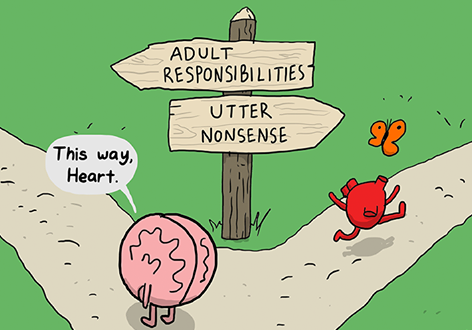
Brain vs Heart, from: theawkwardyeti.com

Here’s an interesting editorial from a “Christian” left blog. (H/T Acton Institute via Lindsay)

The author, Tad Hopp is graduating a PCUSA seminary – an extremely liberal, left-wing denomination.

He writes:

I graduated college in 2007.

[…] I majored in English, not exactly what most people consider a ‘marketable’ or ‘practical’ degree…

[…]I went to a somewhat expensive private school…

[…]I did what many students in their last year of high school do: I went to the school where I felt I was being called…

[…]I do not regret my four years at my undergraduate institution one bit.

[….]When I graduated college, I owed nearly $50,000 in student loan debt and was unemployed for almost six months before I finally found a low-paying office job.

[…]“Can’t find a job? Well, you should have majored in something more ‘practical’, like economics or business or medicine.” Yeah, that would be great…if those were the subjects where my skills and passions lie. They’re not.

[…]I felt called to go to seminary.

[…]I will graduate seminary with close to six figures worth of student loan debt.

Let’s take stock of what he’s said so far:

  • he studied English, a language that he already spoke, which has one of the lowest employment rates
  • he was warned by people who knew something about earning and saving money not to study English
  • he went to a school he couldn’t afford to go to, and he graduated with $50,000 in debt
  • he went to seminary, another subject that doesn’t pay, and added another $50,000 or so of debt
  • he says that he doesn’t have to study subjects that lead to a career because he isn’t “passionate” about them
  • he “followed his heart” by going to the school that he had mystical, emotional, intuitions about = “calling”

My advice to Tad at this point would be for him to take the Bible seriously when it says this:

2 Thessalonians 3:10:

10 For even when we were with you, we used to give you this order: if anyone is not willing to work, then he is not to eat, either.

And 1 Timothy 5:8:

8 But if anyone does not provide for his own, and especially for those of his household, he has denied the faith and is worse than an unbeliever.

The Bible is giving us the goal of working. So what should we do to be able to reach that goal? Why should anyone hire us? What is working really about? It’s those kinds of questions that should guide what we study in school, and what jobs we pursue.

We know what careers have the highest starting salaries and mid-career salaries:

Starting and Mid-Career salaries by profession (click for larger image)

(Source)

Why do some people get paid more than others? The answer is supply and demand. Prices are a way of determining what is most valued by your fellow man. Business owners pay more to people who offer their customers more value. If you really want to serve your neighbor, you have to learn something they really want, but can’t easily obtain. And then you will be paid more. You can’t do what makes you happy. You have to do what makes customers happy. That’s how the free market works – you make money when you provide something of value to others. You make money when you serve others. This is something that is very hard for self-centered, feelings-driven young progressives to grasp. But it’s something older Americans all know.

More Tad:

Is the PCUSA doing anything to address this crisis?

[…]What has our government done to address this issue?

[…]I, like so many in my generation, voted for Obama…

[…]It seems to me that we’ve bought into the lie that student loan debt is brought on by the individual person…

[…]You know what I think might stimulate the economy? Automatically cancelling every single outstanding student loan!

He insists that the results of his own choices aren’t his fault. But didn’t he make the choices about what to study? Didn’t he make the choice to follow his heart? Didn’t he disregard the advice of people who urged him to be practical? Who is to blame, if not he, himself?

Tad needs to push away all his friends who told him to “follow his heart” and stick close by his friends who told him to focus on providing value to others. Don’t look for advice from dreamers, look for advice from doers. Dreamers talk. But doers have demonstrated the ability to create plans that work to achieve results.

By the way, some of you might be wondering how serious this person was about his Christianity. Well, in another post, he comes out as gay. So clearly the Bible is being interpreted in a way where feelings are overturning the plain meanings of words. People who read the Bible closely never come away with the message that they should follow their hearts.

What got me started on apologetics? William Lane Craig debate transcripts

William Lane Craig lecturing to university students

Yes, William Lane Craig debate transcripts. In fact, I still read them from time to time to keep up my skills.

Here’s one of my favorites, the Craig-Nielsen debate on grounding morality without God

Summary:

THE CRAIG-NIELSEN DEBATE: GOD, MORALITY, AND EVIL
William Lane Craig and Kai Nielsen
with annotations by William Lane Craig
February 1991, University of Western Ontario

Best part:

Finally, he raises the issue of immortality and says, “Death doesn’t undermine moral values. In fact, things that we value become all the more precious.” Well, in one sense he’s right. It’s the absence of God that undermines the objectivity of moral values, not death. But let’s suppose that there are objective moral values. What would be undermined by the lack of immortality? I think two things.

First, I think there would be no reason to adopt the moral point of view. Since you’re going to die, everyone ends up the same. It doesn’t make any difference whether you live as a Hitler or a Mother Teresa. There is no relationship between your moral living and your ultimate fate. And so in that sense, death undermines the reason for adopting the moral point of view rather that just being an egoist and living for self.

Second, there’s no basis for self-sacrifice on this point of view. Why should an atheist, who knows everything is going to end in death, do things that are morally right that go against self-interest? For example, a few years ago there was a terrible mid-winter air disaster in Washington, DC, as a plane crashed into a bridge spanning the Potomac River, spilling its passengers into the icy waters. And as the helicopters came to rescue these people, attention focused on one man who again and again passed by the rope ladder rather than be pulled to safety himself. Seven times he did this, and when they came again, he was gone. The whole nation turned its eyes to this man in respect and admiration for the noble act of self-sacrifice that he did. And yet on the atheistic view, that man wasn’t noble. He did the stupidest thing possible. He should have gone for the rope ladder first, pushed others away, if necessary, in order to survive! But to give up all the brief existence he will ever have for others he didn’t even know? Why? It seems to me, then, that it’s not simply the absence of God that undermines objective moral values, but ethical living is also undermined by the atheistic point of view because you then have no reason to adopt the moral point of view and you have no basis for acts of self-sacrifice.

By contrast, on the Christian view, where you have both God and immortality, you have the necessary presuppositions for the affirmation of objective moral values and for consistent living of the ethical life.

And another of my favorites, the Craig-Taylor debate on the ontological grounding of morality.

Summary:

Is The Basis Of Morality Natural Or Supernatural?
Richard Taylor and William Lane Craig
October 1993, Union College, Schenectady, New York

Sample Craig:

(2) I argued that moral accountability also exists under the supernaturalist view, and Professor Taylor didn’t deny the point.

(II) What about my critique, then, of naturalism? I said that naturalism doesn’t provide a sound foundation for morality, and here I made two points:

(1) On the naturalist view, objective right and wrong do not exist. Again, Professor Taylor doesn’t deny this point; he just says, “Well, to say that they’re conventional doesn’t mean they’re contemptible.” Well, granted; but it does mean they’re arbitrary, they’re non–objective. There’s no more difference between moral right and wrong than driving on the right–hand side of the road versus the left–hand side of the road. It’s simply a societal convention. And the modern evolutionist thinks these conventions are just based in socio–biological evolution. According to Michael Ruse, a professor of the philosophy of science,

The position of the modern evolutionist…is that humans have an awareness of morality…because such an awareness is of biological worth. Morality is a biological adaptation, no less than are hands and feet and teeth…. Considered as a rationally justifiable set of claims about an objective something, [ethics] is illusory. I appreciate that when somebody says, ‘Love thy neighbor as thyself,’ they think they are referring above and beyond themselves…. Nevertheless…such reference is truly without foundation. Morality is just an aid to survival and reproduction and…any deeper meaning is illusory….{26}

This is essentially the same view as Professor Taylor’s. Moral values are simply rooted in socio–biological evolution, that have passed down as certain taboos and certain commands, but they have no objective validity in terms of their moral rightness or wrongness. Professor Taylor says, “But I have a high regard for people who are truly moral and decent.” I don’t deny that. Of course he does! But the point is that in his ethics, in his philosophy, he has no basis for that affirmation. What I bring is not a new set of values—I think we pretty much hold those in common—but I’m offering a secure foundation for those values that we all want to hold dear.

You see, on Professor Taylor’s view, there really isn’t any objective morality. I think every one of us here tonight would agree that it’s wrong to kill babies and that the holocaust was morally wrong. But in his book Professor Taylor says, “The infanticide practiced by the Greeks of antiquity did not violate their customs. If we say it was nevertheless wrong, we are only saying that it is forbidden by our ethical and legal rules. And the abominations practiced by the Nazis…are forbidden by our rules, and not, obviously, by theirs.”{27} I submit that that is simply a patently false view of moral values and that naturalism, therefore, can’t provide any objective basis for right and wrong.

And another of my favorites, the Craig-Tooley debate on the problem of evil.

Summary:

A Classic Debate on the Existence of God
Dr. William Lane Craig & Dr. Michael Tooley
November 1994, University of Colorado at Boulder

Sample Craig:

(2) Christian doctrines increase the probability of the coexistence of God and the evils in the world. Let me just mention a couple of these.

(i) On the Christian view, the purpose of life is not happiness as such in this life. Rather it is the knowledge of God—which will ultimately produce true and everlasting happiness. What that means is that many evils occur in this life which might be utterly pointless with respect to producing human happiness. But they might not be pointless with respect to producing the knowledge of God. Dr. Tooley assumes when he talks about changes that would make this world a better place, that the purpose of life is basically to be happy in this life. And I certainly admit that you could make changes that might appear to make this life a better place, make it happier. But that’s not God’s purpose. So if you understand that the purpose of life is not happiness as such, I think that you can see that the existence of evil doesn’t necessarily cast any improbability upon God’s existence.

(ii) It’s also the Christian view that God’s purpose spills over into eternal life. In the afterlife God will bestow a glory and happiness upon us that is incomparable to what we’ve suffered here on earth. And the longer we spend in eternity with Him, the more the sufferings in this life shrink by comparison to an infinitesimal instant. Dr. Tooley admits in his article that it is possible that immortality could justify such evils. But, he says, it’s “very unlikely” that there is life after death. Well, I have two comments. First, I’d like him to prove that it’s unlikely that there is life after death.{26} Second, I suggest that the resurrection of Jesus gives us grounds for hoping in life after death, and I’ve attempted to justify that historically. So given these Christian doctrines, I think you can see that the existence of God and evil is not so improbable after all.

[…]

(4) Finally, I think that there is actually an argument for God from evil. It would go like this:

(i) If God does not exist, objective moral values do not exist. If there is no God, moral values are either socio-biological by-products or just expressions of personal preference.

(ii) Evil exists. That’s the premise of the atheist. There is real evil in the world.

(iii) Therefore, objective values do exist. Some things are really wrong.

(iv) Therefore, God exists.

Thus the presence of evil in the world actually demonstrates God’s existence because in the absence of God, there wouldn’t be any distinction objectively between good and evil, between right and wrong. So although evil in one sense calls into question God’s existence, in a much deeper sense, I think, it actually requires God’s existence.

So in the light of these four responses, I think that the argument from evil, as difficult and emotionally pressing as it might be, in the end doesn’t constitute a good argument against the existence of God. So I think the four arguments given against the existence of God by Dr. Tooley are inconclusive. You’ve still got my six arguments for God’s existence, and therefore I still think that on balance the evidence favors theism as the more rational worldview.

There are more debate transcripts on Craig’s Reasonable Faith web site.

Are Christians responsible for making plans and making good decisions?

Here’s a wonderful post on decision making and the will of God posted on Neil’s blog. In his post, Neil explains the Biblical model for making good decisions.

Excerpt:

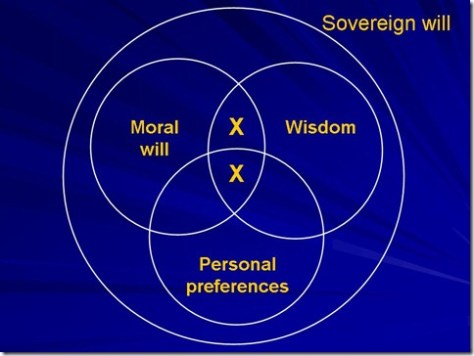
Really short version: Aside from direct and clear personal revelation from God, you don’t have access to his sovereign will when making decisions.  Therefore you must look at other factors.  If it isn’t moral, don’t do it.  If it is moral but not wise, don’t do it.  If it is moral and wise, then use your personal preferences.

Using this model you can end up with a wise and biblical decision, but you have avoided the traps of the “God told me to ____” routine.  People who run around saying that God told them this and that convey a super-spirituality that can leave less mature believers wondering if they really have a relationship with God (i.e., “God doesn’t tell me every little thing to do, so maybe I don’t really know him.”).

He has a helpful picture posted as well:

This is actually a very important topic for me, because I like making plans and making good decisions. I like being the quarterback or squad leader of my own life. I like to pick objectives and then make plans to achieve them. (Nothing too exotic, just simple stuff like saving money or reading more books)

Actually, I really oppose the idea that God has a magical fairy tale will for each person that will make them happy and fulfilled. For me, life isn’t like that. I don’t expect God to lead me along like a child at a scavenger hunt. I expect to survey the battlefield where I am and then do something to make a difference. There are lots of things you can do that will please God. Should you focus on your career and sponsor apologetics conferences? Or should you use your spare time preparing Sunday school lessons? There are lots of good things you could do to please God. Your job is to pick the one that will be the most effective. It doesn’t matter if it makes you happy, it only matters if it’s effective and if you are good at it.

Who is Rifleman Dodd?

A while back, I was busily working my way through the U.S. Marine Corps Official Reading List, and I came across a book by C.S. Forester called Rifleman Dodd, or alternatively titled Death to the French. It’s a work of historical fiction that takes place during the Napoleonic wars. The story is about a British marksman named Dodd, who is cut off from his own lines during a withdrawal maneuver. He is subsequently left to fend for himself behind enemy lines. An ordinary man might be full of despair and forget about his mission entirely. But Dodd is no ordinary man. Not only does he find a way to survive by finding food to eat, water to drink and places to sleep, but he also tries to remember his orders and to think about what he can do to advance the cause of his General, the Duke of Wellington.

Here’s an excerpt from a gritty book review:

It’s about a green-coated British infantry rifleman in the Napoleonic Wars, an age when rifles were a novelty and most of the army was red-coated and carried muskets. Private Matthew Dodd gets separated from his regiment during a retreat and finds himself stranded behind enemy (French) lines in Portugal. With the occasional aid of some natives, but mostly on his own, he harasses the French with his rifle and tries to prevent them from building a bridge across the Tagus River. It’s a remarkable tale of survival and solitary achievement, of a rank-and-file soldier who lives by his wits and slowly learns to make plans without orders, and shows leadership qualities and a knowledge of warfare.

I think we’re in the same situation as Dodd.

There is no point in us looking for breadcrumb trails to happiness at this point. That’s not the point of Christianity. The point of Christianity is friendship with God, imitation of Christ, honoring moral obligations, self-sacrificial love for your neighbor (and even your enemies!), and dedication to the truth – whether anyone else likes you or not. It’s not supposed to make you happy, and it’s not necessarily going to be a normal life like everyone else has. Things may not work out the way you’d like them to.

We seem to be making such a big deal about compassion and forgiveness in the Christian life these days – such a big emphasis on our feelings. Almost like we have forgotten that we have obligations to our friend. A relationship doesn’t mean that one person does whatever they feel like, completely disregarding the character and goals of the other person and then is automatically granted forgiveness whenever they want it. That’s not a friendship – that’s using someone else for your own ends.

For a lot of people today, Christianity only comes into play after you’ve made a mistake and you’re feeling guilty. For example, suppose you decide to go to a party with your secular friends, then you drink too much, and you do something sexual that you shouldn’t have done. Or maybe you watched some prosperity gospel preacher on TV, then made irresponsible business decisions thinking that God would bail you out and make you rich, and you went bankrupt. Most people think Christianity is for this situation: you’re a Christian so that you don’t have to feel guilty about sin. And so that you can tell people that God forgives you, so that they can’t think anything bad about you, either. You sort of get your idea about what you should be doing in order to feel good from the culture, and God is just there to forgive it all when it blows up in your face.

But in my case, putting myself in a situation like that is not even possible. I’m more likely to try to plan to do something for God. Like, I might try to mentor a young Christian by sending them books. Or, I might try to teach a class in apologetics at my church. These are things that are for God, not for me. I’m not just being dragged along by the culture, and trying to find happiness by feeling good (e.g. – with alcohol) or being liked by non-Christians. And if my plans fail because the mentoree doesn’t grow up into anything, or nobody comes to my apologetics class, that’s when I go to God and say “I screwed up. but can I still be in your army?” And God always says yes to that. You don’t have to be the best player on the team for the Coach to like you. He already likes you.

One of the great things about being a Christian is that you can never lose your identity as a Christian by failing to do something for him that you planned to do. That’s what forgiveness is for. If you set out to do something for God’s glory, and you mess it all up, that’s OK. But I do think that, like Dodd, our ambition should not be about just making ourselves happy, or making non-Christians like us. We should be trying to make plans and carry them out for God.

That’s how I understand forgiveness. It’s not just something that’s there for you to use to fix your feelings when you’ve been irresponsible while seeking your own happiness in secular ways. It’s also there when you’re trying to do something good for God, and you fail. A lot of times in life you try your best, but you fail, and then you lose something that you really wanted. With God, when you try your best for his glory, and fail, you don’t lose your identity as a member of his team. I think that not losing your identity in Christ is even more important than not feeling guilty about selfish decision making.

So, have you got a plan to serve your General? Let’s focus more on what operations we’re planning for God than on being happy and being popular with non-Christians. Your life should not be all about you, with God just there to make your bad feelings go away. Your life should be about God’s goals and God’s interests.