Category Archives: Commentary

Ohio Issue 2: Should voters vote yes or vote no on Ohio State Issue 2?

In the 2010 mid-term elections, Republican John Kasich won the governorship and promised to balance the state’s budget by reining in the state’s spending on salaries and benefits for public sector union employees. To accomplish this, the Ohio legislature pass Senate Bill 5. However, an effort is on the ballot to repeal the law, and Ohio voters will get a chance to keep or scrap the law on Tuesday, November 8th, 2011.

Here’s what Ohio’s Issue 2 is all about:

Issue 2 makes some very fair and common sense requests of our government employees to give local communities the flexibility they need to get taxes and spending under control, while providing the essential services that we rely on.

  • It allows an employee’s job performance to be considered when determining compensation, rather than just awarding automatic pay increases based only on an employee’s length of service.
  • It asks that government employees pay at least 15 percent of the cost of their health insurance premium.  That’s less than half of what private sector workers are currently paying.
  • It requires that government health care benefits apply equally to all government employees, whether they work in management or non-management positions.  No special favors.
  • It asks our government employees to pay their own share of a generous pension contribution, rather than forcing taxpayers to pay both the employee and employer shares.
  • It keeps union bosses from protecting bad teachers and stops the outdated practice of laying off good teachers first just because they haven’t served long enough.
  • Finally, it preserves collective bargaining for government employees, but it also returns some basic control of our schools and services to the taxpayers who fund them, not the union bosses who thrive on their mismanagement.

Even under the reforms of State Issue 2, Ohio’s government employees will still receive better pay, better health care and better retirement benefits, on average, than the vast majority of Ohioans who work in the private sector.

There are a number of myths going around about Issue 2, and it’s important to set the record straight, so I’ll do that below.
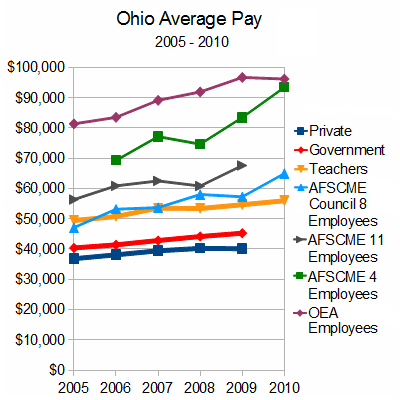
Ohio Average Pay: Public vs. Private
Ohio Average Pay: Public Unions vs. Private

Myths and truths about Ohio State Issue 2

Here’s a common myth:

State Issue 2 would “cut salaries and benefits.”

The truth:

Issue 2 would not cut salaries or benefits for any government employee. Employees would simply be asked to pay a modest share of their benefits, just like employees in the private sector do. For health care coverage, they would pay at least 15% of their overall plan. (Many local government employees currently pay less than 9% of their health care premium, while the average private sector worker pays upwards of 30%.) In addition, employees would be required to pay their personal share of a retirement plan (only 10%), rather than asking taxpayers to pay that share. That’s not too much to ask at a time when many private sector workers get no retirement benefit at all. Finally, Issue 2 requires that benefits apply equally to all public employees, so no one gets special treatment.

And another common myth:

State Issue 2 will eliminate government employee pensions.

The truth:

Government employees will still get a very generous pension benefit – an annual payment that averages their three highest annual salaries. That’s a pretty nice deal, when many private sector workers get no retirement benefit at all. State Issue 2 only ends a practice where some government union contracts require taxpayers to pick up the tab for BOTH the employer AND employee shares of a required pension contribution. In this economy, it’s simply not right to ask struggling taxpayers to foot the bill so government employees can get a free retirement. Issue 2 simply says government employees should pay their required share (10 percent) and taxpayers will contribute the employer share (14 percent).

Another myth:

State Issue 2 will cut teacher salaries.

The truth:

That’s one of the scare tactics government unions are using to turn people against these reforms. Nothing in Issue 2 determines salary levels. It only ends the practice of handing out automatic pay raises, or “step” increases, and longevity pay – or bonuses just for holding the job for a certain period of time. Issue 2 also asks that performance be added as a factor in teacher compensation, a goal President Barack Obama set out in his national education policy in 2009.

And another myth:

State Issue 2 will cost jobs

The truth:

Just the opposite is true. Ohio’s state and local tax burden ranks among the top third in the nation. As a result, companies large and small have left our state in pursuit of better tax incentives elsewhere, taking hundreds of thousands of jobs with them. If Ohio hopes to compete for new job growth, we have to make our state a more affordable place to live, work and do business. That starts with getting the cost of government under control so we can direct more of our limited resources into economic development, community revitalization and better schools.

More myths are corrected on this page.

Newspaper endorsements

So far, Issue 2 has been endorsed by several Ohio newspapers, including the biggest ones.

The Cleveland Plain Dealer:

The fiscal picture of local governments and school districts, especially, will improve as they are able to right-size their work forces and their expenditures on services. That will happen over time, not overnight, as new contracts are established.

Repeal SB 5, though, and it’s going to be awfully hard for local governments to manage their payrolls without resorting to larger-scale layoffs than would otherwise be necessary. And local governments will continue to be hamstrung by anti-merit seniority rules that lead to worker complacency and protect dead weight and time-servers.

Voting YES on Issue 2 will prevent layoffs by keeping public sector wages and benefits in line with what the private sector can afford to pay.

The Columbus Dispatch:

Despite the insistence of opponents, the effort to reform Ohio’s out-of-balance collective-bargaining law is not an expression of disrespect for or dissatisfaction with Ohio teachers, police officers, firefighters and other government employees. It is a much-needed attempt to restore control over public spending to the public officials elected to exercise that control.

It does not assert that public employees are worth less than the compensation they’re receiving, only that the compensation has grown faster than the public’s ability to pay for it.

[…]With more ability to control the escalation of salary and benefit costs, governments won’t be forced as often to impose layoffs, and might be able to afford to keep even more police and firefighters on the streets.

Again, no one is saying that public sector workers don’t matter – the question is whether we can afford to give them better wages and benefits than the private sector workers who are their customers and their employers. Public sector workers work for the public, and the public can only afford to pay so much.

Conclusion

Government employees are paid 43% more than private sector employees, in salary and benefits:

I think that people who care about the long-term prosperity of Ohio should vote “YES” on Issue 2 to make public and private salaries and benefits MORE EQUAL. Ohio is facing enormous economic pressure from the global recession, and everyone has to make sacrifices. Now is not the time for public sector workers to insist on higher wages and benefits, especially when the private sector workers who pay their salaries don’t make as much money, nor do they get the pensions, nor do they get the better job security. Ohio voters can certainly go back and renegotiate union salaries and benefits when Ohio is out of the recession.

Click here to learn more about Ohio Issue 2.

Richard Dawkins responds to Craig’s debate challenge in a UK Guardian editorial

Atheist Richard Dawkins explained why he wouldn’t debate Craig in this UK Guardian column. This is his latest excuse for not debating Craig, (see the full list of excuses here). I guess this is Dawkins’ way of striking at Craig without giving Craig a chance to respond. If he wanted to hear a response, he would have attended the debate at Oxford, and put his arguments on the table to be answered.

Defeating the column

His entire column is easily dispatched using Dawkins’ own words against him, because he contradicts himself.

Dawkins has previously written this:

The total amount of suffering per year in the natural world is beyond all decent contemplation. During the minute that it takes me to compose this sentence, thousands of animals are being eaten alive, many others are running for their lives, whimpering with fear, others are slowly being devoured from within by rasping parasites, thousands of all kinds are dying of starvation, thirst, and disease. It must be so. If there ever is a time of plenty, this very fact will automatically lead to an increase in the population until the natural state of starvation and misery is restored. In a universe of electrons and selfish genes, blind physical forces and genetic replication, some people are going to get hurt, other people are going to get lucky, and you won’t find any rhyme or reason in it, nor any justice. The universe that we observe has precisely the properties we should expect if there is, at bottom, no design, no purpose, no evil, no good, nothing but pitiless indifference.

(“God’s Utility Function,” Scientific American, November, 1995, p. 85)

Meanwhile, in his column, Dawkins claimed that God’s command to destroy the Canaanites was an instance of evil:

Most churchmen these days wisely disown the horrific genocides ordered by the God of the Old Testament. Anyone who criticises the divine bloodlust is loudly accused of unfairly ignoring the historical context, and of naive literalism towards what was never more than metaphor or myth. You would search far to find a modern preacher willing to defend God’s commandment, in Deuteronomy 20: 13-15, to kill all the men in a conquered city and to seize the women, children and livestock as plunder.

So, in one statement, there’s no good or evil, and in the next statement, there’s evil. That’s a contradiction, and it undermines his entire column, Q.E.D. You can’t claim that there is no standard of good and evil in one breath, and then make judgments of good and evil in the next. It’s self-refuting. Dawkins didn’t even try to respond to any of Craig’s standard arguments for God’s existence in the editorial, he just went off on a tangent about a few Bible verses that, even if true, might only defeat Judaism and Christianity in particular, but not the existence of God in general. And the debate “Does God Exist?” is about the latter.

Responding to the argument

If we ignore Dawkins’ first statement denying that morality is real, and just respond to the verses he is complaining about, then we can look at this response online by William Lane Craig, or we can watch a lecture in two parts featuring Christian philosopher Paul Copan (part 1, part 2). So, a response to this objection is not hard to find. We have entire books written to answer this challenge – to say nothing of academic papers.

It’s troubling to me that Dawkins would not reference any responses to his argument in his editorial, since they clearly exist, and can easily be found just by searching the world wide web. Dawkins’ failure to interact with his critics is not surprising, though, given the fact that he didn’t reference any opposing scholars in his latest book. Moreover, Dawkins has cited a professor of German language as an authority on the historical Jesus and suggested that unobservable aliens could explain the origin of life. These are not actions of a genuine scholar, and the refusal to debate William Lane Craig in public is part of that same pattern.

But the main point to realize is that Richard Dawkins refuses to debate William Lane Craig, and that means that nothing Richard Dawkins says can be taken seriously. He isn’t willing to take the stage with an opponent and defend his views. He prefers to take pot shots at peripheral matters, (disputing particular Bible passages has nothing whatsoever to do with the question of whether a Creator of the universe exists or not), from the safety of the UK Guardian’s editorial page. I cited responses to the passages from Craig and Copan above, but Craig could even just reject the passages as mistaken and Dawkins’ argument would be neutralized – the debate is about the existence of God – the bare philosopher’s God who creates and designs the universe. The debate is not about the Christian God in particular, or even about the inerrancy of the Bible. Evidence against inerrancy is not evidence against a Creator and Designer of the universe.

Finally, it’s important to note that Richard Dawkins has peculiar views on morality himself. Not only does he support abortion, which resulted in the death of over 50 million unborn babies since 1973 in the United States alone, but he actually has no problem with infanticide.

(H/T Anglican Samizdat)

That’s why it’s important to make these arguments in a debate – instead of preaching them in an editorial to the UK Guardian choir. Theists do have responses to these and other objections, and it would be nice to be able to give those responses in public. If truth is the goal, then hearing both sides is the best way to reach the goal. It’s part of the scientific method that we should be open to being disproved by the evidence.

About William Lane Craig

William Lane Craig is currently conducting a debating and speaking tour of the UK, with stops at Oxford, Cambridge, London and points in between.

Let’s review William Lane Craig’s qualifications:

William Lane Craig is Research Professor of Philosophy at Talbot School of Theology in La Mirada, California.

Dr. Craig pursued his undergraduate studies at Wheaton College (B.A. 1971) and graduate studies at Trinity Evangelical Divinity School (M.A. 1974; M.A. 1975), the University of Birmingham (England) (Ph.D. 1977), and the University of Munich (Germany) (D.Theol. 1984). From 1980-86 he taught Philosophy of Religion at Trinity… In 1987 they moved to Brussels, Belgium, where Dr. Craig pursued research at the University of Louvain until assuming his position at Talbot in 1994.

He has authored or edited over thirty books, including The Kalam Cosmological Argument; Assessing the New Testament Evidence for the Historicity of the Resurrection of Jesus; Divine Foreknowledge and Human Freedom; Theism, Atheism and Big Bang Cosmology; and God, Time and Eternity, as well as over a hundred articles in professional journals of philosophy and theology, including The Journal of Philosophy, New Testament Studies, Journal for the Study of the New Testament, American Philosophical Quarterly, Philosophical Studies, Philosophy, and British Journal for Philosophy of Science.

Craig’s CV is here.

Craig’s list of publications is here.

Here are some of Craig’s recent publications: (it’s a little out of date, now)

From 2007:

  • Ed. with Quentin Smith. Einstein, Relativity, and Absolute Simultaneity. Routledge Studies in Contemporary Philosophy. London: Routledge, 2007, 302 pp.
  • “Theistic Critiques of Atheism.” In The Cambridge Companion to Atheism, pp. 69-85. Ed. M. Martin. Cambridge Companions to Philosophy. Cambridge University Press, 2007.
  • “The Metaphysics of Special Relativity: Three Views.” In Einstein, Relativity, and Absolute Simultaneity, pp. 11-49. Ed. Wm. L. Craig and Quentin Smith. Routledge Studies in Contemporary Philosophy. London: Routledge, 2007.
  • “Creation and Divine Action.” In The Routledge Companion to Philosophy of Religion, pp. 318-28. Ed. Chad Meister and Paul Copan. London: Routledge, 2007.

From 2008:

  • God and Ethics: A Contemporary Debate. With Paul Kurtz. Ed. Nathan King and Robert Garcia. With responses by Louise Antony, Walter Sinnott-Armstrong, John Hare, Donald Hubin, Stephen Layman, Mark Murphy, and Richard Swinburne. Lanham, Md.: Rowman & Littlefield, 2008.
  • “Time, Eternity, and Eschatology.” In The Oxford Handbook on Eschatology, pp. 596-613. Ed. J. Walls. Oxford: Oxford University Press, 2008.

From 2009:

  • Ed. with J. P. Moreland. Blackwell Companion to Natural Theology. Oxford: Blackwell.
  • “The Kalam Cosmological Argument.” With James Sinclair. In Blackwell Companion to Natural Theology. Ed. Wm. L. Craig and J. P. Moreland. Oxford: Blackwell.
  • “In Defense of Theistic Arguments.” In The Future of Atheism: Alister McGrath and Daniel Dennett in Dialogue. Ed. Robert Stewart. Philadelphia: Fortress Press.

Forthcoming:

  • “The Cosmological Argument.” In Philosophy of Religion: Classic and Contemporary Issues. Ed. Paul Copan and Chad Meister. Cambridge: Blackwell.
  • “Cosmological Argument”; “Middle Knowledge.” In The Cambridge Dictionary of Christian Theology. Ed. G. Fergusson et al. Cambridge: Cambridge University Press.
  • “Divine Eternity.” In Oxford Handbook of Philosophical Theology. Ed. Thomas Flint and Michael Rea. Oxford: Oxford University Press.

He seems eminently qualified to debate the existence of God, doesn’t he? And he’s done it dozens of times, against the top atheist scholars.

What is Richard Dawkins is afraid of?

Here’s an example of William Lane Craig debating the famous atheist Christopher Hitchens, arguably the top popular atheist in the world today.

Here’s a review of that debate from Common Sense Atheism, a popular and respected atheist web site.

Excerpt:

I just returned from the debate between William Lane Craig and Christopher Hitchens at Biola University. It was a bigger deal than I realized. Over 3,000 people were there, and groups from dozens of countries – including Sri Lanka, apparently – had purchased a live feed.

[…]The debate went exactly as I expected. Craig was flawless and unstoppable. Hitchens was rambling and incoherent, with the occasional rhetorical jab. Frankly, Craig spanked Hitchens like a foolish child. Perhaps Hitchens realized how bad things were for him after Craig’s opening speech, as even Hitchens’ rhetorical flourishes were not as confident as usual. Hitchens wasted his cross-examination time with questions like, “If a baby was born in Palestine, would you rather it be a Muslim baby or an atheist baby?” He did not even bother to give his concluding remarks, ceding the time instead to Q&A.

The atheist web site “Debunking Christianity” called it a “landslide” victory for Craig. And I want to suggest that this outcome is exactly what Richard Dawkins was afraid of.

Craig has also debated other prominent atheists like Sam Harris, Daniel Dennett, Bart Ehrman, Peter Atkins, Victor Stenger, and so on. And many of these can be seen for free on Youtube.

What William Lane Craig offers in his debates is a set of deductive arguments that are logically valid, and supported by 1) the latest scientific evidence (which he has published in peer-reviewed scientific journals), and 2) the consensus of academic historians of all persuasions, using standard historical methods. Dawkins should have no trouble debating empirical arguments from science and history, if his beliefs were testable against objective evidence. The debate is about scientific and historical evidence, and we can investigate that evidence.

Finally, I want to note that Craig is not the only person who Dawkins refuses to debate. He was challenged to debate Stephen C. Meyer, whose Ph.D is from Cambridge, and again declined to have his ideas debated in a public forum. Meyer’s book was as a Times Literary Supplement Best Book of 2009 – and it was nominated by the respected atheist philosopher Thomas Nagel.

Walter Williams on CEO salaries and celebrity salaries

Walter Williams
Walter Williams

From CNS News.

Excerpt:

It turns out that the top 10 CEOs have an average salary of $43 million, which pales in comparison with America’s top 10 celebrities, who earn an average salary of $100 million.

When you recognize that celebrities earn salaries that are some multiples of CEO salaries, you have to ask: Why is it that rich CEOs are demonized and not celebrities? A clue might be found if you asked: Who’s doing the demonizing?

It turns out that the demonizing is led by politicians and leftists with the help of the news media, and like sheep, the public often goes along. Why demonize CEOs? My colleague Dr. Thomas Sowell explained it in his brand-new book, “The Thomas Sowell Reader.” One of his readings, titled “Ivan and Boris – and Us,” starts off with a fable of two poor Russian peasants.

Ivan finds a magic lamp and rubs it, and the jinni grants him one wish. As it turns out, Boris has a goat, but Ivan doesn’t. Ivan’s wish is for Boris’ goat to die. That vision reflects the feelings of too many Americans. If all CEOs worked for nothing, it would mean absolutely little or nothing to the average American’s bottom line.

For politicians, it’s another story: Demonize people whose power you want to usurp. That’s the typical way totalitarians gain power. They give the masses someone to hate. In 18th-century France, it was Maximilien Robespierre’s promoting hatred of the aristocracy that was the key to his acquiring more dictatorial power than the aristocracy had ever had.

In the 20th century, the communists gained power by promoting public hatred of the czars and capitalists. In Germany, Adolf Hitler gained power by promoting hatred of Jews and Bolsheviks. In each case, the power gained led to greater misery and bloodshed than anything the old regime could have done.

Let me be clear: I’m not equating America’s liberals with Robespierre, Josef Stalin and Hitler. I am saying that promoting jealousy, fear and hate is an effective strategy for politicians and their liberal followers to control and micromanage businesses.

Tom sent me this article that shows that raising taxes on the wealthy doesn’t even produce more revenue.

Excerpt:

All this nostalgia about the good old days of 70% tax rates makes it sound as though only the highest incomes would face higher tax rates. In reality, there were a dozen tax rates between 48% and 70% during the 1970s… the individual income tax actually brought in less revenue when the highest tax rate was 70% to 91% than it did when the highest tax rate was 28%.

[…]President John F. Kennedy’s across-the-board tax cuts reduced the lowest and highest tax rates to 14% and 70% respectively after 1964, yet revenues (after excluding the 5%-10% surtaxes of 1969-70) rose to 8% of GDP. President Reagan’s across-the-board tax cuts further reduced the lowest and highest tax rates to 11% and 50%, yet revenues rose again to 8.3% of GDP. The 1986 tax reform slashed the top tax rate to 28%, yet revenues dipped trivially to 8.1% of GDP.

Why would a Christian care how much money other people have at all? If you see someone who is poor, help them. If you see someone who needs a gift, give them a gift. The Bible teaches individual charity – you choose who to give your money to and how much to give, after you’ve paid your taxes to Caesar. I think it’s time that we took the Bible seriously on money… there are an awful lot of people sinning by breaking people into groups based on how much money they have – or what the color of their skin is. You do the best you can with what you can earn, and stop being concerned about taking money from people who have more than you do. The purpose of life is not to make everyone happy by making the secular government allocate everyone an equal amount of stuff – how unBiblical.