
All posts by Wintery Knight

https://winteryknight.com/

How long do people wait to be treated in a single-payer health care system?

Instead of talking about single payer health care in the abstract (“wouldn’t it be nice if health care were free?”), let’s discuss a concrete case of a single payer health care system. Canada’s health care system is a pure government-funded system.  Canadian residents pay money into the system via taxation. And when they get sick, they go into a government-run hospital and ask for government-run health care. The idea of single payer health care makes a lot of politicians feel good, and it draws applause when they talk about it in the abstract. But forget the abstract. How well does it work in reality?

Here’s an article from a Canadian health care policy expert, Sally C. Pipes.

She writes:

The Canadian single-payer regime subjects thousands of patients to life-threatening delays for treatment.

Our northern neighbors’ wait times grow longer with each passing year. According to the Fraser Institute, a Canadian think tank, the typical patient in need of specialist treatment last year waited 21.2 weeks after referral from a general practitioner — a record high. In 1993, the median wait time was less than half that figure — 9.3 weeks.

In British Columbia, the median wait is even longer — a grand total of 26.5 weeks from referral from a general practitioner to receipt of treatment from a specialist.  That’s more than half a year.

Lengthy delays are a hallmark of single-payer. Demand for care is essentially limitless when someone else is paying the bill.

But the provincial and federal governments in Canada don’t have limitless resources. So they typically set a global budget for care.  Doctors and hospitals can only provide so much care before their costs exceed their revenue from the government. And they can only afford to keep a limited amount of equipment operational, such as MRI machines or CT scanners.

Demand for care inevitably outstrips supply. So the government has to establish wait lists.

Long waits aren’t merely inconvenient; they’re dangerous. Consider the case of Walid Khalfallah, a British Columbian boy with severe scoliosis profiled by the Vancouver Sun in 2012. The Sun reported that he faced a three-year wait for spinal surgery, even though medical guidelines recommended a maximum wait of three months.

Delays can even prove fatal. Long waits have contributed to the deaths of more than 44,000 Canadian women in the past two decades, according to a Fraser Institute study.

Many patients would gladly pay extra to receive care more quickly. But British Columbian law makes it effectively impossible to do so.

You can read more about wait times in Canada in this report:

The total wait time that patients face can be examined in two consecutive segments.

From referral by a general practitioner to consultation with a specialist. The waiting time in this segment increased from 8.5 weeks in 2015 to 9.4 weeks this year. This wait time is 155% longer than in 1993, when it was 3.7 weeks. The shortest waits for specialist consultations are in Ontario (7.2 weeks) while the longest occur in New Brunswick (21.5 weeks).

From the consultation with a specialist to the point at which the patient receives treatment. The waiting time in this segment increased from 9.8 weeks in 2015 to 10.6 weeks this year. This wait time is 88% longer than in 1993 when it was 5.6 weeks, and more than three weeks longer than what physicians consider to be clinically “reasonable”. The shortest specialist-to-treatment waits are found in Saskatchewan (7.9 weeks), while the longest are in Nova Scotia (17.7 weeks).

You can read more about the cost of Canadian health care in this report. The average cost is about $13,000 per household per year.

The hardest thing to explain to Americans who are only familiar with private insurance is that if the government tells you no in a single-payer system, your only option is to take whatever money you have left (after being taxed for the single-payer system) and go outside the country. A lot of Canadian socialist politicians do exactly that, when they need reliable health care. Like Bernie Sanders, they say one thing to their naive followers, and do something else in their private lives.

So how good is American health care? Maybe Canadians are waiting in line because their health care is so much better than ours.

American health care

One of the best health care policy experts writing today is Avik Roy, who writes for Forbes magazine.

Here is a recent column, which I think is useful for helping us all get better at debating health care policy.

Excerpt:

It’s one of the most oft-repeated justifications for socialized medicine: Americans spend more money than other developed countries on health care, but don’t live as long. If we would just hop on the European health-care bandwagon, we’d live longer and healthier lives. The only problem is it’s not true.

[…]If you really want to measure health outcomes, the best way to do it is at the point of medical intervention. If you have a heart attack, how long do you live in the U.S. vs. another country? If you’re diagnosed with breast cancer? In 2008, a group of investigators conducted a worldwide study of cancer survival rates, called CONCORD. They looked at 5-year survival rates for breast cancer, colon and rectal cancer, and prostate cancer. I compiled their data for the U.S., Canada, Australia, Japan, and western Europe. Guess who came out number one?

Here is the raw data:
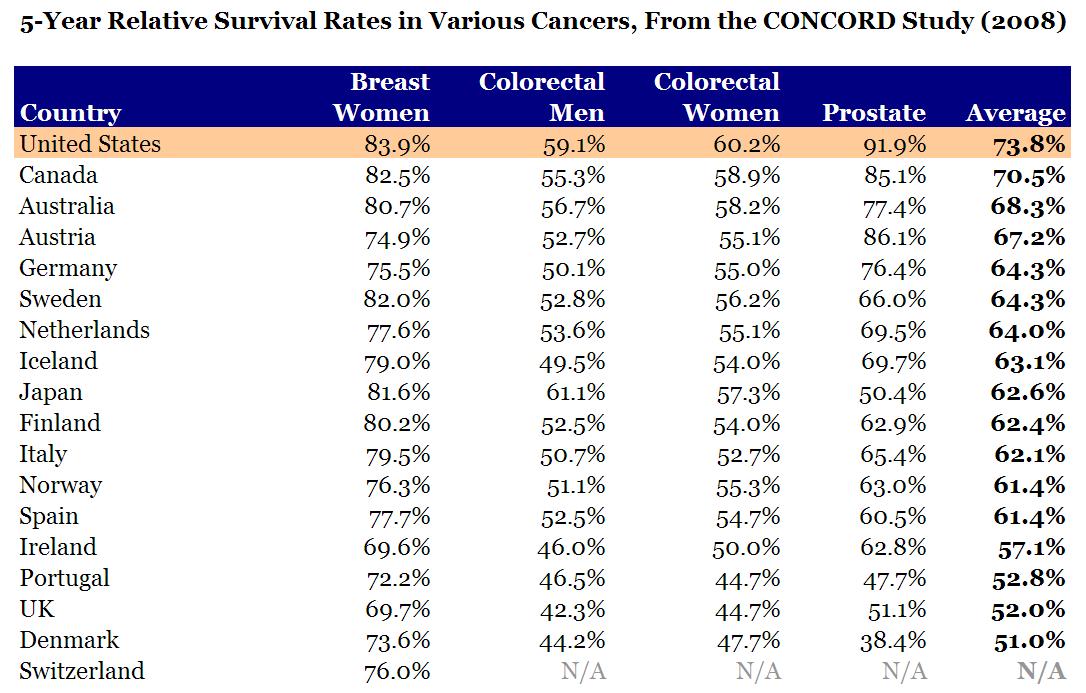
Health care outcomes
Health care outcomes by country and type of treatment

Click here to see the larger graph.

So, what explains this?

The article continues:

Another point worth making is that people die for other reasons than health. For example, people die because of car accidents and violent crime. A few years back, Robert Ohsfeldt of Texas A&M and John Schneider of the University of Iowa asked the obvious question: what happens if you remove deaths from fatal injuries from the life expectancy tables? Among the 29 members of the OECD, the U.S. vaults from 19th place to…you guessed it…first. Japan, on the same adjustment, drops from first to ninth.

It’s great that the Japanese eat more sushi than we do, and that they settle their arguments more peaceably. But these things don’t have anything to do with socialized medicine.

Finally, U.S. life-expectancy statistics are skewed by the fact that the U.S. doesn’t have one health-care system, but three: Medicaid, Medicare, and private insurance. (A fourth, the Obamacare exchanges, is supposed to go into effect in 2014.) As I have noted in the past, health outcomes for those on government-sponsored insurance are worse than for those on private insurance.

To my knowledge, no one has attempted to segregate U.S. life-expectancy figures by insurance status. But based on the data we have, it’s highly likely that those on private insurance have the best life expectancy, with Medicare patients in the middle, and the uninsured and Medicaid at the bottom.

If we’re going to discuss health care, then let’s discuss facts. We shouldn’t be picking a health care system from the campaign speeches of politicians who tell us that we can keep our doctor, and keep our health plan, and our premiums will go down. We tried electing a charismatic deceiver in 2008, and it didn’t work out. We lost our doctors, lost our health plans, and our premiums went up enormously. We can do better than single-payer health care. We can do better than socialism.

Alexander Vilenkin: “All the evidence we have says that the universe had a beginning”

I’ve decided to explain why physicists believe that there was a creation event in this post. That is to say, I’ve decided to let famous cosmologist Alexander Vilenkin do it.

From Uncommon Descent.

Excerpt:

Did the cosmos have a beginning? The Big Bang theory seems to suggest it did, but in recent decades, cosmologists have concocted elaborate theories – for example, an eternally inflating universe or a cyclic universe – which claim to avoid the need for a beginning of the cosmos. Now it appears that the universe really had a beginning after all, even if it wasn’t necessarily the Big Bang.

At a meeting of scientists – titled “State of the Universe” – convened last week at Cambridge University to honor Stephen Hawking’s 70th birthday, cosmologist Alexander Vilenkin of Tufts University in Boston presented evidence that the universe is not eternal after all, leaving scientists at a loss to explain how the cosmos got started without a supernatural creator. The meeting was reported in New Scientist magazine (Why physicists can’t avoid a creation event, 11 January 2012).

[…]In his presentation, Professor Vilenkin discussed three theories which claim to avoid the need for a beginning of the cosmos.

The three theories are chaotic inflationary model, the oscillating model and quantum gravity model. Regular readers will know that those have all been addressed in William Lane Craig’s peer-reviewed paper that evaluates alternatives to the standard Big Bang cosmology.

But let’s see what Vilenkin said.

More:

One popular theory is eternal inflation. Most readers will be familiar with the theory of inflation, which says that the universe increased in volume by a factor of at least 10^78 in its very early stages (from 10^−36 seconds after the Big Bang to sometime between 10^−33 and 10^−32 seconds), before settling into the slower rate of expansion that we see today. The theory of eternal inflation goes further, and holds that the universe is constantly giving birth to smaller “bubble” universes within an ever-expanding multiverse. Each bubble universe undergoes its own initial period of inflation. In some versions of the theory, the bubbles go both backwards and forwards in time, allowing the possibility of an infinite past. Trouble is, the value of one particular cosmic parameter rules out that possibility:

But in 2003, a team including Vilenkin and Guth considered what eternal inflation would mean for the Hubble constant, which describes mathematically the expansion of the universe. They found that the equations didn’t work (Physical Review Letters, DOI: 10.1103/physrevlett.90.151301). “You can’t construct a space-time with this property,” says Vilenkin. It turns out that the constant has a lower limit that prevents inflation in both time directions. “It can’t possibly be eternal in the past,” says Vilenkin. “There must be some kind of boundary.”

A second option explored by Vilenkin was that of a cyclic universe, where the universe goes through an infinite series of big bangs and crunches, with no specific beginning. It was even claimed that a cyclic universe could explain the low observed value of the cosmological constant. But as Vilenkin found, there’s a problem if you look at the disorder in the universe:

Disorder increases with time. So following each cycle, the universe must get more and more disordered. But if there has already been an infinite number of cycles, the universe we inhabit now should be in a state of maximum disorder. Such a universe would be uniformly lukewarm and featureless, and definitely lacking such complicated beings as stars, planets and physicists – nothing like the one we see around us.

One way around that is to propose that the universe just gets bigger with every cycle. Then the amount of disorder per volume doesn’t increase, so needn’t reach the maximum. But Vilenkin found that this scenario falls prey to the same mathematical argument as eternal inflation: if your universe keeps getting bigger, it must have started somewhere.

However, Vilenkin’s options were not exhausted yet. There was another possibility: that the universe had sprung from an eternal cosmic egg:

Vilenkin’s final strike is an attack on a third, lesser-known proposal that the cosmos existed eternally in a static state called the cosmic egg. This finally “cracked” to create the big bang, leading to the expanding universe we see today. Late last year Vilenkin and graduate student Audrey Mithani showed that the egg could not have existed forever after all, as quantum instabilities would force it to collapse after a finite amount of time (arxiv.org/abs/1110.4096). If it cracked instead, leading to the big bang, then this must have happened before it collapsed – and therefore also after a finite amount of time.

“This is also not a good candidate for a beginningless universe,” Vilenkin concludes.

So at the end of the day, what is Vilenkin’s verdict?

“All the evidence we have says that the universe had a beginning.”

This is consistent with the Borde-Guth-Vilenkin Theorem, which I blogged about before, and which William Lane Craig leveraged to his advantage in his debate with Peter Millican.

The Borde-Guth-Vilenkin (BGV) proof shows that every universe that expands must have a space-time boundary in the past. That means that no expanding universe, no matter what the model, can be eternal into the past. No one denies the expansion of space in our universe, and so we are left with a cosmic beginning. Even speculative alternative cosmologies do not escape the need for a beginning.

Conclusion

If the universe came into being out of nothing, which seems to be the case from science, then the universe has a cause. Things do not pop into being, uncaused, out of nothing. The cause of the universe must be transcendent and supernatural. It must be uncaused, because there cannot be an infinite regress of causes. It must be eternal, because it created time. It must be non-physical, because it created space. There are only two possibilities for such a cause. It could be an abstract object or an agent. Abstract objects cannot cause effects. Therefore, the cause is an agent.

Now, let’s have a discussion about this science in our churches, and see if we can’t train Christians to engage with non-Christians about the evidence so that everyone accepts what science tells us about the origin of the universe.

Fascist Canadian Justice Francesca Marzari overrules father’s freedoms of thought and speech

The Honourable Madam Justice Francesca V. Marzari

This story of a transgender child in the left-leaning province of British Columbia shows what the political left would do in America if they were in power. In a previous post, I reported on how the public schools, the government-run health care system, and the government-run courts all conspired to give the child testosterone injections, over the father’s objections.

Here is the latest from The Federalist:

Last week, Justice Francesca Marzari of the Supreme Court of British Columbia, Canada, declared a father guilty of “family violence” against his 14-year-old daughter on the sole basis that he had engaged in “expressions of rejection of [her] gender identity.” These “expressions” revolved entirely around his polite refusal to refer to his daughter as a boy in private, and his steady choice to affirm that she is a girl in public.

[…]Her father, Clark*, strongly objects to this treatment and immediately sought to reverse the decision in the BC Court of Appeal. Hoping to raise awareness of his case, Clark gave a number of interviews to media outlets, including The Federalist. In these interviews, he repeatedly referred to his daughter as a girl, stating to The Federalist that “she is a girl.  Her DNA will not change through all these experiments that they do.”

While many might take this to be an honest statement of biological fact, Marzari quoted it as a prime example of Clark’s “family violence of a public denial of [Maxine’s] gender identity.” Marzari convicted Clark of this violence, and issued a “protection order” preventing him from speaking to journalists or the public about his case.

[…]What Marzari found particularly egregious, however, was not Clark’s private interactions with his daughter but his “continued willingness to provide interviews to the media … in which he identifies [Maxine] as female, uses a female name for [Maxine] … and expresses his opposition to the therapies [Maxine] has chosen.” According to the court, this willingness placed Maxine at “a significant risk of harm.”

[…]Marzari argued that the “people and organizations” to whom Clark granted interviews had shown themselves “fundamentally opposed” to transgender ideology, yet Clark “continued to support the media organizations posting his commentary with additional interviews.” This kind of attitude was, in Marzari’s view, justification for enjoining Clark from sharing any information with journalists—or with practically anyone outside his legal team—about his daughter’s “sex, gender identity, sexual orientation, mental or physical health, medical status or therapies.”

The court also emphasized that Clark must not allow relevant documents (petitions, affidavits, letters, court orders, etc.) to come into the hands of third parties not “authorized by order of this court,” or with “written consent” from his daughter.

If father refers to his daughter as female again, then he will be arrested!

Excerpt:

At about the same time that story was published, the Supreme Court issued an additional, more heavy-handed “protection order” from the same ruling. The three-page document declares that the father, Clark*, will henceforth be subject to arrest, immediately and “without warrant” if any police officer has “reasonable” grounds to believe that he has in any way referred to his daughter as a girl in public or in private.

The new order further stipulated not only that Clark must not discuss his daughter’s sex or gender identity in public, but also that he cannot share court documents describing his own gag order. On the one hand, this demand may seem ironic, since it covers a publicly available court ruling. On the other hand, the injunction is so broad that it naturally includes the very document upon which it is written and that document–with its threats of immediate arrest without warrant–has not, as of yet, been made available on the court’s website.

So you have an anti-science judge, who is paid by the tax dollars of this father, overruling him as the biological father, and imposing her own far-left opinions as law. Why would any moral Christian man marry and start a family in Canada, when immoral far-left atheist leftists can take his money for their salary, and then overrule his basic human rights and parental authority? No free man would live in a country that treats him like a slave. Unfortunately, men are treated like slaves in Canada. The only solution is to get out.

It’s not surprising that the courts would censor him from speaking to the news media. In Canada, the government is run by radical secular leftists, who see any speech critical of the secular left agenda as potential violence. So, for decades in Canada, the government and the courts have issued gag orders on pro-life activists, and they even imprison those who speak out against abortion and same-sex marriage. Nurses and doctors who expose abortion extremism and infanticide are regularly censored b the government and the courts, for example. There is nothing like the first amendment in Canada. On the contrary. The progressives in government have made “offensive speech” a criminal offense.

More:

While the main thrust of Marzari’s ruling focused on Clark’s public statements, Marzari also ordered that Clark be enjoined from “exposing” Maxine to any materials that might “question whether [her] gender identity is real or the treatments [she] seeks are in [her] best interests.”

Well, enough of that. Let’s talk about the legal system in Canada.

Although the university system is funded in part by pro-life and pro-marriage taxpayers through mandatory taxes, the law schools are effectively closed to Christians or conservatives. If any manage to get through law school, then they are barred from practicing law. And of course it’s impossible for anyone right of center to be appointed to a government position on the courts, because of discrimination and bias.

There is no free speech or freedom of thought in Canada

This article about religious liberty in Canada is from Vancouver Sun.

Excerpt:

Ontario’s top court has dismissed an appeal from a private Christian university that forbids sexual intimacy outside heterosexual marriage, denying its proposed law school accreditation in the province.

The key point about the code of conduct is that it doesn’t discriminate against any particular group, e.g. – LGBT. It also forbids excessive drinking and premarital sex by heterosexuals:

It includes requiring students to abstain from gossip, obscene language, prejudice, harassment, lying, cheating, stealing, pornography, drunkenness and sexual intimacy “that violates the sacredness of marriage between a man and a woman.”

Now read this next part carefully. Although there was no legal support for denying a Christian university religious liberty and freedom of association, there was the hurt feelings of the LGBTQ community:

“The part of TWU’s Community Covenant in issue in this appeal is deeply discriminatory to the LGBTQ community, and it hurts,” the appeal court ruling said. “The LSUC’s decision not to accredit TWU was indeed a reasonable conclusion.”

In Canada “it hurts” means the end of human rights like religious liberty and freedom of association. Why? Because the Christian community in Canada has – for decades – voted to increase the size of government at the expense of liberty, in order to get free stuff. It doesn’t matter if the Christians who wanted a Christian university are hurt. Or that the Christian students at TWU are hurt. Only the hurt of the LGBT community matters, and their hurt changes laws, criminalizes dissent and annihilates natural rights. There are no such things as freedom of religion and freedom of conscience in Canada. There never was free speech, either. Anything that might hurt the feelings of left-wing groups has to be made criminal.

I’ll put this as plainly as anyone can: Canadian “Christians” have been voting to transfer wealth and power to a big secular government for years. They wanted government to cover health care, and now the government thinks that health care is providing free sex changes, free IVF and free abortions. Canadian “Christians” wanted their 30 pieces of silver more than they wanted the freedom to act as if the Bible was true in public. It turns out that the more wealth and power that you transfer to a secular leftist government, the more likely they are to trample all over the basic human rights of anyone who disagrees with their ideology.

This sort of thing happens all the time in Canada. Remember the case where another female judge overruled a biological father who grounded his daughter for sending nude pictures of herself using her father’s computer? This is normal in Canada, where biological fathers are competent enough to pay taxes, but not competent enough to parent their own children.

If any of this sounds unappealing to you, remember this at election time. The only way to stop the fascism of the secular left is to elect small-government conservatives who respect the basic human rights in our Constitution, such as the right to free speech and religious liberty. If you want to keep these rights, you will have to vote appropriately, and encourage others to vote appropriately.