
All posts by Wintery Knight

https://winteryknight.com/

Court rules that father must affirm that his son is a girl

Most people today who have noticed that men are hesitant to get married, or even get into relationships, with women. But few outside of the men’s rights movement are aware of the real reasons. Although it’s fashionable to mock men as weaklings for their cautiousness with women and marriage, it takes a little more work to look beyond the insults and find the real root causes.

So, with that in mind, consider this story from the red state of Texas, about a man whose ex-wife took him to court to force their 7-year-old boy to transition (via drugs and surgery) to becoming female.

Here’s the first from Life Site News, posted in December 2018:

A six-year-old Texas boy is being dressed and presented as a girl by his mother; at the same time, she is threatening the boy’s father legally for not going along with her plan for their son to live as a girl.

J4m35 lives as a girl when with his mother, but when with his father and given the choice, the six-year-old boy lives as a boy.

Court order:

J3ffr3y Y0ng3r is currently prohibited by court order from affirming in any way his son’s sex, including imparting Christian teaching on gender and sexuality to J4m35.

Child abuse charges against the father for disapproving:

4nn3 G30rgu1a5 has charged Y0ng3r, her ex-husband and J4m35’s father, with child abuse for not affirming their son as a transgender “girl,” according to court documents.

Restraining order blocking father’s contact with the boys:

She has also sought restraining orders against Y0ng3r, she is trying to terminate his parental rights, and also seeks to compel Y0ng3r to pay for J4m35’s visits with a transgender-affirming therapist and for medical procedures to “transition” J4m35 to a girl.

Chemical castration and sex-reassignment surgery:

The controversial “treatment” could include hormonal sterilization that could begin in as soon as two years when J4m35 turns eight, in preparation for J4m35 to later have “sexual reassignment” surgery.

Father loses all parental rights:

The court has awarded her the sole right to consent to psychiatric and psychological treatment of J4m35 and his twin brother Jude, rendering the boys’ father unable to get a second opinion.

Child Protective Services:

Y0ng3r is even prohibited from cutting his sons’ hair, having been reported by a teacher to Texas Child Protective Services for giving J4m35 a haircut.

Father gets the bill:

Since the cost for psychological and psychiatric treatment of children is considered child support in Texas, a website on the case created by friends of the family says, and current Texas statutes being what they are, Y0ng3r could be “forced to pay for the sexual mutilation of his own son.”

And here is the latest from Life Site News about the outcome of the trial:

A jury has ruled against J3ffr3y Y0ng3r, the father who is trying to protect his seven-year-old son, J4m35, from chemical castration via a gender “transition.”

[…]The jury’s decision likely means that Mr. Y0ng3r will be required to “affirm” J4m35 as a girl, despite his religious and moral objections, and will also be forced to take a class on transgenderism.

Although it was a jury trial, I just want to point out that the judge overseeing the trial is a woman, and G30rgu1a5 has two female lawyers leading the questioning of witnesses.  The therapist who diagnosed the boy with gender dysphoria is also a (gay) woman, and founder of Da11as Ra1nb0w C0uns3l1ng. So a panel of women is overruling the wishes of the child’s father for his son, and this apparently isn’t a problem for anyone.

The American Conservative noted that G30rgu1a5 is not the biological mother of the boys. They were conceived with Y0ng3r’s sperm and eggs from an egg donor. This is an immediate red flag to me, as women who use IVF are often feminists who deliberately delayed child-bearing during their fertile years for their careers.

By the way, the story has also been reported in The Blaze, the Daily Caller, Daily Wire, Christian Post, etc.
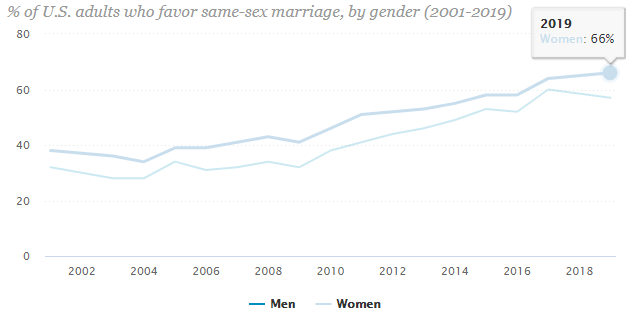
Support for gay marriage by gender (Source: Pew Research 2019)

My thoughts

First, everyone who reads this blog knows that I am forever blaming women for their poor choice of men, and poor choices of when to have sex. Well, it works exactly the same in reverse: Jeff Y0ng3r should not have married this woman. I blame him for this mess.

Second, there is no concern in the church about the challenges facing marriage-minded men in this society. Christian men receive no support from the church when they try to lead on moral or spiritual issues that conflict with women’s emotions and preference for non-judgmentalism. In my opinion, it’s very likely that if I were somehow married to this crazy lady, that my church would side with her against me, just because she is a woman. After all, what are people learning in church about male headship or defenses against feminism or LGBT? NOTHING. The church’s goal is to produce feelings and community. They prioritize essential oils and praise hymns. What good is that to me against  an army of anti-Christian teachers, doctors, therapists, lawyers, judges, and powerful gay rights groups? I’m not going to get involved in a situation where I am wasting a lot of time and money losing legal battles.

Finally, I just wanted to point out that marriage-minded men are aware of how the government is stepping in and overruling their authority as fathers and husbands. It’s not just in obvious ways, like no-fault divorce, higher taxes, big government meddling in families, Equality Act, etc. It’s also in subtle ways, e.g. – men are forced to pay into a public school system that is dominated by secular leftist administrators and teachers. Stories like the one above show a growing intrusion by government into Christian men’s lives, which is made possible by higher taxes and more government spending. The money for big government intrusions comes out of Christian homes. The bigger the government, the less money and fewer degrees of freedom the husband / father has to execute his plan. And this is something we have to address if we expect Christian men to take the risk of getting married and having kids. “Man up and jump off this cliff that feminism and socialism has made!” isn’t going to cut it.

Alabama woman Jessica Taylor announces her candidacy for Congress by bashing socialism

Prattville attorney and businesswoman Jessica Taylor
Prattville, Alabama attorney and businesswoman Jessica Taylor

I love to feature conservative women who want to run for office and make a difference in the laws and policies of our nation. A long time back, I supported Michele Bachmann for President over all the other candidates. I wrote dozens and dozens of posts promoting her policies. But the truth is, we have lots of good conservative women candidates, with conservative accomplishments. Here’s a new one.

Take a look at this short campaign ad from Jessica Taylor.

The ad:

Love that accent.

The Federalist Papers reports:

An Alabama business woman, Jessica Taylor, just called out our favorite socialist superstar, Rep. Alexandria Ocasio-Cortez, in an ad announcing her candidacy for Alabama’s 2nd Congressional district.

The ad starts by showcasing candidate Taylor’s basketball career and her career in public service before she then turns here ire on Ocasio-Cortez and her so-called “squad.”

“Like you, I’m tired of arrogant socialists like AOC who’ve never even run a lemonade stand telling us how we should live in Alabama and that more government is the answer,” Taylor said.

She continues by promoting her support for President Trump and her conservative views, like support for the right to life.

“Even though it might trigger a few liberals, I’ll fight to protect life, the Second Amendment, our borders, our military, our families, and President Trump from socialists in the swamp, and I won’t apologize for it,” Taylor added.

If you like this ad, and like the idea of a conservative woman with a good story running for Congress, then why not share the video on your page? I think it’s interesting. We need more conservatives in Congress, and I don’t care what sex or color they are.

Non-Christian historian Bart Ehrman attended a Christian apologetics conference

Are we allowed to look at the Bible as a historical document?

My summaries of Bart Ehrman’s debates mock him for being a rigid Moody Bible Institute fundamentalist whose blind faith was shattered by 1) minor Bible difficulties, 2) disappointment that God allows good people to suffer, 3) wanting to look smart to his professors, and 4) the desire to make lots of money selling apostasy porn to the New York Times set. But maybe he is not as bad as I thought.

Consider this blog post in which Ehrman reports on his experiences at a recent apologetics conference, where he met with a few of the more effective and engaging evangelical scholars.

He writes:

I spent yesterday at a conservative evangelical apologetics conference outside of Chicago and, as you might imagine, I was the odd person out. But I was very well received, people were overwhelmingly gracious and receptive and openly grateful that I had come. There were jokes about being thrown into the lions’ den, but it didn’t really feel like it. It felt like I was speaking to a crowd that wanted to hear, respected what I said, and simply fundamentally disagreed. In particular there was a group of current Moody Bible Institute students there; really interesting, interested, and good humored, and we had a great time together.

What I was most interested in was how Christian apologetics – the intelligent “defense” of the claims of the faith – has changed in the many years since I was involved in the movement, shifted in ways I never would have imagined, very much away from our old fundamentalist assumptions and assertions into a far more reasonable and intellectually sustainable form of discourse that requires actual research and knowledge rather than hard-core theological assertion based on completely dubious premises.

[…]The issue at the conference were the “Contradictions” in the New Testament. How does one deal with apparent or real contradictions and still remain committed to an evangelical view of Scripture as inspired by God and in some sense “inerrant”?

[…]The discussions yesterday (well, most of them) were at a much, much higher academic/intellectual level than ones I’ve had, say, during a recent debate on the blog. I think some of the positions staked out yesterday were utterly, demonstrably, mind-bogglingly simply WRONG. But they were advanced with the kind of learning and historical knowledge that we simply didn’t see back in my apologetics days in the mid-1970s.

Roughly speaking I was hearing two positions, neither of them ones we were taught and advanced in the day (in my circles). One of the two strikes me as completely tenable, though again, only in a sense.

Our old position, back then, was that any contradiction in the New Testament Gospels (or the Bible, for that matter; but yesterday we were talking only about the Gospels) can in fact be reconciled if you look closely and deeply enough at the matter. ANY contradiction. To be sure, there may be places where you aren’t sure HOW to reconcile them, but in principle they are all reconcilable in one way or another.

And, as a corollary, everything the Bible says is literally true. There are no mistakes, of any kind, whatsoever, in the Bible.

[…]None of the three speakers yesterday has that view, even though they call the Bible inerrant and affirm that it is completely reliable. Their views strike me as odd – that they can admit there are, technically speaking, incorrect statements in the Bible but that it is still without error. But they consider my old view (no mistakes of any kind whatsoever) as a dated kind of fundamentalism that is simply not held by thinking Christians any more, and, even more interesting, that my objections to their views are rooted in fundamentalist views that I myself don’t accept but that I’m assuming in order to attack their alternative views. In other words, they think I’m kicking a dead horse.

Interesting.

And here are the two views that were presented:

One is indeed to “reconcile” them as best as possible; or, the term they appear to prefer, “harmonize” them: that is take the two texts that appear to contradict each other and show how they actually fit together, possibly in a complicated way, into a harmonized whole so that they round out and complement each other, rather than stand at odds with one another.

[…]The current view seems to be much more open to the possibility that there are places that we simply can’t figure it out, places that do appear to be contradictory. And here is the KICKER. When they (the evangelicals who take this view) admit there are apparent contradictions, then they say that the details are not important. What matters is the major message. The ultimate point. The big picture. The gist. The gist of what a passage is trying to teach is what is inspired and inerrant. Not the picayune details.

That is to say – a phrase you hear a lot in these circles – “the Bible is inerrant in what it affirms.” That is, it makes no mistakes in what what it is trying to teach.

So you might have a story in which Jesus heals someone, found, say, in both Matthew and Luke. There may be small contradictory details: in one he heals the person before he does this other thing, in the other he heals the person after he does the other thing. Small discrepancy. But the story is not trying to teach *when* Jesus did the miracle. It’s trying to teach that he did the miracle. And it is inerrant about that. He *did* do the miracle.

We never ever would have allowed that back in my days at Moody Bible Institute. But it’s becoming a thinking-person’s view among evangelicals who believe in the inerrancy of the Bible, apparently.

But the other change – the second position – strikes me as even more significant, a real step toward traditional scholarship, which tries to explain WHY there are contradictions, and then goes on to say that since we know why they are there, they are not really contradictions.

The reason I am posting this is because we are facing a problem in the church, the problem of massive numbers of young people leaving Christianity:

Christianity continues to decline among U.S. adults as the number of adults identifying as “nothing in particular” increases, Pew Research Center found.

The number of American adults who describe themselves as Christian dropped 12 percentage points over the past decade and the number of both Protestants and Catholics in the U.S. has dropped, according to Pew Research data released Thursday.

Surveys Pew conducted over the phone between 2018 and 2019 found 65% of American adults describe themselves as Christian. Meanwhile, 26% of American adults identify as atheist, agnostic or “nothing in particular,” a number that increased from 17% in 2009.

“The data shows that the trend toward religious disaffiliation documented in the Center’s 2007 and 2014 Religious Landscape Studies, and before that in major national studies like the General Social Survey (GSS), has continued apace,” according to Pew.

I was recently at the National Conference on Christian Apologetics, where I saw a debate featuring Michael Licona. Licona is an informed historian who published a book with Oxford University Press about differences in the gospels and the genre of ancient biography.

A video of the debate is here:

Licona argues that ALL ancient authors used “compositional devices” such as “time compression”, which would explain the differences between the gospel accounts. These compositional devices are found in the works of other authors of that period. Most people I polled in the audience liked both debaters, but they thought that Mike Licona won. Licona also emphasized over and over, in his speech, how questions about contradictions, gospel authorship, etc. do not undermine the core of Christianity, which is the bodily resurrection of Jesus. This is important, because even questions about peripheral issues should not affect the core, which is on solid historical grounds.

I think Ehrman’s post shows why apologetics is important for having productive conversations with non-Christians about the Christian worldview. Remember what happened to Antony Flew when someone took the time to share the evidence for a cosmic beginning and fine-tuning and origin of life with him. Bye-bye atheism. This is how the world really works – evidence is important to finding truth. Evangelism works best when we use reason and evidence to make our case that the Christian worldview is true.

We are living in a time when belief in God has been boosted by significant discoveries in the realm of science: origin of the universe, fine-tuning, habitability, origin of life, Cambrian explosion, molecular machines, etc. We have amazing work coming out of philosophers of religion like Alvin Plantinga, William Lane Craig, J.P. Moreland, etc. And now we are seeing ground-breaking, high-quality work coming out of scholars like Richard Bauckham, N.T. Wright, Craig Keener, and Michael Licona. When is the church going to realize the importance of scholarly research for evangelism?