
All posts by Wintery Knight

https://winteryknight.com/

Law-abiding gun owner stops attempted mass shooting at church

Gun ownership up, gun violence down

I often struggle to explain to my Canadian and British friends what the second amendment is, and why Americans insist on being able to legally own firearms. I normally make the argument from academic studies to show that banning guns leads to more violent crime, while concealed carry laws reduce violent crime. But sometimes, it’s nice to illustrate the statistics with a case study.

MSN.com reports on a story of an attempted mass-shooting that occurred on the weekend at a church:

A gunman has killed one person and critically injured another inside a packed Texas church during a livestreamed service before he was shot dead by an armed member of the congregation.

[…]Video of the livestream shows a person wearing a large coat, with the hood covering his head, standing up and walking over toward another man at the back of the room.

The shooter appears to say something to the man, prompting him to point in a direction at the back of the church.

In a matter of seconds, the shooter whips out what appears to be a shotgun and fires two rounds.

One of the shots hits a man who stood up in the back of the church and the other shot hits the man the victim had spoken too.

After the second shot was fired, the gunman attempted to flee the scene before he was shot by an armed member of the congregation.

[…]According to one member of the church, the victim had spoken to one of the deacons in the back of the church before he opened fire.

The member wrote on Facebook that another deacon ‘who is a concealed carry instruction, and retired law enforcement officer, shot the guy before he could fire a third time!’

That deacon has not been identified but according to CBS 11, he is actually a former FBI agent and part of the church’s security.

Here’s some video coverage from the far-left CBS News:

More about the man who took down the criminal.

Here is what Joe Biden, leading Democrat presidential candidate, has to offer the Christians in that church:

Democratic presidential candidate Joe Biden attacked Texas Governor Greg Abbott earlier this year for signing a bill into law that allowed lawful gun owners to carry firearms in places of worship, repeatedly calling Abbott’s decision “irrational.”

[…]“Dealing with firearms, it is irrational, with all due respect to the governor of Texas, irrational what they are doing,” Biden told reporters on September 2. “On the very day you see a mass shooting … and we’re talking about loosening access to have guns, to be able to take them into places of worship, it’s just absolutely irrational. It’s totally irrational.”

[…]Biden continued, saying that any weapon that was capable of carrying “magazines that can hold multiple bullets” should be banned – which is nearly all firearms.

[…]Later asked if there could be any compromises with Republicans on the issue, Biden responded, “None. None on this. I think this is no compromise. This is one we have to just push, and push, and push, and push, and push.”

Biden has armed security everywhere he goes. He just doesn’t want you to have armed security.

Just picture in your mind what would have happened in that church if Joe Biden had prevented law-abiding church members from carrying weapons to defend themselves. That is the goal of every Democrat – they want to disarm law-abiding people, and leave them at the mercy of criminals who don’t obey gun laws.

I want to link to this column from famous black economist Thomas Sowell to help people understand how frequently law-abiding Americans use legally-owned firearms to prevent crimes.

He writes:

We all know that guns can cost lives because the media repeat this message endlessly, as if we could not figure it out for ourselves. But even someone who reads newspapers regularly and watches numerous television newscasts may never learn that guns also save lives — much less see any hard facts comparing how many lives are lost and how many are saved.

But that trade-off is the real issue — not the Second Amendment or the National Rifle Association, which so many in the media obsess about. If guns cost more lives than they save, we can always repeal the Second Amendment. But if guns save more lives than they cost, we need to know that, instead of spending time demonizing the National Rifle Association.

The defensive use of guns is usually either not discussed at all in the media or else is depicted as if it means bullets flying in all directions, like the gunfight at the O.K. Corral. But most defensive uses of guns do not involve actually pulling the trigger.

If someone comes at you with a knife and you point a gun at him, he is very unlikely to keep coming and far more likely to head in the other direction, perhaps in some haste, if he has a brain in his head. Only if he is an idiot are you likely to have to pull the trigger — and if an idiot with a knife is coming after you, you had better have a trigger to pull.

Surveys of American gun owners have found that 4 to 6 percent reported using a gun in self-defense within the previous five years. That is not a very high percentage but, in a country with 300 million people, that works out to hundreds of thousands of defensive uses of guns per year.

Yet we almost never hear about these hundreds of thousands of defensive uses of guns from the media, which will report the killing of a dozen people endlessly around the clock. The murder of a dozen innocent people is unquestionably a human tragedy. But that is no excuse for reacting blindly by preventing hundreds of thousands of other people from defending themselves against meeting the same fate.

Although most defensive uses of guns do not involve actually shooting, nevertheless, the total number of criminals killed by armed private citizens runs into the thousands per year.

Whenever I get into discussions about gun control, I always mention two academic studies by John R. Lott and Joyce Lee Malcolm.

The book by economist John Lott compares the crime rates of all U.S. states that have enacted concealed carry laws, and concludes that violent crime rates dropped after law-abiding citizens were allowed to carry legally-owned firearms. Dr. Malcolm’s Harvard study found that after the UK banned guns, violent crime rates doubled in four years.
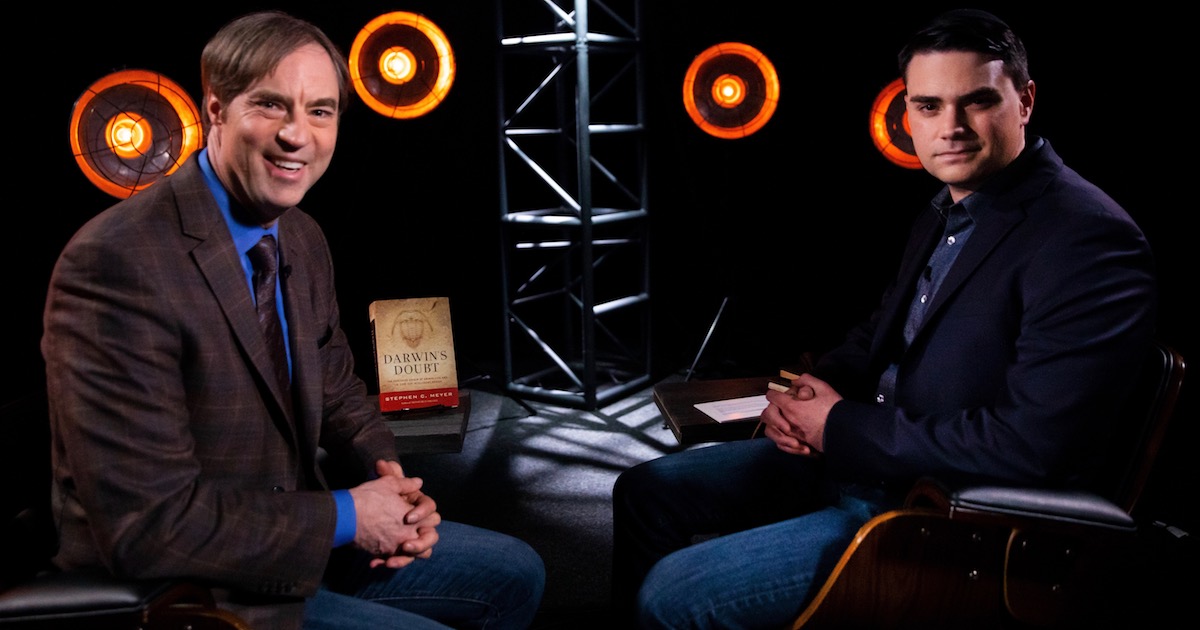

Video, audio and summary of intelligent design discussion, with Ben Shapiro and Stephen C. Meyer

Stephen C. Meyer and Ben Shapiro discuss evolution and intelligent design

(Re-posting this for those who missed it the first time around)

This is a must-see / must-hear conversation. Famous conservative Ben Shapiro discusses evolution and intelligent design with Dr. Stephen C. Meyer, author of “Signature in the Cell” (origin of life) and “Darwin’s Doubt” (fossil record). These are the two best books on intelligent design. Their conversation covers the most important issues in the origins debate.

So to start, here’s the full video:

And here is a link to the audio. You can download the MP3 there.

Someone actually put out an outline on Youtube, with a time-based index, so I’ll just steal that as a base, and add to it:

  • 1:34 What is your scientific background? Science undergraduate degree, professional geologist, later did a PhD in philosophy of science from Cambridge University.
  • 2:39 What is the difference between intelligent design and creationism? Creationism starts from the Bible and posits a shorter history of the universe. ID starts from the data of the natural world and is neutral about the age of the Earth / universe. Meyer accepts the old-Earth.
  • 3:36 How is Intelligent Design a scientific theory? The discovery of DNA reveals that code is central to living systems. Intelligent design uses the method of “inference to the best explanation” in order to argue that the best explanation for the code is an intelligent agent.
  • 6:10 What evidence would have to arise to make Intelligent Design Falsifiable? If a naturalistic mechanism was discovered that could produce biological information using the probabilistic resources of the universe, and the time available, then intelligent design would be falsified.
  • 7:26 Is religion separate from science or intertwined within it? There are three views: science is totally separate from religion, science is in total conflict with religion, science and religion agree on some issues, e.g. – the origin of the universe and Genesis 1:1. There are areas where science and religion overlap.
  • 9:55 Why are the most prominent Darwinians also militant atheists? Evolution is a theory that tries to explain nature using naturalistic mechanisms, so it is compatible with atheism.
  • 10:45 What does the theory of evolution say? The term evolution has multiple meanings, and should be defined before discussions. It can refer to change over time. It can refer to animals changing slightly to adapt to enviromental changes. It can refer to the idea that all animals evolved from simpler life forms, and that there is a tree of life showing how different types of organisms share common ancestors. And it can refer to the idea that purely undirected processes can explain the history of life using purely materialistic forces. It’s that final view that intelligent design challenges.
  • 13:15 Where is the discontinuity in naturalistic processes in the development of life? The first discontinuity is the origin of simple life from non-living components. The second discontinuity is the sudden appearance of different body plans in a very narrow window of time in the Cambrian era.
  • 15:42 Why does information theory suggest that code requires some sort of designer? DNA is a true information-bearing system identical to the software in computers, e.g. – operating system, applications.
  • 19:45 Can information be created by random mutation, and favorable mutations preserved by natural selection? Just as in software code, instructions must be added in order to develop new functionality. Random additions of characters will almost always degrade biological function. The number of possible sequences that do nothing useful is vastly higher than the number of sequences that perform biological functions. Doug Axe did research on this at Cambridge University, and he found that the number of functional sequences of amino acids is 1 in 10 to the 77th power. Given the probabilistic resources (replicating organisms)and the time available, it is extremely unlikely to find sequences that have functional information by chance.
  • 25:05 What about Stephen Jay Gould’s model of punctuated equilibrium – doesn’t it explain the sudden jumps in information? Gould’s mechanism is accurate according to the fossil record, which shows a lot of jumps. But he did not have a naturalistic explanation for sudden jumps in biological function. Darwinian mechanisms work slowly and would (in theory) produce different body plans gradually. But this is not what the fossil record shows.
  • 27:22 What is the mechanism for injecting information in the theory of intelligent design? The information comes in from an intelligence when new major body plans appear, and minor variations within types could be explained by evolution.
  • 29:25 Does the Miller-Urey experiment provide a naturalistic explanation for the building blocks necessary for the origin of life? The MU experiment only produced a few types of amino acids, it doesn’t say anything about how to sequence the amino acids in order to form protein folds that can perform biological functions. The MU experiment also pre-supposes conditions on the early Earth (reducing gases) that do not match what was there (oxidyzing or neutral gases).
  • 32:00 Is the RNA world hypothesis is a good explanation for the origin of life? Evolution requires that replication already be in place, because evolution assumes that mutations appear during the replication. The RNA world hypothesis suggests that sequences contain information, but also catalyze origin of life chemistry. The problem with RNA world is that it starts with self-replicating systems. And those replicating systems require the scientist to inject information into the system to get even the simplest replication started.
  • 34:56 How do scientists respond to the critiques of Darwinism proposed by intelligent design advocates? By and large, they accept them. They think that mutation and selection works once living systems are in place, but they realize it has no explanation for the origin of life or the sudden origin of body plans. (Tells about the  conference of the Royal Society, where problems with Darwinian mechanisms were discussed, and the 2003 MIT Press book by Muller and Newman).
  • 37:16 Why do people hold to Darwinian evolution in the face of these problems? Many scientists presuppose methodological naturalism, which requires that any explanation for the origin of life and the origin of major body plans involve materialist explanations only. No intelligent agents are allowed. The problems occur when assumption of naturalism causes scientists to propose incorrect explanations for what we observe in nature. It’s also not clear how naturalistic mechanisms could produce organisms who are capable of reason and free will.
  • 40:43 Does naturalistic evolution have an answer for conscious minds, reasoning, free will? No, consider the work of atheist scholar Thomas Nagel, who argues in his book “Mind and Cosmos” (Oxford University Press 2012) that the existence of mind is a disproof of the neo-Darwinian explanation for life. Darwinism stops us from accepting the reality of minds.
  • 42:06 So do naturalistic evolutionists have to explain away the mind as an illusion? First, we humans have immediate experience of consciousness, reason and free will. Second, our whole legal system is based on the idea free will, because you can’t hold someone guilty unless they chose to do something they knew was wrong. Third, we have an epidemic of suicide among young people. This is caused by a crisis of meaning. Intelligent design opens up the possibility of their being a mind behind the universe, who we could have a relationships with.
  • 44:53 Why aren’t schools allowed to be honest about the problems with neo-Darwinian evolution? The intellignt design view is to that teachers should be allowed to teach all the vidence for Darwinian evolution, and also discuss some of the problems with the theory. Students learning science should not be told that everything is solved. Students learn science better when they are presented with peer-reviewed evidence for and against a theory, rather than being indoctrinated.
  • 47:37 Is intelligent design theory connected to God? Intelligent design infers from the information content in nature that a mind with capabilities like ours injected information into living systems. Intelligent design is agnostic about the designer, because in principle, embodied or unembodied agents could inject information into living systems. Intelligent design is friendly to theism, because theists will immediately identify the mind as God. Furthermore, the fine-tuning in the initial conditions of the universe is another intelligent design argument. In that case, since the design occurs at the beginning of the universe, the intelligent agent acting prior to the creation of the universe would have to be supernatural, i.e. – God.
  • 50:53 Can naturalists say that the imposition of “function” on a sequence is arbitrary, in the same way that the English language is arbitrary? This won’t work, because biological function is not arbitrary in the same way as language. Biological function is not arbitrary, because sequences can be tested for function objectively by observing whether sequences can perform functions necessary for life, e.g. – replication.
  • 52:43 Doesn’t the multiverse explain away the improbabilities of the fine-tuning, the origin of life, and the development of life? No, because all models of the multiverse require fine-tuning in the mechanism that generates the different universes.
  • 55:42 What about cosmological models that eliminate the beginning of the universe? The standard Big Bang model and the inflationary model both posit a beginning of the universe. There is also the Borde-Guth-Vilenkin theory which proves that any universe that is expanding requires a beginning. The only chance for naturalists is quantum cosmologies, but this doesn’t work because 1) it requires an abstract reality of mathematics to actualize the physical universe, but this presupposes a mind. 2)  The model requires an earlier input of information, which can only have come from a mind.

If you listen to this lecture, or watch the video, and you enjoyed it, then please share. If you have questions, I can try to answer them for you – just leave your question in the comments, or shoot me an e-mail, or message me from the blog’s Facebook page, or direct message me on Twitter. I’ve invested a lot of time in this, and have been studying intelligent design since the late 1990s.

By the way, I listen to the Ben Shapiro podcast, (and the Andrew Klavan podcast), every day. I never miss an episode, and I think if you give them a try, you’ll enjoy them, too.

Does the Bible say that you should forgive someone who does not repent?

Bible study that hits the spot

Kevin Lewis, a professor of Theology and Law at the conservative Biola University, was asked this question:

Recently, I was reading Dr. Kenneth Bailey’s “Jesus Through Middle Eastern Eyes” (IVP press 2008). When commenting on Matthew 6:12-13, he writes,

“It is a common human assumption that the violator of the rights of others must ask for forgiveness before the wronged party can be expected to accept the apology and grant forgiveness…But Jesus here asks the person wronged to forgive the one responsible for the wrongdoing when when there is no confession of guilt… There is a voice from the cross that echoes across history to all saying ‘Father forgive them for they know not what they do.’ Neither Pilate nor the high priest nor the centurion offered any apology to Jesus, yet he prayed for divine forgiveness…(p.125)”

And here’s some of his response copied with permission from his Facebook note:

First, regarding God and His forgiveness, it is undisputed in orthodox Christian theology that God does not forgive everyone. The doctrine of Hell is a sufficient proof of the lack of universal forgiveness by God.

Next, it is clear that God does not forgive without repentance. This doctrine is taught in a number of texts. For example, in Luke 13:3 Jesus says, “unless you repent, you will all likewise perish.” In Mark 1:15 John the Baptist commands that we must “repent and believe the Gospel.” The connection between repentance and forgiveness of sins (i.e. “salvation”) is seen throughout the Scriptures. For example, in Acts 2:38 repentance is directly connected as a condition for the remission of sins. For additional examples of this connection see Matthew 11:20-24; Luke 24:45-49; Acts 3:19; 8:22; 17:30-31; Romans 2:4-5; II Corinthians 7:10; II Tim. 2:25-26.

So since we are to be imitators of God and forgive in the same way God forgives, we would expect the Scriptures to be consistent, stating that the condition of repentance is required to be fulfilled before believers are required to forgive each other’s sins. It does.

Jesus stated in Luke 17:3, “If your brother sins, rebuke him; and if he repents, forgive him.” Here, the meaning is clear. The word “if” (Grk. ean) introduces the condition for a rebuke and for granting forgiveness. If (subjunctive) a person sins, we must (imperative) rebuke him, and if (subjunctive) he repents, we must (imperative) forgive him. This is as clear a statement as you will find on the subject. Forgiveness is conditioned upon repentance—and this is one of the same criteria that God requires before He forgives sin.

This principle of permitting believers to withhold forgiveness unless the condition of repentance is satisfied is also explicitly seen in Matthew 18:15-17. Compared with the Luke 17:3 text above, the situation is the same. If a brother sins, reprove him; if he listens to you, you have won your brother. Here, the word “reprove” is used rather than “rebuke” and the word “listen” is employed rather than “repent,” but the meaning is virtually identical to Luke 17:3. What we see in Matthew 18 is an escalation of the issue and the result if the person fails to repent (i.e. “listen”). If the person fails to repent, we are to shun him in all appropriate ways (v. 17).

[…]Finally, I would make the case that it is harmful to a person to forgive him without requiring repentance. As seen above, the Bible is clear that sin requires a rebuke. Ignoring sin teaches sinners that sin does not bring consequences. This is harmful to their souls. Continuing to have the benefit of a righteous relationship with another and yet remain in sin against that person results in fostering a habituation of sinful inclinations in their soul, which God says brings about suffering and death.

Moreover, since the ultimate purpose of forgiveness is reconciliation, it is meaningless and harmful to forgive when no reconciliation may be had with the sinner. We cannot “walk together” in a biblical manner in righteous peace when the unrepentant sinner walks in unrighteousness. Necessarily, there is a conflict and a want of shalom. Their soul is headed in a different direction than the believer’s soul; they are walking away from God and we cannot have fellowship with darkness. God has no intimate fellowship with unrepentant people, and that is the model for Christians as well (See Matt. 18).

Regarding personal anger issues commonly raised by Christian psychologists, these types of psychologists unbiblically make unconditional forgiveness a part of therapy. By contrast, however, if a counselee will not forgive after the offending party has truly repented, the counselee sins, and this kind of unforgiveness may be one of the causes of his or her problems. But this is a separate issue from universal and unconditional forgiveness raised above.

Human beings in the image of God may be angry in appropriate ways (Eph.4:26, 31). There is a time to love and a time to hate (Ecclesiastes 3:8). The notion that Christians cannot ever hate, be angry, or lack forgiveness is an unbiblical concept. God Himself is eternally angry with sin, but He is certainly not a psychological basket case. He loves, hates, and is angry in appropriate ways. Our task as believers is to imitate this. Be angry with and hate sin appropriately (Rom. 12:9) and love what good appropriately. For example, righteous anger can evolve beyond the biblical limits to become malice, slander, and bitterness while, to give another example, an appropriate love of food can evolve beyond the biblical limits into gluttony.

I agree with Kevin, and I think it is a helpful tool for people to insist on seeing some sort of repentance and restitution from someone who wrongs you before you trust them again. If they are not even sorry for what they’ve done, and they refuse to explain why what they did is wrong, then they can’t be forgiven, and you can’t trust them again.

I think this is the key passage – Luke 17:3-4:

3 Be on your guard! If your brother sins, rebuke him; and if he repents, forgive him.

4 And if he sins against you seven times a day, and returns to you seven times, saying, ‘I repent,’ forgive him.”

That’s Jesus speaking, there.

Also, I was having a debate with someone who disagrees with all this, and while debating with her, I thought of another example.

Luke 18:9-14:

9 And He also told this parable to some people who trusted in themselves that they were righteous, and viewed others with contempt: 

10 “Two men went up into the temple to pray, one a Pharisee and the other a tax collector. 

11 The Pharisee stood and was praying this to himself: ‘God, I thank You that I am not like other people: swindlers, unjust, adulterers, or even like this tax collector. 

12 I fast twice a week; I pay tithes of all that I get.’ 

13 But the tax collector,standing some distance away, was even unwilling to lift up his eyes to heaven, but was beating his breast, saying, ‘God, be merciful to me, the sinner!’ 

14 I tell you, this man went to his house justified rather than the other; for everyone who exalts himself will be humbled, but he who humbles himself will be exalted.”

So again, no forgiveness without repentance.

Forgiveness is what happens when someone who is sinned against treats the sinner as if he had never sinned. It is not on the balance sheet. It is not brought to mind. It is not held against them in the future. The forgiver trusts the sinner again as if the previous sin had never happened.

In divine (vertical) forgiveness, there is no forgiveness without repentance. There are Bible verses above to show that.

My argument is twofold. First, there is a clear teaching of Jesus explaining the sequence of sin and forgiveness. Repentance precedes forgiveness, between humans (Luke 17:3). The verses cited by the forgive without repentance crowd don’t show the mechanics of how to forgive, they are making the point that if you want God to forgive you, you should forgive others. The parable in Luke 18:9-14 affirms this again – repentance always precedes forgiveness.

Second, we have an obligation to imitate God, and that means imitating the way he forgives those who sin against him. When I raise that with the unconditional forgiveness crowd, they want to insist that there is a difference, that the word “forgive” means different things. I’m not convinced.

Finally, I do think that forgiving someone is obligatory if they sincerely repent, and even if they screw up again and again. So long as the repentance is sincere, (like if there is restitution and a genuine effort to show an understanding how the sin affected the wronged party in writing), then forgiveness should be automatic.

Alan E. Kurschner argues that there is serious textual doubt about the originality of Luke 23:34a, a text used by the pro-unconditional-forgiveness crowd. He has a journal article coming out on it, but a synopsis of his argument is here.

He also wrote this in a comment on this blog:

Second, on Matt 6:15, this is what I have to say. Notice the then-clause: “neither will your Father forgive your sins.” This would require universalism on the Father’s part according to the unconditional interpretation given the first half: “But if you do not forgive others their sins.” Since everyone has wronged the Father is the Father required to forgive everyone even if they are not seeking forgiveness?

So I think the case for the forgiveness being conditional on repentance is pretty strong, especially when serious harm has been caused.