Same-sex “marriage” has been the law of the land for 10 years, now. As with the first redefinition of marriage – no-fault divorce – many unexpected problems have arisen. I found an article by two famous social conservative professors in USA Today, where they explain.
Excerpt:
[I]n 2013, [the Supreme Court] struck down the federal definition of marriage as a male-female union in a 5-4 ruling.
[…]Same-sex marriage advocates told the public that they sought only the “freedom to marry.” Same-sex couples were already free to live as they chose, but legal recognition was about the definition of marriage for all of society. It was about affirmation — by the government and everyone else.
It’s unsurprising that once a campaign that used to cry “live and let live” prevailed, it began working to shut down Catholic adoption agencies and harass evangelical bakers and florists. This shows it was never really about “live and let live” — that was a merely tactical stance.
[…]While these were the early effects of redefinition, the more profound consequences will be to marriage itself. Law shapes culture; culture shapes beliefs; beliefs shape action. The law now effectively teaches that mothers and fathers are replaceable, that marriage is simply about consenting adult relationships, of whatever formation the parties happen to prefer. This undermines the truth that children deserve a mother and a father — one of each.
Traditional marriage had the notions of exclusivity and permanence embedded into it. These were seen as necessary to safeguard vulnerable children, who are the natural outcome of natural marriage. But what if you take out the complementary genders, and make marriage about the romantic feelings of adults?
It also undercuts any reasonable justification for marital norms. After all, if marriage is about romantic connection, why require monogamy? There’s nothing magical about the number two, as defenders of “polyamory” point out. If marriage isn’t a conjugal union uniting a man and a woman as one flesh, why should it involve or imply sexual exclusivity? If it isn’t a comprehensive union inherently ordered to childbearing and rearing, why should it be pledged to permanence?
[…]But same-sex marriage is a catalyst for further erosion. Already, we see respectable opinion-makers mainstreaming “throuples,” “ethical nonmonogamy” and “open relationships.”
The progressive elites got rid of natural marriage without even thinking about why marriage was there in the first place. Marriage was traditionally seen as being an exclusive, permanent commitment – and that commitment provided the stability needed for children. Marriage required you to look for a partner who was good at self-control (exclusivity) and commitment (permanence). But when judges decided that marriage was just about two people having romantic feelings, it opened up the door to all of these other “lifestyles”.
I’m just thinking right now about how to stop this. I know that social conservatives are trying to highlight the damage that is being caused by focusing relationships on adult happiness instead of children’s needs and rights. But I still don’t hear any sort of thoughtful presentation of marriage as a commitment enterprise, where two adults suppress their own selfishness in order to make a promise to love and care for this other person. Does anyone see relationships as being a self-sacrificial commitment to another person, and to any children who result? Or are we locked into this view that the goal of relationships is to make my spouse, my children, and everyone else make me feel good and look good?
Is it possible to choose to be moral if we are machines made out of meat?
A while back I finished reading “God’s Crime Scene”, the new book by J. Warner Wallace. I wanted to post something about some studies he mentioned in Chapter 6, on free will. This is one of the places where he found evidence in a surprising area.
Wallace says that free will makes more sense if theism is true, because we have non-material souls that interact with our bodies, but are not causally determined by them. On atheism, only matter exists, and you can’t get free will (or consciousness) from matter. So atheists like Sam Harris and Alex Rosenberg, for example, deny free will, because they are materialists and atheists.
Anyway, here’s what he writes on p. 256:
In 2008, researchers from the University of Minnesota and the University of British Columbia conducted experiments highlighting the relationship between a belief in determinism and immoral behavior. They found students who were exposed to deterministic literature prior to taking a test were more likely to cheat on the test than students who were not exposed to literature advocating determinism. The researchers concluded those who deny free will are more inclined to believe their efforts to act morally are futile and are, therefore, less likely to do so.
In addition, a study conducted by researchers from Florida State University and the University of Kentucky found participants who were exposed to deterministic literature were more likely to act aggressively and less likely to be helpful toward others.” Even determinist Michael Gazzaniga conceded: “It seems that not only do we believe we control our actions, but it is good for everyone to believe it.”” The existence of free will is a common characteristic of our experience, and when we deny we have this sort of free agency, there are detrimental consequences.
Does moral behavior draw on a belief in free will? Two experiments examined whether inducing participants to believe that human behavior is predetermined would encourage cheating. In Experiment 1, participants read either text that encouraged a belief in determinism (i.e., that portrayed behavior as the consequence of environmental and genetic factors) or neutral text. Exposure to the deterministic message increased cheating on a task in which participants could passively allow a flawed computer program to reveal answers to mathematical problems that they had been instructed to solve themselves. Moreover, increased cheating behavior was mediated by decreased belief in free will. In Experiment 2, participants who read deterministic statements cheated by overpaying themselves for performance on a cognitive task; participants who read statements endorsing free will did not. These findings suggest that the debate over free will has societal, as well as scientific and theoretical, implications.
Laypersons’ belief in free will may foster a sense of thoughtful reflection and willingness to exert energy, thereby promoting helpfulness and reducing aggression, and so disbelief in free will may make behavior more reliant on selfish, automatic impulses and therefore less socially desirable. Three studies tested the hypothesis that disbelief in free will would be linked with decreased helping and increased aggression. In Experiment 1, induced disbelief in free will reduced willingness to help others. Experiment 2 showed that chronic disbelief in free will was associated with reduced helping behavior. In Experiment 3, participants induced disbelief in free will caused participants to act more aggressively than others. Although the findings do not speak to the existence of free will, the current results suggest that disbelief in free will reduces helping and increases aggression.
So what to make of this?
If you’re an atheist, then you are a physical object. And like every other physical object in the universe, your behavior is determined by genetic programming (if you’re alive) and external inputs. Material objects do not have the ability to make free choices, including moral choices.
And that’s what neurobiology is telling us: Our brains are simply meat computers that, like real computers, are programmed by our genes and experiences to convert an array of inputs into a predetermined output. Recent experiments involving brain scans show that when a subject “decides” to push a button on the left or right side of a computer, the choice can be predicted by brain activity at least seven seconds before the subject is consciously aware of having made it. (These studies use crude imaging techniques based on blood flow, and I suspect that future understanding of the brain will allow us to predict many of our decisions far earlier than seven seconds in advance.) “Decisions” made like that aren’t conscious ones. And if our choices are unconscious, with some determined well before the moment we think we’ve made them, then we don’t have free will in any meaningful sense.
Atheist William Provine says atheists have no free will, no moral accountability and no moral significance:
Let me summarize my views on what modern evolutionary biology tells us loud and clear — and these are basically Darwin’s views. There are no gods, no purposes, and no goal-directed forces of any kind. There is no life after death. When I die, I am absolutely certain that I am going to be dead. That’s the end of me. There is no ultimate foundation for ethics, no ultimate meaning in life, and no free will for humans, either.
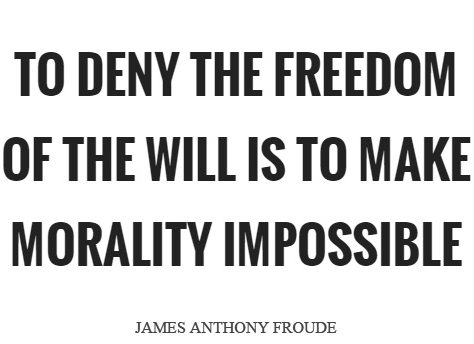
If you don’t have free will, then you can’t make moral choices, and you can’t be held morally responsible. No free will means no morality. Can you imagine trying to get into any sort of enterprise with someone who has this view of moral choices? A marriage, or a business arrangement, etc? It would be crazy to expect them to behave morally, when they don’t even think that moral choices is possible. It just excuses all sorts of bad behavior, because no one is responsible for choosing to do the right thing.
Believers in materialism are going to struggle with prescriptive morality, including self-sacrificial care and concern for others. Their worldview undermines the rationality of the moral point of view. You might find atheists acting morally for their own purposes, but their worldview doesn’t rationally ground it. This is a big problem for people who can see objective morality woven into the universe – and themselves – because they have the awareness of objective right and wrong.
Choosing to do the right thing
I think what atheists like to say is “I can be moral, too”. That’s not interesting. What is interesting is whether it is rational for you to be moral when doing the right thing sets you back. When I look at the adultery of Dawkins, the polyamory of Carrier, the divorces of Shermer and Atkins, etc. I am not seeing anything that really wows me about their ability to do the right thing when it was hard for them to do it. They all deny free will of course, and think that trying to resist temptation is a waste of time.
Wallace explains how the awareness of free will and moral choices caused him to turn away from atheism, in this blog post.
He writes:
As an atheist, I chose to cling to naturalism, in spite of the fact that I lived each day as though I was capable of using my mind to make moral choices based on more than my own opinion. In addition, I sought meaning and purpose beyond my own hedonistic preferences, as though meaning was to be discovered, rather than created. I called myself a naturalist while embracing three characteristics of reality that simply cannot be explained by naturalism. As a Christian, I’m now able to acknowledge the “grounding” for these features of reality. My philosophical worldview is consistent with my practical experience of the world.
I think atheists who want to be honest about their own experience of first-person consciousness, free will, moral realism, etc. will do well to just accept that theism rationally grounds all of these things, and so you should accept theism. Theism is real. If you like morality, and want to be a virtuous person, then you should accept theism.
I noticed that there is some silly Democrat running around harassing Mike Pence because he accepts Jesus’ definition of marriage. What’s annoying about this particular Democrat is that he calls himself a Christian, despite being in a gay relationship with another man. I thought it might be a good idea to remind everyone what the actual definition of marriage is, according to Jesus.
1 Now when Jesus had finished these sayings, he went away from Galilee and entered the region of Judea beyond the Jordan.
2 And large crowds followed him, and he healed them there.
3 And Pharisees came up to him and tested him by asking, “Is it lawful to divorce one’s wife for any cause?”
4 He answered, “Have you not read that he who created them from the beginning made them male and female,
5 and said, ‘Therefore a man shall leave his father and his mother and hold fast to his wife, and the two shall become one flesh’?
6 So they are no longer two but one flesh. What therefore God has joined together, let not man separate.”
7 They said to him, “Why then did Moses command one to give a certificate of divorce and to send her away?”
8 He said to them, “Because of your hardness of heart Moses allowed you to divorce your wives, but from the beginning it was not so.
9 And I say to you: whoever divorces his wife, except for sexual immorality, and marries another, commits adultery.”
10 The disciples said to him, “If such is the case of a man with his wife, it is better not to marry.”
11 But he said to them, “Not everyone can receive this saying, but only those to whom it is given.
To be a Christian, minimally, is to be a follower of Jesus Christ. That means that we accept what Jesus teaches, on whatever he teaches about. We don’t overturn the teachings of Jesus in order to make people who are rebelling against God feel better about their rebellion. It is central to the Christian worldview that Christians care more about what God thinks of them than what non-Christians think of them. In fact, Christians are supposed to be willing to endure suffering rather than side with non-Christians against God’s authority.
As Christians, our goal is not to avoid being like the big bad “other Christians,” but to strive to be like Christ Himself. This is one of the advantages to having an Incarnate God. He went around acting and speaking and teaching and generally functioning in our realm, thereby giving us a model to follow. This is the model of a loving and merciful man, and also a man of perfect virtue who fought against the forces of evil, condemned sin, defended his Father in Heaven with sometimes violent force, spoke truth, and eventually laid down His life for those He loved (which would be all of us).
[…]This is what it means to believe in Christ. Not just to believe that He existed, but to believe that Christ is Truth itself, and that everything He said and did was totally and absolutely and irreversibly true forever and always. Many Christians today — not only the ones in the video, but millions alongside them — seem to think we can rightly claim to have “faith” in Jesus or a “relationship” with Him while still categorically denying much of His Word. This is a ridiculous proposition. We can’t declare, in one breath, that Christ is Lord, and in the next suggest that maybe God got it wrong on this or that point. Well, we can make that declaration, but we expose our belief as fraudulent and self-serving. We worship a God we either invented in our heads, which is a false idol, or a God who is fallible, which is a false idol.
If you really accept Jesus as God, then you can’t think he is wrong when he explains what marriage is. Period. End of issue.
Real Christians don’t make excuses for sin. Real Christians present the gospel. The gospel is that all men have rebelled against God and fallen short of perfect submission to and obedience of him. For this, they deserve to be separated from God eternally. Jesus paid the price for this rebellion on the cross, and anyone who accepts him as Savior and Lord will be with God eternally after they die. There is no salvation apart from Jesus. That’s what Christians say. And they say it regardless of how weird they look, and how many non-Christians don’t like them for saying it.