
All posts by Wintery Knight

https://winteryknight.com/

Why was Twitter so focused on banning people who opposed sexualizing children?

I cannot even keep up with all of the news that is coming out about the Biden administration’s collusion with Twitter in order to interfere with the 2020 election. Last week, I wrote about part one and part two of the Twitter dumps. In this post, I’ll have to cover two in order to catch up: 3) federal departments collusion with Twitter, and 4) the banning of Donald Trump by Twitter.

Here’s part 3 from Daily Wire:

The third installment of the so-called “Twitter Files” released Friday night showed that federal agencies were in contact with Twitter during the 2020 presidential election and were involved in censoring content on the platform.

[…]Then-Twitter Policy Director Nick Pickles appeared to admit that the platform was meeting officials from the FBI and DHS regarding some of the actions that it was taking.

Yoel Roth, then-Twitter Global Head for Trust & Safety, confirmed in an internal message that he was meeting with the FBI, DHS, and Director of National Intelligence about election security and about the Hunter Biden laptop story. The DHS, FBI, and DOJ said during the election that the laptop story was not disinformation, which the former Director of National Intelligence confirmed to The Daily Wire on Friday night.

We’ll come back to Yoel Roth in a minute, but first let’s see what was in part 4 of the “Twitter Files”, reported in the Daily Wire:

The fourth installment of “The Twitter Files” released over the weekend revealed new information about the actions that led up to the platform banning former President Donald Trump following the January 6, 2021, riot in the nation’s capital.

[…]Shellenberger… noted tweets from former Twitter Global Lead of Trust & Safety Yoel Roth that were derogatory towards conservatives, which has been public knowledge for years and has previously been reported on.

[…]The next tweet showed that Roth told a senior executive Dorsey intended for Trump to be banned for “*ANY* policy violation” after the 12-hour suspension was lifted on his account. Roth said that due to the unique circumstances of everything that was happening that Twitter was, in Trump’s case, dropping its “public interest” policy which previously let Trump stay on the platform despite violations because what Trump had to say was deemed to be relevant to public policy. In essence, Twitter altered its processes and rules in real-time to adapt to the situation the company was dealing with.

They changed their policies just for the Republican candidate for president, just before the 2020 election.

Why was Yoel Roth so filled with hatred for conservatives? What issue was driving him to collude with the Biden administration in order to use Twitter to help the Democrat party?

Here is a little more about his “education”:

During the fall semester, Yoel Roth ’11 returned to campus to deliver a lecture titled “Swiping Left: Identity, Preference, and the Politics of Online Dating.” In the lecture, Roth gives an overview of the development of online dating sites and explores notions of privacy and self-expression with a particular focus on the case studies of Tinder and Grindr.

Roth earned his B.A. from Swarthmore College with honors in political science. He received his Ph.D. from the Annenberg School for Communication at the University of Pennsylvania. His research focuses on the privacy and self-expression choices of gay men using geosocial networking services like Grindr. He currently works on the Trust & Safety team at Twitter, developing policies and products to promote the privacy and safety of Twitter users worldwide.

Grindr, as you may know, is the hook-up app primarily used by gay men. I didn’t know you could do a PhD in gay hook-up apps. I had to write code in order to earn my graduate degree in computer science.

Yoel Roth is not known for his skills in computer science, which makes me wonder why he works for Twitter?

According to his LinkedIn, Roth has a bachelor’s degree in film and media studies and political science from Swarthmore College… Roth has full professional proficiency in English and Hebrew, according to his LinkedIn page.

Film Studies and political science.

Here is Elon Musk talking about Yoel’s PhD thesis:
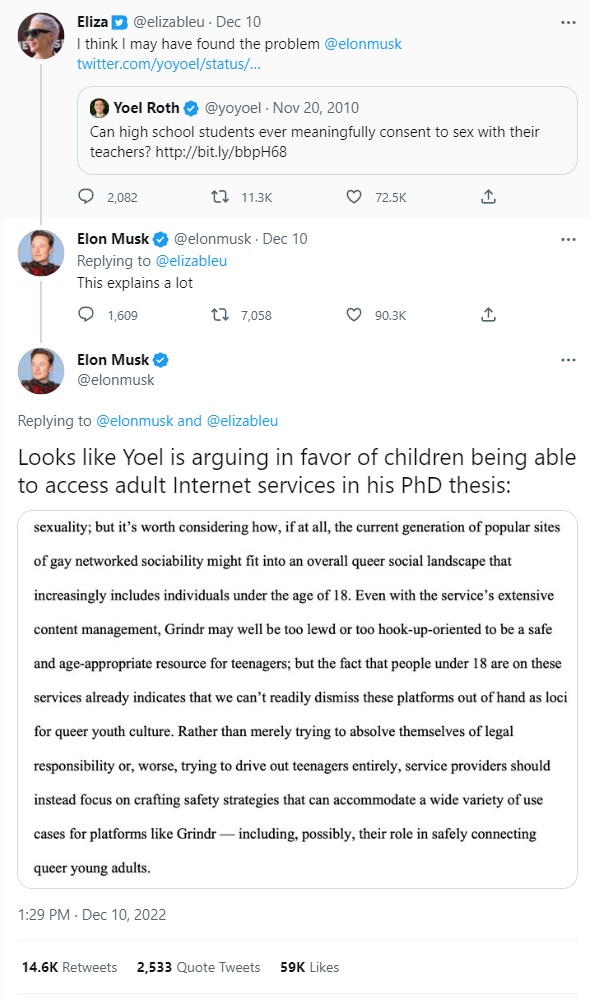
Yoel Roth Groomer

You might remember that Twitter also banned a lot of accounts that were critical of “grooming”, including Gay Against Groomers, which is an excellent association of gay people who are extremely opposed to grooming children for sex with adults. But Twitter banned them. Tweeting about grooming got you an immediate ban. I think they also made the #groomer hashtag  illegal. Why so much hostility to people who oppose grooming children for sex, Yoel Roth?

There is a nice thread of his previous tweets here, if you want to understand him better.

Here is something interesting from Heavy.com:

Roth is married. He wrote, “This reminds me of the time both of my husband’s boots suffered cascading failures 2 days into a hiking trip in a remote part of Japan. Turns out Japanese super-glue is extremely effective.”

Roth is male, and he has a husband. Not a wife.

N.T. Wright: what is the best explanation for the early belief in a bodily resurrection?

Here’s a lecture from N.T. Wright, whose multi-volume case for the historicity of the bodily resurrection of Jesus seems to be getting a lot of respect from the other side, (although I strongly disagree with his economic and political views, which are progressive). Wright has taught at Cambridge University, Oxford University, Duke University, McGill University, and lectured on dozens of prestigious campuses around the world. He’s published 40 books.

Here’s a video of his case for the resurrection:

You can read an article similar to the lecture here.

N.T. Wright’s historical case for the bodily resurrection of Jesus

Wright basically argues that the resurrection cannot have been a myth invented by the early Christian community, because the idea of the Messiah dying and being bodily resurrected to eternal life was completely unexpected in Jewish theology, and therefore would not have been fabricated.

In Judaism, when people die, they stay dead. At the most, they might re-appear as apparitions, or be resuscitated to life for a while, but then die again later. There was no concept of the bodily resurrection to eternal life of a single person, especially of the Messiah, prior to the general resurrection of all the righteous dead on judgment day.

Wright’s case for the resurrection has 3 parts:

  • The Jewish theological beliefs of the early Christian community underwent 7 mutations that are inexplicable apart from the bodily resurrection of Jesus
  • The empty tomb
  • The post-mortem appearances of Jesus to individuals and groups, friends and foes

Here’s the outline of Wright’s case:

The Christian claim from the beginning was that the question of Jesus’s resurrection was a question, not of the internal mental and spiritual states of his followers a few days after his crucifixion, but about something that had happened in the real, public world.

This “something” left not only an empty tomb, but a broken loaf at Emmaus and footprints in the sand by the lake among its physical mementoes. It also left his followers with a lot of explaining to do, but with a transformed worldview which is only explicable on the assumption that something really did happen, even though it stretched their existing worldviews to breaking point.

What I want to do here is to examine this early Christian claim, to ask what can be said about it historically, and to enquire, more particularly, what sort of “believing” we are talking about when we ask whether we – whether “we” be scientists or historians or mathematicians or theologians – can “believe” that which “the resurrection” actually refers to.

And here are the 7 mutations:

  1. Christian theology of the afterlife mutates from multiples views (Judaism) to a single view: resurrection (Christianity). When you die, your soul goes off to wait in Sheol. On judgment day, the righteous dead get new resurrection bodies, identical to Jesus’ resurrection body.
  2. The relative importance of the doctrine of resurrection changes from being peripheral (Judaism) to central (Christianity).
  3. The idea of what the resurrection would be like goes from multiple views (Judaism) to a single view: an incorruptible, spiritually-oriented body composed of the material of the previous corruptible body (Christianity).
  4. The timing of the resurrection changes from judgment day (Judaism) to a split between the resurrection of the Messiah right now and the resurrection of the rest of the righteous on judgment day (Christianity).
  5. There is a new view of eschatology as collaboration with God to transform the world.
  6. There is a new metaphorical concept of resurrection, referred to as being “born-again”.
  7. There is a new association of the concept of resurrection to the Messiah. (The Messiah was not even supposed to die, and he certainly wasn’t supposed to rise again from the dead in a resurrected body!)

There are also other historical puzzles that are solved by postulating a bodily resurrection of Jesus.

  1. Jewish people thought that the Messiah was not supposed to die. Although there were lots of (warrior) Messiahs running around at the time, whenever they got killed, their followers would abandon them. Why didn’t Jesus’ followers abandon him when he died?
  2. If the early Christian church wanted to communicate that Jesus was special, despite his shameful death on the cross, they would have made up a story using the existing Jewish concept of exaltation. Applying the concept of bodily resurrection to a dead Messiah would be a radical departure from Jewish theology, when an invented exaltation was already available to do the job.
  3. The early church became extremely reckless about sickness and death, taking care of people with communicable diseases and testifying about their faith in the face of torture and execution. Why did they scorn sickness and death?
  4. The gospels, especially Mark, do not contain any embellishments and “theology historicized”. If they were made-up, there would have been events that had some connection to theological concepts. But the narratives are instead bare-bones: “Guy dies public death. People encounter same guy alive later.” Plain vanilla narrative.
  5. The story of the women who were the first witnesses to the empty tomb cannot have been invented, because the testimony of women was inadmissible under almost all circumstances at that time. If the story were invented, they would have invented male discoverers of the tomb. Female discovers would have hampered conversion efforts.
  6. There are almost no legendary embellishments in the gospels, while there are plenty in the later gnostic forgeries. No crowds of singing angels, no talking crosses, and no booming voices from the clouds.
  7. There is no mention of the future hope of the general resurrection, which I guess they thought was imminent anyway.

To conclude, Wright makes the argument that the best explanation of all of these changes in theology and practice is that God raised Jesus (bodily) from the dead. There is simply no way that this community would have made up the single resurrection of the Messiah – who wasn’t even supposed to die – and then put themselves on the line for that belief.

And remember, the belief in a resurrected Jesus was something that the earliest witnesses could really assess, because they were the ones who saw him killed and then walking around again after his death. They were able to confirm or deny their belief in the resurrection of Jesus based on their own personal experiences with the object of those beliefs.

William Lane Craig debates Austin Dacey: Does God Exist?

Here is the video and summary of a debate between Christian theist William Lane Craig and Austin Dacey at Purdue University in 2004 about the existence of God.

The debaters:

The video: (2 hours)

The video shows the speakers and powerpoint slides of their arguments. Austin Dacey is one of the top atheist debaters, and I would put him second to Peter Millican alone, with Walter Sinnott-Armstrong in third place. This is the debate to show people who are new to apologetics. The debate with Peter Millican is better for advanced students, and that’s no surprise since he teaches at Oxford University and is familiar with all of Dr. Craig’s work. The Craig-Dacey debate is the one that I give to my co-workers.

By the way, you can get the DVDs and CDs for the first Craig-Dacey debate and the second Craig-Dacey debate and the second Craig-Sinnott-Armstrong debate. The Peter Millican debate is not available on DVD, but the link above (Peter Millican) has the video and my summary.

Dr. Dacey’s 5 arguments below are all good arguments that you find in the academic literature. He is also an effective and engaging speaker, This is a great debate to watch!

SUMMARY of the opening speeches:

Dr. Craig’s opening statement:

Dr. Craig will present six reasons why God exists:

  1. (Contingency argument) God is the best explanation of why something exists rather than nothing
  2. (Cosmological argument)  God’s existence is implied by the origin of the universe
  3. (Fine-tuning argument) The fine-tuning of the universe for intelligent life points to a designer of the cosmos
  4. (Moral argument) God is the best explanation for the existence of objective moral values and objective moral duties
  5. (Miracles argument) The historical facts surrounding the life, death and resurrection of Jesus
  6. (Religious experience) God’s existence is directly knowable even apart from arguments

Dr. Dacey’s opening argument:

There are two ways to disprove God’s existence, by showing that the concept of God is self-contradictory, or by showing that certain facts about ourselves and the world are incompatible with what we would expect to be true if God did exist. Dr. Dacey will focus on the second kind of argument.

  1. The hiddenness of God
  2. The success of science in explaining nature without needing a supernatural agency
  3. The dependence of mind on physical processes in the brain
  4. Naturalistic evolution
  5. The existence of gratuitous / pointless evil and suffering

One final point:

One thing that I have to point out is that Dr. Dacey quotes Brian Greene during the debate to counter Dr. Craig’s cosmological argument. Dr. Craig could not respond because he can’t see the context of the quote. However, Dr. Craig had a rematch with Dr. Dacey where was able to read the context of the quote and defuse Dr. Dacey’s objection. This is what he wrote in his August 2005 newsletter after the re-match:

The following week, I was off an another three-day trip, this time to California State University at Fresno. As part of a week of campus outreach the Veritas Forum scheduled a debate on the existence of God between me and Austin Dacey, whom I had debated last spring at Purdue University. In preparation for the rematch I adopted two strategies: (1) Since Dacey had come to the Purdue debate with prepared speeches, I decided to throw him for a loop by offering a different set of arguments for God, so that his canned objections wouldn’t apply. I chose to focus on the cosmological argument, giving four separate arguments for the beginning of the universe, and on the evidence for Jesus’ resurrection. (2) I reviewed our previous debate carefully, preparing critiques of his five atheistic arguments. In the process I found that he had seriously misunderstood or misrepresented a statement by a scientist on the Big Bang; so I brought along the book itself in case Dacey quoted this source again. I figured he might change his arguments just as I was doing; but I wanted to be ready in case he used his old arguments again.

[…]The auditorium was packed that night for the debate, and I later learned that there were overflow rooms, too. To my surprise Dr. Dacey gave the very same case he had presented at Purdue; so he really got clobbered on those arguments. Because he wasn’t prepared for my new arguments, he didn’t even respond to two of my arguments for the beginning of the universe, though he did a credible job responding to the others. I was pleased when he attacked the Big Bang by quoting the same scientist as before, because I then held up the book, specified the page number, and proceeded to quote the context to show what the scientist really meant.

Dr. Craig is always prepared!