In this post, I explain why I’m not Roman Catholic. And I also explain how Protestant Christians arrive at their beliefs. We’ll start with J. Warner Wallace on Purgatory, then I’ll go second.
Purgatory
Here’s the first article from Cold Case Christianity, by the Master of the Evidence J. Warner Wallace. He writes about the Roman Catholic doctrine of purgatory, and his experience with studying and then rejecting it.
Here is his introduction:
The notion of purgatory assumes many of us die with unforgiven sins that need to be purged from our account; some of us are not good enough to go to heaven, but not bad enough to go to hell. Purgatory, therefore, is a temporary, intermediate place (or state of being) where good deeds and works can be performed in order to purge our impurity prior to our final destiny with God. Although millions of Catholics believe purgatory to be a reality, the idea needs to be tested in light of the Scripture. Is purgatory something we, as Bible believing Christians, should accept as true?
He’s got a stack of Bible verses to make two points against Purgatory: first, that Jesus’ death on the cross is sufficient to atone for all our rebellion against God, and we don’t need to endure any suffering or punishment to supplement it. And second, the teaching about the afterlife in the Bible says that believers are immediately ushered into the presence of God after they die (without resurrection bodies, yet), while unbelievers are separated away from God.
Here’s what he says about the first point:
Our Salvation Isn’t Based On Our Good Works
According to the Biblical doctrine of Salvation, forgiveness is not based on the good works of the believer. For this reason, deeds or works performed for those in purgatory are both unnecessary and ineffectual:
Romans 3:21-24, 27-28
But now a righteousness from God, apart from law, has been made known, to which the Law and the Prophets testify. This righteousness from God comes through faith in Jesus Christ to all who believe. There is no difference, for all have sinned and fall short of the glory of God, and are justified freely by his grace through the redemption that came by Christ Jesus… Where, then, is boasting? It is excluded. On what principle? On that of observing the law? No, but on that of faith. For we maintain that a man is justified by faith apart from observing the law.
Romans 8:1
Therefore, there is now no condemnation for those who are in Christ Jesus, because through Christ Jesus the law of the Spirit of life set me free from the law of sin and death. For what the law was powerless to do in that it was weakened by the sinful nature, God did by sending his own Son in the likeness of sinful man to be a sin offering.
Our Salvation Is Based On Jesus’ Work on the Cross
According to the Biblical doctrine of Salvation, Jesus’ work on the cross (His blood) purifies us from allsin. For this reason, there isn’t a lingering sin problem requiring the existence of a place like purgatory:
Titus 2:13-14
…we wait for the blessed hope—the glorious appearing of our great God and Savior, Jesus Christ, who gave himself for us to redeem us from all wickedness and to purify for himself a people that are his very own, eager to do what is good.
1John 1:7b
…the blood of Jesus, his Son, purifies us from all sin.
1John 1:9b
…he is faithful and just and will forgive us our sins and purify us from all unrighteousness.
1John 2:2
He is the atoning sacrifice for our sins, and not only for ours but also for the sins of the whole world.
Hebrews 10:14
…because by one sacrifice he has made perfect forever those who are being made holy.
Our Salvation Has, Therefore, Already Been Guaranteed
According to the Biblical doctrine of Salvation, Jesus has already purified and purged believers of sin based on our faith in Him. For this reason, there is no need for a place like Purgatory where additional purging must be performed…
[…]The Biblical doctrine of Salvation clearly eliminates the need for purgatory.
I was never able to find anything in the Bible to support purgatory. It’s a very very late doctrine that was unknown to the early church until the late 2nd / early 3rd century, where it is spoken about by a handful of people. But lots of weird doctrines were creeping up on the fringe around that time, so we shouldn’t be surprised… the point is that they have no support from the Bible, and not in the community of believers for the first 150 years after the death of Jesus.
The bodily assumption of Mary
Anyway, my turn now. The Roman Catholic church teaches that Mary was “bodily assumed” into Heaven. Let’s see if that is in the Bible or in the early church.
Here’s what I found:
To be a Roman Catholic, you need to believe in Papal infallibility in matters of dogma.
There is no historical record of this doctrine in the Bible.
No early church father mentions the assumption until 590 AD.
Documents dated 377 AD state that no one knows how Mary died.
The assumption appears for the first time in an apocryphal gospel dated about 495 AD.
Data
I only cite Roman Catholic sources for my facts.
6. “But if some think us mistaken, let them search the Scriptures. They will not find Mary’s death; they will not find whether she died or did not die; they will not find whether she was buried or was not buried … Scripture is absolutely silent [on the end of Mary] … For my own part, I do not dare to speak, but I keep my own thoughts and I practice silence … The fact is, Scripture has outstripped the human mind and left [this matter] uncertain … Did she die, we do not know … Either the holy Virgin died and was buried … Or she was killed … Or she remained alive, since nothing is impossible with God and He can do whatever He desires; for her end no-one knows.” (Epiphanius, Panarion, Haer. 78.10-11, 23. Cited by Juniper Carol, O.F.M. ed.,Mariology, Vol. II (Milwaukee: Bruce, 1957), pp. 139-40).
7. “The idea of the bodily assumption of Mary is first expressed in certain transitus–narratives of the fifth and sixth centuries. Even though these are apocryphal they bear witness to the faith of the generation in which they were written despite their legendary clothing. The first Church author to speak of the bodily ascension of Mary, in association with an apocryphal transitus B.M.V., is St. Gregory of Tours.” (Ludwig Ott, Fundamentals of Catholic Dogma(Rockford: Tan, 1974), pp. 209–210).
It should be noted that the apocryphal gospel in which the doctrine of the assumption of Mary first appeared was condemned as heretical by two Popes in the 5th and 6th centuries. However, I was not able to find a CATHOLIC source for this fact, so I deliberately chose not to use it in my case.
Conclusion
The first thing I want to say is that the Bible is not the only place you look to decide these issues. You also look in church history, and you are looking for a clear chain of custody of the doctrine as far back as it can go. Purgatory and the perpetual virginity of Mary have some track record, but the bodily assumption of Mary is just nowhere – not in the Bible, not in the Early Church fathers. So that’s the silver bullet against Roman Catholicism, since they made it “infallible”.
This post is more directed to non-Christians to sort of show you how we do our homework. I am the first Protestant in my family. We have half the family who is Muslim, and the other half mostly Hindu, with some Catholic. I had to debate all these people growing up, and I wiped the floor with them. It was not even close. I simply settled on the beliefs that allowed me to win every argument, every time. That’s how you do religion. If you have to go against your whole family in order to be right, you do it. It’s not good to be wrong about things just because that’s what your family believes. These things were not pushed hard on me by my parents, I studied them on my own in order to win arguments. After a while of winning, I found myself acting consistently with what I was arguing for. Although that might sound really weird to you, that’s probably the right way to do this. Don’t listen to parents and church, find your own way forward by winning arguments, and believing only what the evidence supports.
Although most people think that if I had kids, I’d bully them into my beliefs, I actually would not. Because that’s not what worked on me. What really works is fighting about evidence, welcoming questions, and allowing differences of opinion. Being free to pursue truth is more important in the long run than coercing your kids to act nicely.
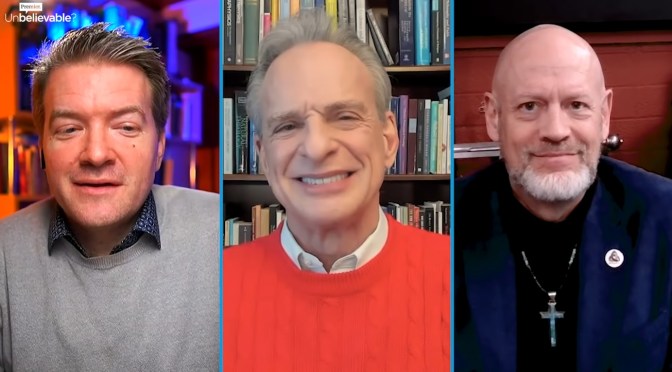
In a recent episode of the Unbelievable show, Calvinist pastor / theologian James White discussed middle knowledge (a.k.a. Molinism) with philosopher / theologian William Lane Craig. In this post, you’ll find a link to the audio, the YouTube video, and my comments on the debate. My comments were quoted in an episode of William Lane Craig’s Reasonable Faith podcast.
Here is a link to the details from Unbelievable: (with MP3 download link)
Calvinism and Molinism are two very different ways of understanding God’s sovereignty. But which one best addresses the problem of evil?
James White argues that Calvinism – God foreordaining all human behaviour both good and evil – is the more Biblical and coherent view. William (Bill) Lane Craig argues that Molinism – a view which reconciles human freedom and divine sovereignty – is Biblically consistent without making God the author of evil.
And the video:
Summary:
JB: Why is there evil?
JW: Natural and moral evil are the results of God’s divine decree to create the world.
WLC: God has knowledge of what individual humans would do in different circumstances prior to his divine decree to create the world. God’s decree takes into account the free decisions of people in different situations. With regard to natural evil, Calvinists and Molinists do not differ much – they are permitted to achieve a greater good. But for moral evil, there is a difference. Moral evil is the result of free decisions by individual humans. They are not God’s will. God permits people to perform evil actions, because those free actions will lead to him achieving his ultimate purposes. God does not override human free will. He achieves his ultimate purposes through the actions of his free creatures. On the Calvinist view, God moves the will of creatures to do evil. God is the cause of their evil acts.
JB: God sees all of the possible worlds and instantiates a world where he is able to achieve his ultimate purposes while respecting the free decisions of his creatures.
WLC: God does not see what humans WILL do, and decree based on that. He sees what they WOULD do in different circumstances, and articulates a world where the free decisions they make in the circumstances he decrees lead to his ultimate purposes being fulfilled.
JB: And this view achieves God’s sovereignty (God gets the result he wants) with human freedom (God is not responsible for moral evil)
JB: James, isn’t it better for God to get what he wants while respecting free will, rather than micromanaging every thought and action of the people?
JW: There’s micromanaging on both sides. On Molinism, God micromanages the circumstances. On Calvinism, God micromanages everything. But how could God have that knowledge of what people would do, prior to actually creating those people? The Bible teaches Calvinism, and so we should go with that. Calvinists are concerned when Craig says that God does not determine the truth value of these subjunctive conditionals (i.e. – what free individuals would do in different circumstances) The individuals determine what they will do in different circumstances. And Calvinists would prefer that God determine (i.e. – exhaustive determinism) what individuals do in different circumstances. WLC, would you agree that the knowledge of these subjunctive conditionals are the essence of what middle knowledge is? (WK note: micromanaging circumstances doesn’t violate free will, micromanaging everything does violate free will)
WLC: No, but it is an essential aspect of it. According to Molinism, God does not determine what free individuals would do in different situations in which they find themselves. The Calvinist view is that in any situation, God actually moves the will of the creature, so God is the author of moral evil. On the Molinist view, creatures are responsible for moral evil, not God.
JW: So you’re saying that these subjunctive conditionals are not under God’s control. How can they be under the control of the creatures, since prior to God’s creative decree, the creatures do not exist yet? Where do these truth values come from.
WLC: This objection to Molinism is called the “grounding objection”. The counterfactuals of creaturely freedom are true without having to be grounded by the created individuals. This objection presupposes a view of truth called “truth-maker” theory. This theory says that in addition to propositions that are true, there are things that make propositions true. There are many counterexamples to this view. For example, if you deny the existence of something that does not exist, then there is no truth maker that makes that claim true. (WK note: E.g. – a unicorn does not exist) Another example is “If WLC were rich, WLC would buy a Mercedes” but there is no truth-maker situation that makes that true, except maybe if he were rich. (WK note: I think that the created individual WLC would be the truth-maker in that case?)
JW: The decisions that I make are caused by God’s decree of what gifts I have or don’t have. He has freedom to decree those gifts, and then that has an effect of what I am free to do. E.g. – I am not 6’11” so I am not free to be a center in the NBA. So on the Molinist view, what is the basis for these subjunctive counterfactuals that limit what God can do?
WLC: The grounding objection presupposes the truth-maker theory, and a particular strain of that theory called truth-maker maximalism, and counterfactuals of creaturely of creaturely freedom would be prime candidates to be exceptions to the truth-maker theory.
WLC: Regarding the point about how people don’t exist in a vacuum but have a whole history, background, characteristics, etc. to shape their decisions. That’s right. But the counterfactuals of creaturely freedom factor all that in. The key point that divides us is that God doesn’t determine what creatures decide, he decides the circumstances. And so the creature is responsible for moral evil, not God. And so God doesn’t cause people to commit moral evils, then punish them for it.
WLC: We should guide our views based on what is in the Bible. But even Calvinist theologians affirm things about God that are not taught explicitly in the Bible, such as God’s spacelessness and timelessness. And Molinism makes the best sense of divine sovereignty and human freedom. On the Calvinist view, God determines how anyone would act in any situation God might place him in, so God is responsible for the moral evil committed by his creatures.
JW: (repeats) If God is limited in what he can do by counterfactuals of creaturely freedom, then we have to know where these counterfactuals come from. (WK note: the counterfactuals of creaturely freedom come from… creaturely freedom.)
JW: Genesis 50:20 says that God used the moral evil committed by some creatures to achieve the good purposes he intended. (WK note: that’s exactly what the Molinist view is, God permits moral evil by his creatures, as long as it achieves his ultimate good purposes)
JW: Molinism is unknown in the church for 1500 years. (WK note: Molinism is in Acts 17:24-27, and also, Calvin and Luther were unknown in the church for 1500 years)
JB: Is Genesis 50:20 a good example of Calvinism?
WLC: (very excited) NO!!!!!! It’s a great example of Molinism!!!! The text says that God didn’t move the bad actors to perform sinful actions – that would make God the author of evil. But God knew that if they were in this situation, they would behave in these evil ways, but ultimately it would lead to good results that God wanted. There is a chain of people partially articulating the middle knowledge view prior to Molina.
JW: You shouldn’t believe Molinism, because it comes from Jesuits. (WK Note: this is the genetic fallacy)
JW: The Bible has examples where God “hardens hearts”, e.g. Pharaoh.
WLC: It’s not that the Bible authors had Molinism in mind. It’s that this theory is consistent with what the Bible teaches.
JW: Ephesians 1 teaches that God unilaterally determines who the elect are. Calvinism emerges from the text. But in Genesis 50:20, Molinism doesn’t emerge from it.
WLC: We’re both trying to make sense of the data of Scripture. Scripture doesn’t teach the universal divine determinism of every human act, especially evil acts. The Bible says thate God is not evil, and cannot even be tempted with evil, but on the Calvinist view, God is causing the evil actions of his creatures, and then he punishes them for it. If it’s evil to cause someone to do evil, it makes God himself evil.
JW: In Isaiah 10, God uses the Assyrians to punish Israel, then he punishes the Assyrians for the haughty attitude of their heart.
WLC: The Molinist view of Ephesians 1 is that part of God’s good pleasure is to respect human freedom, and not to unilaterally divinely determine them to sin. Regarding Isaiah 10, you’re asking how God can punish the Assyrians for something he causes them to do? No, God knows that the Assyrians are going to do this moral evil and he uses that for his purposes, and he is free to punish their immoral act, because they did it of their own free will.
JW: But if you need Molinism to understand these texts, then what did the authors intend for people to think before Molinism.
WLC: People understand from Genesis 50:20 that people do evil things, but God gets a good outcome out of it.
JW: As a Calvinist, I do not believe that God respects human freedom.
JW: I don’t think that individuals have control of the circumstances in which they are born or where they live that limits God’s sovereignty. (WK note: he doesn’t understand Molinism or Acts 17:24-27. Individuals control their own decisions. But God controls the circumstances – i.e. – everything else). There is no essence of James White that determines where I am born, my physical characteristics, my siblings, etc. God decrees everything about who I am.
WLC: “That’s because you’re a determinist, James, and I’m not”
JW: “Yes. Yes. OK.”
WLC: There are number of possible worlds where James White could exist. Different country, different education, different language, different family. God decides the circumstances for James White. James White makes the decisions. God doesn’t cause James White’s moral evil. James White does. The counterfactuals of creaturely freedom must exist prior to the divine decree in order for humans to be responsible for their evil actions.
JW: You’re using philosophy. But your view should come from the Bible. (WK note: look at Acts 17:24-27)
WLC: Universal divine determinism isn’t taught in the Bible.
JW: Yes, in Ephesians 1.
WLC: The Molinist affirms Ephesians 1.
JW: It doesn’t mention respecting free will there, it’s teaching universal divine determinism.
WLC: The Bible teaches that God does have knowledge of counterfactuals of creaturely freedom, e.g. 2 Cor 2:8. So the question is whether God has this knowledge logically prior the decree (Molinism requires this), or is it logically after. If it is logically after, then it makes God the cause of human moral evil.
JW: The verses raised by Craig can be subsumed under God’s natural knowledge and free knowledge.
JW: Some Molinists believe that the only people who are lost in this world are people who cannot freely respond to God’s saving initiative in any circumstances (WK note: this is called trans-world damnation (TD), and I hold this view). Does anyone in the Bible know about this idea? That changes God’s expression from universal divine determinism to accepting human free will and human responsibility for sin (which Calvinism denies).
WLC: Yes, there are two different views. The one view takes human free will, and human responsibility for sin, seriously. The other view makes God the cause of human sin, and therefore makes God evil for being the author of evil.
JW: On Molinism, God knew that if he actualized this world, then he knew the evil that would result, but he didn’t do it for some purpose, like revealing his own character?
WLC: No, he didn’t bring the evil into the world. He actualized a set of circumstances, and a set of free creatures. And he knew that in those circumstances, he knew that the creatures would choose to do evil. His absolute will is for all his creatures to always do the right thing. But he knows that often they will do evil. He permits that to happen, but in the end he achieves the good purposes. E.g. – achieving the redemption of mankind through Jesus through the evil decisions of the rulers at that time.
WLC: I love the Westminster Confession. But without middle knowledge, that Confession is incoherent. Middle knowledge explains how things work, so that the Westminster Confession’s affirmations are logically coherent.
JW: What you’re saying is that God respects human free will and human responsibility.
WLC: Molinism is extremely fruitful theologically. I have applied to the problem of exclusivity of salvation, to the perseverance of the saints, to the inspiration of Scripture… but the focus of the discussion today is on moral evil. Who is the cause of human evil?
JW: Only universal divine determinism and the denial of human free will and human responsibility are consistent with Scripture.
WLC: Scripture alone is my authority, not church tradition. But Reformed theology is permeated with concepts that are not described in Scripture, but are consistent with Scripture, e.g. – timelessness, spacelessness, simplicity.
JW: I disagree, ALL the concepts in Calvinism emerge directly from the text. Isaiah 40-48 clearly teaches divine necessity, that God exists necessarily, in every possible world. (WK note: Calvinist thought emerges 1500 years after the Bible was written)
JW: Middle knowledge is a Catholic dogma, which is why even the Catholics rejected it.
WLC: (holds up 2 volumes of a 4 volume, 2144 page set of books on Reformed theology) Anyone who thinks that Reformed Dogmatics are simply read out of Scripture “doesn’t know the history of Reformed theology”. These volumes are permeated with theological constructs, philosophical models, philosophical principles. The necessity of God’s existence, timelessness, spacelessness, etc. are all affirmed by Reformed theologians, and were inherited from medieval scholastics (Catholics).
JW: The central claim of middle knowledge, that counterfactuals of creaturely freedom are known by God, are not in the Bible. (WK note: Craig gave an example of counterfactuals of creaturely freedom in the Bible. There are lots of them.)
Four volume 2144-page book set on Reformed dogmatics
My thoughts:
I think that it was a good debate. Well worth watching. I don’t promise that my summary is 100% accurate. Please leave room for a little snark, and watch the debate yourself. I like to take the spin off of people’s words, when I feel that they are trying to weasel out of the conclusions of their own views. It’s 2 AM on Monday morning now, and I don’t want to proof-read. Please point out errors in the comments.
If I could boil down the mistake that James White makes to one sentence, it would be to say that he comes to the text with a philosophical presupposition (determinism), and this causes him to misinterpret the plain meaning of the text as a whole. And this misinterpretation isn’t about peripheral teachings of the Bible. His embrace of God as the cause of moral evil means that he denies the goodness of God – a basic Christian doctrine. (This is compounded by his embrace of double-predestination, although that was not the topic of the debate). Christians shouldn’t let a philosophy – determinism – override the plain meaning of Scripture. Determinism is man’s philosophy – it’s a Greek philosophy that existed centuries before Christ.
White also was clearly unfamiliar with the philosophy of religion of his own Reformed tradition, and especially with the history of the development of Reformed theology. Craig was able to correct him, by showing him the books on Reformed Dogmatics and explain the historical antecedents of Reformed thought.
James White is not a “hyper-Calvinist”. He is a normal Calvinist. Calvinism teaches universal divine determinism. Calvinism teaches that where each individual goes after the judgment is decided unilaterally by God. Calvinism teaches that human moral evil is caused by God. Calvinism teaches that God punishes people for this moral evil. Calvinism teaches intentional double-predestination.
I wrote about the problems with Calvinism, citing Calvinist D.A. Carson and William Lane Craig, in a previous post. Determinism denies free will, and therefore undermines all meaning in life. That’s not consistent with the Bible’s clear teaching that God issues commands to his creatures, because he expects (free will) obedience. That is how we develop our relationship with God after becoming Christians (sanctification), and those relationships have ultimate significance.
Note: I link to James White’s work on this blog. He does a great job of fighting cultural and political enemies. I really appreciate his conservative perspective on issues like abortion, and his sensitivity to the totalitarian impulses of the secular left. His work on KJV-only and and debating Catholics is excellent. I don’t always agree with Craig. I recently posted disagreement with Craig on his latest work on the historical Adam and evolution. I have other minor disagreements with him as well, in substance and method. The only theology books in my house are by R. C. Sproul, Wayne Grudem, D.A. Carson, Millard Erickson, John MacArthur, etc. – all Calvinists.
If you missed Craig’s debate with Paul Helm, which is mentioned in the debate, I blogged about that previously, as well.
I have some experience dicussing Islam because my mother’s side of the family is all Muslim. My go-to argument has always been to confront them about the Qur’an’s claim that Jesus did not die of crucifixion. But I noticed a different argument from Laura Powell, who knows far more about this topic than I do. Do you think her approach is the best one?
The crux of the argument is this: The Qur’an affirms the inspiration, authority, and preservation of the New Testament Gospels;[2] yet the Qur’an also contradicts the Gospels on major theological and historical points. Therefore, the Qur’an cannot be reliable.
According to the Qur’an, the Gospel is the trustworthy, reliable revelation of God given as a guidance for mankind (Qur’an 3:3-4). These Scriptures from God were available and trustworthy when the Qur’an was revealed in the 7th century A.D., and those who had access to them were repeatedly told to obey them, judge by them, submit to their teaching, and stand fast upon them. In other words, according to the Qur’an, the Gospels are the inspired and authoritative words of God.
Qur’an 5:47 says, “And let the People of the Gospel judge by what Allah has revealed therein. And whoever does not judge by what Allah has revealed—then it is those who are the defiantly disobedient.”
Furthermore, Qur’an 5:68 states, “Say, ‘O People of the Scripture, you are [standing] on nothing until you uphold [the law of] the Torah, the Gospel, and what has been revealed to you from your Lord’” (see also 6:114; 3:3-4).
What I like about her argument is that she’s just taking the words of the Qur’an seriously, and asking the Muslims who claim to believe it what’s going on here. Why say that the gospels are unreliable today, when the Qur’an said that the gospels were reliable, yesterday.
My argument about the death of Jesus requires us to ask Muslims “where is the non-Muslim historian who thinks that Jesus did not die?” There isn’t one.
But my argument requires that the Muslim know something about historical scholarship, to know what non-Muslim historians think.Laura’s argument has wider appeal, because it doesn’t require that the Muslim have any knowledge about history – only knowledge about what their own holy book says.
She concludes with this:
What we see here is that the Qur’an teaches the inspiration, authority, and preservation of the Gospels. The Qur’an was intended as an Arabic version of the message of truth found in the Jewish and Christian Scriptures, but this presents a huge problem for Muslims because the Qur’an contradicts the Christian Scriptures on essential doctrines. Most notably, the Qur’an teaches that Jesus was not God incarnate, he did not die on a cross, and he was not raised from the dead (Qur’an 4:157; 5:116).
Here’s the dilemma for Muslims: If the Gospels are not trustworthy, then the Qur’an is false because it teaches that the Gospels are the inspired, perfectly preserved, authoritative words of God. But if the Gospels are trustworthy, then the Qur’an is false because it teaches contradictory, mutually exclusive facts about key issues. Either way, the Qur’an is false.
This, of course, is a huge problem for Muslims. The validity of Islam rests upon the reliability of the Qur’an, just as Christianity rests upon the truth of the divinity, death, and resurrection of Jesus. If the Qur’an is unreliable, then Islam is a false religion.
I like that she’s comfortable having disagreements with people. That’s not very common in the church today, in my experience.
By the way, this is the same Laura who wrote that really good article about how she found a better way to discuss her Christian worldview when she moved on from sharing her testimony. I blogged about it here.




 WINTERY KNIGHT