
All posts by Wintery Knight

https://winteryknight.com/

Will computers and robots ever become self-aware?

Lets take a closer look at a puzzle

There is a very famous thought experiment from UC Berkeley philosopher John Searle that all Christian apologists should know about. And now everyone who reads the Wall Street Journal knows about it, because of this article.

In that article, Searle is writing about the IBM computer that was programmed to play Jeopardy. Can a robot who wins on Jeopardy be “human”? Searle says no. And his famous Chinese room example (discussed in the article) explains why.

Excerpt:

Imagine that a person—me, for example—knows no Chinese and is locked in a room with boxes full of Chinese symbols and an instruction book written in English for manipulating the symbols. Unknown to me, the boxes are called “the database” and the instruction book is called “the program.” I am called “the computer.”

People outside the room pass in bunches of Chinese symbols that, unknown to me, are questions. I look up in the instruction book what I am supposed to do and I give back answers in Chinese symbols.

Suppose I get so good at shuffling the symbols and passing out the answers that my answers are indistinguishable from a native Chinese speaker’s. I give every indication of understanding the language despite the fact that I actually don’t understand a word of Chinese.

And if I do not, neither does any digital computer, because no computer, qua computer, has anything I do not have. It has stocks of symbols, rules for manipulating symbols, a system that allows it to rapidly transition from zeros to ones, and the ability to process inputs and outputs. That is it. There is nothing else.

Here is a link to the full article by John Searle on the Chinese room illustration.

By the way, Searle is a naturalist – not a theist, not a Christian. Now, let’s hear from a Christian scholar who can make more sense of this for us.

Here’s a related article on “strong AI” by Christian philosopher Jay Richards.

Excerpt:

Popular discussions of AI often suggest that if you keep increasing weak AI, at some point, you’ll get strong AI. That is, if you get enough computation, you’ll eventually get consciousness.

The reasoning goes something like this: There will be a moment at which a computer will be indistinguishable from a human intelligent agent in a blind test. At that point, we will have intelligent, conscious machines.

This does not follow. A computer may pass the Turing test, but that doesn’t mean that it will actually be a self-conscious, free agent.

The point seems obvious, but we can easily be beguiled by the way we speak of computers: We talk about computers learning, making mistakes, becoming more intelligent, and so forth. We need to remember that we are speaking metaphorically.

We can also be led astray by unexamined metaphysical assumptions. If we’re just computers made of meat, and we happened to become conscious at some point, what’s to stop computers from doing the same? That makes sense if you accept the premise—as many AI researchers do. If you don’t accept the premise, though, you don’t have to accept the conclusion.

In fact, there’s no good reason to assume that consciousness and agency emerge by accident at some threshold of speed and computational power in computers. We know by introspection that we are conscious, free beings—though we really don’t know how this works. So we naturally attribute consciousness to other humans. We also know generally what’s going on inside a computer, since we build them, and it has nothing to do with consciousness. It’s quite likely that consciousness is qualitatively different from the type of computation that we have developed in computers (as the “Chinese Room” argument, by philosopher John Searle, seems to show). Remember that, and you’ll suffer less anxiety as computers become more powerful.

Even if computer technology provides accelerating returns for the foreseeable future, it doesn’t follow that we’ll be replacing ourselves anytime soon. AI enthusiasts often make highly simplistic assumptions about human nature and biology. Rather than marveling at the ways in which computation illuminates our understanding of the microscopic biological world, many treat biological systems as nothing but clunky, soon-to-be-obsolete conglomerations of hardware and software. Fanciful speculations about uploading ourselves onto the Internet and transcending our biology rest on these simplistic assumptions. This is a common philosophical blind spot in the AI community, but it’s not a danger of AI research itself, which primarily involves programming and computers.

AI researchers often mix topics from different disciplines—biology, physics, computer science, robotics—and this causes critics to do the same. For instance, many critics worry that AI research leads inevitably to tampering with human nature. But different types of research raise different concerns. There are serious ethical questions when we’re dealing with human cloning and research that destroys human embryos. But AI research in itself does not raise these concerns. It normally involves computers, machines, and programming. While all technology raises ethical issues, we should be less worried about AI research—which has many benign applications—than research that treats human life as a means rather than an end.

When I am playing a game on the computer, I know exactly why what I am doing is fun – I am conscious of it. But the computer has no idea what I am doing. It is just matter in motion, acting on it’s programming and the inputs I supply to it. And that’s all computers will ever do. Trust me, this is my field. I have the BS and MS in computer science, and I have studied this area. AI has applications for machine learning and search problems, but consciousness is not on the radar. You can’t get there from here.

Ryan T. Anderson lectures on marriage and why it matters

Marriage and family
Marriage and family

Here’s the lecture:

About the speaker:

Ryan T. Anderson researches and writes about marriage and religious liberty as the William E. Simon Fellow at The Heritage Foundation. He also focuses on justice and moral principles in economic thought, health care and education, and has expertise in bioethics and natural law theory.

Anderson, who joined the leading Washington think tank’s DeVos Center for Religion and Civil Society in 2012, also is the editor of Public Discourse, the online journal of the Witherspoon Institute of Princeton, N.J.

Anderson’s recent work at Heritage focuses on the constitutional questions surrounding same-sex “marriage.” He is the co-author with Princeton’s Robert P. George and Sherif Girgis of the acclaimed book “What Is Marriage? Man and Woman: A Defense” (Encounter Books, December 2012).

The lecture starts at 7:20 in. The lecture ends at 49:35. There are 32 minutes of Q&A.

Introduction:

  • When talking about marriage in public, we should talk about philosophy, sociology and public policy
  • Gay marriage proponents need to be pressed to define what marriage is, on their view
  • Every definition of marriage is going to include some relationships, and exclude others
  • It’s meaningless to portray one side as nice and the other mean
  • Typically, marriage redefiners view marriage as a more intense emotional relationship
  • Marriage redefiners should be challenged in three ways:
  • 1) Does the redefined version of marriage have a public policy reason to prefer only two people?
  • 2) Does the redefined version of marriage have a reason to prefer permanence?
  • 3) Does the redefined version of marriage have a reason to prefer sexual exclusivity?
  • Also, if marriage is just about romance, then why is the state getting involved in recognizing it?
  • The talk: 1) What marriage is, 2) Why marriage matters, 3) What are the consequences of redefining marriage?

What marriage is:

  • Marriage unites spouses – hearts, minds and bodies
  • Marriage unites spouses to perform a good: creating a human being and raising that human being
  • Marriage is a commitment: permanent and exclusive
  • Male and female natures are distinct and complementary

The public purpose of marriage:

  • to attach men and women to each other
  • to attach mothers and fathers to their children
  • there is no such thing as parenting, there is only mothering and fathering
  • the evidence shows that children benefit from mothering and fathering
  • boys who grow up without fathers are more likely to commit crimes
  • girls who grow up without fathers are more likely to have sex earlier
  • Children benefit from having a mother and a father
  • can’t say that fathers are essential for children if we support gay marriage, which makes fathers optional
  • without marriage: child poverty increases, crime increases, social mobility decreases, welfare spending increases
  • when government encourages marriage, then government has less do to – stays smaller, spends less
  • if we promote marriage as an idea, we are not excluding gay relationships or even partner benefits
  • finally, gay marriage has shown itself to be hostile to religious liberty

Consequences redefining marriage:

  • it undermines the norm in public like that kids deserve a mom and a dad – moms and dads are interchangeable
  • it changes the institution of marriage away from the needs of children, and towards the needs of adults
  • it undermines the norm of permanence
  • we learned what happens when marriage is redefined before: with no-fault divorce
  • no-fault divorce: after this became law, divorce rates doubled – the law changed society
  • gay marriage would teach society that mothers and fathers are optional when raising children
  • if marriage is what people with intense feelings do, then how can you rationally limit marriage to only two people?
  • if marriage is what people with intense feelings do, then if other people cause intense feelings, there’s no fidelity
  • if marriage is what people with intense feelings do, then if the feelings go away, there is no permanence
  • the public policy consequences to undermining the norms of exclusivity and permanence = fatherless children and fragmented families
  • a final consequences is the decline and elimination of religious liberty – e.g. – adoption agencies closing, businesses being sued

We’re doing very well on abortion, but we need to get better at knowing how to discuss marriage. If you’re looking for something short to read, click here. If you want to read a long paper that his book is based on.

Related posts

New study: nearly half of millenials reject monogamy

Marriage and family
Marriage and family

Study reported on by The Stream:

A new report found nearly half of American millennials don’t want monogamous relationships.

YouGov revealed the research on monogamy and cheating, showing couples under 30 are significantly less monogamous than older generations.

Only 51 percent of people under 30 reported desiring a “completely monogamous” relationship, compared to 58 percent from the 30-44 age bracket, 63 percent from the 45-64 age bracket, and 70 percent from the 65 plus age bracket polled.

[…]Reports also show that men and women are cheating at almost equal rates.

It’s not just adultery that millenials don’t care about any more, it’s premarital sex. An article from the Washington Post found that both men and women no longer desire their romantic partners to be chaste:

Dating has changed hugely over the past generations, and so have cultural ideas about what men and women value most in a mate.

This idea is perfectly illustrated by a chart that economist Max Roser, who created the blog Our World in Data, recently put out on Twitter. The chart is made with data from a study published in the Journal of Family Issues in 2013, in which three researchers compared how heterosexual men and women ranked the importance of 18 traits in wives and husbands, first in 1939, and then again in 2008.

[…]For both men and women, the importance of chastity nose-dived, from #10 in 1939 to #18 in 2008. Emotional stability and maturity, a pleasing disposition, good health, and refinement and neatness also declined for both sexes.

For women, a similar religious background and a desire for home and children became less important in their mates, while men placed less value on ambition and industriousness in their wives.

It goes without saying that adultery is more like to reduce marriage stability. And studies also show that marriage stability is severely impacted by the number of premarital sex partners.  That’s why chastity matters: it’s a predictor of marital stability. If a person can control themselves before marriage when they don’t get any sex, it’s easier to control themselves when that need is being supplied safely and generously. Also, chastity just reinforces the idea that sex is something that is done within a lifelong commitment, not something that is done outside of a commitment for fun and thrills. I don’t that the millenial approach of premarital unchastity and post-marital non-monogamy is going to help them keep their marriages together.

But young people today aren’t interested in looking at studies to figure out how to do marriage right so that it will last. They make their decisions with their feelings. They value what the culture tells them to value, rather than picking a mate who has the skills and abilities to make the marriage last.

How well is picking mates based on emotions rather than demonstrated ability working out? The marriage rates are plummeting:

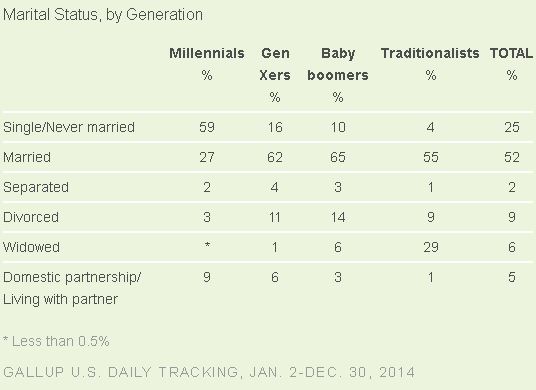
Gallup poll:

Contrary to what we would expect, given normal demographic patterns of adolescents’ movement into early adulthood and family formation, the data show that significantly more millennials are currently single/never married than was true for those in older generations, and considerably more are in domestic partnerships. Specifically, more than half of all millennials (59%) have never married, and 9% are in domestic partnerships. Gallup has noted a trend toward fewer young adults being married in recent years.

In the 2014 Gallup Daily tracking data, just 27% of millennials were married. According to historical U.S. Census Bureau data, 36% of Generation Xers, 48% of baby boomers and 65% of traditionalists were married when they were the age that millennials are now. For millennials currently aged 18 to 30, just 20% are married, compared with nearly 60% of 18- to 30-year-olds in 1962, according to the U.S. Census. When Gen Xers were the same age, 32% were married; for baby boomers, it was more than 40%.

Millennials are clearly delaying marriage longer than any generation before them, in spite of evidence suggesting that many millennials intend to marry at some point. For example, a 2013 Gallup poll found that 86% of single/never married Americans aged 18 to 34 (roughly equivalent to the millennial generation) wanted to get married someday.

Table:

Marriage rates across different generations of Americans

Who can keep a relationship going when the top criterion is ability to entertain rather than ability to commit self-sacrificially? I hear lots of Christian women say they want to get married “some day”, but there they are in their mid 30s, unemployed, penniless, with empty resumes, backpacking through Europe. The words “some day” sound good to their parents and pastors, but the actions are all about hedonism and thrill-seeking – just what the culture told them to do, in order to have a meaningful life.

Is there a cost to the younger generation turning their backs on traditional marriage, including the norms of chastity, fidelity and permanence?

I saw an article on the Public Discourse that talked about the fiscal costs of abandoning traditional marriage.

It says:

In 1965, liberal Harvard political scientist Daniel Patrick Moynihan was astonished to find that about 25 percent of African-American children were born out of wedlock. Moynihan was deeply worried about this finding because he knew exactly what being born out of wedlock means for a child. Decades of social science confirm what common sense has always taught us: that children born out of wedlock are disadvantaged in every way. They are more likely to be physically and mentally ill, more likely to be poor and unhappy, more likely to have trouble in school and with education generally, more likely to be abused sexually, more likely themselves to abuse others sexually, more likely to abuse alcohol or other drugs, and more likely to engage in criminal activity and to have a disdain for authority.

This, in turn, invariably increases the size and scope of the power of the state. The state must expand to replace fathers who have abandoned their families by providing for single mothers. It must increase its public-health efforts to provide for children whose single parents cannot pay for private healthcare and to treat victims of violence committed by those who have been raised in an environment that has failed to equip them for a robust and peaceful social life. It must create and maintain adoption agencies to care for children whose parents are unfit or absent. It must commit more funds to police departments to address crime that results from families breaking apart (or failing to form in the first place), and hence failing to instill virtue in children. It must commit funds to the creation of prisons where criminals are to be kept. The list goes on and on.

The economic costs of abandoning social conservatism, then, run quite high—in addition to all of the unquantifiable social costs of broken families, deaths, broken relationships, and ruined lives. It is no surprise that leftists, committed to consolidating power in the state, have sought to undermine the family: they realize—better than many fiscal conservatives do—that a flourishing marriage culture is required for free markets and limited governments to exist.

So, there really is a cost to the embrace of moral relativism. When morality goes, expensive things happen, and government grows to pick up the costs. The bigger the government grows, the taxes are required to pay for it, leaving you with less of your own money – less of your own freedom to live how you want to live.