All posts by Wintery Knight

https://winteryknight.com/

1 Corinthians 15: the earliest source for the basic facts about the life of Jesus

The Son of God became flesh and dwelt among us

First, the creed – which is found in 1 Corinthians 15:3-8:

3For what I received I passed on to you as of first importance: that Christ died for our sins according to the Scriptures,

4that he was buried, that he was raised on the third day according to the Scriptures,

5and that he appeared to Peter, and then to the Twelve.

6After that, he appeared to more than five hundred of the brothers at the same time, most of whom are still living, though some have fallen asleep.

7Then he appeared to James, then to all the apostles,

8and last of all he appeared to me also, as to one abnormally born.

Almost all historians accept this creed as dating back to within 5 years of the death of Jesus. But why?

Here’s a great article from Eric Chabot, director of Ratio Christi Apologetics Alliance, The Ohio State University to explain why.

Excerpt:

The late Orthodox Jewish scholar Pinchas Lapide was so impressed by the creed of 1 Cor. 15, that he concluded that this “formula of faith may be considered as a statement of eyewitnesses.” (5)

Paul’s usage of the rabbinic terminology “passed on” and “received” is seen in the creed of 1 Cor. 15:3-8:

“For what I received I passed on to you as of first importance: that Christ died for our sins according to the Scriptures, that he was buried, that he was raised on the third day according to the Scriptures, and that he appeared to Peter, and then to the Twelve. After that, he appeared to more than five hundred of the brothers at the same time, most of whom are still living, though some have fallen asleep. Then he appeared to James, then to all the apostles, and last of all he appeared to me also, as to one abnormally born.”

There is an interesting parallel to Paul’s statement in 1 Cor. 15:3-8 in the works of Josephus. Josephus says the following about the Pharisees.

“I want to explain here that the Pharisees passed on to the people certain ordinances from a succession of fathers, which are not written down in the law of Moses. For this reason the party of the Sadducees dismisses these ordinances, averaging that one need only recognize the written ordinances, whereas those from the tradition of the fathers need not be observed.” (6)

As Richard Bauckham notes, “the important point for our purposes is that Josephus uses the language of “passing on” tradition for the transmission from one teacher to another and also for the transmission from the Pharisees to the people.”(7)

Bauckham notes in his book Jesus and the Eyewitnesses: The Gospels as Eyewitness Testimony that the Greek word for “eyewitness” (autoptai), does not have forensic meaning, and in that sense the English word “eyewitnesses” with its suggestion of a metaphor from the law courts, is a little misleading. The autoptai are simply firsthand observers of those events. Bauckham has followed the work of Samuel Byrskog in arguing that while the Gospels though in some ways are a very distinctive form of historiography, they share broadly in the attitude to eyewitness testimony that was common among historians in the Greco-Roman period. These historians valued above all reports of firsthand experience of the events they recounted.

Best of all was for the historian to have been himself a participant in the events (direct autopsy). Failing that (and no historian was present at all the events he need to recount, not least because some would be simultaneous), they sought informants who could speak from firsthand knowledge and whom they could interview (indirect autopsy).” In other words, Byrskog defines “autopsy,” as a visual means of gathering data about a certain object and can include means that are either direct (being an eyewitness) or indirect (access to eyewitnesses).

Byrskog also claims that such autopsy is arguably used by Paul (1 Cor.9:1; 15:5–8; Gal. 1:16), Luke (Acts 1:21–22; 10:39–41) and John (19:35; 21:24; 1 John 1:1–4).

While the word “received” (a rabbinical term) can also be used in the New Testament of receiving a message or body of instruction or doctrine (1 Cor.11:23; 15:1, 3; Gal. 1:9, 12 [2x], Col 2:6; 1 Thess 2:13; 4:1; 2 Thess 3:6), it also means means “to receive from another.” This entails that Paul received this information from someone else at an even earlier date. 1 Corinthians is dated 50-55 A.D. Since Jesus was crucified in 30-33 A.D. the letter is only 20-25 years after the death of Jesus. But the actual creed here in 1 Cor. 15 was received by Paul much earlier than 55 A.D.

[…]Even the co-founder Jesus Seminar member John Dominic Crossan, writes:

“Paul wrote to the Corinthians from Ephesus in the early 50s C.E. But he says in 1 Corinthians 15:3 that “I handed on to you as of first importance which I in turn received.” The most likely source and time for his reception of that tradition would have been Jerusalem in the early 30s when, according to Galatians 1:18, he “went up to Jerusalem to visit Cephas [Peter] and stayed with him fifteen days” (11).

This comment by Crossan makes sense because within the creed Paul calls Peter by his Aramic name, Cephas. Hence, if this tradition originated in the Aramaic language, the two locations that people spoke Aramaic were Galilee and Judea. (12) The Greek term “historeo” is translated as “to visit” or “to interview.” (13) Hence, Paul’s purpose of the trip was probably designed to affirm the resurrection story with Peter who had been an actual eyewitness to the resurrected Christ (1 Cor. 15:5).

I know what you’re thinking. You’re thinking “Hey WK, isn’t John Dominic Crossan that wacky liberal atheist who is on the far-left fringe of historical Jesus scholarship? So wacky, that he actually thought that Secret Gospel of Mark was real, instead of just being a hoax?” Yes, that’s the nutty John Dominic Crossan I mean. The very one.

Here’s a bit more about this early creed from Gary Habermas.

Quote:

(1) Contemporary critical scholars agree that the apostle Paul is the primary witness to the early resurrection experiences. A former opponent (1 Cor. 15:9; Gal. 1:13-14; Phil. 3:4-7), Paul states that the risen Jesus appeared personally to him (1 Cor. 9:1; 15:8; Gal. 1:16). The scholarly consensus here is attested by atheist Michael Martin, who avers: “However, we have only one contemporary eyewitness account of a postresurrection appearance of Jesus, namely Paul’s.”[3]

(2) In addition to Paul’s own experience, few conclusions are more widely recognized than that, in 1 Corinthians 15:3ff., Paul records an ancient oral tradition(s). This pre-Pauline report summarizes the early Gospel content, that Christ died for human sin, was buried, rose from the dead, and then appeared to many witnesses, both individuals and groups.

Paul is clear that this material was not his own but that he had passed on to others what he had received earlier, as the center of his message (15:3). There are many textual indications that the material pre-dates Paul. Most directly, the apostle employs paredoka and parelabon, the equivalent Greek terms for delivering and receiving rabbinic tradition (cf. 1 Cor. 11:23). Indirect indications of a traditional text(s) include the sentence structure and verbal parallelism, diction, and the triple sequence of kai hoti Further, several non-Pauline words, the proper names of Cephas (cf. Lk. 24:34) and James, and the possibility of an Aramaic original are all significant. Fuller attests to the unanimity of scholarship here: “It is almost universally agreed today that Paul is here citing tradition.”[4] Critical scholars agree that Paul received the material well before this book was written.[5]

The most popular view is that Paul received this material during his trip to Jerusalem just three years after his conversion, to visit Peter and James, the brother of Jesus (Gal. 1:18-19), both of whose names appear in the appearance list (1 Cor. 15:5; 7). An important hint here is Paul’s use of the verb historesai (1:18), a term that indicates the investigation of a topic.[6] The immediate context both before and after reveals this subject matter: Paul was inquiring concerning the nature of the Gospel proclamation (Gal. 1:11-2:10), of which Jesus’ resurrection was the center (1 Cor. 15:3-4, 14, 17; Gal. 1:11, 16).

Critical scholars generally agree that this pre-Pauline creed(s) may be the earliest in the New Testament. Ulrich Wilckens asserts that it “indubitably goes back to the oldest phase of all in the history of primitive Christianity.”[7] Joachim Jeremias agrees that it is, “the earliest tradition of all.”[8] Perhaps a bit too optimistically, Walter Kasper even thinks that it was possibly even “in use by the end of 30 AD . . . .”[9]

Indicating the wide approval on this subject, even more skeptical scholars frequently agree. Gerd Ludemann maintains that “the elements in the tradition are to be dated to the first two years after the crucifixion of Jesus. . . . not later than three years. . . . the formation of the appearance traditions mentioned in I Cor.15.3-8 falls into the time between 30 and 33 CE. . . .”[10] Similarly, Michael Goulder thinks that it “goes back at least to what Paul was taught when he was converted, a couple of years after the crucifixion.”[11] Thomas Sheehan agrees that this tradition “probably goes back to at least 32-34 C.E., that is, to within two to four years of the crucifixion.”[12] Others clearly consent.[13]

Overall, my recent overview of critical sources mentioned above indicates that those who provide a date generally opt for Paul’s reception of this report relatively soon after Jesus’ death, by the early to mid-30s A.D.[14] This provides an additional source that appears just a half step removed from eyewitness testimony.

(3) Paul was so careful to assure the content of his Gospel message, that he made a second trip to Jerusalem (Gal. 2:1-10) specifically to be absolutely sure that he had not been mistaken (2:2). The first time he met with Peter and James (Gal. 1:18-20). On this occasion, the same two men were there, plus the apostle John (2:9). Paul was clearly doing his research by seeking out the chief apostles. As Martin Hengel notes, “Evidently the tradition of I Cor. 15.3 had been subjected to many tests” by Paul.[15]

These four apostles were the chief authorities in the early church, and each is represented in the list of those who had seen the resurrected Jesus (1 Cor. 15:5-7). So their confirmation of Paul’s Gospel preaching (Gal. 2:9), especially given the apostolic concern to insure doctrinal truth in the early church, is certainly significant. On Paul’s word, we are again just a short distance from a firsthand report.

(4) Not only do we have Paul’s account that the other major apostles confirmed his Gospel message, but he provides the reverse testimony, too. After listing Jesus’ resurrection appearances, Paul tells us he also knew what the other apostles were preaching regarding Jesus’ appearances, and it was the same as his own teaching on this subject (1 Cor. 15:11). As one, they proclaimed that Jesus was raised from the dead (15:12, 15). So Paul narrates both the more indirect confirmation of his Gospel message by the apostolic leaders, plus his firsthand, direct approval of their resurrection message.

That’s how solid this early creed is – even atheists like Crossan and Ludemann accept it as historically reliable. It’s historical bedrock, as Michael Licona likes to say. This is the stuff that everyone accepts – across the ideological spectrum!
Comparing male and female support for abortion, divorce and gay marriage

Disclaimer: This post doesn’t apply to married women. When I refer to women below, I mean young, unmarried women. But I’m just going to say “women” for brevity’s sake.

Are women really more moral than men? Let’s take a look at the attitudes of men and women on five of the most prominent moral issues of our time: gay marriage, divorce, abortion, war, and crime.

Gay marriage, divorce and abortion

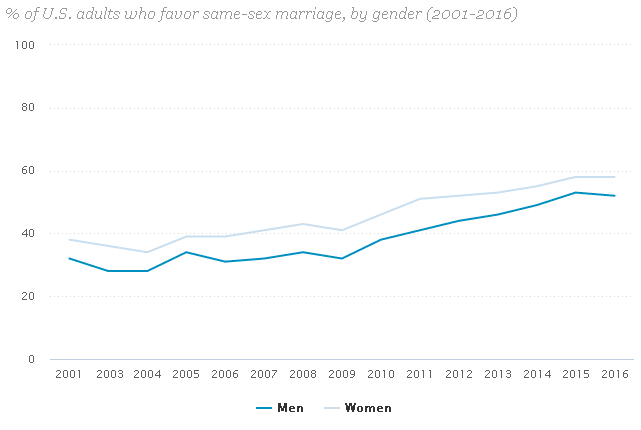
Here is Pew Research on gay marriage as of 2016:

Women far more likely to support gay marriage than men
Women are more immoral on gay marriage than men

Women favor gay marriage by a margin of 58% compared to only 52% for men.

Here is the Austin Institute on divorce in 2014:

Women are more immoral on divorce than men

Women initiate about 70% of divorces, even though they freely chose the man they married, and vowed to stick by him through all circumstances.

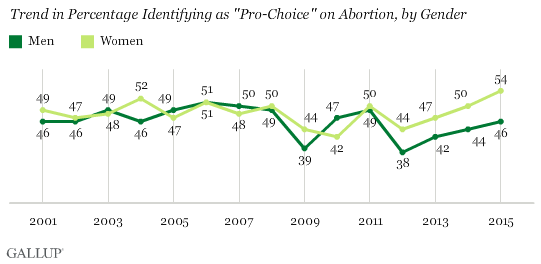
Here is Gallup on abortion as of 2015:

Women are more immoral on abortion than men

About 75% of young, unmarried women vote for the Democrat party – the party of unrestricted, taxpayer-funded abortion.

Abortion ignores the needs of unborn children. Same-sex marriage ignores the need of children for a mother and a father. Divorce devastates children, causing all sorts of negative effects. Men are more willing to judge all three of these bad behaviors than women. Men are more concerned about protecting the weak than they are about feeling compassionate and being perceived as “tolerant”.

What about war and self-defense against criminals?

Women are also more liberal than men on war and self-defense. You can just look at what happened in the Middle East to the Yazidi girls who are being raped and sex-trafficked to understand the consequences of this anti-war viewpoint. To be anti-war when the war is just is to be pro-evil. Just ask the Christians being tortured and murdered in Syria whether they are happy that American troops were withdrawn from Iraq. Just ask the victims of crimes like rape whether they wish they had been armed when they were attacked. Men are tougher on terrorists and criminals than women are.

Blaming men for what women choose to do

This data shows that men should be challenging women to improve their views on these important issues. But Christian pastors and scholars often discourage men from challenging women on moral issues, preferring to blame men when women take the wrong side of moral issues.

For example, here’s Mark Driscoll explaining how men are to blame for single motherhood:

Part of it is the unintended consequences of divorce. Forty percent of kids go to bed at night without a father. Not to be disparaging toward single moms, but if you’re a single mom and you’re working 60 hours a week, and you’ve got a boy, and he’s home all by himself with no parents and no dad, he’s just going to be hanging out with his buddies, feeding himself pizza rolls.

The number one consumer of online pornography is 12- to 17-year-old boys. What that means is he’s home eating junk food, drinking Monster energy drinks, downloading porn, masturbating and screwing around with his friends. That really doesn’t prepare you for responsible adulthood. That’s a really sad picture, especially if you’re a single gal hoping to get married someday. You’re like: “Seriously, that’s the candidate pool? You’ve got to be kidding me.” That’s why 41 percent of births right now are to unmarried women. A lot of women have decided: “I’m never going to find a guy who is actually dependable and responsible to have a life with. So I’ll just get a career and have a baby and just intentionally be a single mother because there are no guys worth spending life with.”

This practice among Christian leaders of blaming men for the actions of women is one of the major reasons why women have the views that they do on abortion, divorce, gay marriage, just war and self-defense. Men have been cowed into silence by man-blamers like Mark Driscoll and James Dobson. This message actually weakens the moral leadership of men, and creates a worse world.

This lack of moral leadership by men is particularly problematic with “pro-life” men who try to blame men for abortion. Abortions occur (in non-rape cases) because a woman makes two choices: 1) choosing a man who only wants recreational sex, and 2) choosing to have recreational sex with a man who has shown no interest in commitment or parenting. Speaking as an unmarried virgin somewhat advanced in years, there are plenty of good men out there who don’t believe in sex before marriage, and who have prepared very well for the traditional male roles of protector, provider and moral/spiritual leader. If women insist on choosing the wrong men, and choosing to do the wrong things with those men, it makes sense to hold them accountable. The bad men were bad before the women chose them, and so they should have been recognized and avoided by the women before any need for abortion occurred. A woman cannot expect a bad man to suddenly turn into a good man after he is given recreational sex. Recreational sex does not make a man who is not interested in marriage and children somehow become interested in marriage and children. And women need to be told this by pro-life men who are not cowards.

Men really need to shed this perception that there is something wrong with them, and challenge women on areas where they have immoral views. Men: don’t let yourselves be manipulated into silence in order to get affection, approval or sex. If you must have affection, approval and sex, then choose a woman who puts moral standards above feeling happy and being perceived as compassionate.

Reported cases of sexually-transmitted diseases reaches record high

HIV infection rates from Center for Disease Control

This is from the far-left CNN, of all places.

Excerpt:

There were more reported cases of sexually transmitted diseases last year than ever before in the United States, according to the latest STD surveillance report by the Centers for Disease Control and Prevention.

The annual report, which was released on Wednesday, showed that the rates of chlamydia, gonorrhea, and syphilis — the three most commonly reported STDs in the nation — increased between 2014 and 2015, reaching an all-time high.

Reported cases of primary and secondary syphilis rose by 19%, gonorrhea cases rose by 12.8%, and chlamydia cases rose by 5.9%, from 2014. All three STDs are curable with antibiotics, but most infections go undiagnosed and untreated, according to the CDC.

What is interesting is how overspending by bureaucrats on social welfare, amnesty, refugees, etc. has left less money to combat sexually-transmitted diseases:

In a foreword to the new report, Bolan wrote that some 21 health department STD clinics across the country have closed due to many state and local programs experiencing budget cuts. Therefore, fewer people have access to the testing and treatment resources provided by such clinics.

Meanwhile, as more STD cases emerge, treating infections costs the country nearly $16 billion annually.

With the national debt doubled from 10 to 20 trillion under Obama, Obama’s free-spirited supporters can look forward to not having access to the “health care” they now need.

Not surprisingly, the reckless young people who voted for Obama are the most reckless with sex. And so they are the most affected by STDs:

Young people, 15 to 24 years old, accounted for nearly two-thirds of last year’s chlamydia diagnoses — and half of the gonorrhea diagnoses.

Not only are there more STD infections, but the diseases have adapted to beat our antibiotics.

The Center for Disease Control reports:

Gonorrhea has progressively developed resistance to the antibiotic drugs prescribed to treat it. Following the spread of gonococcal fluoroquinolone resistance, the cephalosporin antibiotics have been the foundation of recommended treatment for gonorrhea. The emergence of cephalosporin-resistant gonorrhea would significantly complicate the ability of providers to treat gonorrhea successfully, since we have few antibiotic options left that are simple, well-studied, well-tolerated and highly effective. It is critical to continuously monitor antibiotic resistance in Neisseria gonorrhoeae and encourage research and development of new treatment regimens.

Gonorrhea is the second most prominent STD, right behind chlamydia.

One reason for the upsurge in STDs might be society’s growing celebration of male homosexuality.

The Center for Disease Control explains:

P&S syphilis among men who have sex with men (MSM) has been increasing since at least 2000. In 2014, rates of P&S syphilis increased among MSM, who account for 83 percent of reported cases among men when the sex of the partner is known. Also concerning is that more than half of MSM (51 percent) diagnosed with syphilis in 2014 were also HIV-positive. Infection with syphilis can cause sores on the genitals, which make it easier to transmit and acquire HIV.

Syphilis is currently the only STD for which information on the sex of the sex partner is reported. However, a growing body of evidence indicates that MSM are experiencing similar increases in gonorrhea and chlamydia infections– underscoring the need to further understand what is contributing to the rise.

Gay and bisexual men face a combination of social, epidemiologic, and individual risk factors that can fuel high levels of STDs. Higher prevalence of infection within sexual networks increases the likelihood of acquiring an STD with each sexual encounter.

And on a different CDC page:

Gay, bisexual, and other men who have sex with men made up an estimated 2% of the population but 55% of people living with HIV in the United States in 2013. If current diagnosis rates continue, 1 in 6 gay and bisexual men will be diagnosed with HIV in their lifetime, including 1 in 2 black/African American gay and bisexual men, 1 in 4 Hispanic/Latino gay and bisexual men, and 1 in 11 white gay and bisexual men.

The CDC’s solution to this disparity is to ask for more taxpayer money, of course. No disapproval here, just take the money from the moral people and pay for the choices of the reckless people.

Right now, many people are freely choosing to engage in these behaviors, and to celebrate the lifestyles of those who engage in these behaviors, because they think that the government has unlimited taxpayer money to pay for all the costs of these decisions. Little do they know about the national debt, and what happens to “government-provided” health care when the interest rates on that debt increases. As a society, we have decided that it is better to be forgiving and compassionate when people make reckless, risky decisions. “Oh, we can just make the prudent people pay for the mess – they have money”, the progressives say. And that works fine, until the money runs out, and people realize that the mean, judgmental, controlling bullies who were defending chastity, fidelity, marriage, moral standards and personal responsibility were right all along.