
Supreme Court: Christians taxpayers are allowed access to social programs

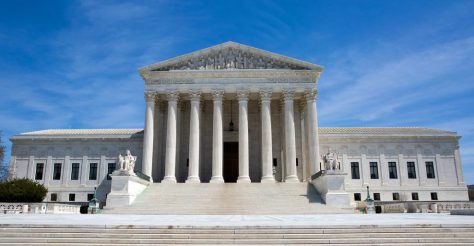
The Supreme Court of the United States

Here is the latest Supreme Court decision news, and I’ll explain shortly why this is good news for a much more important religious liberty case.

David French posted this analysis in National Review:

While there are many threats to religious liberty, few are more consequential over the long term than the state’s ever-expanding role in private life. If the government is able to vacuum up tax dollars, create programs large and small for public benefit, and then exclude religious individuals or institutions from those programs, it has functionally created two tiers of citizenship. Secular individuals and institutions enjoy full access to the government they fund, while religious individuals and institutions find themselves funding a government that overtly discriminates against them.

That’s the issue the Supreme Court addressed today in Trinity Lutheran Church v. Comer. By a 7–2 margin, the Court held that when a state creates a neutral program for public benefit — in this case, a program that uses scrap tires to provide rubberized safety flooring for playgrounds — it can’t exclude a church from that program, even if that means state benefits flow directly to a house of worship.

Social conservative Maggie Gallagher writes this in The Stream:

The good news is the Trinity Lutheran victory shows us the current Court is more supportive of religious liberty than many of us feared.

Justice Elana Kagan joined the majority opinion without any reserve. Justice Breyer wrote his own concurring opinion limiting his judgement to playground resurfacing programs and not all government benefits.

Only Justices Sonia Sotomayor and Ruth Bader Ginbsurg dissented. In Justice Sotomayor’s dissent, she warned of almost apocalyptic consequences:

This ruling, “weakens this country’s longstanding commitment to a separation of church and state beneficial to both,” she wrote, “If this separation means anything, it means that the government cannot, or at the very least need not, tax its citizens and turn that money over to houses of worship. The court today blinds itself to the outcome this history requires and leads us instead to a place where separation of church and state is a constitutional slogan, not a constitutional commitment.”

If so, it’s a good thing.

You’ll remember that Sotomayor was the wise Latina nominated by Barack Obama, who many Christians-in-name-only voted for. And of course separation of church and state is nowhere in the Constitution. What Sotomayor and her ilk on the secular left want is for Christian taxpayers to channel their earnings into the coffers of their secular leftist overlords, who apparently know much better how to spend it than the fools who earned it.

This is good news, but it’s also a hopeful sign that the Supreme Court will come out in favor of religious liberty and conscience in another case, a case that pits powerful and wealthy gay rights activists and their government allies against Christian small business owners trying to follow Jesus in everything they do.

The other case is reported on in the Daily Signal:

By deciding to hear the appeal of a Colorado baker, the Supreme Court could make its first ruling next year on whether government may coerce some Christians, Jews, and Muslims to use their creative gifts to celebrate same-sex marriage.

The high court announced Monday that it would review the case of baker Jack Phillips, who cites his Christian faith in declining to make custom cakes for same-sex weddings.

The Supreme Court’s eventual ruling could be the first since its 2015 decision legalizing same-sex marriage to say whether bakers, photographers, florists, and others must be part of such celebrations through their creative expression.

Phillips, whose Masterpiece Cakeshop is in Lakewood, Colorado, stopped making all wedding cakes in 2014 rather than be compelled by the state to design and bake them for same-sex marriages—or be fined for not obeying.

State agency and court decisions said Phillips must make such cakes after a gay couple complained about him in July 2012.

“There’s just certain events, certain cakes I don’t make,” Phillips told The Daily Signal in a phone interview in August 2015. “That was one of them.”

He also won’t make cakes depicting witchcraft, ghosts, and demons or sexually suggestive images, Phillips said in the interview.

The Supreme Court previously delayed nine times on deciding to hear Phillips’ appeal in the case, first filed last July. But with the newest justice, Neil Gorsuch, settled into his seat to succeed the late Antonin Scalia, the high court announced Monday morning that it would do so in its next term, which begins in October.

You can find out more about the Masterpiece Cakes case by watching this short video from Alliance Defending Freedom:

Although today’s decision makes me more optimistic, David French is less optimistic, because of Justice Kennedy’s previous statements on the gay marriage decision.

He writes in National Review:

Third, if Justice Kennedy views this case primarily through the LGBT lens, then the First Amendment may well lose. Kennedy is obviously proud of his long line of LGBT-friendly precedents, and that pride has even led him to a relatively rare First Amendment misstep, so it will be critical to explain to him (and the other justices, of course) that this isn’t a case about “discrimination” but rather about forced speech. Framing matters, and the other side will wrongly frame the case as raising the specter of Jim Crow. The right framing is found in the First Amendment.

I’ll be watching this case closely.
Canada passes criminal law against undesired gender pronouns

Canada criminalizes speech that makes people feel bad

The Daily Signal reports:

Canada passed a law Thursday making it illegal to use the wrong gender pronouns. Critics say that Canadians who do not subscribe to progressive gender theory could be accused of hate crimes, jailed, fined, and made to take anti-bias training.

Canada’s Senate passed Bill C-16, which puts “gender identity” and “gender expression” into both the country’s Human Rights Code, as well as the hate crime category of its Criminal Code by a vote of 67-11, according to LifeSiteNews. The bill now only needs royal assent from the governor general.

Royal assent is a formality, it is automatic.

I have some friends who are big fans of Justin Trudeau, Canada’s Liberal Party prime minister. Trudeau is a former substitute drama teacher, who was elected prime minister because of his famous last name. He knows about as much about economics and national security as this keyboard that I am typing on. 

For his part, Trudeau is very pleased with this law:

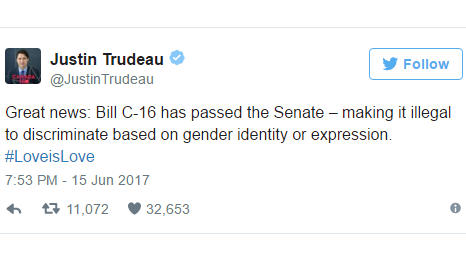
“Great news,” announced Justin Trudeau, Canada’s prime minister. “Bill C-16 has passed the Senate – making it illegal to discriminate based on gender identity or expression. #LoveisLove.”

So is Canada’s attorney general – the chief law enforcement officer of the land. She tweeted:

“Proud that Bill C-16has passed in the Senate,” said Jody Wilson-Raybould, the country’s attorney general and minister of justice. “All Canadians should feel #FreeToBeMe.”

Yes, everyone is free to be themselves… except when they throw you in the slammer for offending people with mental illnesses.

You’ll recall that one University of Toronto professor is in big trouble for opposing this law. He is quoted in the article:

Jordan Peterson, a professor at the University of Toronto, and one of the bill’s fiercest critics, spoke to the Senate before the vote, insisting that it infringed upon citizens’ freedom of speech and institutes what he views as dubious gender ideology into law.

“Compelled speech has come to Canada,” stated Peterson. “We will seriously regret this.”

“[Ideologues are] using unsuspecting and sometimes complicit members of the so-called transgender community to push their ideological vanguard forward,” said the professor to the Senate in May. “The very idea that calling someone a term that they didn’t choose causes them such irreparable harm that legal remedies should be sought [is] an indication of just how deeply the culture of victimization has sunk into our society.”

Peterson has previously pledged not to use irregular gender pronouns and students have protested him for his opposition to political correctness.

“This tyrannical bill is nothing but social engineering to the nth degree, all in the name of political correctness,” Jeff Gunnarson, vice president of Campaign Life Toronto, a pro-life political group in Canada, told LifeSiteNews.

Should a Christian try to make a life in a country that has not only taxpayer funded abortion, but taxpayer funded sex changes, too? Seems to me that this a joke country, and people of conscience should get out as quickly as they can. It’s a clown country, ruled by amoral idiots.

Robin Collins and atheist Peter Millican discuss the fine-tuning of the universe for life

British Spitfire and German Messerschmitt Me 109 locked in a dogfight

You might remember Peter Millican from the debate he had with William Lane Craig. I ranked that debate as one of the 3 best I have ever seen, along with the first Craig  vs Dacey debate and the second Craig vs Sinnott-Armstrong debate.

Details:

Science has revealed that the fundamental constants and forces of the cosmos appear to be exquisitely fine-tuned to allow a universe in which life can develop. Is God the best explanation of the incredibly improbable odds of the universe we live in being a life-permitting one?

Robin Collins is a Christian philosopher and a leading advocate of the argument for God from cosmic design. Peter Millican is an atheist philosopher at Oxford University. They debate the issues.

From ‘Unbelievable?’ on ‘Premier Christian Radio’, Saturday 19th March 2016.

The debate:

MP3 file is available on the Unbelievable web site.

As usual when the atheist is an expert, there is no snark or paraphrasing in the summary.

Summary

Brierley: What is the fine-tuning argument?

Collins: the fine-tuning is structure of the universe is extremely precisely set to allow the existing of conscious, embodied agents who are capable of moral behavior. There are 3 kinds of fine-tuning: 1) the laws of nature (mathematical formulas), 2) the constants of physics (numbers that are plugged into the equations), 3) the initial conditions of the universe. The fine-tuning exists not just because there are lots of possibilities, but there is something special about the actual state of affairs that we see. Every set of laws, parameters and initial conditions is equally improbable, but the vast majority of permutations do not permit life. The possible explanations: theism or the multiverse.

Brierley: How improbable are the numbers?

Collins: Once case is the cosmological constant (dark energy density), with is 1 part in (10 raised to 120th power). If larger, the universe expands too rapidly for galaxies and stars to form after the Big Bang. If smaller, the universe collapses in on itself before life could form. Another case is the initial distribution of mass energy to give us the low entropy we have that is necessary for life. The fine-tuning there is 1 part in (10 raised to the 10th power raised to the 123rd power).

Brierley: What do you think of the argument?

Millican: The argument is worth taking very seriously. I am a fan of the argument. The other arguments for God’s existence such as the ontological and cosmological arguments are very weak. But the fine-tuning argument has the right structure to deliver the conclusion that theists want. And it is different from the traditional design argument tended to focus on biological nature, which is not a strong argument. But the fine-tuning argument is strong because it precedes any sort of biological evolution. Although the design is present at the beginning of the universe, it is not visible until much later. The argument points to at least deism, and possibly theism. The argument is not based on ignorance, it is rooted in “the latest results from the frontiers of science” (his phrase).

Brierley: Is this the best argument from natural theology?

Collins: The cosmological argument makes theism viable intuitively, but there are some things that are puzzling, like the concept of the necessary being. But the fine-tuning argument is decisive.

Brierley: What’s are some objections to the fine-tuning argument?

Millican: The argument is based on recent physics, so we should be cautious because we maybe we will discover a natural explanation.

Brierley: Respond to that.

Collins: The cosmological constant has been around since 1980. But the direction that physics is moving in is that there are more constants and quantities being discovered that need to be fine-tuned, not less. Even if you had a grand unified theory, that would have to be have the fine-tuning pushed into it.

(BREAK)

Millican: Since we have no experience of other laws and values from other universes, we don’t know whether these values can be other than they are. Psychologically, humans are prone to seeing purpose and patterns where there is none, so maybe that’s happening here.

Brierley: Respond to that.

Collins: It is possible to determine probabilities on a single universe case, for example using multiple ways of calculating Avogadro’s number all converging on the same number makes it more probable.

Millican: Yes, I willing to accept that these constants can take on other values, (“principle of indifference”). But maybe this principle be applied if the improbability were pushed up into the theory?

Collins: Even if you had a grand theory, selecting the grand theory from others would retain the improbability.

Brierley: What about the multiverse?

Millican: What if there are many, many different universes, and we happen to be in the one that is finely-tuned, then we should not be surprised to observe fine-tuning. Maybe a multiverse theory will be discovered in the future that would allow us to have these many universes with randomized constants and quantities. “I do think that it is a little bit of a promissary note”. I don’t think physics is pointing to this right now.

Brierley: Respond to that.

Collins: I agree it’s a promissary note. This is the strongest objection to the fine-tuning argument. But there are objections to the multiverse: 1) the fine-tuning is kicked back up to the multiverse generator has to be set just right to produce universes with different constants, 2) the multiverse is more likely to produce a small universe with Boltzmann brains that pop into existence and then out again, rather than a universe that contains conscious, embodied intelligent agents. I am working on a third response now that would show that the same constants that allow complex, embodied life ALSO allow the universe to be discoverable. This would negate the observer-selection effect required by the multiverse objection.

Brierley: Respond to that.

Millican: I don’t see why the multiverse generator has to be fine-tuned, since we don’t know what the multiverse generator is. I’m not impressed by the Boltzmann brains, but won’t discuss. We should be cautious about inferring design because maybe this is a case where we are seeing purpose and design where there is none.

Brierley: Can you negate the discoverability of the universe by saying that it might be psychological?

Collins: These things are not psychological. The selected value for the cosmic microwave background radiation is fine-tuned for life and for discoverability. It’s not merely a discoverability selection effect, it’s optimal for discoverability. If baryon-photon value were much smaller, we would have known that it was not optimal. So that judgment cannot be explained by

Millican: That’s a very interesting new twist.

Brierley: Give us your best objection.

Millican: I have two. 1) Even if you admit to the fine-tuning, this doesn’t show a being who is omnipotent and omnisicient. What the fine-tuning shows is that the designer is doing the best it can given the constraints from nature. If I were God, I would not have made the universe so big, and I wouldn’t have made it last 14 billion years, just to make one small area that supports life. An all-powerful God would have made the universe much smaller, and much younger. 2) The fine-tuning allows life to exist in other solar systems in other galaxies. What does this alien life elsewhere mean for traditional Christian theology? The existence of other alien civilizations argues against the truth of any one religion.

Brierley: Respond to those.

Collins: First objection: with a finite Creator, you run into the problem of having to push the design of that creature up one level, so you don’t really solve the fine-tuning problem. An unlimited being (non-material, not composed of parts) does not require fine-tuning. The fine-tuning is more compatible with theism than atheism. Second objection: I actually do think that it is likely that are other universes, and life in other galaxies and stars, and the doctrine of the Incarnation is easily adaptable to that, because God can take on multiple natures to appear to different alien civilizations.

Other resources (from WK)

If you liked this discussion, be sure and check out a full length lecture by Robin Collins on the fine-tuning, and a shorter lecture on his very latest work. And also this the Common Sense Atheism podcast, featuring cosmologist Luke Barnes, who answers about a dozen objections to the fine-tuning argument.