Can atheists know whether God has a reason for allowing pain and suffering?

This tiny little thing is a No-See-Um

Have you heard about the terrible noseeums? Then read on, for Steven Cowan will tell you about them.

Intro:

The problem of evil is no doubt the most serious challenge to belief in God. Even religious believers find it troubling that evil exists in the world—and so much evil! It is puzzling, to say the least, that an all-powerful, absolutely good being would allow evil to exist in his creation. And yet it does. Evil and suffering exist and they are often overwhelming in their magnitude. Consider the recent Tsunami in the Indian Ocean that took the lives of almost 200,000 people. Consider as well the infamous Nazi Holocaust in which millions of Jews and others were mercilessly slaughtered. Moreover, we can watch the evening news on almost any day and hear of people in our neighborhoods being robbed, beaten, and murdered. How and why could God allow such things?

Excerpt:

However, perhaps God’s existence is incompatible with a certain kind of evil that exists. For example, the atheist William Rowe has argued that God’s existence is inconsistent with pointless or gratuitous evil. By “pointless evil,” Rowe means evil that does not and cannot serve a greater good. And Rowe believes that there is such pointless evil in the world. He thus concludes that God does not exist. Rowe’s argument may be simply stated as follows:

  1. If God exists, there would be no pointless evil.
  2. There is pointless evil.
  3. Therefore, God does not exist.

[…]But, is there pointless evil in the world? Rowe thinks there is. To show that there is pointless evil, Rowe introduces what he calls the “noseeum inference.” Like the pesty little bugs that some readers may be familiar with, a “noseeum” is something that you cannot see—it is a “no-see-um.” And a noseeum inference is a conclusion drawn on the basis of what one does not see. The basic structure of all noseeum inferences looks like this:

  1. I cannot see an x.
  2. Therefore, there probably is no x.

We all make noseeum inferences everyday of our lives. Every time I go to cross a street, I look both ways and I step out into the street only after I “no-see-um” a car coming.

[…]Rowe applies this kind of noseeum reasoning to God and evil. Rowe suggests that if we cannot see a reason for a particular instance of evil, then there is probably not a reason. Suppose we hear about a very young child who is tortured to death to amuse some psychotic person. We think about this event and we examine all the circumstances surrounding it. No matter how hard we try, we cannot see any good reason why this child had to suffer the way she did. Since we cannot see a reason why God would allow this child to suffer, there probably is not a good reason—the child’s suffering was pointless. Of course, Rowe would be quick to point out that he is not speaking merely hypothetically. There are cases like this in the news every day—real-life cases in which we shake our heads in frustration, wondering why God would allow such a thing.

Is Rowe correct in his conclusion? Do such examples prove that there is pointless evil in the world? I don’t think so. To see why, we must recognize that noseeum inferences are not all created equal. Some noseeum inferences, as we have seen, are reasonable and appropriate. But, many are not. Suppose I look up at the night sky at the star Deneb and I do not see a planet orbiting that star. Would it be reasonable for me to conclude that there is no planet orbiting Deneb? Of course not. Suppose that using the best telescopes and other imaging equipment presently available, I still cannot see a planet around Deneb. I would still be unjustified in concluding that there was no such planet.

To know that any given instance of evil or suffering is gratuitous/pointless requires a high level of knowledge. How much knowledge? Well, consider this paper by the late William Alston of Syracuse University, who lists six problems with the idea that humans can know that any particular instance of evil and suffering is gratuitous. Humans just do not have the capability to know for certain that God has NO morally sufficient reason for allowing any particular instance of evil and/or suffering. God’s morally sufficient reason is a noseeum. Just because we don’t see it doesn’t mean it isn’t there, and the burden of proof is on the person who says there is NO morally sufficient reason. They’re making the claim, they have to shoulder the burden of proof.

By the way, I HAVE the PDF of the William Alston paper. But I can’t post it publicly because it’s copyrighted.

However, here is a summary of his argument: (it’s unnecessarily wordy – this is not Thomas Sowell or Theodore Dalrymple writing this)

The recent outpouring of literature on the problem of evil has materially advanced the subject in several ways. In particular, a clear distinction has been made between the “logical” argument against the existence of God (“atheological argument”) from evil, which attempts to show that evil is logically incompatible with the existence of God, and the “inductive” (“empirical”, “probabilistic”) argument, which contents itself with the claim that evil constitutes (sufficient) empirical evidence against the existence of God. It is now acknowledged on (almost) all sides that the logical argument is bankrupt, but the inductive argument is still very much alive and kicking.

In this paper I will be concerned with the inductive argument. More specifically, I shall be contributing to a certain criticism of that argument, one based on a low estimate of human cognitive capacities in a certain application. To indicate the point at which this criticism engages the argument, I shall use one of the most careful and perspicuous formulations of the argument in a recent essay by William Rowe (1979).

  1. There exist instances of intense suffering which an omnipotent, omniscient being could have prevented without thereby losing some greater good or permitting some evil equally bad or worse. ,
  2. An omniscient, wholly good being would prevent the occurrence of any intense suffering it could, unless it could not do so without thereby losing some greater good or permitting some evil equally bad or worse.
  3. There does not exist an omnipotent, omniscient, wholly good being (p. 336).

Let’s use the term ‘gratuitous suffering’ for any case of intense suffering, E, that satisfies premise 1, that is, which is such that an omnipotent, omniscient being could have prevented it without thereby losing some greater good or permitting some evil equally bad or worse.’

[…]The criticism I shall be supporting attacks the claim that we are rationally justified in accepting 1, and it does so on the grounds that our epistemic situation is such that we are unable to make a sufficiently well grounded determination that 1 is the case. I will call this, faute de mieux, the agnostic thesis, or simply agnosticism. The criticism claims that the magnitude or complexity of the question is such that our powers, access to data, and so on are radically insufficient to provide sufficient warrant for accepting 1.And if that is so, the inductive argument collapses.

What the atheist has to show is that God could have prevented some instance of evil that appears to be pointless without losing any overall goodness. I.e. – suppose someone gets sick and has to stay home instead of going to a party. The person is suffering, but how do we know that God isn’t justified in allowing this suffering? What if, by allowing this suffering, God protects the person from being killed by a drunk driver? If the atheist says that there cannot be ANY moral justification for allowing the suffering, he has to be able to know what would happen in the future to know that nothing good would never come out of it. That’s the burden of proof on the atheist, and Alston claims that the atheist is not in a position to know that.

Also, remember that on the Christian view, the good aim that God has is NOT to make humans have happy feelings in this life, regardless of their knowledge, wisdom and character. That’s what atheists think, though. They think that God, if he exists, is obligated to make them feel happy all the time. They don’t think that God’s goal is being actively involved in forming their knowledge, wisdom and character. God has a purpose – to work in the world so that everyone who can freely respond to him will respond to him. The Bible says that allowing pain and suffering is one of the ways that he gets that group of people who are willing to respond to respond to him – FREELY. To be able to claim that evil is gratuitous, the atheist has to show that God can achieve his goal of saving all the people he wants to save while permitting less suffering in the world. And that is a very difficult thing for an atheist to show, given our human cognitive limitations.

But as I said before, atheist confuse the purpose of life. They think that the purpose of life is to have happy feelings, and they wonder “how could allowing me to suffer create MORE happy feelings?” And that’s where the problem arises. They can’t accept the idea that God has a right to form their character, to put them through certain experiences, and to place humans in times and places where he can orchestrate a world that meets his needs, not our needs.

You can hear William Lane Craig use the noseeum inference in his debate with Walter Sinnott-Armstrong on the problems of evil and suffering. (MP3)

I also found this opening speech from a debate that Steven Cowan did on the problem of evil, which may also be useful to you.

The best place to learn about no-see-ums is in this amazing, perfect lecture by Biola University professor Doug Geivett.
New study: total compensation of public school teachers is 52% greater than fair market value

Whenever advocates of greater spending on education try to argue that teachers are not paid enough, they always compare teachers to other workers to other workers in terms of years spent in college. On that view, a software engineer with 6 years of college (B.S. and M.S. in computer science) is the same as an English teacher with 6 years of “Education college” (B.Ed and M.Ed in education). But is the ability to write code to perform real-time commercial transactions in a distributed database environment really deserving of the same total compensation as teaching 6-year olds how to read Dr. Seuss books? Is the supply of each skill set the same? Is the demand for each skill set the same? What should the price of each kind of labor be?

Let’s see what this new study from the American Enterprise Institute says.

Excerpt:

The teaching profession is crucial to America’s society and economy, but public-school teachers should receive compensation that is neither higher nor lower than market rates. Do teachers currently receive the proper level of compensation? Standard analytical approaches to this question compare teacher salaries to the salaries of similarly educated and experienced private-sector workers, and then add the value of employer contributions toward fringe benefits. These simple comparisons would indicate that public-school teachers are undercompensated. However, comparing teachers to non-teachers presents special challenges not accounted for in the existing literature.

First, formal educational attainment, such as a degree acquired or years of education completed, is not a good proxy for the earnings potential of school teachers. Public-school teachers earn less in wages on average than non-teachers with the same level of education, but teacher skills generally lag behind those of other workers with similar “paper” qualifications.

Here’s what the study shows:

  • The wage gap between teachers and non-teachers disappears when both groups are matched on an objective measure of cognitive ability rather than on years of education.
  • Public-school teachers earn higher wages than private- school teachers, even when the comparison is limited to secular schools with standard curriculums.
  • Workers who switch from non-teaching jobs to teaching jobs receive a wage increase of roughly 9 percent. Teachers who change to non-teaching jobs, on the other hand, see their wages decrease by roughly 3 percent. This is the opposite of what one would expect if teachers were underpaid.
  • Pension programs for public-school teachers are significantly more generous than the typical private sector retirement plan, but this generosity is hidden by public-sector accounting practices that allow lower employer contributions than a private-sector plan promising the same retirement benefits.
  • Most teachers accrue generous retiree health benefits as they work, but retiree health care is excluded from Bureau of Labor Statistics benefits data and thus frequently overlooked. While rarely offered in the private sector, retiree health coverage for teachers is worth roughly an additional 10 percent of wages.
  • Job security for teachers is considerably greater than in comparable professions. Using a model to calculate the welfare value of job security, we find that job security for typical teachers is worth about an extra 1 percent of wages, rising to 8.6 percent when considering that extra job security protects a premium paid in terms of salaries and benefits.

And they conclude:

We conclude that public-school teacher salaries are comparable to those paid to similarly skilled private sector workers, but that more generous fringe benefits for public-school teachers, including greater job security, make total compensation 52 percent greater than fair market levels, equivalent to more than $120 billion overcharged to taxpayers each year.

Well, maybe teachers are overpaid – but that would be OK if they were somehow super intelligent and productive.

Are teachers intelligent?

CBS Moneywatch explains what the research shows about teachers.

Excerpt:

Research over the years has indicated that education majors, who enter college with the lowest average SAT scores, leave with the highest grades.   Some of academic evidence documenting easy A’s for future teachers goes back more than 50 years!

The latest damning report on the ease of majoring in education comes from research at the University of Missouri, my alma mater.  The study, conducted by economist Cory Koedel shows that education majors receive “substantially higher” grades than students in every other department.

Koedel examined the grades earned by undergraduates during the 2007-2008 school year at three large state universities that include sizable education programs — University of Missouri, Miami (OH) University and Indiana University.  The researcher compared the grades earned by education majors with the grades earned by students in 12 other majors including biology, economics, English, history, philosophy, mathematics, chemistry, psychology and sociology.

Education majors enjoyed grade point averages that were .5 to .8 grade points higher than students in the other college majors. At the University of Missouri, for instance, the average education major has a 3.80 GPA versus 2.99 GPA (science, math, econ majors), 3.12 GPA (social science majors) and 3.16 GPA (humanities majors).

So it is easy for teachers with lower SAT scores to get much higher grades than other applicants to non-teaching programs with much higher SAT scores. It doesn’t sound like the smartest people go to teachers college. Nor does it sound as if they learn anything very challenging when they are there.

Are teachers doing a good job of teaching useful skills?

CNN sheds some light on how well teachers perform.

Excerpt:

Last week, the College Board dealt parents, teachers and the education world a serious blow. According to its latest test results, “SAT reading scores for the high school class of 2011 were the lowest on record, and combined reading and math scores fell to their lowest point since 1995.”

The reading scores, which stand at 497, are noticeably lower than just six years ago, when they stood at 508. And it’s just the second time in the last 20 years that reading scores have dropped so precipitously in a single year.

[…]The 2011 budget for the Department of Education is estimated to top $70 billion, while overall spending on public elementary and secondary education is about $600 billion a year. By comparison, in 1972, before the Department of Education even existed, SAT critical reading scores for college-bound seniors were above 525, more than 20 points higher than they are today, while today’s math scores are only slightly better than in 1972.

So, not only are these highly-paid teachers less intelligent (on average) than other college applicants, but they also fail to educate our children properly. And we are forced to pay them, through taxes, regardless of how they perform. Our children who are suffering from this failed monopoly.

Do teacher unions improve teacher quality?

And do you know who protects bad teachers from being fired, and prevents good teachers from being paid more?

This is why we need to abolish the federal Department of Education and teacher unions. Why are we paying these people ridiculous salaries and benefits to fail our children?

Must-see videos on education policy

Related posts

We can’t wait: the do-nothing Democrat Senate is blocking 15 bipartisan jobs bills

Have you heard about “The Forgotten 15“? Here’s a news article by the Washington Times that explains it.

Excerpt:

Last week, the House passed a strongly bipartisan bill which would prevent a job-killing 3 percent withholding tax on all government contractors from going into effect. Even though the White House supports the measure, Mr. Reid, a Nevada Democrat, has chosen instead to bring another “small bite” from the president’s failed American Jobs Act to the floor. He wants to hike taxes on business owners so he can blow $60 billion in more stimulus for bike paths, choo-choo trains and bus stops.

Mr. Reid can’t even round up all the Democrats behind his partisan plan, but he continues to drag his feet on items that could pass because the last thing he wants to do is adopt legislation that gives the GOP the chance to take some credit with the public.

The Senate has not been this inactive in at least a quarter-century. As of Tuesday, the Senate had held 194 votes for the year, 54 fewer than at this time last year.

The intransigence has real-world implications. In March, the House passed a strongly bipartisan bill which would have stopped a court order from imposing duplicate and expensive regulations on farmers and ranchers. The Senate never brought the bill up for a vote, and on Monday a key deadline passed, allowing new regulations on pesticide applications to go into effect. That’s bad for jobs.

House Republican leaders want the public to know that they aren’t to blame for the stalemate on Capitol Hill. Speaker John A. Boehner produced a card listing the “forgotten 15” jobs bills that have passed the House but not the Senate. The Ohio Republican gave the card to members, telling them to carry it with them, hold it up at events at home, and flash it during interviews to remind Americans that Republicans are doing everything they can to address the employment situation.

The Democratic strategy is to set up Republicans as a foil for their 2012 re-election bids. Even though the congressional approval rating is down in the single-digits, Mr. Reid wants to draw a distinction between his party and the GOP by only bringing up bills that Republicans will oppose so his caucus can send out accusatory press releases.

The messaging is carefully crafted to fit with Mr. Obama’s latest campaign trail slogans about how “we can’t wait” for Congress to act. He showed his true motives on Tuesday when the president invited congressional Democrats to the White House to ostensibly talk about the jobs agenda. He has no plans to invite Republicans over to chat.

You can print a PDF of the The Forgotten 15 card right here.

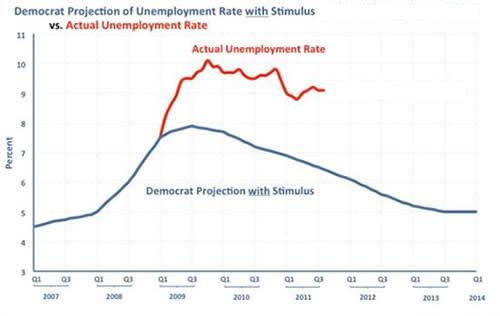
Remember, Democrats are great at spending money – not so good at creating jobs.

Projected vs Actual Unemployment With Stimulus 2011

Back in 2007, when the Republicans controlled the House and Senate, the unemployment rate was near 4%. FOUR PERCENT. And we had a deficit of $160 billion – NOT 1.6 TRILLION.

Let’s take a closer look at the Forgotten 15 from an article on John Boehner’s web site.

Excerpt:

Campaigning for another failed stimulus and more job destroying taxes, President Obama has repeatedly—and falsely—asserted that “Congress isn’t willing to move” legislation to facilitate job growth. While the president plays politics, House Republicans have been working and approving legislation to promote economic growth and job creation. The House has approved more than 15 bills that, if enacted, would immediately help to grow the economy without more failed stimulus spending. These bills are currently stalled in the Democrat-controlled Senate and the president has not encouraged the Senate to act.

Here is a sample:

4)  H.R. 1230—Restarting American Offshore Leasing Now Act: H.R. 1230 would require the Department of the Interior (DOI) to auction offshore oil and gas leases in the Central and Western Gulf of Mexico, as well as in an area off the coast of Virginia. The bill would help to reduce energy prices and promote job creation by expediting offshore oil and natural gas exploration in the Gulf of Mexico and the Virginia coast.

6) H.R. 1231—Reversing President Obama’s Offshore Moratorium Act:  H.R. 1231 would require that each five-year offshore oil and gas leasing program offer leasing in the areas with the most prospective oil and gas resources, and would establish a domestic oil and natural gas production goal.  The bill would essentially lift the President’s ban on new offshore drilling by requiring the Administration to move forward on American energy production in areas estimated to contain the most oil and natural gas resources.

7) H.R. 2021—The Jobs and Energy Permitting Act of 2011:  H.R. 2021 would eliminate needless permitting delays that have stalled important energy production opportunities off the coast of Alaska.  The bill would also eliminate the permitting back-and-forth that occurs between the EPA and its Environmental Appeals Board.  Rather than having exploration air permits repeatedly approved and rescinded by the agency and its review board, the EPA will be required to take final action – granting or denying a permit—within six months.

10) H.R. 1938— North American-Made Energy Security Act:  H.R. 1938 would direct the President, acting through the Secretary of Energy, to coordinate with all federal agencies responsible for an aspect of the President’s National Interest Determination and Presidential Permit decision regarding construction and operation of Keystone XL, to ensure that all necessary actions are taken on an expedited schedule.  The bill would promote job creation and energy security by ending the needless delay of the construction and operation of the Keystone XL pipeline.

11) H.R. 2587—Protecting Jobs From Government Interference Act:  H.R. 2587 would prohibit the National Labor Relations Board (NRLB) from ordering any employer to close, relocate, or transfer employment under any circumstance.

16)  H.R. 2433—Veterans Opportunity to Work Act:  H.R. 2433 would create or modify programs that provide employment and training services to veterans and service members separating from active duty.  The bill would also make changes to programs that offer home loan guarantees, ambulance services, and pension payments to qualifying individuals. Among other things, the bill would provide up to 12 months of Veterans Retraining Assistance to no more than 100,000 unemployed veterans that enter education or training programs at community colleges or technical schools to prepare them for employment in an occupational field that is determined by Department of Labor to have significant employment opportunities.

17) H.R. 674—To amend the Internal Revenue Code of 1986 to repeal the imposition of 3 percent withholding on certain payments made to vendors by government entities:   H.R. 674 would permanently repeal the imposition of 3 percent withholding on certain payments made to vendors by government entities. Currently, the imposition of the 3 percent withholding is set to take effect on January 1, 2013. If the 3 percent withholding tax were implemented as scheduled, government entities would be required to withhold 3 percent of payments to persons providing property or services to the government.  For example, on an invoice for $20,000 the government would pay the business $19,400 and withhold $600 as a preemptive tax.  These added costs would almost certainly translate into fewer private-sector jobs and higher costs for the government and taxpayers.

They are actually up to 17 jobs bills now.

And finally, I have to post this funny John Boehner clip:

We need more of that Mr. Boehner. I think that was a good opportunity to say “freaking” as well. Because he should be pissed off with this Solyndra-bailout President.