
Tag Archives: Youth

Two great podcasts from J. Warner Wallace of Please Convince Me

J Warner Wallace and Please Convince Me

Please Convince Me is my absolute favorite podcast. The host, J. Warner Wallace, is a cold case homicide detective. He has a real job! And he talks about Christian things like you might expect a detective to talk – everything is logic, case-making and evidence. Very cool.

Why Being Respected Is Better Than Being Liked

The MP3 file is here.

The most interesting segment starts at 8 minutes and ends at 21 minutes in.

Topics

  • humans have an innate desire to be liked and to fit in with their peers
  • there are times when our desire to do what is right will conflict with the desire to be liked and to fit in
  • 1 Peter talks about how Christian living in the world will often have these conflicts
  • Christians have a different standard and that creates conflicts with the surrounding culture
  • at times like this, it is important for us to be RESPECTED rather than LIKED
  • being a Christian conflicts with the goal of being popular
  • two ways for us to proceed: 1) agree with others, 2) be who you are and let others agree with you
  • James also says that there is a conflict between being friends with the world and friends with God
  • you cannot have both friendship with the world and friendship with God
  • even non-believers understand that there is a conflict between morality and the hedonistic culture\
  • courage is needed in order to resist the pressure to embrace the beliefs of others in order to be liked
  • courage is needed in order to point others to the truth so that they change to match what is true
  • politicians often change their positions in order to appeal to the culture
  • politicians seem to shy away from trying to argue through why others should accept their positions
  • we should seek to influence others by explaining why others should accept what we believe
  • we should have the courage to make the case for what we believe
  • even if people do not accept our beliefs, they will still respect the way we can make the case
  • they will respect our courage in being willing to prepare a case and make the case in public
  • they will respect that we have not formed our beliefs based on feelings
  • we need to get better at knowing more stuff and communicating that knowledge better
  • wanting to be popular is too easy
  • we should take the harder path and desire to be respected instead of liked

Other topics from listeners:

  • the interpretation of “thou shalt not kill” in the Bible
  • can a person still be a Christian if they are not doing works, like tithing or serving in the church?
  • theistic evolution and the presumption of naturalism in science

And here’s another good podcast – it’s on the same topic as the PCM post I linked before.

Stop Teaching Young Christians About Their Faith

The MP3 is here.

Topics:

  • our nation is becoming more and more secular
  • secularism makes it harder for us to defend our faith and values in public and influence the culture
  • why is secularism happening? it’s because young people are walking away from the faith
  • young Christians are leaving the faith in high school and college
  • this is where the real battleground is – and that’s where apologists need to focus
  • we need to be focused especially on junior high school and high school, and to a lesser degree college
  • it’s good that we have lots scholars working physics, philosophy and biology
  • but what we really need is ordinary Christians to get serious about apologetics and work on young people
  • some people believe that there is no great youth exodus problem: are they right to doubt the statistics
  • it’s undeniable that young people are inarticulate about their faith – that much is certain
  • what young people in church actually believ is not Christianity, but moralistic therapeutic deism
  • young people: life is about feeling good, being liked, and nice people of all religions are saved
  • young people think that there is so little substance to Christianity that it can’t even be discussed
  • the focus among young people today is not on true beliefs, but on being kinds to others
  • even in churches, there is higher respect for helping others than on having knowledge and evidence
  • instead of focusing on the worldview that grounds good works, the focus is on good works
  • young people have learned to minimize discussions about specifics of theology
  • teachers and college professors are hostile to public expressions of evangelical Christianity
  • television is also hostile and much less Christian than it used to be
  • even if young people come back to the church, they come back for the wrong reasons
  • the adults come back for tradition and comfort but they don’t really believe Christianity is true
  • they want to pick and choose what they believe based on what they like, like going to a buffet
  • they return to church when they have kids so that their kids will absorb values – but not truth
  • that’s what we have sitting in the pews: people who think Christianity is false, but “useful”
  • and that’s why so many christians are so liberal on social values (abortion, same-sex marriage)
  • they don’t really accept the Bible as authoritative, they pick and choose what they like and don’t like
  • if Christianity is taught as “useful” then they will dump it when they find something more “useful”
  • people who leave the church are exposed to Christianity, but it doesn’t stick
  • young people lose their faith before college, and then when they escape the nest, they act it out
  • the disconnecting from the faith occurs in high school, but it only becomes public after they leave home
  • young people are becoming more focused on redefining “the good life” with consumption and materialism
  • the typical experience of young adults involves alcohol use, drug use, and recreational sex
  • young people actually want more than niceness – they want real answers to serious questions
  • young people have doubts and questions, but no one in the church or home is equipped to answer them
  • adults have to be involved in the education of young people
  • parents who are engaged in teaching their children Christian truths see much better retention rates
  • we need to stop teaching people (one-way preaching) and start training them (two-way interactive)
  • when you give a young person a definite goal – a fight with a date certain – then they will be engaged
  • when people know that they will fail unless they can perform, then they will be more engaged in learning
  • church needs to be in the business of scheduling battles, and then training young people for the battles
  • there is no sense of urgency, risk and purpose in young people, so the teaching is not effective

I’m absolutely sure you will love these podcasts. Give them a listen! I’m pretty sure that he will put me in jail if you don’t listen to them. So, um… please do!
Are young people really leaving Christianity?

J Warner Wallace of Please Convince Me summarizes the research by citing a number of sources.

Here’s one:

Soul Searching: The Religious and Spiritual Lives of American Teenagers
Christian Smith and Melinda Lundquist Denton, Oxford University Press, 2005
Book Findings: The majority of teenagers are incredibly inarticulate about their faith, religious beliefs and practices, and its place in their lives. The de facto dominant religion among contemporary U.S. teenagers is what they call ‘Moralistic Therapeutic Deism’: A God exists who created and orders the world and watches over human life on earth; God wants people to be good, nice, and fair to each other, as taught in the Bible and by most world religions; the central goal of life is to be happy and to feel good about oneself; God does not need to be particularly involved in one’s life except when God is needed to resolve a problem; and good people go to heaven when they die.

And another:

Southern Baptist Convention Data
Pinkney, T.C., Remarks to the Southern Baptist Convention Executive Committee, Nashville, Tennessee (2001)
Study Findings: Data from the Southern Baptist Convention indicates that they are currently losing 70-88% of their youth after their freshman year in college. 70% of teenagers involved in church youth groups stop attending church within two years of their high school graduation.

And another:

Soul Searching: The Religious and Spiritual Lives of American Teenagers
Christian Smith and Melinda Lundquist Denton, Oxford University Press (2005)
Book Findings: Students leave faith behind primarily because of intellectual doubt and skepticism (page 89). “Why did they fall away from the faith in which they were raised?” This was an open-ended question there were no multiple-choice answers. 32% said they left faith behind because of intellectual skepticism or doubt. (“It didn’t make any sense anymore.” “Some stuff is too far-fetched for me to believe.” “I think scientifically and there is no real proof.” “Too many questions that can’t be answered.”)

And one more:

Lost in Transition: The Dark Side of Emerging Adulthood
Christian Smith with Kari Christoffersen, Hilary Davidson and Patricia Snell Herzog
Oxford University Press (2011)
Book Findings: Young adults are unable to think coherently about moral beliefs and problems. Young adults have an excessive focus on consumption and materialism as the good life. The prevalent lifestyle of young adults includes routine intoxication and drug usage. The sexual encounters of young adults are not practiced in an environment of physical, mental, or emotional health. Young adults appear to have an inability to care about, invest in, and hope for the larger world through civic and political participation.

He concludes:

There you have it; a short summary of some of the research being done on the exodus of young people from the Church and some of the reasons they give for their departure. Can a case be made that young Christians are leaving the Church in record numbers? Yes. Can a case be made that many of these young people are leaving because the culture around them has impacted them deeply and caused them to question the truth claims of Christianity? Yes, again.

He finishes the post with a cliff-hanger ending, in which he promises to give us a plan for dealing with this problem. Stay tuned!

Minimum wage: doing what feels good doesn’t produce good results

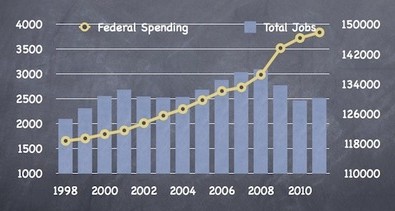
Government Spending Vs Jobs

From Investors Business Daily.

Excerpt:

How amusing to watch Democrats wring their hands over what they can do to get businesses to create jobs, when one of the biggest job killers is the minimum wage they keep hiking.

Recall that it was Democrats who raised the federal wage floor a whopping $2.10 an hour in the middle of the recession. The record 41% increase has led to record unemployment among young people, especially black teens.

Congress started ratcheting up the minimum wage from $5.15 an hour in mid-2007, arguing it would help abate poverty. But retailers looking to slash costs eliminated low-skilled, entry-level jobs rather than pay the mandated increases.

Now 1.5 million fewer teens are working. Last year’s unemployment rate for workers ages 16 to 19 shot up to 26% from 2007’s 15%.

As for black teens, their joblessness soared to a record 43% after the final raise to $7.25 took effect in mid-2009. It helped put more than half of young black men out of work — a first.

The president proposes cranking the minimum wage even higher to $9.50. Then he wants to raise it every year thereafter as a “living wage” indexed to inflation.

Yes, this is the problem that happens when you elect someone who knows nothing whatsoever about economics. And when I say nothing, I mean he is in disagreement with virtually all economists across the ideological spectrum.

Moderate economist Gregory Mankiw of Harvard University lists the policies that are accepted by virtually all economists.

Here’s Greg’s list, together with the percentage of economists who agree:

  1. A ceiling on rents reduces the quantity and quality of housing available. (93%)
  2. Tariffs and import quotas usually reduce general economic welfare. (93%)
  3. Flexible and floating exchange rates offer an effective international monetary arrangement. (90%)
  4. Fiscal policy (e.g., tax cut and/or government expenditure increase) has a significant stimulative impact on a less than fully employed economy. (90%)
  5. The United States should not restrict employers from outsourcing work to foreign countries. (90%)
  6. The United States should eliminate agricultural subsidies. (85%)
  7. Local and state governments should eliminate subsidies to professional sports franchises. (85%)
  8. If the federal budget is to be balanced, it should be done over the business cycle rather than yearly. (85%)
  9. The gap between Social Security funds and expenditures will become unsustainably large within the next fifty years if current policies remain unchanged. (85%)
  10. Cash payments increase the welfare of recipients to a greater degree than do transfers-in-kind of equal cash value. (84%)
  11. A large federal budget deficit has an adverse effect on the economy. (83%)
  12. A minimum wage increases unemployment among young and unskilled workers. (79%)
  13. The government should restructure the welfare system along the lines of a “negative income tax.” (79%)
  14. Effluent taxes and marketable pollution permits represent a better approach to pollution control than imposition of pollution ceilings. (78%)

From CNBC, we get this article showing that any increase in the minimum wage will raise the unemployment rate for young people.

Excerpt:

A quarter of teenagers were jobless in March, representing a surprising increase from February, even as the unemployment rate for the rest of the population decreased.

This figure may only get worse if budget-strapped states raise the minimum wage, and it could also be a sign of greater structural damage underlying our economy, analysts said.

The unemployment rate for 16- to 19-year olds jumped back up to 24.5 percent in March, up from 23.9 percent the prior month, according to the latest jobs data from the Labor Department.

[…]“Even when comprehending that teen employment is volatile in nature, the data that exists serves up some shock and awe,” said Brian Sozzi, a retail research analyst with Wall Street Strategies, in a note Wednesday. “If these (wage) increases do go through, the prospect for teen employment will remain grim as employers search for workers with advanced skills to fill positions.”

Twelve states, including Illinois and Pennsylvania, are considering a hike in the minimum wage. While this has been the subject of a long-running debate, many economists and analysts say raising this pay bar may cause more teen layoffs, even as it helps teens who manage to stay employed make more.

“Minimum wage increases over the past few years has definitely made it worse,” said Peter Boockvar, chief equities strategist at Miller Tabak. “In fact, there should be zero minimum wage for teenagers, or at most, something much less than the current rate.”

Teens typically are the first to be fired and the last to be hired back in a normal economic cycle, so this rate can be considered a kind of leading indicator of employment.

A new study shows that only 25% of teens will be able to find jobs this summer. And Obama thinks that this number is apparently too high. He wants to lower it by raising the price that must be paid by employers who would like to hire younger workers.

You can find out more about how raising the minimum wage increases unemployment from this comprehensive, 50-year, government study.

Excerpt:

Summary of Research on the Minimum Wage

* The minimum wage reduces employment.

Currie and Fallick (1993), Gallasch (1975), Gardner (1981), Peterson (1957), Peterson and Stewart (1969).

* The minimum wage reduces employment more among teenagers than adults.

Adie (1973); Brown, Gilroy and Kohen (1981a, 1981b); Fleisher (1981); Hammermesh (1982); Meyer and Wise (1981, 1983a); Minimum Wage Study Commission (1981); Neumark and Wascher (1992); Ragan (1977); Vandenbrink (1987); Welch (1974, 1978); Welch and Cunningham (1978).

* The minimum wage reduces employment most among black teenage males.

Al-Salam, Quester, and Welch (1981), Iden (1980), Mincer (1976), Moore (1971), Ragan (1977), Williams (1977a, 1977b).

* The minimum wage helped South African whites at the expense of blacks.

Bauer (1959).

* The minimum wage hurts blacks generally.

Behrman, Sickles and Taubman (1983); Linneman (1982).

* The minimum wage hurts the unskilled.

Krumm (1981).

* The minimum wage hurts low wage workers.

Brozen (1962), Cox and Oaxaca (1986), Gordon (1981).

* The minimum wage hurts low wage workers particularly during cyclical downturns.

Kosters and Welch (1972), Welch (1974).

* The minimum wage reduces average earnings of young workers.Meyer and Wise (1983b).

* The minimum wage reduces employment in low-wage industries, such as retailing.Cotterman (1981), Douty (1960), Fleisher (1981), Hammermesh (1981), Peterson (1981).

* The minimum wage causes employers to cut back on training.Hashimoto (1981, 1982), Leighton and Mincer (1981), Ragan (1981).

* The minimum wage encourages employers to install labor-saving devices.Trapani and Moroney (1981).

* The minimum wage increases the number of people on welfare.Brandon (1995), Leffler (1978).

* The minimum wage hurts the poor generally.

Stigler (1946).

* The minimum wage does little to reduce poverty.

Bonilla (1992), Brown (1988), Johnson and Browning (1983), Kohen and Gilroy (1981), Parsons (1980), Smith and Vavrichek (1987).

* The minimum wage helps unions.Linneman (1982), Cox and Oaxaca (1982).

* The minimum wage increases teenage crime rates.Hashimoto (1987), Phillips (1981).

* The minimum wage encourages employers to hire illegal aliens.

Beranek (1982).

* Few workers are permanently stuck at the minimum wage.

Brozen (1969), Smith and Vavrichek (1992).

* The minimum wage has reduced employment in foreign countries.Canada: Forrest (1982); Chile: Corbo (1981); Costa Rica: Gregory (1981); France: Rosa (1981).

This is why it is important for voters to understand economics. When you raise the price of labor, fewer employers will purchase labor. Supply and demand.