
Tag Archives: Young

Should young people vote for Barack Obama and Obamacare?

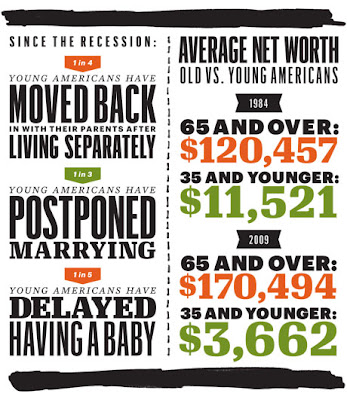
The real inequality: young America and old America

From Donald Sensing at Sense of Events blog.

Excerpt:

Shikha Dalmia, responds to Slate’s Dahlia Lithwick, who was so, “Shell shocked by the shellacking that the Solicitor General Donald Verrilli received at the hearing Tuesday, [that] she went into a deep sulk and threw the intellectual equivalent of a hissy fit.” Shikha observes:

In our current health care system, a mix of taxpayers; (rich) hospitals/providers and (even richer) private insurers are stuck with the tab for uncompensated care. There are many problems with this. But isn’t it at least more compassionate than ObamaCare that would force asset-poor young people – trying to pay off their college debt and hang on to some beer money – to subsidize the coverage of relatively wealthier prospective geezers? If maximizing compassion is the issue, shouldn’t we stick with what we’ve got?

In other words, under Obamacare the young overpay for health insurance in order to subsidize the old, whose medical costs are magnitudes higher than those of the young. That is a key feature of the “individual mandate” that makes it mandatory to buy health insurance under Obamacare. I remember reading during the SCOTUS hearings that men and women younger than 30 (or so) average using about $1,800 of health insurance per year, but will have to pay $5,400.

It’s very important to understand that when government gets involved with spending money on handing out goodies, that it is tempting for them to buy the votes of those who are politically informed with the money taken from those who don’t know a thing about real life.

Now consider these numbers from socialist Europe – where Obama’s plan is a little further along.

Excerpt:

Youth unemployment now exceeds 50pc in both Spain and Greece as the number of people out of work in the eurozone as a whole hit a 15-year high of 17.2m.

The unemployment rate among Spain’s under-25s rose to 50.5pc in January, and to 50.4pc in Greece in December, according to the latest available data from Eurostat, the European Union’s statistics office. It compared with an average eurozone youth unemployment rate of 21.6pc. One of the lowest rates of youth unemployment is in Germany, where it remained at 8.2pc in February.

The rise in Spain and Greece reflects the deep financial woes of both countries, which are in the midst of far-reaching and highly unpopular austerity programmes, considered necessary by the broader EU to reduce huge deficits.

Spain’s unemployment rate now stands at 23.6pc, compared with a eurozone average of 10.8pc. The extent of Spain’s problems are further underlined by a housing market in crisis, with prices expected to fall the most on record this year. One-in-four homeowners in the country owes more than their property is worth.

I find it so sad that kids are brainwashed by unionized public school teachers to support nonsense like global warming, while despising free market capitalism. And then they go out and vote for more and more government, so that their “teachers” can be paid more and more. They will never fix their worldviews until they get out into the real world, and by then it they will have voted in many elections.
In California, students protest the results of their own liberal voting

Victor Davis Hanson writes about it National Review.

Excerpt:

Here in California, students just marched on Sacramento in outrage that state-subsidized tuition at the UC and CSU campuses keeps climbing. It is true that per-unit tuition costs are rising, despite even greater exploitation of poorly paid part-time teachers and graduate-student TAs. But the protests are sort of surreal. The California legislature is overwhelmingly Democratic. The governor is a Democrat. The faculties and administrative classes are largely Democratic. Who then, in the students’ minds, have established these supposedly unfair budget priorities?

Sales, income, and gas taxes are still among the highest in the nation (and are proposed to rise even higher) — prompting one of the largest out-of-state exoduses of upper-income brackets in the nation. The state budget is pretty much entirely committed to K–12 education (whose state-by-state comparative test scores in math and science hover between 45th and 49th in the nation), prisons, social services, and public-employee salaries and pensions. Whom, then, can the students be angry at?

Are students angry at public-union salaries and pensions that are among the highest in the nation? Do they think the many highly compensated retired Highway patrol officers have shorted students at UC Davis? Are they mad at the 50,000 illegal aliens in the California prison system that might have siphoned off scholarship funds from CSU Monterey Bay? Or is the rub the influx of hundreds of thousands of children of illegal aliens who require all sorts of language remediation and extra instruction in the public schools, and so might in theory divert library funds from UC Santa Cruz?

Perhaps the students don’t want billions to be committed to high-speed rail that might rob Berkeley of needed funding, or environmental efforts to introduce salmon into the San Joaquin River, in which the $70 million spent so far in studies and surveys might have come from nearby CSU Fresno? Are they mad at state social services, whose medical expenses have skyrocketed to address the health-care needs of millions of illegal aliens, and thus in theory could curb the choice of classes at CSU Stanislaus? Are they angry that some $10–15 billion a year probably leaves the state as remittances to Mexico?

If one cannot blame the wealthy for “not paying their fair share” (the top 1 percent of Californians now pay about 37 percent of all income-tax revenue — and their numbers have decreased by one-third in recent years, as the state has come to rely on the income tax for half its revenue), or Republican majorities in government, who, then, is left to blame?

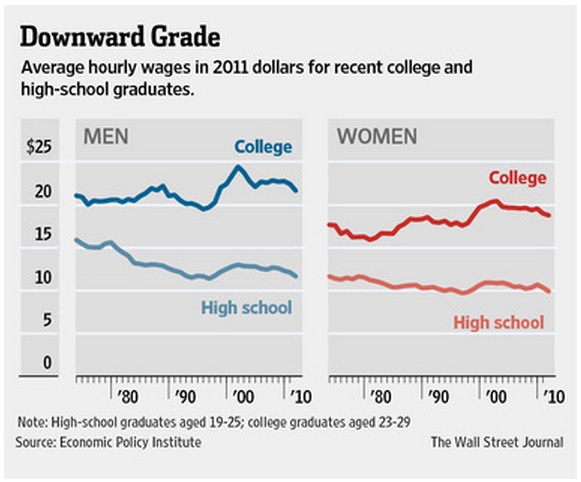
Not only are their tuition costs going UP but their likely salary is going DOWN.

Students majoring in booze and hook-up sex
How's that hopey-changey stuff workin' for ya?

I got that image from a post at the American Enterprise Institute.

Excerpt:

  • Only 35 percent of students starting a four-year degree program will graduate within four years, and less than 60 percent will graduate within six years.
  • The U.S. college dropout rate is about 40 percent, the highest college dropout rate in the industrialized world.
  • Over the past 25 years, the total number of students in college has increased by about 50 percent. But the number of students graduating with degrees in STEM subjects has remained more or less constant.
  • In 2009, the United States graduated 37,994 students with bachelor’s degrees in computer and information science. That’s not bad, but we graduated more students with computer-science degrees 25 years ago!
  • Few disciplines have changed as much in recent years as microbiology, but in 2009 we graduated just 2,480 students with bachelor’s degrees in microbiology—about the same number as 25 years ago. Who will solve the problem of antibiotic resistance?
  • If students aren’t studying science, technology, engineering, and math, what are they studying?
  • In 2009, the United States graduated 89,140 students in the visual and performing arts, more than in computer science, math, and chemical engineering combined and more than double the number of visual-and-performing-arts graduates in 1985.
  • Moreover, more than half of all humanities graduates end up in jobs that don’t require college degrees, and those graduates don’t get a big income boost from having gone to college.

I think this is interesting. What exactly are these students paying for?

If there is one thing I learned from my love of Shakespeare, it’s that it is tragic to be the cause of your own downfall because of your own tragic flaw. Right now, there are a bunch of young people who have been totally brainwashed by the unionized public school teachers and professors to have views on economics that are completely opposite to what works in the real world. They keep voting for bigger and bigger government, which creates more and more debt in order to provide their parents with bigger and bigger benefits. They have lots of self-esteem, but very few marketable skills. Eventually, the bill for all the government spending on “helping the poor”, (e.g. – food stamps for millionaires and bailouts for bankrupt green energy firms), comes due, and it’s the students who will be paying the bill. I wonder if they will look as favorably on socialism and global warming alarmism then?

UPDATE: I noticed that in Quebec, the most liberal province in Canada, students are doing the same thing.

Europe’s socialist debt crisis: who suffers most? Can bailouts fix it?

This is the most popular article on Investors Business Daily right now.

Excerpt:

Rational or not, Greece’s street riots and emigration rates signify one thing: Socialism offers very little to the young. So why is the EU’s $172 billion bailout geared toward saving so much of the failed socialist system?

As Europe prepares to deliver a historic $172 billion bailout to Greece in a deal announced Monday, it’s pretty much a given that the austerity conditions required, in the absence of a true free market, will hit youth hardest. Athens will be trashed by another youth rampage, as many youths blame the pain on something other than Greece’s deeply rooted socialism.

A bigger effect will come from Greeks who do recognize reality. They won’t riot. They’ll leave, voting with their feet just as Eastern Europe’s youth once did.

The young in both cases are victims of socialism, which claims to make people equal but, in reality, penalizes the young. For Greece, a country already gutted by a below-replacement birth rate and an aging population, that’s a disaster.

It’s not just Greece, but also every EU state with institutionalized socialism — where high government spending seeks to create a warm blanket insulating everyone from risk, but instead has led to bankruptcy.

[…]One out of five jobs in Greece is held by a bureaucrat, which is why unemployment among the under-24s runs at 42%. A 2010 poll shows that seven out of 10 Greek college graduates seek to leave.

Some 9% of Greek college graduates and at least 51% of Greece’s Ph.D.s are already gone, according to University of Macedonia demographer Lois Lambrianidis.

What jobs there are come from the bottom of a two-tier labor system that shields older workers in Greece’s rigid labor market. Young Greeks earn a 500-and-change euro monthly minimum wage as older workers doing the same work make 700.

In contrast, immigrant-magnet Australia holds packed job fairs at its Athens embassy. In 2011, it took in 249,000 immigrants. In 2012, a 20% rise is expected.

[…]Meanwhile, Spain’s EFE News reports that the Spanish Embassy in Santiago, Chile, has seen a 10% rise in registered nationals to 48,000, while Chile reports a 25% rise in work permits issued to Spanish citizens.

It’s not just jobs that are penalizing Europe’s young. Housing is stacked against youth, too. Eurostat reports that in 2008, 46% of young European adults ages 18-34 lived with their parents — 51 million people.

The two-tier job market, which leans heavily toward unstable contract employment, affects housing choices for the young. Other socialist measures designed to protect current owners against the market also shut out the young.

Perhaps most hostile of all to youth are the EU’s outdated state pension systems — which force the young to pay the pensions of the old as the population shrinks.

In Italy, 14% of all economic output goes to pensions. It’s no coincidence that states attracting Europe’s young, like Chile and Australia, have privatized their social security systems that give youth a real shot at building personal wealth and a credible pension through their own efforts, instead of political favoritism.

This is the direction that the United States is also headed in. What I find mystifying is why young people in the United States are voting for these policies. Young people here have a higher rate of unemployment, and they ought to know that all of these entitlement programs won’t be there for them when they retire. What possible reason could they have for voting for more and more government control?