
Tag Archives: Wisdom

Are Christians responsible for making plans and making good decisions?

Here’s a wonderful post on decision making and the will of God posted on Neil’s blog. In his post, Neil explains the Biblical model for making good decisions.

Excerpt:

Really short version: Aside from direct and clear personal revelation from God, you don’t have access to his sovereign will when making decisions.  Therefore you must look at other factors.  If it isn’t moral, don’t do it.  If it is moral but not wise, don’t do it.  If it is moral and wise, then use your personal preferences.

Using this model you can end up with a wise and biblical decision, but you have avoided the traps of the “God told me to ____” routine.  People who run around saying that God told them this and that convey a super-spirituality that can leave less mature believers wondering if they really have a relationship with God (i.e., “God doesn’t tell me every little thing to do, so maybe I don’t really know him.”).

He has a helpful picture posted as well:
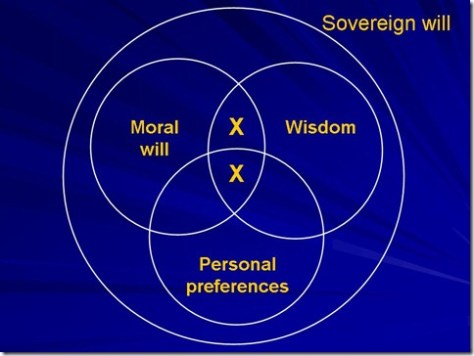
This is actually a very important topic for me, because I like making plans and making good decisions. I like being the quarterback or squad leader of my own life. I like to pick objectives and then make plans to achieve them. (Nothing too exotic, just simple stuff like saving money or reading more books)

Actually, I really oppose the idea that God has a magical fairy tale will for each person that will make them happy and fulfilled. For me, life isn’t like that. I don’t expect God to lead me along like a child at a scavenger hunt. I expect to survey the battlefield where I am and then do something to make a difference. There are lots of things you can do that will please God. Should you focus on your career and sponsor apologetics conferences? Or should you use your spare time preparing Sunday school lessons? There are lots of good things you could do to please God. Your job is to pick the one that will be the most effective. It doesn’t matter if it makes you happy, it only matters if it’s effective and if you are good at it.

Who is Rifleman Dodd?

A while back, I was busily working my way through the U.S. Marine Corps Official Reading List, and I came across a book by C.S. Forester called Rifleman Dodd, or alternatively titled Death to the French. It’s a work of historical fiction that takes place during the Napoleonic wars. The story is about a British marksman named Dodd, who is cut off from his own lines during a withdrawal maneuver. He is subsequently left to fend for himself behind enemy lines. An ordinary man might be full of despair and forget about his mission entirely. But Dodd is no ordinary man. Not only does he find a way to survive by finding food to eat, water to drink and places to sleep, but he also tries to remember his orders and to think about what he can do to advance the cause of his General, the Duke of Wellington.

Here’s an excerpt from a gritty book review:

It’s about a green-coated British infantry rifleman in the Napoleonic Wars, an age when rifles were a novelty and most of the army was red-coated and carried muskets. Private Matthew Dodd gets separated from his regiment during a retreat and finds himself stranded behind enemy (French) lines in Portugal. With the occasional aid of some natives, but mostly on his own, he harasses the French with his rifle and tries to prevent them from building a bridge across the Tagus River. It’s a remarkable tale of survival and solitary achievement, of a rank-and-file soldier who lives by his wits and slowly learns to make plans without orders, and shows leadership qualities and a knowledge of warfare.

I think we’re in the same situation as Dodd.

There is no point in us looking for breadcrumb trails to happiness at this point. That’s not the point of Christianity. The point of Christianity is friendship with God, imitation of Christ, honoring moral obligations, self-sacrificial love for your neighbor (and even your enemies!), and dedication to the truth – whether anyone else likes you or not. It’s not supposed to make you happy, and it’s not necessarily going to be a normal life like everyone else has. Things may not work out the way you’d like them to.

We seem to be making such a big deal about compassion and forgiveness in the Christian life these days – such a big emphasis on our feelings. Almost like we have forgotten that we have obligations to our friend – and his objectives. A relationship doesn’t mean that one person completely disregards the character and goals of the other person and then is automatically granted forgiveness whenever they want it. That’s not a friendship – that’s using someone else for your own ends. Maybe it’s time to remember what this is all about.


New study: women seeking to have a child should start before age 32

Brain vs Heart, from: theawkwardyeti.com

Dina sent me this sobering piece of research from the New Scientist which is perfect for all the young feminists who have been taught in college that marriage should be put off, and women can easily get pregnant after age 40.

Excerpt:

It’s a question many people will ask themselves at some point in their lives: when should I start a family? If you know how many children you’d like, and whether or not you would consider, or could afford, IVF, a computer model can suggest when to start trying for your first child.

Happy with just one? The model recommends you get started by age 32 to have a 90 per cent chance of realising your dream without IVF. A brood of three would mean starting by age 23 to have the same chance of success. Wait until 35 and the odds are 50:50 (see “When to get started”).

The suggestions are based on averages pulled from a swathe of data so don’t give a personal prediction. And of course, things aren’t this simple in real life – if only family size and feelings about IVF were the only factors to consider when planning a family. But the idea behind the model is to help people make a decision by condensing all the information out there into an accessible form.

“We have tried to fill a missing link in the decision-making process,” says Dik Habbema at Erasmus University in Rotterdam, the Netherlands, one of the creators of the model. “My son is 35 and many of his friends have a problem deciding when to have children because there are so many things they want to do.”

It’s a scenario that will be familiar to many; the age at which people have their first child has been creeping up over the last 40 or so years. For example, the average age at which a woman has her first child is 28 in the UK and has reached 30 in Italy, Spain and Switzerland. In the US, the birth rate for women in their 20s has hit a record low, while the figures for those over 35 have increased over the last few decades.

The decision is more pressing for women thanks to their limited supply of eggs, which steadily drop in quantity and quality with age. Female fertility is thought to start declining at 30, with a more significant fall after the age of 35.

[…]The new model incorporates data from studies that assess how fertility naturally declines with age. The team took information on natural fertility from population data collected over 300 years up to the 1970s, which includes data on 58,000 women.

I have often tried to talk to young women about the need to get their lives in gear. I advise them to work summers during high school, obtain a STEM degree in university, minimize borrowing money by going to community college for the generic prerequisites, don’t have premarital sex, get a job related to their STEM field straight out of college, pay off their debts, move out of their parents’ house, start investing from the first paycheck, marry between age 25-30, and then start having children after the first two “stabilizing” years of marriage. This is sound advice, rooted in my careful reconnaissance of the things that human beings care about and need in their old age. This advice is not bullying, it comes from reading many, many relevant papers. It comes from putting the knowledge gained from reading the papers into practice, and seeing results where appropriate.

I am giving you the numbers. Straight out of a peer-reviewed study. Don’t follow your heart. Don’t listen to your friends. Follow the science. Make your decisions within the boundaries of reality. God will not save you from foolish decisions.

Related posts

The surprising pro-masculinity message in the “Far From the Madding Crowd” film

Man helping a woman with proper handgun marksmanship

So, I have about a half-dozen older and/or experienced Christian women who advise me and assist me in various ways. The wisest and most experienced is calm and thoughtful Dina. She has a very stressful job dealing with demanding women, and what she admires most in men is “masculinity”, which she defines as a man’s ability to tell a woman what is right and wrong, what God expects from her, what she should be doing with her life, and guiding her and providing for her through the steps to get there.

What makes Dina angry is when a man makes a fool of himself for youth and beauty, abdicating his role as moral and spiritual leader because of attraction / lust. According to Dina, men who have self-control think about what a woman should do that is morally right, with the goal of her producing a return for God. Men who are swayed by youth and beauty are willing to give up that leadership role in exchange for attention and/or sex.

So, with that said, Dina asked me to watch a recently-made movie called “Far From the Madding Crowd“, based on a novel by Thomas Hardy. I immediately said “no” because I know about Thomas Hardy from Tess of the D’Urbervilles, where he presents Tess as the helpless victim of Providence. I really hate that view of women, where they can do reckless, selfish things and then blame everyone but themselves for the destructive consequences of their own free-will decisions. But Dina said “wasn’t I right about the debate between David Robertson and Matt Dillahunty?” I said yes, and watched the movie. And of course, she was right, as she almost always is. This movie is a punch in the face to the radical feminism that seems to have infected so many young women, even in the church.

Here is a review of the movie by Rebekah, posted at her blog.

Rebekah writes:

What does this 19th century tale offer to modern audiences?  This latest rendering emphasizes something actually surprising and unexpected given that it is made in our age of radical feminism.  It is Gabriel Oak’s character that shines the most, not the proto-feminist Bathsheba.  […]In Bathsheba and Gabriel we see how men and women support one another in such a way as to ensure a flourishing in any role that fate might thrust on them.

[…]The relationship between Gabriel and Bathsheba, though unequal in earthly terms of authority and wealth, is one of mutual dependence.  We see Oak taking on a role of both counselor and conscience with Bathsheba – roles that in her striving towards independence she struggles to admit her need for.  She is not unlike the modern feminist in this regard, nor is she unlike all of us in our relationship with the Lord.  Her struggle is best seen in the various times she repels Gabriel only to find herself in desperate situations in which only he can help.  The filmmakers’ clever use of a recurring theme of Bathsheba galloping after Gabriel on a horse when he is needed is particularly moving (and surprising) here.  In the end, the film resists the urge to pander to our more extreme modern views on what women require to thrive.

Gabriel Oak also seems to be an embodiment of the biblical virtue of selflessness.  We see in his actions towards Bathsheba the Philippians admonition to refrain from “being motivated by selfish ambition or vanity,” but rather “in humility, be moved to treat one another as more important than yourself.” Indeed, vanity itself can be seen as a fateful character flaw of every major character apart from Gabriel.  He alone is able to move past rejection and carry on.  In fact, he is required to go so far as to be under the authority of the very woman who rejected his offer of marriage and, despite his continuing affections for her, witness her being courted and then married by another far less worthy man, Frank Troy.  No other major character is able to accomplish this challenge to their pride.  Though Bathsheba does eventually overcome the rejection of her husband, she only does so after tremendous tragedy and with the selfless and steady support of Gabriel.

Gabriel respects her independence, but, like a good shepherd, stays close by to protect and guide her.  Though he cannot protect her from her free-will choices, he does warn her.  He then remains faithful to her in the midst of the trouble she brings upon herself.  In this, he is not unlike our God, for he allows her to stray, all the while letting her know of a better course when asked.  And, she does ask.

In an important scene at a party, where Bathsheba must decide whether or not to marry a particularly obsessive suitor, when she asks, “Tell me what to do, Gabriel,” he simply tells her to “Do what is right.”  Is that not like our Lord?  Gentle shepherd, indeed, for our wild, independent hearts.  In this, I see Gabriel as most suitable for the role as the husband written of in the epistle to the Ephesians.  He loves Bathsheba “just as Christ loved the church and gave himself for her…”

Men and women both struggle with self-centeredness, but men usually work themselves out of it by studying hard things in school, and doing hard work that pays. Men have a natural desire to provide for others, and it is actually a duty laid out for them in the Bible. As a result of studying and working at things they don’t like, men typically are better at resisting their feelings and desires. In fact, if you ever want to make a woman less self-centered and emotional, leading her to study STEM and work a demanding job is a good plan. Dina has multiple STEM degrees, and a very difficult, challenging work history.

I would be suspicious of men who don’t prioritize providing, (as in 1 Tim 5:8), because working and saving gives a man practical experience at self-denial. When a man gets accustomed to working to share with others, it helps helps him to lead a woman to do the same: deny her feelings and desires, and make prudent decisions that will allow her to love and serve others – including God – in a sustainable way. Over the long-term, this practice of effective, self-sacrificial love will be worth more to the woman than the short-term pursuit of fun and thrills. To provide for a woman means to look into her future, and make a decision today to set aside something that will help her to deal with what the future has in store for her.

Dina’s advice to young women

I asked Dina to take a look at the draft of this post before I hit “Schedule” and Dina said:

What I would advise to all young women is not to expect a Gabriel Oak to be waiting for you at the end of your reckless years of hooking up, partying and wasting your youth on fun and men who have no desire to lead you to God or guide you to goodness. Don’t expect the hot stud that your friends approve of to turn into someone with the character of Oak with the magic powers of your premarital sex life. Find a man who doesn’t give in to your every whim, because if he does, you will only resent him for it, and blame him, for being what you thought you wanted him to be.  Find a man who leads, one who demonstrates self control, self denial, who can provide and protect. And most importantly, respect him for doing it.

Emphasis mine.

Sound advice from the Dina, young ladies. By the way, Dina’s favorite drama is the BBC production of “North and South” from 2004. I also give it a 10/10.