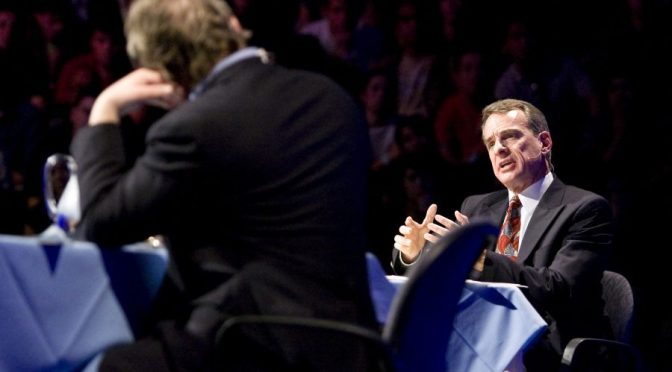
Here is the video and summary of a debate between Christian theist William Lane Craig and Austin Dacey at Purdue University in 2004 about the existence of God.
The video shows the speakers and powerpoint slides of their arguments. Austin Dacey is one of the top atheist debaters, and I would put him second to Peter Millican alone, with Walter Sinnott-Armstrong in third place. This is the debate to show people who are new to apologetics. The debate with Peter Millican is better for advanced students, and that’s no surprise since he teaches at Oxford University and is familiar with all of Dr. Craig’s work. The Craig-Dacey debate is the one that I give to my co-workers.
Dr. Dacey’s 5 arguments below are all good arguments that you find in the academic literature. He is also an effective and engaging speaker, This is a great debate to watch!
SUMMARY of the opening speeches:
Dr. Craig’s opening statement:
Dr. Craig will present six reasons why God exists:
(Contingency argument) God is the best explanation of why something exists rather than nothing
(Cosmological argument) God’s existence is implied by the origin of the universe
(Fine-tuning argument) The fine-tuning of the universe for intelligent life points to a designer of the cosmos
(Moral argument) God is the best explanation for the existence of objective moral values and objective moral duties
(Miracles argument) The historical facts surrounding the life, death and resurrection of Jesus
(Religious experience) God’s existence is directly knowable even apart from arguments
Dr. Dacey’s opening argument:
There are two ways to disprove God’s existence, by showing that the concept of God is self-contradictory, or by showing that certain facts about ourselves and the world are incompatible with what we would expect to be true if God did exist. Dr. Dacey will focus on the second kind of argument.
The hiddenness of God
The success of science in explaining nature without needing a supernatural agency
The dependence of mind on physical processes in the brain
Naturalistic evolution
The existence of gratuitous / pointless evil and suffering
One final point:
One thing that I have to point out is that Dr. Dacey quotes Brian Greene during the debate to counter Dr. Craig’s cosmological argument. Dr. Craig could not respond because he can’t see the context of the quote. However, Dr. Craig had a rematch with Dr. Dacey where was able to read the context of the quote and defuse Dr. Dacey’s objection. This is what he wrote in his August 2005 newsletter after the re-match:
The following week, I was off an another three-day trip, this time to California State University at Fresno. As part of a week of campus outreach the Veritas Forum scheduled a debate on the existence of God between me and Austin Dacey, whom I had debated last spring at Purdue University. In preparation for the rematch I adopted two strategies: (1) Since Dacey had come to the Purdue debate with prepared speeches, I decided to throw him for a loop by offering a different set of arguments for God, so that his canned objections wouldn’t apply. I chose to focus on the cosmological argument, giving four separate arguments for the beginning of the universe, and on the evidence for Jesus’ resurrection. (2) I reviewed our previous debate carefully, preparing critiques of his five atheistic arguments. In the process I found that he had seriously misunderstood or misrepresented a statement by a scientist on the Big Bang; so I brought along the book itself in case Dacey quoted this source again. I figured he might change his arguments just as I was doing; but I wanted to be ready in case he used his old arguments again.
[…]The auditorium was packed that night for the debate, and I later learned that there were overflow rooms, too. To my surprise Dr. Dacey gave the very same case he had presented at Purdue; so he really got clobbered on those arguments. Because he wasn’t prepared for my new arguments, he didn’t even respond to two of my arguments for the beginning of the universe, though he did a credible job responding to the others. I was pleased when he attacked the Big Bang by quoting the same scientist as before, because I then held up the book, specified the page number, and proceeded to quote the context to show what the scientist really meant.
MY NOTES ON THE DEBATE: (WC = William Lane Craig, CH = Christopher Hitchens)
WC opening speech:
Introduction:
WC makes two contentions:
– there are no good arguments for atheism
– there are good arguments for theism
These topics are IRRELEVANT tonight:
– social impact of christianity
– morality of Old Testament passages
– biblical inerrancy
– the debate is whether god (a creator and designer of the universe) exists
1. cosmological argument
– an actually infinite number of past events is impossible
– number of past events must be finite
– therefore universe has a beginning
– the beginning of the universe is confirmed by science – universe began to exist from nothing
– space, time, matter, energy began at the big bang
– the creation of the universe requires a cause
– the cause is uncaused, timeless, spaceless, powerful
– the cause must be beyond space and time, because it created space and time
– the cause is not physical, because it created all matter and energy
– but there are only two kinds of non-physical cause: abstract objects or minds
– abstract objects don’t cause effects
– therefore must be mind
2. teleological argument
– fine-tuned constants and ratios
– constants not determined by laws of nature
– also, there are arbitrary quantities
– constants and quantities are in narrow range of life-permitting values
– an example: if the weak force were different by 1 in 10 to the 100, then no life
– there are 3 explanations: physical law or chance or design
– not due to law: because constants and quantities are independent of the laws
– not due to chance: the odds are too high for chance
– therefore, due to design
– the atheist response is the world ensemble (multiverse)
– but world ensemble has unobservable universes, no evidence that they exist
– and world ensemble contradicts scientific observations we have today
3. moral argument
– objective moral values are values that exist regardless of what humans think
– objective values are not personal preferences
– objective values are not evolved standards that cultures have depending on time and place
– objective moral values and duties exist
– objective moral values and duties require a moral lawgiver
4. argument from resurrection miracle
– resurrection implies miracle
– miracle implies God
– 3 minimal facts pass the historical tests (early attestation, eyewitness testimony, multiple attestation, etc.)
– minimal fact 1: empty tomb
– minimal fact 2: appearances
– minimal fact 3: early belief in the resurrection
– jewish theology prohibits a dying messiah – messiah is not supposed to die
– jewish theology has a general resurrection of everybody, there is not supposed to be a resurrection of one person
– jewish theology certainly does not predict a single resurrection of the messiah after he dies
– therefore, the belief in the resurrection is unlikely to have been invented
– disciples were willing to die for that belief in the resurrection
– naturalistic explanations don’t work for the 3 minimal facts
5. properly basic belief in god
– religious experience is properly basic
– it’s just like the belief in the external world, grounded in experience
– in the absence of defeaters, those experiences are valid
Conclusion: What CH must do:
– destroy all 5 of WC’s arguments
– erect his own case in its place
CH opening speech:
1. evolution disproves biological design argument
– evolution disproves paley’s argument for a watchmaker
2. god wouldn’t have done it that way
– god wouldn’t have waited that long before the incarnation
– mass extinction and death before Jesus
– god wouldn’t have allowed humans to have almost gone extinct a while back in africa
– why insist that this wasteful and incompetent history of life is for us, that’s a bad design
– the universe is so vast, why would god need so much space, that’s a bad design
– there is too much destruction in the universe, like exploding stars – that’s a bad design
– the heat death of the universe is a bad design
– too many of the other planets don’t support life, that’s a bad design
– the sun is going to become a red giant and incinerate us, that’s a bad design
3. hitchens’ burden of proof
– there is no good reason that supports the existence of god
– all arguments for god can be explained without god
– atheists can’t prove there is no god
– but they can prove there is no good argument for god
4. craig’s scientific arguments don’t go far enough, they only prove deism, not theism
– the scientific arguments don’t prove prayer works
– the scientific arguments don’t prove specific moral teachings of christianity
5. if the laws of physics are so great then miracles shouldn’t be allowed
– good laws and miracles seem to be in contradiction
6. extraordinary claims need extraordinary evidence
– none of craig’s evidence was extraordinary
7. science can change, so craig can’t use the progress of science
– it’s too early for craig to use the big bang and fine-tuning
– the big bang and fine-tuning evidences are too new
– they could be overturned by the progress of science
8. craig wrote in his book that the internal conviction of god’s existence should trump contradicting evidence
– but then he isn’t forming his view based on evidence
– he refuses to let evidence disprove his view
– but then how can atheists be to blame if they don’t believe
– so evidence is not really relevant to accepting theism
9. the progress of science has disproved religion
– christianity taught that earth was center of the universe
– but then cosmology disproved that
Response to the big bang and fine-tuning arguments:
– was there pre-existing material?
– who designed the designer?
WC first rebuttal:
Reiterates his 2 basic contentions
CH agrees that there is no good argument for atheism
– then all you’ve got is agnosticism
– because CH did not claim to know there is no God
– and he gave no arguments that there is no God
CH’s evolution argument
– irrelevant to christianity
– Genesis 1 allows for evolution to have occurred
– christianity is not committed to young earth creationism
– the origin of biological diversity is not central to christianity
– st. augustine in 300 AD said days can be long, special potencies unfold over time
– also there are scientific reasons to doubt evolution
– cites barrow and tipler, and they say:
– each of 10 steps in evolution is very improbable
– chances are so low, it would be a miracle if evolution occurred
CH’s argument that god is wasteful
– efficiency is only important to people with limited time or limited resources
– therefore god doesn’t need to be efficient
CH’s argument that god waits too long to send Jesus
– population was not that high before jesus
– jesus appears just before the exponential explosion of population
– conditions were stable – roman empire, peace, literacy, law, etc.
CH’s argument that Craig’s scientific arguments only prove deism, not theism
– deism a type of theism, so those scientific arguments work
– all that deism denies is miraculous intervention
CH’s argument that Craig has a burden of proof
– theism doesn’t need to be proven with certainty
– must only prove best explanation of the evidence
CH’s citation of Craig’s book saying that evidence should not overrule experience
– there is a difference between knowing and showing christianity is true
– knowing is by religious experience which is a properly basic belief
– showing is done through evidence, and there the evidence does matter
CH’s rebuttal to the big bang
– there was no pre-existent material
– space and time and matter came into being at the big bang
– the cause must be non-physical and eternal
– cause of universe outside of time means = cause of universe did not begin to exist
– this is the state of science today
CH’s rebuttal to the fine tuning
– CH says scientists are uncertain about the fine-tuning
– craig cites martin rees, an atheist, astronomer royal, to substantiate the fine tuning
– the fine-tuning is necessary for minimal requirements for life of any kind
– the progress of science is not going to dethrone the fine-tuning
CH’s argument about heat death of the universe
– duration of design is irrelevant to whether something was designed
– cars are designed, yet they break down
– design need not be optimal to be designed
– ch is saying why create if we all eventually go extinct
– but life doesn’t end in the grave on christianity
CH’s rebuttal to the moral argument
– CH says no obj moral values
– but CH uses them to argue against god and christians
– but CH has no foundation for a standard that applies to God and Christians
CH’s rebuttal to the resurrection argument
– empty tomb and appearances are virtually certain
– these are minimal facts, well evidenced using standard historical criteria
– best explanation of these minimal facts is the resurrection
CH’s rebuttal to religious experience
– prop basic belief is rational in the absence of defeaters
– so long as craig has no psychological deficiency, experience is admissible
CH first rebuttal:
it’s not agnosticism
– if there are no good arguments for theism
– then there is no reason for belief in god
– that is atheism
– everything can be explained without god
god wouldn’t have done it that way
– homo sapiens is 100K years old
– for 98K years, they had no communication from God
– lots of people died in childbirth
– disease and volcanos are a mystery to them
– life expectancy is very low
– they die terrible deaths
– their teeth are badly designed
– their genitalia are badly designed
– why solve the problem of sin by allowing a man to be tortured to death
– that’s a stupid, cruel, bumbling plan
lots of people haven’t even heard of jesus
– many of them die without knowing about him
– they cannot be held responsible if they do not know about jesus
the early success of christianity doesn’t prove christianity is true
– because then it applies to mormonism and islam, they’re growing fast
objective morality
– belief in a supreme dictator doesn’t improve moral behavior
– i can do moral actions that you can do
– i can repeat moral positions that you can say
religious people are immoral
– genital mutilation
– suicide bombing
moral behavior doesn’t need god
– we need to act moral for social cohesion
– it evolved for our survival
– that’s why people act morally
– it’s degrading to humans, and servile, to require god for morality
free will
– i believe in free will
– i don’t know why, because i can’t ground free will on atheism
– a bossy god seems to reduce free will because then we are accountable to god
WC cross-examination of CH:
WC why call yourself an atheist when you have no reasons?
CH because absence of belief is atheism
WC but agnosticism, atheism, verificationism all don’t hold that belief, which are you?
CH i think god does not exist
WC ok give me an argument for the claim you just made to know god does not exist
CH i have no argument, but i don’t believe in god because it depresses me to think he might be real
WC would you agree that absence of evidence is not evidence of absence?
CH no i don’t agree
WC moral argument: it’s not epistemology it’s the ontology – have you got a foundation for moral values and duties?
CH i do not, it’s just evolution, an evolved standard based on social cohesion
CH cross-examination of WC:
CH you said that the historical reports of jesus doing exorcisms are generally accepted – do you believe in devils?
WC i commit to nothing, what I am saying there historical concensus on the reports that jesus did exorcisms
CH what about the devils going into the pigs, do you believe that?
WC yes i do, but the main point i’m making is that the historical reports show that jesus acted with divine authority
CH do you believe in the virgin birth?
WC yes, but that’s not historically provable using the minimal facts methods, and i did not use the virgin birth in my arguments tonight, because it doesn’t pass the historical tests to be a minimal fact
CH do you believe that all the graves opened and dead people all came out?
WC not sure if the author intended that part as apocalyptic imagery or as literal, i have no opinion on it, have not studied it
CH do exorcisms prove son of god?
WC no, i am only saying that the historical reports show that jesus exercised authority and put himself in the place of god
CH are any religions false? name one that’s false
WC islam
CH so some religions are wicked right?
WC yes
CH if a baby were born in saudi arabia would it be better if it were an atheist or a muslim?
WC i have no opinion on that
CH are any christian denominations wrong?
WC calvinism is wrong about some things, but they are still christians, i could be wrong about some things, i do the best i can studying theology so i’m not wrong
WC second rebuttal
Response to CH arguments:
no reasons for atheism
– no reasons to believe that god does not exist
– ch withholds belief in god
why wait so long before contacting humans with jesus
– population matters, not time – jesus waited until there was about to be a population explosion
– there is natural revelation (Romans 1) for those who lived before christ
what about those who never heard
– (Acts 17:22-31) god chooses the time and place of each person who is born to optimize their opportunity to know him based on how they will respond to evidence (this is called middle knowledge)
– those who haven’t heard will be judged based on general revelation
WC re-assess the state of his five arguments:
cosmological argument
– heat death of the universe won’t happen on christianity
moral argument
– if no objective moral standard, can’t judge other cultures as wrong
– no transcendent objective standard to be able to judge slavery as wrong
name an action argument
– e.g. – tithing
– the greatest command – love the lord your god your god with everything you’ve got
– atheists can’t do that, and that is the biggest commandment to follow
moral obligations
– there are no objective moral obligations for anyone on atheism
– on atheism, you feel obligated because of genetics and social pressure
– on atheism, we’re animals, and animals don’t have moral obligations
resurrection
– the belief in resurrection of 1 man, the messiah is totally unexpected on judaism
– they would not have made this up, it was unexpected
religious experience
– experience is valid in the absence of defeaters
CH second rebuttal:
faith and reason
– Tertullian says faith is better when it’s against reason
it’s easy to start a rumor with faith-based people
– mother teresa: to be canonized she needs to have done a miracle
– so there was a faked miracle report
– but everybody believes the fake miracle report!
– this proves that religious rumors are easy to start
– the resurrection could have started as a similar rumor by people wanting to believe it
name an action
– tithing is a religious action, i don’t have to do that
moral argument
– i can be as moral as you can without god
– i can say that other cultures are wrong, there i just said it
– without god, people would still be good, so god isn’t needed
religious people did bad things in history
– this church did a bad thing here
– that church did a bad thing there
– therfore god doesn’t exist
religion is the outcome of man’s struggle with natural phenomenon
– that is why there are so many religions
WC concluding speech
no arguments for atheism presented
What CH has said during the debate:
– god bad, mother teresa bad, religion bad
atheism is a worldview
– it claims to know the truth
– therefore it is exclusive of other views
what does theism explain
– theism explains a broad range of experiences
– origin of universe, CH has dropped the point
– fine-tuning, CH has dropped the point
– moral, CH says that humans are no different from animals – but an evolved standard is illusory, there are no actual moral values and standards, it’s just a genetic predisposition to act in a certain way – that’s not prescriptive morality
– resurrection, CH has dropped the point
– experience, craig tells his testimony and urges the audience to give it a shot
CH concluding speech
HITCHENS YIELDS HIS ENTIRE CONCLUDING SPEECH!
A question & answer Period followed end of the formal debate
Further study
Check out my analysis of the 11 arguments Hitchens made in his opening speech in his debate with Frank Turek.
There is not much snark in this summary, because Crossley is a solid scholar, and very fair with the evidence.
SUMMARY
William Lane Craig’s opening speech
Two contentions:
There are four minimal facts that are accepted by most historians
The best explanation of the four minimal facts is that God raised Jesus from the dead
Contention 1 of 2:
Fact 1: The burial
The burial is multiply attested
The burial is based on the early source material that Mark used for his gospel
Scholars date this Markan source to within 10 years of the crucifixion
The burial is also in the early passage in 1 Cor 15:3-8
So you have 5 sources, some of which are very early
The burial is credited to a member of the Sanhedrin
the burial is probable because shows an enemy of the church doing right
this makes it unlikely to to be an invention
Fact 2: The empty tomb
The burial story supports the empty tomb
the site of Jesus’ grave was known
the disciples could not proclaim a resurrection if the body were still in it
the antagonists to the early Christians could have produced the body
The empty tomb is multiple attested
it’s mentioned explicitly in Mark
it’s in the separate sources used by Matthew and John
it’s in the early sermons documented in Acts
it’s implied by 1 Cor 15:3-8, because resurrection requires that the body is missing
The empty tomb was discovered by women
the testimony of women of women was not normally allowed in courts of law
if this story was being made up, they would have chosen male disciples
The empty tomb discover lacks legendary embellishment
there is no theological or apologetical reflection on the meaning of the tomb
The early Jewish response implies that the tomb was empty
the response was that the disciples stole the body
that requires that the tomb was found empty
Fact 3: The appearances to individuals and groups, some of the them hostile
The list of appearances is in 1 Cor 15:3-8
this material is extremely early, withing 1-3 years after the cross
James, the brother of Jesus, was not a believer when he got his appearance
Paul was hostile to the early church when he got his appearance
Specific appearances are multiply attested
Peter: attested by Luke and Paul
The twelve: attested by Luke, John and Paul
The women: attested by Matthew and John
Fact 4: The early belief in the resurrection emerged in a hostile environment
There was no background belief in a dying Messiah
There was no background belief in a single person resurrecting before the general resurrection of all of the righteous at the end of the age
The disciples were willing to die for their belief in the resurrection of Jesus
The resurrection is the best explanation for the transformation of the disciples from frightened to reckless of death
Contention 2 of 2:
The resurrection is the best explanation because it passes C.B. McCullough’s six tests for historical explanations
None of the naturalistic explanations accounts for the minimal facts as well as the resurrection
James Crossley’s opening speech
Appeals to the majority of scholars doesn’t prove anything
the majority of people in the west are Christians so of course there are a majority of scholars that support the resurrection
there are Christian schools where denial of the resurrection can result in termination
The best early sources (1 Cor 15:3-8 and Mark) are not that good
1 Cor 15:3-8 doesn’t support the empty tomb
verse 4 probably does imply a bodily resurrection
the passage does have eyewitnesses to appearances of Jesus
but there are no eyewitnesses to the empty tomb in this source
appearances occur in other cultures in different times and places
Jesus viewed himself as a martyr
his followers may have had hallucinations
Mark 16:1-8
Mark is dated to the late 30s and early 40s
The women who discover the tomb tell no one about the empty tomb
The gospels show signs of having things added to them
Jewish story telling practices allowed the teller to make things up to enhance their hero
one example of this would be the story of the earthquake and the people coming out of their graves
that story isn’t in Mark, nor any external sources like Josephus
if there really was a mass resurrection, where are these people today?
so this passage in Matthew clearly shows that at least some parts of the New Testament could involve
what about the contradiction between the women tell NO ONE and yet other people show up at the empty tomb
the story about Jesus commissioning the early church to evangelize Gentiles was probably added
there are also discrepancies in the timing of events and appearances
why are there explicit statements of high Christology in John, but not in the earlier sources?
William Lane Craig’s first rebuttal
Crossley’s response to the burial: he accepts it
Crossley’s response to the empty tomb: he thinks it was made up
rabbinical stories are not comparable to the gospel accounts
the rabbinical stories are just anecdotal creative story-telling
the gospels are ancient biographies – the genre is completely different
the rabbinic miracle stories are recorded much later than the gospels
the rabbi’s legal and moral ideas were written down right away
the miracle stories were written down a century or two later
in contrast, the miracle stories about Jesus are in the earliest sources, like Mark
the rabbinical stories are intended as entertainment, not history
the gospels are intended as biography
just because there are some legendary/apocalyptic elements in Matthew, it doesn’t undermine things like the crucfixion that are historically accurate
Crossley’s response to the evidence for the empty tomb:
no response to the burial
the empty tomb cannot be made up, it was implied by Paul early on
the women wouldn’t have said nothing forever – they eventually talked after they arrived to where the disciples were
no response to the lack of embellishment
no response to the early Jewish polemic
Crossley’s response to the appearances
he agrees that the first followers of Jesus had experiences where they thought Jesus was still alive
Crossley’s response to the early belief in the bodily resurrection:
no response about how this belief in a resurrection could have emerged in the absence of background belief in the death of the Messiah and the resurrection of one man before the general resurrection of all the righteous at the end of the age
What about Crossley’s hallucination theory?
Crossley says that the followers of Jesus had visions, and they interpreted these visions against the story of the Maccabean martyrs who looked forward to their own resurrections
but the hallucination hypothesis doesn’t account for the empty tomb
and the Maccabean martyrs were not expecting the resurrection of one man, and certainly not the Messiah – so that story doesn’t provide the right background belief for a hallucination of a single resurrected person prior to the end of the age
if the appearances were non-physical, the disciples would not have applied the word resurrection – it would just have been a vision
the visions could easily be reconciled with the idea that somehow God was pleased with Jesus and that he had some glorified/vindicated non-corporeal existence – but not resurrection
not only that, the hallucination hypothesis doesn’t even explain the visions, because there were visions to groups, to skeptics and to enemies in several places
What about the argument that only Christians accept the resurrection?
it’s an ad hominem attack that avoids the arguments
James Crossley’s first rebuttal
Regarding the burial:
I could be persuaded of that the burial account is accurate
Regarding the non-expectation of a suffering/dying Messiah:
Jesus thought he was going to die
this thinking he was going to die overturned all previous Messianic expectations that the Messiah wouldn’t suffer or die
the early Jews could easily reconcile the idea of a suffering, dead man killed by the Romans with the power of the all-powerful Messiah who supposed to reign forever
no actually bodily resurrection would have to happen to get them to continue to identify an executed corpse with the role of Messiah
Regarding the belief in the bodily resurrection:
it would be natural for Jews, who believed in a general resurrection of all the rigtheous dead at the end of the age, to interpret a non-physical vision of one man after he died as a bodily resurrection, even though no Jew had ever considered the resurrection of one man before the general resurrection before Jesus
Regarding the testimony of the women:
Just because women were not able to testify in courts of law (unless there were no male witnesses), the early church might still invent a story where the women are the first witnesses
first, the disciples had fled the scene, so only the women were left
and it would have been a good idea for the early church to invent women as the first witnesses – the fact that they could not testify in court makes them ideal witnesses and very persuasive
also, it’s a good idea to invent women as witnesses, because the Romans had a rule that said that they never killed women, so they wouldn’t have killed these women – Romans only ever kill men
in any case, the first witness to the empty tomb is angel, so as long as people could talk to the angel as being the first witness, that’s the best story to invent
Regarding the consensus of Christian scholars:
I am not saying that Craig’s facts are wrong, just that appealing to consensus is not legitimate
he has to appeal to the evidence, not the consensus
Regarding my naturalistic bias:
I don’t know or care if naturalism is true, let’s look at the evidence
Regarding the genre of the gospels:
the creative story-telling is common in all genres, it’s not a genre in itself
stuff about Roman emperors also has creative story-telling
Regarding the legendary nature of the empty tomb in Mark:
First, Christians interpreted the visions as a bodily resurrection
Second, they invented the story of the empty tomb to go with that interpretation
Third, they died for their invention
William Lane Craig’s second rebuttal
The burial:
Bill’s case doesn’t need to know the specifics of the burial, only that the location was known
the location is important because it supports the empty tomb
to proclaim a resurrection, the tomb would have to be empty
a tomb with a known location is easier to check
The empty tomb:
creative story telling was common in Judaism: retelling OT stories (midrash), romances/novels, rabbinical anecdotes
but the gospels are none of these genres – the gospels are ancient biographies
Craig also gave five arguments as to why the tomb was empty
the burial story supports the empty tomb
there is multiple independent attestation, then it cannot be a creative fiction invented in Mark alone
the witnesses were in Jerusalem, so they were in a position to know
regarding the women, even though Jesus respected the women, their testimony would not be convincing to others, so why invent a story where they are the witnesses
the male disciples did not flee the scene, for example, Peter was there to deny Jesus three times
if the story is made up, who cares what the male disciples did, just invent them on the scene anyway
the angel is not authoritative, because the angel cannot be questioned, but the women can be questioned
there was no response on the lack of embellishment
there was no response to the earliest Jewish response implying that the tomb was empty
The appearances:
we agree on the appearances
The early belief in the resurrection:
he says that Jesus predicted his own death
yes, but that would only cause people to think that he was a martyr, not that he was the messiah – something else is needed for them to keep their believe that he was the Messiah even after he died, because the Messiah wasn’t supposed to die
and of course, there was no expectation of a single person rising from the dead before the general resurrection, and certainly not the Messiah
The consensus of scholars:
Jewish scholars like Geza Vermes and Pinchas Lapide accept these minimal facts like the empty tomb, it’s not just Christian scholars
Against Crossley’s hallucination hypothesis:
it doesn’t explain the empty the tomb
it doesn’t explain the early belief in the resurrection
hallucinations would only lead to the idea that God had exalted/glorified Jesus, not that he was bodily raised from the dead
the hallucination theory cannot accommodate all of the different kinds of appearances; individual, group, skeptic, enemy, etc.
The pre-supposition of naturalism:
if Crossley is not committed to naturalism, then he should be open to the minimal facts and to the best explanation of those facts
the hallucination hypothesis has too many problems
the resurrection hypothesis explains everything, and well
James Crossley’s second rebuttal
Religious pluralism:
well, there are lots of other religious books
those other religious books have late sources, and are filled with legends and myths, and no eyewitness testimony
so why should we trust 1 Cor 15 and the early source for Mark and the other early eyewitness testimony in the New Testament?
if other religious books can be rejected for historical reasons, then surely the New Testament can be rejected for historical reasons
Genre:
the genre of ancient biography can incorporate and commonly incorporates invented legendaryt story-telling
this is common in Roman, Greek and Jewish literature and everyone accepts that
Empty tomb: multiple attestation
ok, so maybe the empty tomb is multiply attested, but that just gets back to a belief, not to a fact
multiple attestation is not the only criteria, and Craig needs to use the other criteria to make his case stronger
Empty tomb: invented
if there is a belief in the resurrection caused by the visions, then the empty tomb would have to be invented
why aren’t there more reliable stories of people visiting the empty tomb in more sources?
Empty tomb: role of the women
there are women who have an important role in the Bible, like Judith and Esther
Mark’s passage may have used women who then kept silent in order to explain why no one knew where the empty tomb was
if the fleeing of the men is plausible to explain the women, then why not use that? why appeal to the supernatural?
we should prefer any explanation that is naturalistic even if it is not as good as the supernatural explanation at explaining everything
Empty tomb: embellishment
well there is an angel there, that’s an embellishment
anyway, when you say there is no embellishment, what are you comparing it to that makes you say that?
Appearances: anthropology
I’ve read anthropology literature that has some cases where people have hallucinations as groups
Appearances: theology
the hallucinations would not be interpreted against the background theological beliefs that ruled out the resurrection of one man before then general resurrection of all the righteous dead
these hallucinations could have been so compelling that they made the earliest Christians, and skeptics like James, and enemies like the Pharisee Paul abandon all of their previous background beliefs, proclaim the new doctrine of a crucified and resurrected Messiah which no one had ever expected, and then gone on to die for that belief
the hallucinations could have changed all of their theology and reversed all of their beliefs about the what the word resurrection meant
William Lane Craig’s conclusion
Supernaturalism:
None of the four facts are supernatural, they are natural, and ascertained by historians using normal historical methods
the supernatural part only comes in after we decide on the facts when we are deciding which explanation is the best
a tomb being found empty is not a miraculous fact
Genre:
the gospels are not analagous to these rabbinical stories, the purpose and dating is different
Empty tomb:
what multiple attestation shows is that it was not made-up by Mark
and the argument was augmented with other criteria, like the criterion of embarrassment and the criterion of dissimilarity
Judith and Esther are very rare exceptions, normally women were not viewed as reliable witnesses
if the story was invented, whatever purpose the inventors had would have been better served by inventing male witnesses
Craig grants that the angel may be an embellishment for the sake of argument, but there are no other embellishments
the real embellishments occur in forged gnostic gospels in the second and third centuries, where there are theological motifs added to the bare fact of the empty tomb (e.g. – the talking cross in the Gospel of Peter)
he had no response to the earliest jewish response which implied an empty tomb
Belief in the resurrection:
there was no way for Jewish people to interpret an appearance as a bodily resurrection before the end of the world, they did not expect that
they could have imagined exaltation, but not a bodily resurrection
James Crossley’s conclusion
Supernatural explanation:
as long as there is any other other possible naturalistic explanation, we should prefer that, no matter how unlikely
Creative stories:
some of these creative stories appear within the lifetimes of the people connected to the events (none mentioned)
Embellishment:
you should compare to earlier stories when looking for embellishments, not later
and we don’t have any earlier sources, so we just don’t know the extent of the embellishment
Jewish response:
they probably just heard about the empty tomb, and didn’t check on it, then invented the stole-the-body explanation without ever checking to see if the tomb was empty or not



 WINTERY KNIGHT