
Tag Archives: Wayne Grudem

Christian feminist says that husbands who provide don’t deserve respect

In previous posts, I’ve described how I tried to keep the male provider role in mind when deciding how hard to study, what to major in, what jobs to choose, and how much to save. I wanted to earn the respect of my future wife, and have leverage to lead the family according to a (known) plan that would produce results for God. But not everyone sees self-sacrificial decisions that produce results as worthy of respect.

Here is a comment from a Christian feminist:

Based on this, and other things you’ve said, I… would frankly consider you ineligible for marriage. I have read some of your blog and it seems to me that you trust in your own earning power, your own planning ability, and haven’t even considered that it’s God who gives you the health and strength to carry out these things. Also, if you’re planning to retire at 50 with this net wealth, then you’re not giving enough money away. I don’t want to marry a dead beat guy who can’t provide. But I don’t want to marry an arrogant guy who thinks he can provide better than God either.

I think what she’s saying here, is that despite the husband’s abilities as a provider, wives are not obligated to respect their husbands. Why not? Because the husband’s preparation and planning to be the main provider was all a gift from God. The husband didn’t sacrifice anything or make good decisions in order to become a good provider. God did that. So, the wife should just give God the respect, not her husband.

Is her view consistent with Ephesians 5:22-24, 33?

22 Wives, submit yourselves to your own husbands as you do to the Lord.

23 For the husband is the head of the wife as Christ is the head of the church, his body, of which he is the Savior.

24 Now as the church submits to Christ, so also wives should submit to their husbands in everything.

33 However, each one of you also must love his wife as he loves himself, and the wife must respect her husband.

What her view really means, in practice, is that the wife only has to “respect” her husband when she feels like it. And when is that? When he makes her feel happy. By doing what she tells him to do.

And, since provider ability was all God’s doing, the husband didn’t really make good decisions about education, work experience, and finances. God made all those good decisions. The husband doesn’t actually know how to make good decisions, and so he shouldn’t be making the decisions for the family.

In practice, only the wife knows what God has decided for her (and the family). God speaks to her directly, through her feelings. So really, she should just explain to her husband what God is telling her through her feelings, and the husband should submit to her decision-making.
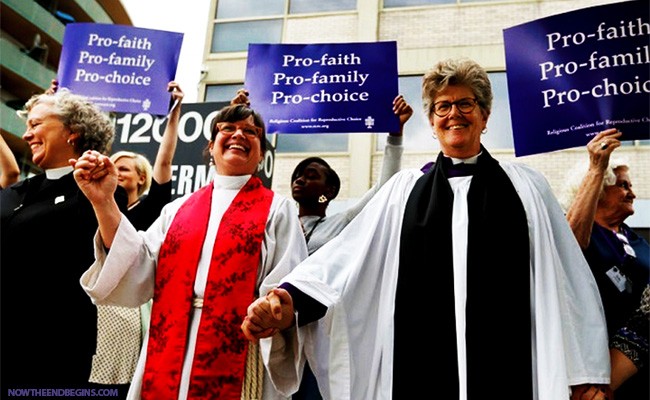
United Methodist women clergy declare support for abortion
United Methodist clergy declare their support for abortion

What does the Bible teach about women and marriage?

Consider Genesis 3:16:

16 To the woman he said,

“I will make your pains in childbearing very severe;
    with painful labor you will give birth to children.
Your desire will be for your husband,
    and he will rule over you.”

Is the woman’s her desire for her husband a romantic or sexual desire? It is not.

Famous evangelical theologian Dr. Wayne Grudem explains in his book “Biblical Foundations for Manhood and Womanhood”:

The word translated “desire” is an unusual Hebrew word, teshûqåh. What is the meaning of this word? In this context and in this construction, it probably implies an aggressive desire, perhaps a desire to conquer or rule over, or else an urge or impulse to oppose her husband, an impulse to act “against” him. This sense is seen in the only other occurrence of teshûqåh in all the books of Moses (Genesis, Exodus, Leviticus, Numbers, Deuteronomy), and the only other occurrence of teshûqåh plus the preposition ’el in the whole Bible. That occurrence of the word is in the very next chapter of Genesis, in 4:7. God says to Cain, “Sin is crouching at the door, and its desire is for you, but you must master it” ( NASB ). Here the sense is very clear. God pictures sin as a wild animal waiting outside Cain’s door, waiting to attack him, even to pounce on him and overpower him. In that sense, sin’s “desire” or “instinctive urge” is “against” him. 20

The striking thing about that sentence is what a remarkable parallel it is with Genesis 3:16. In the Hebrew text, six words are the same and are found in the same order in both verses. It is almost as if this other usage is put here by the author so that we would know how to understand the meaning of the term in Genesis 3:16. The expression in 4:7 has the sense, “desire, urge, impulse against” (or perhaps “desire to conquer, desire to rule over”). And that sense fits very well in Genesis 3:16 also. 21

(Quotation found on Dalrock’s blog)

How Christian feminists interpret the Bible

I urge you to listen to a presentation by Dr. Wayne Grudem at a meeting of the Evangelical Theological Society (ETS). He evaluates the claims of a Christian feminist named Catherine Kroeger.

Bottom line: not every church-attending woman who paints herself as a “spiritual” Christian (with words) takes the Bible seriously as an authority (in her actions).

Men: make sure you evaluate wife-candidates thoroughly, and make sure that they demonstrate the ability to do what the Bible says, especially when it goes against their feelings and desires. Never believe words about the future. Evaluate actions in the past. Your marriage must achieve something for God, and that means you must choose someone with proven character and ability, to help you execute your plan. That is why we evaluate women before proposing. Remember, after you marry her, you will be morally obligated to love her as Christ loved the church. Make sure you pick someone who is easy to love all the way.


What does the Bible say about capital punishment?

Let's take a look at what the Bible says
Let’s take a look at what the Bible says

Note: This post has a twin post which talks about the crime-preventing effect of capital punishment.

First, let’s take a look at what the Bible says in general about capital punishment, using this lecture featuring eminent theologian Wayne Grudem.

About Wayne Grudem:

Grudem holds a BA from Harvard University, a Master of Divinity from Westminster Theological Seminary, and a PhD from the University of Cambridge. In 2001, Grudem became Research Professor of Bible and Theology at Phoenix Seminary. Prior to that, he had taught for 20 years at Trinity Evangelical Divinity School, where he was chairman of the department of Biblical and Systematic Theology.

Grudem served on the committee overseeing the English Standard Version translation of the Bible, and in 1999 he was the president of the Evangelical Theological Society. He is a co-founder and past president of the Council on Biblical Manhood and Womanhood. He is the author of, among other books, Systematic Theology: An Introduction to Biblical Doctrine, which advocates a Calvinistic soteriology, the verbal plenary inspiration and inerrancy of the Bible, the body-soul dichotomy in the nature of man, and the complementarian (rather than egalitarian) view of gender equality.

The MP3 file is here.

A PDF sermon outline is here.

Topics:

  • what kinds of crimes might require CP?
  • what did God say to Noah about CP?
  • what does it mean that man is made in the image of God?
  • is CP just about taking revenge?
  • what does CP say about the value of human life?
  • does CP apply to animals, too?
  • could the statements supporting CP be understood as symbolic?
  • one purpose of CP is to protecting the public
  • another purpose of CP is to deter further wrongdoing
  • but the Biblical purpose of CP is to achieve justice by retribution
  • does the Pope make a good argument against CP?
  • what is the role of civil government in achieving retribution?
  • do people in Heaven who are sinless desire God to judge sinners?
  • should crimes involving property alone be subject to CP?
  • is the Mosaic law relevant for deciding which crimes are capital today?
  • should violent crimes where no one dies be subject to CP?
  • is CP widespread in the world? why or why not?
  • what are some objections to CP from the Bible?
  • how do you respond to those objections to CP?
  • should civil government also turn the other cheek for all crimes?
  • what is the “whole life ethic” and is it Biblical?
  • what do academic studies show about the deterrence effect of CP?
  • how often have innocent people been executed in the USA?
  • should there be a higher burden of proof for CP convictions?

You can find more talks by Wayne Grudem here.

Wayne Grudem explains what the Bible says about capital punishment

Bible study that hits the spot

Reformed Baptist theologian Wayne Grudem speaks on the Bible and capital punishment.

About Wayne Grudem:

Grudem holds a BA from Harvard University, a Master of Divinity from Westminster Theological Seminary, and a PhD from the University of Cambridge. In 2001, Grudem became Research Professor of Bible and Theology at Phoenix Seminary. Prior to that, he had taught for 20 years at Trinity Evangelical Divinity School, where he was chairman of the department of Biblical and Systematic Theology.

Grudem served on the committee overseeing the English Standard Version translation of the Bible, and in 1999 he was the president of the Evangelical Theological Society. He is a co-founder and past president of the Council on Biblical Manhood and Womanhood. He is the author of, among other books, Systematic Theology: An Introduction to Biblical Doctrine, which advocates a Calvinistic soteriology, the verbal plenary inspiration and inerrancy of the Bible, the body-soul dichotomy in the nature of man, and the complementarian (rather than egalitarian) view of gender equality.

The MP3 file is here.

The PDF outline is here.

Topics:

  • what kinds of crimes might require CP?
  • what did God say to Noah about CP?
  • what does it mean that man is made in the image of God?
  • is CP just about taking revenge?
  • what does CP say about the value of human life?
  • does CP apply to animals, too?
  • could the statements supporting CP be understood as symbolic?
  • one purpose of CP is to protecting the public
  • another purpose of CP is to deter further wrongdoing
  • but the Biblical purpose of CP is to achieve justice by retribution
  • does the Pope make a good argument against CP?
  • what is the role of civil government in achieving retribution?
  • do people in Heaven who are sinless desire God to judge sinners?
  • should crimes involving property alone be subject to CP?
  • is the Mosaic law relevant for deciding which crimes are capital today?
  • should violent crimes where no one dies be subject to CP?
  • is CP widespread in the world? why or why not?
  • what are some objections to CP from the Bible?
  • how do you respond to those objections to CP?
  • should civil government also turn the other cheek for all crimes?
  • what is the “whole life ethic” and is it Biblical?
  • what do academic studies show about the deterrence effect of CP?
  • how often have innocent people been executed in the USA?
  • should there be a higher burden of proof for CP convictions?

The Bible is awesome because it gives us knowledge about God’s character. How are we supposed to act in a way that is pleasing to God if we don’t know what he thinks of the issues of the day? We won’t know how we are supposed to act unless we know who God is first. And that’s why when we read the Bible we should be looking to find out the truth about who God is.