Tag Archives: Waiting

How well is Canada’s “Medicare for All” health care working for patients?

Wait times in weeks (Source: Maclean's magazine)
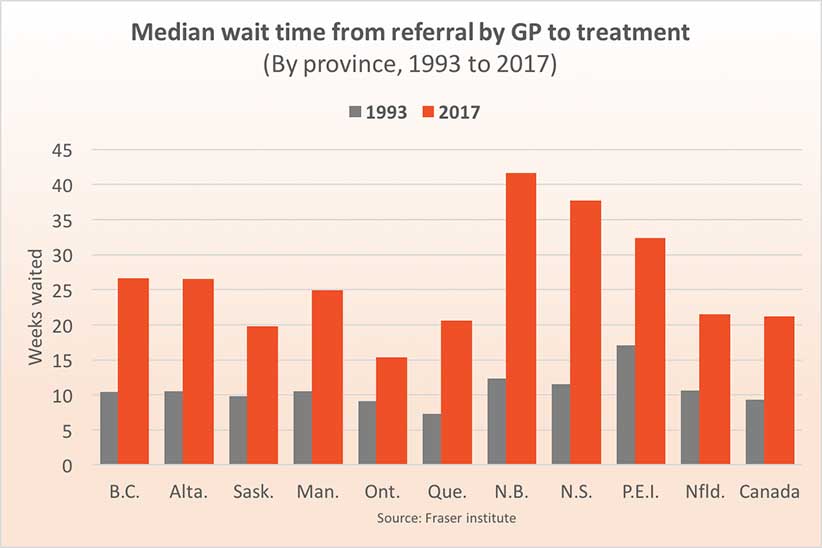
Wait times for health care treatment in Canada (Source: Fraser institute)

I get into conversations about politics with my co-workers about who they like in the 2020 election. And I also ask them which particular policies of the candidates they like best. The one they like most is Medicare for All, with “for All” including illegal immigrants. When I ask them which country has got Medicare for All working, they say “Canada”. Let’s take a look at Canada’s health care system.

Here’s a nice article from Mona Charen, posted in TownHall.

She writes:

It’s true that all Canadian citizens and legal residents (though not immigrants there illegally) get “free” health care, but only in the sense that you don’t get a bill after seeing a doctor or visiting a hospital. Medical care is subsidized by taxes, but the price comes in another form as well — rationing. A 2018 report from the Fraser Institute, a Canadian think tank, found that wait times between seeing a general practitioner and a specialist average 19.8 weeks. That’s the average. There are variations among specialties. Those hoping to see an orthopedist wait an average of 39 weeks in Nova Scotia, while those seeking an oncologist wait about 3.8 weeks.

[…]Imagine the anxiety of learning that you need an MRI to find out whether the mass in your breast is anything to worry about and then being told that the next available appointment is in 10 weeks. In addition to the psychic price, Canadians who had to wait for treatment expended an average of $1,822 out of pocket last year, due to lost wages and other costs. The Fraser Institute also calculated the value of the lost productivity of those waiting for treatment — nearly $5,600 per patient, totaling $5.8 billion nationally.

[…]When there’s an artificial shortage of a good or service, a black market usually follows. I have heard from several Canadians that paying doctors bribes to jump the line is not uncommon. But Canada has another pressure reliever: Ninety percent of Canadians live within 90 miles of the U.S. border, and medical centers in Buffalo, Chicago, Rochester and elsewhere receive tens of thousands of Canadian patients every year.

Regarding that last point, I’ve written many times about socialist politicians in Canada electing to travel to the United States for care, and that’s because (as you might expect) health care outcomes for Canadians are vastly inferior to health care outcomes for Americans. And keep in mind that the delay from specialist to GP does not take into account the delay to see the GP, or the delay from seeing the specialist to actually getting treatment.

And how much are Canadians spending for the privilege of waiting 19.8 weeks to see a specialist? Well, the average cost of Canadian health care is about $13,000 per household per year, paid through taxes. What that means is that people who work pay for all the health care being provided, including the health care for people who don’t work. But when it’s time to get treatment, those who pay the bills get in line behind those who don’t pay anything.

So how good is American health care? Maybe Canadians are waiting in line because their health care is so much better than ours.

American health care

One of the best health care policy experts writing today is Avik Roy, who writes for Forbes magazine.

Here is a recent column, which I think is useful for helping us all get better at debating health care policy.

Excerpt:

If you really want to measure health outcomes, the best way to do it is at the point of medical intervention. If you have a heart attack, how long do you live in the U.S. vs. another country? If you’re diagnosed with breast cancer? In 2008, a group of investigators conducted a worldwide study of cancer survival rates, called CONCORD. They looked at 5-year survival rates for breast cancer, colon and rectal cancer, and prostate cancer. I compiled their data for the U.S., Canada, Australia, Japan, and western Europe. Guess who came out number one?

The United States came out number one, and you can click here to see the larger graph of the complete results.

Some people like to point out that the United States has a low life expectancy, but there’s a problem with those numbers.

The article continues:

Another point worth making is that people die for other reasons than health. For example, people die because of car accidents and violent crime. A few years back, Robert Ohsfeldt of Texas A&M and John Schneider of the University of Iowa asked the obvious question: what happens if you remove deaths from fatal injuries from the life expectancy tables? Among the 29 members of the OECD, the U.S. vaults from 19th place to…you guessed it…first. Japan, on the same adjustment, drops from first to ninth.

It’s great that the Japanese eat more sushi than we do, and that they settle their arguments more peaceably. But these things don’t have anything to do with socialized medicine.

Finally, U.S. life-expectancy statistics are skewed by the fact that the U.S. doesn’t have one health-care system, but three: Medicaid, Medicare, and private insurance. (A fourth, the Obamacare exchanges, is supposed to go into effect in 2014.) As I have noted in the past, health outcomes for those on government-sponsored insurance are worse than for those on private insurance.

To my knowledge, no one has attempted to segregate U.S. life-expectancy figures by insurance status. But based on the data we have, it’s highly likely that those on private insurance have the best life expectancy, with Medicare patients in the middle, and the uninsured and Medicaid at the bottom.

If we’re going to discuss health care, then let’s discuss facts. We shouldn’t be picking a health care system from the campaign speeches of politicians who tell us that we can keep our doctor, and keep our health plan, and our premiums will go down. We tried electing a charismatic deceiver in 2008, and it didn’t work out. We lost our doctors, lost our health plans, and our premiums went up astronomically. We can do better than single-payer health care. We can do better than socialism.

Are French parents superior to American parents?

From the Wall Street Journal, a shocking story.

Excerpt:

Rest assured, I certainly don’t suffer from a pro-France bias. Au contraire, I’m not even sure that I like living here. I certainly don’t want my kids growing up to become sniffy Parisians.

But for all its problems, France is the perfect foil for the current problems in American parenting. Middle-class French parents (I didn’t follow the very rich or poor) have values that look familiar to me. They are zealous about talking to their kids, showing them nature and reading them lots of books. They take them to tennis lessons, painting classes and interactive science museums.

Yet the French have managed to be involved with their families without becoming obsessive. They assume that even good parents aren’t at the constant service of their children, and that there is no need to feel guilty about this. “For me, the evenings are for the parents,” one Parisian mother told me. “My daughter can be with us if she wants, but it’s adult time.” French parents want their kids to be stimulated, but not all the time. While some American toddlers are getting Mandarin tutors and preliteracy training, French kids are—by design—toddling around by themselves.

And:

Authority is one of the most impressive parts of French parenting—and perhaps the toughest one to master. Many French parents I meet have an easy, calm authority with their children that I can only envy. Their kids actually listen to them. French children aren’t constantly dashing off, talking back, or engaging in prolonged negotiations.

One Sunday morning at the park, my neighbor Frédérique witnessed me trying to cope with my son Leo, who was then 2 years old. Leo did everything quickly, and when I went to the park with him, I was in constant motion, too. He seemed to regard the gates around play areas as merely an invitation to exit.

Frédérique had recently adopted a beautiful redheaded 3-year-old from a Russian orphanage. At the time of our outing, she had been a mother for all of three months. Yet just by virtue of being French, she already had a whole different vision of authority than I did—what was possible and pas possible.

Frédérique and I were sitting at the perimeter of the sandbox, trying to talk. But Leo kept dashing outside the gate surrounding the sandbox. Each time, I got up to chase him, scold him, and drag him back while he screamed. At first, Frédérique watched this little ritual in silence. Then, without any condescension, she said that if I was running after Leo all the time, we wouldn’t be able to indulge in the small pleasure of sitting and chatting for a few minutes.

“That’s true,” I said. “But what can I do?” Frédérique said I should be sterner with Leo. In my mind, spending the afternoon chasing Leo was inevitable. In her mind, it was pas possible.

I pointed out that I’d been scolding Leo for the last 20 minutes. Frédérique smiled. She said that I needed to make my “no” stronger and to really believe in it. The next time Leo tried to run outside the gate, I said “no” more sharply than usual. He left anyway. I followed and dragged him back. “You see?” I said. “It’s not possible.”

Frédérique smiled again and told me not to shout but rather to speak with more conviction. I was scared that I would terrify him. “Don’t worry,” Frederique said, urging me on.

Leo didn’t listen the next time either. But I gradually felt my “nos” coming from a more convincing place. They weren’t louder, but they were more self-assured. By the fourth try, when I was finally brimming with conviction, Leo approached the gate but—miraculously—didn’t open it. He looked back and eyed me warily. I widened my eyes and tried to look disapproving.

After about 10 minutes, Leo stopped trying to leave altogether. He seemed to forget about the gate and just played in the sandbox with the other kids. Soon Frédérique and I were chatting, with our legs stretched out in front of us. I was shocked that Leo suddenly viewed me as an authority figure.

“See that,” Frédérique said, not gloating. “It was your tone of voice.” She pointed out that Leo didn’t appear to be traumatized. For the moment—and possibly for the first time ever—he actually seemed like a French child.

There’s a young woman I was very impressed by and I was spending some time with her last year. One day she and I were over at a friend’s house and they have 3 kids. The lady was paying attention to the eldest boy – smiling and being gentle. He decided to start wielding a bean bag around and there was a danger of knocking things over. The lady leaned forward and said to the boy “NO” sternly. He sat there staring at her for a few seconds defiantly, and all conversation in the room stopped. He was trying to decide if she was in a position to command him, and if she was serious about her command. She kept looking sternly at him, right in the eyes. He never looked at his parents. Then he put the bean bag down, and his parents laughed. They were delighted. And so was I – with her. It was such a joy her to see how she paid attention to the boy and set boundaries on him – and he listened to her.

Women gives birth after NHS nurses send her home from hospital

From the UK Telegraph. (H/T Secondhand Smoke via ECM)

Excerpt:

It was a bitterly cold night in January when Geraldine Weller gave birth in the car park of a London hospital. Three hours earlier, the maternity unit had sent her away. Midwives who said they were short-staffed had confidently told her that it would be “ages yet” before she went into labour. They maintained that view even as her husband made frantic phone calls, reporting from their Surrey home that the baby’s head could now be seen.

In desperation, the couple ignored advice to stay put and drove back to the hospital. With her husband shouting into the security cameras of the maternity unit for help, Mrs Weller stepped from the passenger seat. As she did so, she gave birth to their first child, catching the newborn in one leg of her pyjamas.

She says: “We just huddled together. My husband came back and wrapped Henry in a bath towel, and finally one of the nurses came out and said: ‘What’s this?’ ”

[…]Last month, a survey of 25,000 women who had children in England last winter found that more than one in five was left alone during childbirth at a point when it worried them.

The rest of the article features eyewitness comments from midwives working within the system. Naturally, no real names were used because the NHS sanctions anyone who speaks out against their government-run health care system. The same kind of government-run health care that the Democrats want in this country.

Related posts