Tag Archives: Vouchers

Louisiana governor Bobby Jindal delivers effective education reform

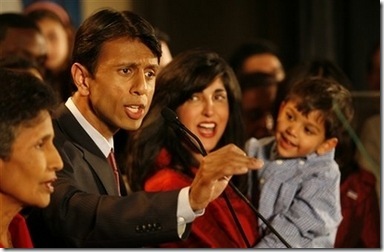
Bobby and Supriya Jindal

Looks like Republican governor Bobby Jindal made it into the Wall Street Journal.

Excerpt:

Governors of both parties have promoted education reform, but so far no one has delivered more than Louisiana’s Bobby Jindal. This week he’ll sign two bills that offer a national model for competition and parental choice.

Louisiana’s new laws will essentially give all parents an average of $8,500 to use for their child’s education as they see fit. They can keep their child in their local public school, but they can also try to get Johnny into a more demanding charter school, or a virtual school, or into special language or career-training courses, among other options.

Nearly 400,000 low-income children—a bit more than half of all students—will also be eligible for vouchers to attend private schools. State officials estimate that about 2,000 students will use vouchers this September given private-school capacity limits, but that tens of thousands will do so over time.

Louisiana is also making life easier for charter schools, with new authorizing boards, a fast-track for high-performing networks, and access to facilities equal to that of traditional public schools. The new laws seek to strengthen superintendents and principals over local school boards, which are bastions of bureaucratic and union intransigence.

Nearly as dramatic are reforms in teacher tenure. To earn tenure, teachers will now have to rate in the top 10% (measured in part by student performance) for five of six consecutive years, and any teacher who falls into the bottom 10% loses tenure. No teacher in the bottom 10% can get a raise, while layoffs will no longer hit the junior-most teachers first while ignoring performance.

Mr. Jindal made school reform a second-term priority after winning a landslide re-election last November. By then he had appointed or helped elect reformers to the state superintendent’s office and board of education.

Louisiana voters also had a preview of reform’s potential. Since Hurricane Katrina in 2005, New Orleans schools have become almost exclusively charters—with dramatic academic improvements—and the city has run a small and oversubscribed voucher program since 2008. As for tenure, the reforms attach consequences to a teacher-evaluation system enacted in 2010.

The result: the reforms attracted bipartisan legislative majorities of roughly 60%. Over four votes (two different bills, each having to pass the House and Senate), one-quarter to one-half of Democrats voted for reform, including many black representatives, especially those from New Orleans.

Teachers unions were predictably opposed and even heavier-handed than usual. Michael Walker Jones of the Louisiana Association of Educators dismissed choice on grounds that “If I’m a parent in poverty I have no clue because I’m trying to struggle and live day to day.” Unions pushed principals to cancel school—sometimes giving parents less than 24 hours notice—so teachers could protest at the state Capitol. It was a tired act.

Mr. Jindal joins Indiana’s Mitch Daniels in passing the most far-reaching school reforms, and now they’ll have to follow through to produce better student outcomes. Unions will seize on any troubles as a sign of failure, but success might catalyze similar reforms across the country that could finally improve the life prospects for all American children.

Now is a good time to compare and contrast those reforms with the record of the Obama administration:

The Democrats worked with the teacher unions to kill voucher programs for the poorest students in Washington DC, many of them minority students.

Excerpt:

“House and Senate Appropriators this week ignored the wishes of D.C.’s mayor, D.C.’s public schools chancellor, a majority of D.C.’s city council, and more than 70 percent of D.C. residents and have mandated the slow death of the D.C. Opportunity Scholarship Program. This successful school voucher program–for D.C.’s poorest families–has allowed more than 3,300 children to attend the best schools they have ever known.

The decision to end the program, a decision buried in a thousand-page spending bill and announced right before the holidays, destroys the hopes and dreams of thousands of D.C. families. Parents and children have rallied countless times over the past year in support of reauthorization and in favor of strengthening the OSP.

Yet, despite the clearly positive results and the proven success of this program, Sen. Dick Durbin, Rep. Jose Serrano, Del. Eleanor Holmes Norton, and Secretary Arne Duncan worked together to kill the OSP. Funding the program only for existing children shrinks the program each year, compromises the federal evaluation of the program, denies entry to the siblings of existing participants, and punishes those children waiting in line by sentencing them to failing and often unsafe schools.

What is incredibly disappointing to low-income families in Washington, D.C. has been the silence of President Barack Obama. The President, who benefited from K-12 scholarships himself, worked on behalf of low-income families in Chicago, and exercises school choice as a parent, has stood silently on the sidelines while his Secretary of Education belittled the importance of helping such a small number of children in the nation’s capital.”

Another Wall Street Journal article explains why voucher programs work for children. They don’t work for teacher unions, and that’s why Democrats oppose them.

Excerpt:

In a study published last year, Patrick Wolf of the University of Arkansas found that voucher recipients had graduation rates of 91%. That’s significantly higher than the D.C. public school average (56%) and the graduation rate for students who applied for a D.C. voucher but didn’t win the lottery (70%). In testimony before a Senate subcommittee in February, Mr. Wolf said that “we can be more than 99% confident that access to school choice through the Opportunity Scholarship Program, and not mere statistical noise, was the reason why OSP students graduated at these higher rates.”

The administration downplays these findings. But the students who attend D.C. public schools are overwhelmingly black and poor, and the achievement gap has a particularly devastating impact on their communities. High school dropouts are eight times more likely than someone with a diploma to wind up behind bars. Some 60% of black male high school dropouts in their 30s have prison records. And nearly one in four young black male dropouts is in jail or juvenile detention.

Mr. Obama says he wants to help all students—not just the lucky few who receive vouchers. But that’s an argument for offering more vouchers to those in need, not for reducing school choice. Policies ought to be weighed against available alternatives, not some unattainable ideal. The alternative to a voucher for families in D.C. ghettos and elsewhere is too often a substandard public school.

The positive effects of the D.C. voucher program are not unique. A recent study of Milwaukee’s older and larger voucher program found that 94% of students who stayed in the program throughout high school graduated, versus just 75% of students in Milwaukee’s traditional public schools. And contrary to the claim that vouchers hurt public schools, the report found that students at Milwaukee public schools “are performing at somewhat higher levels as a result of competitive pressure from the school voucher program.” Thus can vouchers benefit even the children that don’t receive them.

Research gathered by Greg Forster of the Foundation for Educational Choice also calls into question the White House assertion that vouchers are ineffective. In a paper released in March, he says that “every empirical study ever conducted in Milwaukee, Florida, Ohio, Texas, Maine and Vermont finds that voucher programs in those places improved public schools.” Mr. Forster surveyed 10 empirical studies that use “random assignment, the gold standard of social science,” to assure that the groups being compared are as similar as possible. “Nine [of the 10] studies find that vouchers improve student outcomes, six that all students benefit and three that some benefit and some are not affected,” he writes. “One study finds no visible impact. None of these studies finds a negative impact.”

Such results might influence the thinking of an objective observer primarily interested in doing right by the nation’s poor children. But they are unlikely to sway a politician focused on getting re-elected with the help of teachers unions.

There is a difference between Demcorats and Republicans, and the difference is that Republicans think that children do better when their parents can choose a school that works for their child. Republicans are the evidence-based party – they do what’s right. But Democrats do whatever it takes to please their special interest groups.
Louisiana governor Bobby Jindal unveils education reform plan

Here are the details on Bobby Jindal’s new education plan, from New Orleans Online Access.

Excerpt:

 Gov. Bobby Jindal on Tuesday outlined a far-reaching set of proposals aimed at improving education in Louisiana, including a state-wide voucher program for low-income students, an expansion of autonomous charter schools and steps to link a teachers’ classroom performance to their job protections and their compensation. The governor has been promising for months now to make education reform the centerpiece of his second-term agenda.

[…]The voucher program may prove the most controversial aspect of the plan. Jindal is proposing to help pay tuition at private and parochial schools for any child of a low-income family who attends a school that receives a letter grade of C, D or F.

More than 70 percent of Louisiana’s public schools would fall into that category, opening up districts across the state to competition for public funding from private institutions. Parents who opt out of those public schools would be able to take the public funding set aside for their child with them to pay for tuition.

Voucher opponents argue that offering private school tuition siphons money away from public education, but the governor is framing the idea as a way to put decision-making in the hands of parents.

Also toward that end, Jindal is proposing to fast-track the approval of new charter schools for proven charter operators. Charters are publicly funded but privately managed and typically overseen by nonprofit boards. They compete with traditional public schools in their area for students.

Jindal is also proposing to end regular annual pay increases for teachers based on years in the classroom, ban the use of seniority in all personnel decisions and weaken the power that local school boards have in hiring and firing decisions in favor of superintendents.

Teachers coming into the classroom for the first time would also see major changes under Jindal’s plan: districts would have greater flexibility to establish their own pay scales for new teachers and tenure would be set aside only for those who earn high ratings on evaluations five years in a row.

I thought it might be helpful to also post this quick introduction to the issue of school choice, from the Cato Institute.

I don’t agree with the Cato Institute on everything, but they’re right on this issue. The Heritage Foundation also has 3 small videos explaining school choice – with cartoons!

There’s an even longer video narrated by John Stossel that you can watch, that really explains the why school reform matters – and why it’s a conservative issue. Like the sex-selection abortion issue that I blogged about here before, this is an issue that conservatives need to seize on. Here, we can really let our compassionate side show by helping the poorest students, especially those in visible minorities, who simply cannot get a quality education in a public school monopoly that is not responsive to the needs of parents, or their children. This is an issue where we can win – the only losers are the educational bureaucrats and the teacher unions. But the kids are more important.

A closer look at Michele Bachmann’s record on fiscal policy

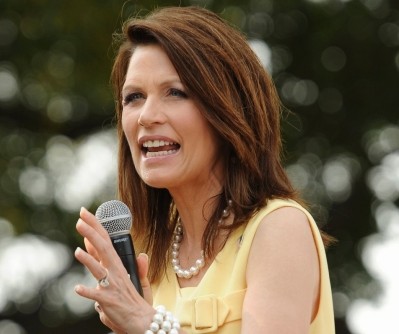
Michele Bachmann: On the Issues

An analysis of Michele Bachmann’s record on economic policy, courtesy of the Club for Growth.

Summary:

Congresswoman Michele Bachmann was first elected to Congress in 2006 after serving in the Minnesota State Senate from 2001 to 2006. If elected President, she would be the first woman President and the second person elected directly from the U.S. House of Representatives since James Garfield. Congresswoman Bachmann received a 100% score in the Club for Growth’s 2010 scorecard and has a lifetime score of 94%. The average house Republican score from 2007-2010 was 78%. Congresswoman Bachmann also has a lifetime score of 94% from the Minnesota Taxpayers League during the time she served in the State Senate. The average score for Republican State Senators during that time was 76%.

These guys do the most thorough job of anyone vetting the candidates – they go over every bill, every speech, every vote, every editorial – even campaign advertisements.

The report covers the following areas:

  • TAXES
  • SPENDING
  • ENTITLEMENT REFORM
  • REGULATION
  • FREE TRADE
  • SCHOOL CHOICE
  • TORT REFORM
  • POLITICAL FREE SPEECH
  • POLITICAL ACTIVITY & ENDORSEMENTS

Excerpt:

SCHOOL CHOICE
The Club for Growth supports broad school choice, including charter schools and voucher programs that create a competitive education market including public, private, religious, and non-religious schools.  More competition in education will lead to higher quality and lower costs.
Congresswoman Bachmann not only has a strong record on school choice, she is the first major presidential candidate to actually found a charter school. In fact, Congresswoman Bachmann co-founded the first K-12 charter school in the nation, New Heights Charter School back in 1993.  Her record on school choice has, predictably, been flawless since then.
In 2011, Bachmann voted to re-establish the DC school voucher program.  As a member of the State Senate, Bachmann voted to prohibit teacher strikes during the school year.  She also voted to allow parents to use education tax credits for tuition at private schools.  She’s introduced legislation to make foster children eligible for education vouchers.
As far back as 2003, Bachmann was fighting the No Child Left Behind Act, filing a bill in the Minnesota legislature that would have prohibited the Dept. of Children, Families and Learning or any other state agency “from entering into a contract or other agreement under the provisions of the No Child Left Behind Act of 2001, unless the financial consequences to the state and each school district have been identified.”  Another bill, S.F. 1921, “requires all state plans, agreements and contracts associated with NCLB compliance to be nullified and revoked on June 1, 2004, unless the Legislature specifically affirms implementation of the federal law by that date.”

Conclusion:

With very few exceptions, Congresswoman Bachmann has supported pro-growth policies throughout her career. She especially deserves praise for her consistent defense of school choice. After reviewing her record, we are confident that Congresswoman Bachmann would be a pro-growth President.

For my social conservative friends: please print out the paper and read it. These guys are not indifferent to your concerns at all.

Pat Toomey and the Club for Growth

The past director of the Club for Growth is current Pennsylvania senator Pat Toomey.

Here’s a blurb from his web site:

Pat is pro-life and believes that children should be welcomed into the world and protected by its laws.

While reasonable people may differ on the question of abortion rights, we should all be able to agree on policies that encourage adoption over abortion, that avoid taxpayer funding of abortions, and that allow parental involvement in decisions that involve minors. As a senator, Pat will support policies that further these important goals.

Pat also believes the tradition of marriage is sacred and is best defined as between a man and a woman. As a congressman, Pat voted to protect the institution of marriage in many ways. For example, Pat voted to reduce the tax penalty on married couples and will support similar policies as a U.S. senator. Throughout his time in Congress, Pat voted for legislation to protect innocent life, strengthen marriage, and protect the traditional values upon which this country was founded.

His voting record on abortion:

  • Voted YES on making it a crime to harm a fetus during another crime. (Feb 2004)
  • Voted YES on banning partial-birth abortion except to save mother’s life. (Oct 2003)
  • Voted YES on forbidding human cloning for reproduction & medical research. (Feb 2003)
  • Voted YES on funding for health providers who don’t provide abortion info. (Sep 2002)
  • Voted YES on banning human cloning, including medical research. (Jul 2001)
  • Voted YES on banning Family Planning funding in US aid abroad. (May 2001)
  • Voted YES on federal crime to harm fetus while committing other crimes. (Apr 2001)
  • Voted YES on banning partial-birth abortions. (Apr 2000)
  • Voted YES on barring transporting minors to get an abortion. (Jun 1999)
  • Rated 0% by NARAL, indicating a pro-life voting record. (Dec 2003)

And on marriage:

  • Voted YES on establishing nationwide AMBER alert system for missing kids. (Apr 2003)
  • Voted YES on reducing Marriage Tax by $399B over 10 years. (Mar 2001)
  • Rated 100% by the Christian Coalition: a pro-family voting record. (Dec 2003)

This is the record of the former leader of the most fiscally conservative PAC. The most pro-business group. The most anti-spending group.

Fiscal conservatives are more socially conservative than you think. If you are a social conservative, but not a fiscal conservative, then you should print out the paper on Michele Bachmann, a radical social conservative, and see how these fiscal conservatives at the Club for Growth judge what counts as fiscally conservative. It might be the case that fiscally conservative positions actually dovetail nicely with socially conservative positions. I think they do.

Campaign speeches, interviews and debates

Speeches:

Reactions from her recent debate performance:

Profiles of Michele Bachmann:

Michele Bachmann on television news

Let Americans spend their own money

Time to prioritize spending

Obama’s plan is to raise your taxes

Michele Bachmann in the legislature

Against socialism:

For economic growth:

Against ACORN funding: