
Tag Archives: Victimhood

New study: children who grow up with single parents more likely to see domestic violence

Domestic violence least likely in married homes

This is from Family Studies. (H/T Brad Wilcox)

Excerpt:

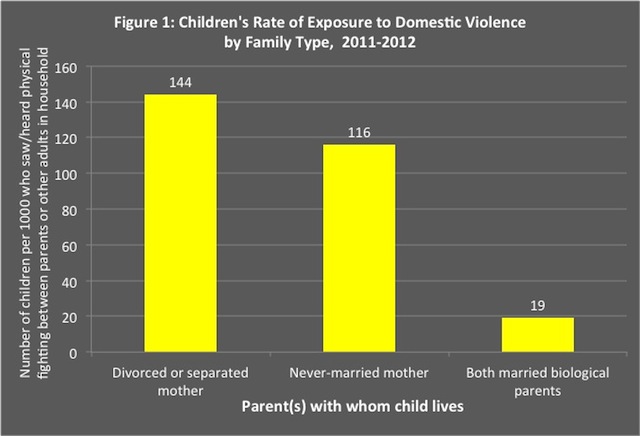
In the 2011-2012 National Survey of Children’s Health, conducted by the U.S. National Center for Health Statistics, parents of 95,677 children aged 17 and under were asked whether their child had ever seen or heard “any parents, guardians, or any other adults in the home slap, hit, kick, punch, or beat each other up.” Among children living with both married biological parents, the rate of exposure to family violence was relatively low: for every 1,000 children in intact families, 19 had witnessed one or more violent struggles between parents or other household members. By comparison, among children living with a divorced or separated mother, the rate of witnessing domestic violence was seven times higher: 144 children per 1,000 had had one or more such experiences. (See Figure 1.) These comparisons are adjusted for differences across groups in the age, sex, and race/ethnicity of the child, family income and poverty status, and the parent’s education level.

One might suppose that women who had never married would be less likely to get into violent arguments with the fathers of their children than separated or divorced mothers. Yet the rate of witnessing domestic violence among children living with never-married mothers was also elevated. It was 116 per 1,000, six times higher than the rate for children in intact families. (Some of these fights involved subsequent partners or boyfriends of the mother, rather than the father of the child.) Even children living with both biological parents who were cohabiting—rather than married—had more than double the risk of domestic violence exposure as those with married birth parents: 45 out of 1,000 of these children had witnessed family fights that became physical. Note also that a child’s family structure was a better predictor of witnessing family violence than was her parents’ education, family income, poverty status, or race.

Experiencing family violence is stressful for children, undercuts their respect and admiration for parents who engage in abusive behavior, and is associated with increased rates of emotional and behavioral problems at home and in school. For example, among children of never-married mothers who had witnessed family violence, 58 percent had conduct or academic problems at school requiring parental contact. The rate of school behavior problems for those who had not been exposed to family fights was significantly lower, though still fairly high (36 percent). Likewise, among children of divorced or separated mothers, nearly half of those exposed to family violence—48 percent—had had conduct or academic problems at school. Even among the small number of children in intact families who had witnessed family violence, just over half—51 percent—presented problems at school. This was twice the rate of school problems among students from intact families who had not witnessed domestic violence. (See Figure 2.) These figures are also adjusted for differences across groups in age, sex, and race/ethnicity of children, family income and poverty, and parent education levels. Children experiencing domestic violence were also more likely to have repeated a grade in school and to have received psychological counseling for emotional or behavioral problems. This was true in intact as well as disrupted families.

A good book to read on this topic is Theodore Dalrymple’s “Life at the Bottom“, which offered this memorable anecdote about about how and why women choose men who abuse them.

Introduction:

The disastrous pattern of human relationships that exists in the underclass is also becoming common higher up the social scale. With increasing frequency I am consulted by nurses, who for the most part come from and were themselves traditionally members of (at least after Florence Nightingale) the respectable lower middle class, who have illegitimate children by men who first abuse and then abandon them. This abuse and later abandonment is usually all too predictable from the man’s previous history and character; but the nurses who have been treated in this way say they refrained from making a judgment about him because it is wrong to make judgments. But if they do not make a judgment about the man with whom they are going to live and by whom they are going to have a child, about what are they ever going to make a judgment?

“It just didn’t work out,” they say, the “it” in question being the relationship that they conceive of having an existence independent of the two people who form it, and that exerts an influence on their on their lives rather like an astral projection. Life is fate.

Chapter one:

All the more surprising is it to me, therefore, that the nurses perceive things differently. They do not see a man’s violence in his face, his gestures, his deportment, and his bodily adornments, even though they have the same experience of the patients as I. They hear the same stories, they see the same signs, but they do not make the same judgments. What’s more, they seem never to learn; for experience—like chance, in the famous dictum of Louis Pasteur—favors only the mind prepared. And when I guess at a glance that a man is an inveterate wife beater (I use the term “wife” loosely), they are appalled at the harshness of my judgment, even when it proves right once more.

This is not a matter of merely theoretical interest to the nurses, for many of them in their private lives have themselves been the compliant victims of violent men. For example, the lover of one of the senior nurses, an attractive and lively young woman, recently held her at gunpoint and threatened her with death, after having repeatedly blacked her eye during the previous months. I met him once when he came looking for her in the hospital: he was just the kind of ferocious young egotist to whom I would give a wide berth in the broadest daylight.

Why are the nurses so reluctant to come to the most inescapable of conclusions? Their training tells them, quite rightly, that it is their duty to care for everyone without regard for personal merit or deserts; but for them, there is no difference between suspending judgment for certain restricted purposes and making no judgment at all in any circumstances whatsoever. It is as if they were more afraid of passing an adverse verdict on someone than of getting a punch in the face—a likely enough consequence, incidentally, of their failure of discernment. Since it is scarcely possible to recognize a wife beater without inwardly condemning him, it is safer not to recognize him as one in the first place.

This failure of recognition is almost universal among my violently abused women patients, but its function for them is somewhat different from what it is for the nurses. The nurses need to retain a certain positive regard for their patients in order to do their job. But for the abused women, the failure to perceive in advance the violence of their chosen men serves to absolve them of all responsibility for whatever happens thereafter, allowing them to think of themselves as victims alone rather than the victims and accomplices they are. Moreover, it licenses them to obey their impulses and whims, allowing them to suppose that sexual attractiveness is the measure of all things and that prudence in the selection of a male companion is neither possible nor desirable.

Often, their imprudence would be laughable, were it not tragic: many times in my ward I’ve watched liaisons form between an abused female patient and an abusing male patient within half an hour of their striking up an acquaintance. By now, I can often predict the formation of such a liaison—and predict that it will as certainly end in violence as that the sun will rise tomorrow.

At first, of course, my female patients deny that the violence of their men was foreseeable. But when I ask them whether they think I would have recognized it in advance, the great majority—nine out of ten—reply, yes, of course. And when asked how they think I would have done so, they enumerate precisely the factors that would have led me to that conclusion. So their blindness is willful.

The blindness is wilful, because the emotions cannot be corrected by evidence. And everything in the culture affirms women in this craziness, even after they fail over and over again with men – cohabitating with the bad ones for years, and then turning away from the good ones. They freely choose the wrong men, and freely pass by the good ones. And almost no one tells them that it’s entirely their fault. Everyone just tells them “follow your heart”. This emotional craziness causes harm to innocent children, and it needs to stop. We have to stop the man-blaming and hold women accountable for making decisions with their emotions and then expecting craziness to “work out”.

You can read the Dalrymple book online for free in this post.

Matt Walsh: women need to take responsibility for their failed relationships

The latest from Matt Walsh was sent to me by about a dozen people, so I must blog on it. He is responding to “Rebecca” who interpreted some of his previous “man up” posts as a license to blame men for everything that followed from her own poor decisions.

Excerpt:

[…]'[M]en’ aren’t the problem, Rebecca. It’s you. You’re the one. You’re the common denominator. You’re to blame. There has been one person conspicuously involved in all of Rebecca’s romantic flops, and her name is Rebecca. Maybe you should take a look at her for a change.

Frankly, it seems that when you refer to ‘men’ you aren’t even talking about a group of actual human beings. ‘Men’ have become an abstract idea, a conceptual manifestation of everything that’s wrong with your life. If men exist at all in your world, they exist only as vehicles for your misery.

Consider that, for ritual purification, the Ancient Syrians used to cast a goat out into the wastelands. The literal scapegoat was supposed to carry the sins of the town into the nether regions, where it and its spiritual luggage would die and decay. What you’ve done with men is just a more efficient, animal-friendly version of this strategy. You’ve saddled them with your personal baggage and sent them to the desert to perish. You’ve made a scapegoat of the entire gender.

Let’s borrow a recent example from your own life.

You went on a date with a man who, you claim, had no manners. Maybe that’s true, or maybe you’re so desperate to find fault in every male on the planet that he was fated to be labeled a boorish dolt no matter what he did or said. You also mention that he ‘couldn’t look you in the eyes and have a conversation.’ Maybe. Maybe he was nervous. Maybe he has social anxieties. Maybe he tried to talk to you but he sensed your stand-offish, snobbish demeanor and it made him uncomfortable. I don’t know. I wasn’t there. Maybe he wasn’t as bad as you say, or maybe he actually was a big, awkward, uncouth, stammering warthog. You seem to have come to latter conclusion very early on in the evening, yet you still chose to go back to his place.

What does that say about you, Rebecca? Look in the mirror and ask yourself what it says aboutyou that you came back to this man’s house even though you were apparently disgusted by him.

That’s a choice you made. You. Not him. You.

He continued to fumble and falter well into the night, committing the unconscionable sin of revealing himself to be a fan of the X-Men film franchise. The uncultured, lethargic lout only succeeded in finding more ways to repulse and offend you as time wore on, yet you were never put off enough to decline the invitation to stay over.

Here’s the thing, Rebecca: I was always told that if I want to attract a good woman, I have to be a good man. Admittedly, I managed to attract a good woman despite being a horribly flawed and sinful man, but there is still wisdom in this idea even if it doesn’t always hold true. The point is, you have to work on improving yourself if you want to end up with a man who is equally intent on improving himself.

Not all men are desperate, drooling oafs straight out of some cliched beer commercial. There are plenty of hardworking, engaging, dependable, morally upright men out there, but they won’t come knocking on your door just because you’ve announced that you’re a ‘woman who deserves it.’

Rebecca, you’re willing to essentially typecast a man because he plays with video games and watches superhero movies, but have you ever considered that you might be the victim of similar assumptions because you sleep with dudes you just met? Of course, ‘victim’ isn’t the right word. You’ve earned the assumptions. I’m not saying that you ought to be alone for the rest of your life, but I am pointing out that you are eager to jump to profound conclusions about a man based on the most superficial of flaws, without stopping to consider what conclusions might be drawn about you based on slightly more significant character traits.

Then again, this guy was willing to sleep with you on the first date just as you were with him. He’s not innocent in the transaction, and neither are you. It sounds like, right now, you two are evenly matched. You look at him and see yourself, and you hate him for it.

We hear all of the handwringing about the decline of masculinity and the disappearance of ‘real men,’ yet very little is ever said about the corresponding deterioration of femininity. It’s strange that you purport to care about ‘manners and chivalry’ yet your email was vulgar and overly aggressive, at times coming across like dialogue out of a middle school boys’ locker room.

‘P*ssy’? Really? A 32-year-old woman using a word like that to describe men while simultaneously complaining that men aren’t courteous? I bet the ones who are courteous just get written off as ‘p*ssies’ anyway, so it’s a lose-lose. A lose-lose for you, especially, because in the end you’re the only one who has to pay for your extremely unappealing attitude.

By your account, you’ve had two broken engagements, and both were the fault of the men who were allegedly ‘full of sh*t.’ Maybe they were. But it is, from a mathematical perspective, almost impossible for one human being to have two failed engagements without being at least partially to blame. In fact, in the history of human relationships, only a very, very, very tiny fraction of them have ever soured or splintered due completely to the actions and choices of one person. It’s been my experience, both personally and as a student of history and an observer of people (as creepy as that sounds), that fractured and strained relationships can rarely be broken down into a clear Bad Person vs Good Person dichotomy. And, on the rare occasion when things are actually that simple, it’s just as likely to be Bad Woman vs Good Guy as it is to be Bad Guy vs Good Woman.

In short, Rebecca, I’m playing the odds here and assuming that you were probably not the victim of both spoiled engagements, just as you are not the victim of your other fruitless romantic endeavors. You are a participant, a catalyst, a cause.

I have, in my life, seen my share of women who, under the influence of feminism, undertake incredibly unwise and selfish courses of action and then blame the predictable consequences on bad men. In fact, it seems to be very popular. Women make poor choices with men, they complain to other women about how they are victims. You can see it with problems like abortion, cohabitation, divorce, infertility, adultery – lots of cases where women choose bad men, and then blame men when things go wrong. I guess I would recommend that men carefully read Matt’s post and then be on the lookout for women who act selfishly, don’t choose good men, neglect the needs of good men, and then try to play the victim and blame men. Don’t be the guy who ends up married to a woman like that. I don’t think it’s an accident that this woman had premarital sexual experience, either.

UPDATE: I think this post dovetails nicely with my previous post about the one factor that most causes relationships to succeed or fail.

Eight ways that feminists are ruining America’s women

A list of feminist faults by the famous blogger Cassy Chesser (Fiano).

Here are the eight ways:

  1. Encouraging Promiscuity
  2. Sanctioning Victimhood
  3. Dabbling In Misandry
  4. Destroying Chivalry
  5. Attacking Motherhood
  6. Requiring A Feminist Litmus Test (for high-achieving women)
  7. Promoting Lies and Manipulation
  8. Glorifying Abortion

Number 4 is my favorite:

One of the easiest ways a man can show respect towards a woman is through chivalrous actions. Opening a door, pulling out a chair, giving up a seat for a lady… actions like these all show deference and respect for a woman. Being willing to protect a woman and put yourself at risk for her shows her value and worth. But for some reason, chivalry has come under attack. Men don’t practice chivalry anymore, to the disappointment of women everywhere.

Why not? Well, according to a poll taken of college men, it’s because of radical feminism. Chivalry has been dubbed sexist. There’s an attitude from women that they don’t need a man. Women act as if chivalrous actions are somehow disrespectful. So why should men continue to be chivalrous? Many, many women are completely unappreciative when men treat them like a lady. And, according to the femisogynists, things like holding doors open for women are totally sexist. Fascist feminists see chivalry as dated, sexist, and demeaning. It doesn’t matter that most women yearn for it deep down. They miss romance, they miss dating, and they miss being treated with respect and honor. How many times do women cry on the phone to their friends that they can’t find a man who treats them well? Killing chivalry has a lot to do with that. Women have been manipulated and conditioned to see chivalry as something antiquated and disrespectful, so they spurn it when they see it. They still crave it though. They’re wanting something better.

Chivalry gives a woman power, the very thing that femisogynists claim to be after. If a man is going out of his way to be chivalrous towards a women, it’s because he respects her, it’s because he sees value in her, and it’s because he wants to show that he is worthy of her. Chivalry is actually empowering to women, it elevates them, but it’s missing in our relationships today because fascist feminists destroyed it. It says a lot more about the worldview of the radical feminists than it does about the merits of chivalry.

WARNING! This post takes a very angry tone towards feminism. (Third-wave feminism)