Tag Archives: University

North Carolina passes bill to prohibit discrimination against religious and political groups

From Campus Reform.

Excerpt:

The North Carolina House passed a measure last week to prohibit university administrators from denying facilities, funding, or recognition to political or religious groups on the basis that they are exclusionary.

The bill came in response to Christian groups that have been stripped of their student organization status because they did not allow students with other beliefs to become leaders in their organization.

The bill, which has now been passed by both chambers of the North Carolina legislature, awaits Governor Pat McCrory’s (R) signature.

“Our society is engaged in an ongoing cultural battle,” said Rep. Bert Jones (R), the bill’s primary sponsor. “There is a war on God…Unfortunately these efforts have been extended to our campuses.”

[…]“We need to make clear that just because a student decides to attend our public schools and universities … that does not somehow mean that the student forfeits his rights to the university. This bill also recognizes that there is an important difference between education and indoctrination coercion,” Jones said.

The bill passed the North Carolina House of Representatives by a vote of 78-37 last Wednesday. All 37 votes against the bill were cast by Democrats.

Lest you think that universities are not really doing this to Christian and conservative clubs, here is an example.

From the radically leftist New York Times.

Excerpt:

For 40 years, evangelicals at Bowdoin College have gathered periodically to study the Bible together, to pray and to worship. They are a tiny minority on the liberal arts college campus, but they have been a part of the school’s community, gathering in the chapel, the dining center, the dorms.

After this summer, the Bowdoin Christian Fellowship will no longer be recognized by the college. Already, the college has disabled the electronic key cards of the group’s longtime volunteer advisers.

In a collision between religious freedom and antidiscrimination policies, the student group, and its advisers, have refused to agree to the college’s demand that any student, regardless of his or her religious beliefs, should be able to run for election as a leader of any group, including the Christian association.

Similar conflicts are playing out on a handful of campuses around the country, driven by the universities’ desire to rid their campuses of bias, particularly against gay men and lesbians, but also, in the eyes of evangelicals, fueled by a discomfort in academia with conservative forms of Christianity. The universities have been emboldened to regulate religious groups by a Supreme Court ruling in 2010 that found it was constitutional for a public law school in California to deny recognition to a Christian student group that excluded gays.

At Cal State, the nation’s largest university system with nearly 450,000 students on 23 campuses, the chancellor is preparing this summer to withdraw official recognition from evangelical groups that are refusing to pledge not to discriminate on the basis of religion in the selection of their leaders. And at Vanderbilt, more than a dozen groups, most of them evangelical but one of them Catholic, have already lost their official standing over the same issue; one Christian group balked after a university official asked the students to cut the words “personal commitment to Jesus Christ” from their list of qualifications for leadership.

[…]The consequences for evangelical groups that refuse to agree to the nondiscrimination policies, and therefore lose their official standing, vary by campus. The students can still meet informally on campus, but in most cases their groups lose access to student activity fee money as well as first claim to low-cost or free university spaces for meetings and worship; they also lose access to standard on-campus recruiting tools, such as activities fairs and bulletin boards, and may lose the right to use the universities’ names.

So if you agree with the secular and liberal elites, you can form a club. But if you disagree with them, you can’t. Either way, you pay them your money.

You may also find this column by conservative professor Mike Adams to be of interest. He replies to a concerned parent who wants to know how bad secularism and leftism really are on campus.
Advice for Christian parents from a woman who left Christianity at university

This is from the Beyond Teachable Moments blog – a great blog for Christian parents who want to raise effective, influential children.

Intro:

I recently had the opportunity to meet an intelligent young Christian woman who is proactively learning how to discuss her faith in a secular society.

Why is she so dedicated to doing this?  Because her Christian upbringing had completely failed to prepare her for the challenges of secularism, religious pluralism and atheism at university.

This young woman grew up in close-knit, loving Christian home.  She faithfully attended church.  She was enrolled in a Christian school that taught subjects such as apologetics, hermeneutics, inductive Bible study and managing relationships.  Her parents cared about her spiritual formation.

And yet, this is how she describes her university experience:

“Although I was still living at home during the beginning of my freshman year, university was traumatic at best. I went from a class of 15 in a small Christian school, to 30,000 people at a public university.

The most troubling thing was the amount of differing beliefs and worldviews I encountered, from professors and other students. At the time I thought they had much better arguments than I did for the validity of their views.”

Added to her challenge was the fact that her faith was borrowed, not her own.

“I can honestly and sadly say that as I started my freshman year at age 19, my faith was very much borrowed. It was a set of rules to adhere too. Although I was well aware of the concept of a relationship with Jesus Christ, I did not have it. I was entrenched in the notion of conforming to what people wanted me to do in order to escape condemnation and judgment.”

“My faith at the university was non-existent. If you asked me what I believed I would say Christian, but I did not back that up with any action whatsoever.”

As a mom of two young boys, the top-of-mind question I had for her was: what did she wish she’d known before she went to university?

The rest of the post is her response, but I wanted to quote this part, because it reminds me of what Pastor Matt Rawlings posted about his own loss of faith a while back.

The mysterious Christian woman says this:

Don’t use me to make you look good in front of other people at church, I can see straight through that. It does not feel good and drives me far away. What matters is what is going on inside, not what is projected. Looking perfect and going through the motions does nothing. The very basis for Christianity is what is going on in the heart. Only by letting Jesus work in your heart can actions follow with true authenticity.

And here’s what Pastor Matt said:

Looking back, I had a very fuzzy understanding of the Gospel.  I (and I think many people who call themselves Christians) are what theologians call “semi-Pelagians.”  I believed anyone could come to the altar but if they wanted to continue to be welcomed in the pews, they had to clean up their act and do so almost overnight.  The culture of Christianity at large appeared to me to be that if you came to faith and continued to struggle with lust, a foul mouth or whatnot then there was just something wrong with you.  I felt the church was more about behavior modification than grace.

I needed someone who I knew loved me to sit down with me long before all of these problems arose, look me in the eye and tell me how easy and how difficult it is to be a Christian.  I needed someone cared for me to unpack 2 Corinthians 5:21 and point out that by being “in Christ” I would be judged by Christ’s perfect life instead of my own.  I needed to know that the faith is not about “keeping the rules” but about doing things and not doing certain things to show my love and gratitude to God for what He did for me.  I needed to be able to read the Bible, especially the Old Testament, in a way that always pointed to Jesus Christ.  I needed to understand that God has graciously given us the spiritual disciplines of fasting, prayer, serving the poor, worship, etc. to help me grow.  I needed to hear that all Christians struggle with sin and will, to a certain degree, until they go to be with the Lord or He returns to be with us.

I needed good theology, good spiritual practices, good apologetics and good relationships.  I needed  knowledge and it needed to come from someone who I knew loved me even though I was thoroughly unlovable.  You can’t just leave this to the church staff because they do not have to time to meet with everyone and people with a chip on their shoulder about the church (like I had) feel like they are just doing it as part of their job.  All young people in the church, especially the “troubled kids” need this.  It is a lot of work but anyone’s eternity is worth it, isn’t it?

As J.P. Moreland has pointed out, your beliefs are not something that you form by sheer acts of will. You cannot will to believe things. Your beliefs form naturally through study, and then outward actions come from those beliefs. You cannot focus on the outward actions of your children – you have to focus on the beliefs inside. And know that those beliefs are not formed by habit, singing, church attendance or any other non-cognitive approaches. Beliefs form through a careful study of the evidence on BOTH SIDES. The first thing that Christian parents should be showing their kids is debates with both sides represented. That shows them that there is more to a worldview than just being bullied into it by raising your voice at them.

Christian parents, take note. Don’t be focused on making your child behave nicely on the outside and making it impossible for them to talk about temptations and doubts.  Christianity comes from the inside – from the mind. You need to be helping them form a worldview that has been tested and approved by them, before they ever set foot on a university campus. The Christian faith is not adopted by habit or tradition, it is adopted by transferring knowledge and discussing opposing views openly and honestly.

Don’t be like this mother who is only focused on externals – what family and friends think of her:

The good news is that atheism is not generally adopted because of logic or evidence. That means that a little bit evidence for God’s existence goes a long way against no evidence. A little bit evidence for the reliability of the Bible goes a long way against no evidence. A little bit of the minimal facts case for the resurrection of Jesus goes a long way against no evidence. It’s very important that when your children get to university that they find a conflict between some evidence and no evidence. At that point, it becomes their choice to decide what to do, and it could go either way. You don’t have to make them William Lane Craig before they get to university, for example. But they should have at least read his popular-level essays and books, heard his podcasts, and seen him debate.

Peer pressure on a secular university is powerful – but if you’ve taught your children to value truth over popularity, vanity, selfishness and immorality, then you’ve done your job. Lots of people fall away from Christianity in university because of the hostile environment. Some fall away because they want to be approved of by their peers, some because they just want to be seen as tolerant or smart, some because they want to get good grades from liberal professors, some because they want to have a good time, etc. That’s not your concern. Your concern is to demonstrate your love of truth, and communicate to them  a sober assessment of the evidence pro and con on ultimate issues. After that, it’s up to them.

Young people who voted for Obama are holding fewer and fewer jobs

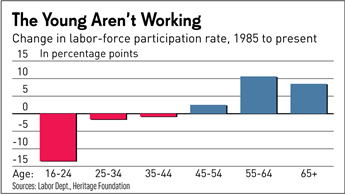
Youth labor force participation

Stephen Moore writes about Investors Business Daily.

Excerpt:

Economists are scratching their heads trying to figure out a puzzle in this recovery: Why are young people not working? People retiring at age 60 or even 55 in a weak economy is easy to understand. But at 25?

The percentage of adult Americans who are working or looking for work now stands at 62.8%, a 36-year low and down more than 3 percentage points since late 2007, according to the Labor Department’s May employment report.

This is fairly well-known. What isn’t so well-known is that a major reason for the decline is that fewer and fewer young people are holding jobs. This exit from the workforce by the young is counter to the conventional wisdom or the Obama administration’s official line.

The White House claims the workforce is contracting because more baby boomers are retiring. There’s some truth to that. About 10,000 boomers retire every day of the workweek, so that’s clearly depressing the labor market. Since 2009, 7 million Americans have reached official retirement age. The problem will get worse in the years to come as nearly 80 million boomers hit age 65.

But that trend tells only part of the story. The chart above shows the real problem: The largest decline in workforce participation has been those under 25.

[…]We do no favors to the young by teaching them that they can consume or have a good time without first earning the money they spend.

I think young people are often brainwashed at a young age to think that bashing the free enterprise system and voting for socialism isn’t going to take away their jobs. But if you vote to tax and regulate the businesses who may employ you later, you’ll find that they are too busy groaning under the strain of big government to employ you.

If young people were serious about getting jobs, they’d be voting to cut subsidies on universities to lower tuition costs, to lower corporate taxes, to cut environmental regulations, to repeal Obamacare, and so on. They would be more concerned that schools teach them actual skills instead of politically correct views, and so they would be voting for school choice and for right-to-work laws, to weaken the teacher unions who are not accountable to them. They should be voting against the minimum wage hikes that will price them out of an all-important first job. They should be voting against the (more than) doubling of the national debt in the 5.5 years under Obama. Job offers are not just there independent of the legal and economic environment. And just reaching a certain age doesn’t mean that you are qualified for a job.