Today’s interview is with Jim Wallace of PleaseConvinceMe.com and host of the PleaseConvinceMe Podcast. As a cold case detective, Jim brings a unique perspective to his approach to apologetics and a very down-to-earth logical style. In this interview, Jim talks about his approach to the evidence (inference to the best explanation), Tactics and apologetics, debate vs. dialogue, pitfalls to apologists, and more.
Topics:
Jim’s background as an Catholic-raised atheist, and cold-case detective
Jim believed in the progress of science to answer all the unresolved questions
How did Jim become an atheist?
Why didn’t Jim respond to Christians witnessing to him without evidence?
What approach worked to start him thinking about becoming a Christian?
What did Jim do to grow as a Christian?
How did Jim’s police training help him to investigate Christianity?
What investigative approach is used in his police work?
Does “abductive reasoning” also work for investigating Christianity?
What sort of activities did Jim get involved in in his community?
How Jim’s experience as a youth pastor convinced him of the value of apologetics
How young people learn best by training for engagement with opponents
How Jim takes his youth on mission trips to UC Berkeley to engage the students
Is it possible to run an apologetics ministry part-time while keeping a day job?
Do you have to be an expert in order to have an apologetics ministry?
What books would Jim recommend to beginning apologists?
How the popular apologist can have an even bigger impact than the scholar
How the tactical approach is different for debates and conversations
Jim’s advice for Christians who are interested in learning apologetics
How Christian apologist need to make sure they remain humble and open-minded
How your audience determines how much you need to know from study
Jim’s reason for becoming an atheist, (his mother was excluded from the Catholic church after her divorce), is one I have heard before. Without saying anything about the Catholic church’s policy. I like the way he eventually came back to Christianity. No big emotional crisis, just taking a sober second look at the evidence by himself, and talking with his Christian friends. I’m impressed with the way he has such a productive ministry, as well.
Dr. Walter E. Williams holds a B.A. in economics from California State University, Los Angeles, and M.A. and Ph.D. degrees in economics from UCLA. He has served on the faculty of George Mason University in Fairfax, Virginia, as John M. Olin Distinguished Professor of Economics, since 1980.
Williams was born into an African-American family. His family during childhood consisted of himself, his mother, and his sister. His father played no role in raising either child. He grew up in Philadelphia. The family initially lived in West Philadelphia, moving to North Philadelphia and the Richard Allen housing projects when Williams was ten. In 1959 he was drafted into the military, and served as a Private in the United States Army. Following his military service, he re-entered college as a far more motivated student.
While at UCLA, Thomas Sowell arrived on campus in 1969 as a visiting professor. Though he never took a class from Dr. Sowell, the two met and began a friendship that has lasted to this day.
Watch this 5-minute video where he explains why capitalism is more moral than socialism:
And here’s another 5-minute video where he explains the profit motive:
Now let’s consider another economist, Thomas Sowell:
Thomas Sowell (born June 30, 1930) is an American economist, social theorist, political philosopher, and author. A National Humanities Medal winner, he advocates laissez-faire economics and writes from a conservative and libertarian perspective. He is currently the Rose and Milton Friedman Senior Fellow on Public Policy at the Hoover Institution, Stanford University. He is considered a leading representative of the Chicago school of economics.
Sowell was born in North Carolina, but grew up in Harlem, New York. He dropped out of high school, and served in the United States Marine Corps during the Korean War. He received a bachelor’s degree from Harvard University in 1958 and a master’s degree from Columbia University in 1959. In 1968, he earned his doctorate degree in Economics from the University of Chicago.
Sowell has served on the faculties of several universities, including Cornell University and University of California, Los Angeles, and worked for think tanks such as the Urban Institute. Since 1980 he has worked at the Hoover Institution. He is the author of more than 30 books.
Here is a 33-minute interview with Thomas Sowell on basic economics:
Lately, I have been thinking a lot about Christians who focus on only one issue during elections, typically abortion. I consider this to be a weak and short-sighted approach. Even if the main goal you desire is to stop the murder of unborn babies, you would do well to consider your opponent and use every tool available to defeat them in elections. Our opponent on the abortion issue is the Democrat voter. A Democrat is a person who is liberal on social policy – who supports abortion and gay marriage. If you want to defeat the Democrat candidate in an election, then you need to appeal to as many voters as possible on as many issues as possible – not just on social policy. You need to defeat Democrat fiscal policy with arguments and evidence. You need to defeat Democrat foreign policy with arguments and evidence. If you engage every target using every argument and every piece of evidence, you will get more success and win the battle for public opinion.
Let’s face it. We are not going to win elections if we turn only to people who call themselves Christians and try to get them to vote pro-life. There are not enough Christians – and not every person who calls himself a Christians is one. Focusing only on Christians is not going to get the pro-life majority we are looking for. It may be easier to avoid confronting people outside of our church, but it won’t work. A much better idea is to use every argument against every person – Christian or not. And to be able to address objections on every issue – not just one social issue. If the voters don’t care about one issue, then you can argue on another issue. You must be all things to all people so that you can win some by knowing what to say when they ask you for reasons and evidence. Now where have I heard that before?
Here is a full audio course on economics from famous Christian philosopher Ron Nash which I recommend to those who have not yet learned to integrate their Christian faith with economics. His two favorite economists are Walter Williams and Thomas Sowell – he says so in the lectures. In fact, he actually quotes a lot of Walter Williams material from his public lectures on economics, and Thomas Sowell material from his books on economics.
Note: for those who want MP3s of the Thomas Sowell lecture I posted above, here they are:
Looking for a good textbook on apologetics that covers everything you need to know? Check out Dr. Groothuis’ book. It’s now under $22 on Amazon.
Here are the chapters:
Part I: Apologetic Preliminaries
1 Introduction: Hope, Despair and Knowing Reality
2 The Biblical Basis for Apologetics
3 Apologetic Method: Evaluating Worldviews
4 The Christian Worldview
5 Distortions of the Christian Worldview–or the God I Don’t Believe In
6 Truth Defined and Defended
7 Why Truth Matters Most: Searching for Truth in Postmodern Times
8 Faith, Risk and Rationality: The Prudential Incentives to Christian Faith
Part II: The Case for Christian Theism
9 In Defense of Theistic Arguments
10 The Ontological Argument
11 Cosmological Arguments: A Cause for the Cosmos
12 The Design Argument: Cosmic Fine-Tuning
13 Origins, Design and Darwinism
14 Evidence for Intelligent Design
15 The Moral Argument for God
16 The Argument from Religious Experience
17 The Uniqueness of Humanity: Consciousness and Cognition
18 Deposed Royalty: Pascal’s Anthropological Argument
19 Jesus of Nazareth: How Historians Can Know Him and Why It Matters by Craig L. Bloomberg
20 The Claims, Credentials and Achievements of Jesus Christ
21 Defending the Incarnation
22 The Resurrection of Jesus
Part III: Objections to Christian Theism
23 Religious Pluralism: Many Religions, One Truth
24 Apologetics and the Challenge of Islam
25 The Problem of Evil: Dead Ends and the Christian Answer
26 Conclusion: Take It to the Streets
Appendix 1 Hell on Trial
Appendix 2 Apologetic Issues in the Old Testament by Richard S. Hess
Contemporary Christians interested in apologetics can now turn to another text that is bound to become one of the most-used textbooks in apologetics. Douglas Groothuis’ Christian Apologetics: A Comprehensive Case for the Biblical Faith (InterVarsity, 2011) may have more breadth both in content and wisdom than any apologetics text to date. The subtitle is justified as the book, over 700 pages and 26 chapters long (not including two appendixes), presents the need for apologetics and explores the main philosophical arguments for the existence of God. Unlike other apologetics texts, Groothuis includes chapters examining truth in postmodern society, religious pluralism, and a tactful approach to dealing with Islam. Furthermore, biblical scholars (and Denver Seminary colleagues) Richard Hess and Craig Blomberg build on an already strong text by writing chapters on apologetics in the Old Testament (Appendix 2) and a historical approach to the person of Christ and the gospels, respectively.
Here’s a snip from the review:
The chapter on cosmological arguments is superb and only further qualifies Groothuis as a proficient thinker. This chapter without question is the chapter I learned the most from. Groothuis engages very difficult scientific and philosophical concepts and communicates them in a way that even the beginner will be able to grasp. Though there are many different versions of the cosmological argument, the chapter hones in on the kalam cosmological argument as put forth by William Lane Craig. The kalam argument is superior to other cosmological arguments in that it supposedly secures the theistic doctrine of ex nihilo if the arguments proves successful (note: a minor quibble of this chapter is that Groothuis purports that the Thomistic cosmological argument does not endorse ex nihilo. I believe this to be false). This specific chapter was sensational – however I was left disappointed that no time was given to addressing the cosmological argument posited by Aquinas. In some respects, the Thomistic cosmological argument is the simplest form for people new to apologetics. The Thomistic version does not get into the technical issues of the metaphysics of time and Big Bang cosmology that the kalam version uses, nor does it require knowledge of the principle of sufficient reason that the Leibnizian version necessitates. While the kalam and Leibnizian versions are logical and sound arguments, they may confusing to people new to apologetics. Because of this, beginners ought to take the time to read this chapter slowly and more than once because of the finer technical details.
Chapters 12-14 are devoted to the design argument and issues relating to it. Groothuis opposes macroevolution and thus goes to great extent to battle Darwinism. Those interested in the philosophy of science will be drawn to these chapters. The chapter focused on intelligent design relies heavily on the work of William Dembski and Michael Behe. These chapters serve as a valuable introduction for those new to discussion between Christian and naturalistic sciences.
Chapter 15 is perhaps the most successful chapter of the entire book as it deals with the moral argument. It is my belief that the moral argument is the most successful argument for the existence of God as it appeals to everyone, Christian, atheist, and non-Christian religious persons. Ethical theory may perhaps be the most widely debated philosophical topic throughout history and thus Groothuis could have taken many approaches when discussing the moral argument. The way he structured his chapter, however, is nearly flawless. Building off his chapter examining truth in the postmodern culture (chapter 7), Groothuis correlates the denial of objective truth to the ridding of objective moral value. He unmercifully attacks moral relativism and brilliantly shows its dangers. He states that cultural relativism reduces to individual relativism, which, in turn, ultimately rests on nihilism. The setup of this reductio ad absurdum points the reader to a moral system that does not reduce to nihilism. Thus, a worldview that embraces objective moral truths must be embraced. Groothuis makes the claim that the source of objective moral truths is found in the absolute Being – God. Groothuis puts for the notion that God is the source of all perfect moral code because he himself is incapable of an evil act as it would be a contradiction of God’s Being.
I think that the big advantage you get from Doug Groothuis is his worldview. He has the most fully-integrated worldview of any Christian scholar I know.
I bought one copy of Dr. Groothuis’ book, but I gave it away. So I got myself another one. It’s a must have. My favorite four apologetics books are this one, “Philosophical Foundations for a Christian Worldview” by William Lane Craig and J.P. Moreland, Michael Licona’s “The Resurrection of Jesus” and Stephen C. Meyer’s “Signature in the Cell”. I think that if you add Wayne Grudem’s “Politics According to the Bible” to that list, then that’s a very practical set of tools.

 and apologetics, debate vs. dialogue, pitfalls to apologists, and more.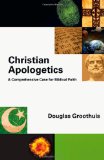
 WINTERY KNIGHT