
Tag Archives: Tuition

Big government spending is suffocating the next generation with debt

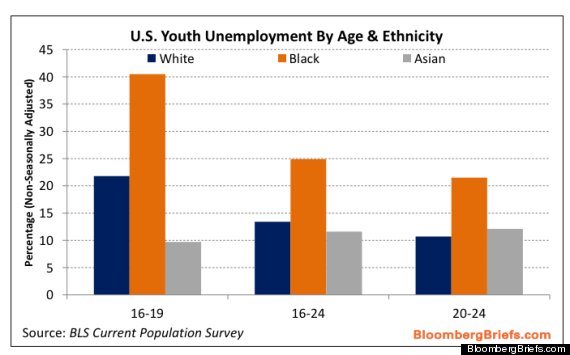
Youth unemployment by ethnicity (5/13)

Libertarian economist Veronique de Rugy writes about it in Reason magazine.

Excerpt:

A word of caution for kids heading off to college this year: Your degree may be worth less and cost more than you think. Your job prospects will likely be grim, whether or not you get that sheepskin. Oh, and you’re on the hook for trillions in federal debt racked up by your parents and grandparents.

Washington has willfully ignored the looming crisis of entitlement spending, knowingly consigning young Americans to a future of crushing debt, persistent underemployment, and burdensome regulation. Politicians on both sides of the aisle share the blame.

This summer, Congress made a big bipartisan show of cutting student loan rates to 3.4 percent from an already artificially low 6.8 percent. But even that seemingly helpful gesture will wind up hurting the Americans it claims to help. Federal student aid, whether in the form of grants or loans, is the main factor behind the runaway cost of higher education. Subsidies raise prices, leading to higher subsidies, which raise prices even more. This higher education bubble, like the housing bubble before it, will eventually pop. Meanwhile, large numbers of students will graduate with more debt than they would have in an unsubsidized market.

And when those new, debt-laden graduates head out into the labor market with their overpriced diplomas, they may not be able to find a job. According to data provided to me by my Mercatus Center colleague, former Bureau of Labor Statistics (BLS) commissioner Keith Hall, fewer than half of Americans today between the ages of 18 and 25 are employed. For those in that cohort actively on the job market, the unemployment rate is 16 percent, versus 6 percent for job-seekers aged 25 and above.

These young folks are also more likely to be long-term unemployed: While accounting for just 14 percent of the labor force, they make up 19 percent of the long-term unemployed, defined by the BLS as 27 weeks or longer.

The lucky few young’uns with jobs of some kind also suffer from rampant underemployment. In a recent blog post, Diana Carew of the Progressive Policy Institute wrote: “In July 2013, just 36 percent of Americans age 16-24 not enrolled in school worked full-time, 10 percent less than in July 2007.” In other words, of these 17 million young Americans, 5.6 million were working part-time, 3.2 million were unemployed, and 8.4 million were out of the labor force altogether.

I really recommend you read the rest of the article, especially if you aren’t following what Obama’s policies are doing to our economy. Special attention is given to the effects of Obamacare on job creation.

Just as a community service, I want to post for you young people (and your parents) a list of the majors that lead to higher paying jobs:

Top 10 highest-paid college majors

  1. Petroleum Engineering: $120,000
  2. Pharmacy Pharmaceutical Sciences and Administration: $105,000
  3. Mathematics and Computer Science: $98,000
  4. Aerospace Engineering: $87,000
  5. Chemical Engineering: $86,000
  6. Electrical Engineering: $85,000
  7. Naval Architecture and Marine Engineering: $82,000
  8. Mechanical Engineering: $80,000
  9. Metallurgical Engineering: $80,000
  10.  Mining and Mineral Engineering: $80,000

And here are some majors that you should avoid at all costs:

  1. Counseling Psychology: $29,000
  2. Early Childhood Education: $36,000
  3. Theology and Religious Vocations: $38,000
  4. Human Services and Community Organization: $38,000
  5. Social Work: $39,000
  6. Drama and Theater Arts: $40,000
  7. Studio Arts: $40,000
  8. Communication Disorders Sciences and Service: $40,000
  9. Visual and Performing Arts: $40,000
  10. Health and Medical Preparatory Programs: $40,000

So young people need to be careful what they study in order to get a job that will allow them to pay off all the government debts that their teachers were busy running up. Their teachers taught them that government spending was good, but their teachers aren’t going to be paying for the government spending. They are the beneficiaries of the increased government spending. The pupils are the ones who will have to work to pay for the spending on the social programs enjoyed by their teachers.

It’s very important for young Christians to understand that degrees are getting more expensive, and it’s important to choose a field that is going to produce a return on your investment. Not only do STEM (science, technology, engineering and math) degrees get you a job that pays, but it has other benefits. For example STEM degrees grind out every last bit of impracticality and entitlement-feeling out of you – because in a STEM program, no one cares about your “specialness”. You solve problems or you fail the class. It’s not a situation where you can just repeat what the professor says in order to get good grades, as is often (but not always) the case in the humanities. 

What factors are contributing to the higher education bubble?

This article from the Wall Street Journal was discussed at length by Dennis Prager on his radio show yesterday.

Excerpt:

College costs have continued to explode despite 50 years of ostensibly benevolent government interventions, according to Mr. Vedder, and the president’s new plan could exacerbate the trend. By Mr. Vedder’s lights, the cost conundrum started with the Higher Education Act of 1965, a Great Society program that created federal scholarships and low-interest loans aimed at making college more accessible.

In 1964, federal student aid was a mere $231 million. By 1981, the feds were spending $7 billion on loans alone, an amount that doubled during the 1980s and nearly tripled in each of the following two decades, and is about $105 billion today. Taxpayers now stand behind nearly $1 trillion in student loans.

Meanwhile, grants have increased to $49 billion from $6.4 billion in 1981. By expanding eligibility and boosting the maximum Pell Grant by $500 to $5,350, the 2009 stimulus bill accelerated higher ed’s evolution into a middle-class entitlement. Fewer than 2% of Pell Grant recipients came from families making between $60,000 and $80,000 a year in 2007. Now roughly 18% do.

This growth in subsidies, Mr. Vedder argues, has fueled rising prices: “It gives every incentive and every opportunity for colleges to raise their fees.”

Many colleges, he notes, are using federal largess to finance Hilton-like dorms and Club Med amenities. Stanford offers more classes in yoga than Shakespeare. A warning to parents whose kids sign up for “Core Training”: The course isn’t a rigorous study of the classics, but rather involves rigorous exercise to strengthen the glutes and abs.

Or consider Princeton, which recently built a resplendent $136 million student residence with leaded glass windows and a cavernous oak dining hall (paid for in part with a $30 million tax-deductible donation by Hewlett-Packard CEO Meg Whitman). The dorm’s cost approached $300,000 per bed.

[…]Some college officials are also compensated more handsomely than CEOs. Since 2000, New York University has provided $90 million in loans, many of them zero-interest and forgivable, to administrators and faculty to buy houses and summer homes on Fire Island and the Hamptons.

Former Ohio State President Gordon Gee (who resigned in June after making defamatory remarks about Catholics) earned nearly $2 million in compensation last year while living in a 9,630 square-foot Tudor mansion on a 1.3-acre estate. The Columbus Camelot includes $673,000 in art decor and a $532 shower curtain in a guest bathroom. Ohio State also paid roughly $23,000 per month for Mr. Gee’s soirees and half a million for him to travel the country on a private jet.

[…]Colleges have also used the gusher of taxpayer dollars to hire more administrators to manage their bloated bureaucracies and proliferating multicultural programs. The University of California system employs 2,358 administrative staff in just its president’s office.

“Every college today practically has a secretary of state, a vice provost for international studies, a zillion public relations specialists,” Mr. Vedder says. “My university has a sustainability coordinator whose main message, as far as I can tell, is to go out and tell people to buy food grown locally. . . . Why? What’s bad about tomatoes from Pennsylvania as opposed to Ohio?”

[…]Today, only about 7% of recent college grads come from the bottom-income quartile compared with 12% in 1970 when federal aid was scarce. All the government subsidies intended to make college more accessible haven’t done much for this population, says Mr. Vedder. They also haven’t much improved student outcomes or graduation rates, which are around 55% at most universities (over six years).

[…]”Thirty-percent of the adult population has college degrees,” he notes. “The Department of Labor tells us that only 20% or so of jobs require college degrees. We have 115,520 janitors in the United States with bachelor’s degrees or more. Why are we encouraging more kids to go to college?”

Mr. Vedder sees similarities between the government’s higher education and housing policies, which created a bubble and precipitated the last financial crisis. “In housing, we had artificially low interest rates. The government encouraged people with low qualifications to buy a house. Today, we have low interest rates on student loans. The government is encouraging kids to go to school who are unqualified just as it encouraged people to buy a home who are unqualified.”

The higher-ed bubble, he says, is “already in the process of bursting,” which is reflected by all of the “unemployed or underemployed college graduates with big debts.” The average student loan debt is $26,000, but many graduates, especially those with professional degrees, have six-figure balances.

Mr. Obama wants to help more students discharge their debts by capping their monthly payments at 10% of their discretionary income and forgiving their outstanding balances after 20 years. Grads who take jobs in government or at nonprofits already can discharge their debt after a decade.

“Somehow working for the private sector is bad and working for the public sector is good? I don’t see on what basis one would make that conclusion,” Mr. Vedder says. “If I had to make some judgment, I would do just the opposite.”

He adds that the president’s approach “creates a moral hazard problem. What it signals to current and future loan borrowers is that I don’t have to take these repayment of loans very seriously. . . . I don’t have to worry too much about getting a high-paying job.” It encourages “sociology and anthropology majors compared with math and engineering majors.”

The most trouble thing for me is that we are taxing money away from current earners, and borrowing money from future earners, in order to subsidize many, many degrees that will never pay back the initial investment we are making to send them to college. The more that government jumps in to pay people to do useless degrees and then doesn’t get the money back, the more students are going choose useless degrees. Other countries like New Zealand and Canada have major problems right now because these loans are not being paid back. That’s what happens when government takes over student loan administration – they aren’t as concerned about being paid back.

What’s also troubling to me is that people who choose not to go to college but instead to go to trade school or start their own businesses are subsidizing the worthless degrees that so many people choose to pursue today. Why would the government waste taxpayer money on these worthless degrees? Well, because college is four years of liberal indoctrination. Students are so stupid that they will actually accept the propaganda pushed by professors as if it were true, even though these professors often have no experience in the private sector themselves. And these students will have the illusion of being educated as they vote for the secular left come election time. They don’t even realize that they are voting to harm their prospective employers and increase the national debt which they will have to pay back. When I try to talk to them about it, they seem to fall back on name-calling instead of making any kind of factual case. This seems to be the result of college as well. They’ve learned to demonize their opponents rather than debate them with evidence.

Hope: California set to offer college credit for online courses

There are forces in motion that could turn the tide against the secular left, and one of them is online education.

Excerpt:

A bill in California’s Legislature would force public colleges to award students credit for taking some outside online courses. It looks likely to pass, and its implications for higher education are vast.

A successful monopoly has an impregnable wall around some much-desired good, such as education, and controls the only door.

The higher education establishment in America has always operated this way. But cracks are starting to appear in its wall. A significant one opened this week.

On Wednesday, a bill was introduced in California’s state Senate to require public colleges to give students credit for online courses from outside providers.

If students can’t take an introductory or remedial class in the traditional way, they can turn to offerings from businesses such as Coursera, Udacity and StraighterLine, or the nonprofit EdX, a joint project of Harvard and MIT.

The bill looks likely to pass in some form.

[…]For the first time, colleges would have to offer credit for courses outside the academic establishment. As StraighterLine founder Burck Smith told the New York Times, “This would be a big change, acknowledging that colleges aren’t the only ones who can offer college courses.”

Up to now, online teaching could offer plenty of knowledge but not the credits leading to degrees.

Colleges could refuse to recognize the courses, and most did. That balance of power would shift if Steinberg’s bill becomes law.

That would be the start of real competition.

If online courses can teach more students just as well and cost the public less, the professors behind the walls will have to change their hidebound ways or lose more business to outsiders.

Either way, the public would be well served.

The faster we can disrupt the current higher education monopoly and focus students back on getting marketable skills at a reasonable price, the better off we’ll be. The financial crisis actually helps with this, because young people now have to be more serious about what they are choosing to study and how much they are paying to study. We have a chance here to turn the tide. It’s good news!