
Tag Archives: The Bible

A Jewish rabbi explains what the Bible teaches about capitalism

A Jewish rabbi explains what the Bible says about economics, in the Wall Street Journal. (H/T Tom)

Excerpt:

More than any other nation, the United States was founded on broad themes of morality rooted in a specific religious perspective. We call this the Judeo-Christian ethos, and within it resides a ringing endorsement of capitalism as a moral endeavor.

Regarding mankind, no theme is more salient in the Bible than the morality of personal responsibility, for it is through this that man cultivates the inner development leading to his own growth, good citizenship and happiness. The entitlement/welfare state is a paradigm that undermines that noble goal.

The Bible’s proclamation that “Six days shall ye work” is its recognition that on a day-to-day basis work is the engine that brings about man’s inner state of personal responsibility. Work develops the qualities of accountability and urgency, including the need for comity with others as a means for the accomplishment of tasks. With work, he becomes imbued with the knowledge that he is to be productive and that his well-being is not an entitlement. And work keeps him away from the idleness that Proverbs warns leads inevitably to actions and attitudes injurious to himself and those around him.

[…]At the opening bell, Genesis announces: “Man is created in the image of God”—in other words, like Him, with individuality and creative intelligence. Unlike animals, the human being is not only a hunter and gatherer but a creative dreamer with the potential of unlocking all the hidden treasures implanted by God in our universe. The mechanism of capitalism, as manifest through investment and reasoned speculation, helps facilitate our partnership with God by bringing to the surface that which the Almighty embedded in nature for our eventual extraction and activation.

Capitalism makes possible entrepreneurship, which is the realization of an idea birthed in human creativity. Whereas statism demands that citizens think small and bow to a top-down conformity, capitalism, as has been practiced in the U.S., maximizes human potential. It provides a home for aspiration, referred to in the Bible as “the spirit of life.”

The Bible speaks positively of payment and profit: “For why else should a man so labor but to receive reward?” Thus do laborers get paid wages for their hours of work and investors receive profit for their investment and risk.

[…]Many on the religious left criticize capitalism because all do not end up monetarily equal—or, as Churchill quipped, “all equally miserable.” But the Bible’s prescription of equality means equality under the law, as in Deuteronomy’s saying that “Judges and officers . . . shall judge the people with a just judgment: Do not . . . favor one over the other.” Nowhere does the Bible refer to a utopian equality that is contrary to human nature and has never been achieved.

The motive of capitalism’s detractors is a quest for their own power and an envy of those who have more money. But envy is a cardinal sin and something that ought not to be.

God begins the Ten Commandments with “I am the Lord your God” and concludes with “Thou shalt not envy your neighbor, not for his wife, nor his house, nor for any of his holdings.” Envy is corrosive to the individual and to those societies that embrace it. Nations that throw over capitalism for socialism have made an immoral choice.

I think that Christians are sometimes attracted to socialism because they think that the only way to help the poor is by state-controlled redistribution of wealth. Socialists might have the right goal of helping the poor (I actually believe that socialism is just the happy-face on fascism, but let us be charitable), but capitalism is the right way to achieve that goal of helping the poor.

Here is an article by Jay Richards for the American Enterprise Institute.

First, his introduction:

If you’re like me, when you think of wealth and poverty, you picture its material manifestations. To have wealth, we imagine, is to have money, stocks, real estate, or valuable commodities, which, in turn, gives us the means to achieve various material ends, such as food, clothing, cars, housing, and healthcare. Poverty, in contrast, is the lack of such goods, which, in turn, leads to a lack of food, shelter, basic medical care, and other such items. These mental associations can make it hard to discover the preconditions of wealth creation, many of which are immaterial, even spiritual, rather than material.

For most of human history, discovering the sources of wealth creation would have been devilishly hard, since most economies, such as there were, tended to be static. If a Mesopotamian farmer or Greek shepherd in the second century BC ever asked, “Where does wealth come from?” he would have assumed that wealth came from rain, common labor, good luck, or some combination of these. He probably also would have assumed that to get really wealthy, you need to plunder other people.

But we now have concrete examples of cultures that have created vast new wealth, moving the majority of their citizens from poverty to relative prosperity. And when we look at these cultures retroactively, we discover answers that, for most of us, are counterintuitive. I’ve argued elsewhere that we’re able to discern ten crucial features allowing such cultures to alleviate poverty and create wealth. The more of these a culture has or does, the more likely it is to be prosperous.

The Top Ten Ways to Alleviate Poverty

  1. Establish and maintain the rule of law.
  2. Focus the jurisdiction of government primarily on maintaining the rule of law, and limit its jurisdiction over the economy and the institutions of civil society.
  3. Implement a formal property system with consistent and accessible means for securing a clear title to property one owns.
  4. Encourage economic freedom.
  5. Encourage stable families and other important private institutions which mediate between the individual and the state.
  6. Encourage belief in the truth that the universe is purposeful and makes sense.
  7. Encourage the right cultural mores.
  8. Instill a proper understanding of the nature of wealth creation and poverty.
  9. Focus on cultivating your comparative advantage rather than protecting what used to be your comparative advantage.
  10. Work hard.

There is a striking correlation between societies that exhibit these traits, or some subset of them, and the large-scale wealth creation. But notice that only one of them describes a material good. All the others are intangible, immaterial, spiritual. You can’t find economic freedom or cultural mores on a map or put them in a safe. You can’t bottle diligence or weigh the ingredients for stable families and voluntary institutions on a scale. These goods involve beliefs, social conventions, institutions, commitments, virtues, and creativity. Having listed them in brief, now I want to hold each of the ten immaterial ingredients up to the light and consider how each helps a society move from poverty to prosperity.

If someone has a spiritual or moral sickness that is preventing them from working, then the solution is not to hand them someone else’s money. That’s not going to make them happy. They need to earn their own pay and be responsible for their own independence.

Jay Richards on Christianity and Capitalism

Jay Richards actually wrote the book on Christianity and capitalism: “Money, Greed and God“.

To understand what capitalism is, you can watch this lecture entitled “Money, Greed and God: Why Capitalism is the Solution and Not the Problem” by Jay W. Richards, delivered at the Heritage Foundation think tank, and televised by C-SPAN2.

If you can’t see the Richards video, here is an audio lecture by Jay Richards on the “Myths Christians Believe about Wealth and Poverty“. Also, why not check out this series of 4 sermons by Wayne Grudem on the relationship between Christianity and economics? (a PDF outline is here)

And you can listen to Ron Nash’s course on Christianity and economics.
What is the Christian doctrine of the Trinity?

The Christian doctrine of the Trinity

I have a friend who is considering Christianity and he is stuck on the doctrine of the Trinity. Tom, this one’s for you.

Excerpt:

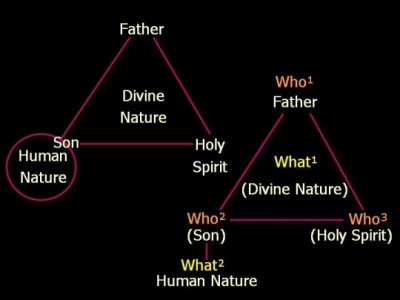
So, what exactly do we mean when we talk about the Trinity? Writing in the early third century, in hisAgainst Praxeas, Tertullian is credited with first employing the words “Trinity”, “person” and “substance” to convey the idea of the Father, Son and Spirit being “one in essence — but not one in person”. Indeed, Tertullian writes,

“Thus the connection of the Father in the Son, and of the Son in the Paraclete, produces three coherent Persons, who are yet distinct One from Another. These Three are, one essence, not one Person, as it is said, “I and my Father are One,” in respect of unity of substance not singularity of number.”

This concept was established as church orthodoxy at the famous Council of Nicaea in A.D. 325. The Nicene Creed speaks of Christ as “God of God, Light of Light, very God of very God, begotten not made, being of one substance with the Father.”

It is this definition that I am going to assume in the discussion that follows. Succinctly, then, the doctrine of the Trinity may be defined thusly: Within the one being or essence that is God, there exists three co-equal and co-divine distinct persons — namely the Father, Son and Holy Spirit — who share that essence fully and completely. This concept is not to be confused with polytheism, which maintains that there are multiple gods. While orthodox Christianity emphatically holds there to be only one God, we nonetheless understand God to be complex in his unity. The concept is also not to be confused with the ancient heresy of modalism, which maintains that God exists in three different modes. The Son has never been the Father and the Holy Spirit has never been the Son or the Father. Modalism is refuted by the picture given to us in all four gospels (Matthew 3:16-17; Mark 1:9-11; Luke 3:21-22; John 1:32-34) in which the Holy Spirit descends on Jesus in the form of a dove and a voice is heard from Heaven “This is my beloved Son. With him I am well pleased.” Similarly, it should be noted that the Father, Son and Spirit do not each make up merely a third of the Godhead. Rather, each of the three persons is God in the full and complete sense of the word.

Having shown that Scripture emphatically rejects the notion that the Father, Son and Spirit are synonymous persons, only five propositions remain to be demonstrated in order to provide Biblical substantiation for the concept of the Trinity. Those propositions are:

  1. There is only one eternal God.
  2. The Father is the eternal God.
  3. The Son is the eternal God.
  4. The Holy Spirit is the eternal God.
  5. Although the Father, Son and Holy Spirit are non-synonymous persons, the concept of the Trinity does not violate the law of non-contradiction.

Let’s take a look at each of these in turn.

He then takes a close look at what the Bible says about God with respect to those assertions. There can be no doubt that the Bible teaches that God is one divine substance, and three persons.

Does the Bible teach that faith is opposed to logic and evidence?

Probably the biggest misconception that I encounter when defending the faith is the mistaken notion of what faith is. Today we are going to get to the bottom of what the Bible says faith is, once and for all. This post will be useful to Christians and atheists, alike.

What is faith according to the Bible?

I am going to reference this article from apologist Greg Koukl of Stand to Reason in my explanation.

Koukl cites three Biblical examples to support the idea that faith is not blind leap-of-faith wishing, but is based on evidence.

  1. Moses went out into the wilderness and he had that first encounter with the burning bush, and God gave him the directive to go back to Egypt and let his people go. Moses said, Yeah, right. What’s going to happen when they say, why should we believe you, Moses?God said, See that staff? Throw it down.Moses threw it down and it turned into a serpent.God said, See that serpent? Pick it up.And he picked it up and it turned back into a staff.God said, Now you take that and do that before the Jewish people and you do that before Pharaoh. And you do this number with the hail, and the frogs, and turning the Nile River into blood. You put the sun out. You do a bunch of other tricks to get their attention.And then comes this phrase: “So that they might know that there is a God in Israel.”
  2. [I]n Mark 2 you see Jesus preaching in a house, and you know the story where they take the roof off and let the paralytic down through the roof. Jesus said, “Your sins are forgiven.” And people get bugged because how can anyone forgive sins but God alone?Jesus understood what they were thinking and He said this: What’s harder to say, your sins are forgiven, or to rise, take up your pallet and go home?Now, I’ll tell you what would be harder for me to say : Arise, take up your pallet and go home. I can walk into any Bible study and say your sins are forgiven and nobody is going to know if I know what I am talking about or not. But if I lay hands on somebody in a wheelchair and I say, Take up your wheelchair and go home, and they sit there, I look pretty dumb because everyone knows nothing happened.But Jesus adds this. He says, “In order that you may know that the Son of Man has the power and authority to forgive sins, I say to you, arise, take up your pallet and go home.” And he got up and he got out. Notice the phrase “In order that you may know”.  Same message, right?
  3. Move over to the Book of Acts. First sermon after Pentecost. Peter was up in front of this massive crowd. He was talking about the resurrection to which he was an eyewitness. He talked about fulfilled prophecy. He talked about the miraculous tongues and the miraculous manifestation of being able to speak in a language you don’t know. Do you think this is physical evidence to those people? I think so. Pretty powerful.Peter tells them, These men are not drunk as it seems, but rather this is a fulfillment of prophecy. David spoke of this. Jesus got out of the grave, and we saw him, and we proclaim this to you.Do you know how he ends his sermon? It’s really great. Acts 2:36. I’ve been a Christian 20 years and I didn’t see this until about a year ago. This is for all of those who think that if you can know it for sure, you can’t exercise faith in it. Here is what Peter said. Acts 2:36, “Therefore let all the house of Israel know for certain that God has made him both Lord and Christ, Messiah, this Jesus whom you crucified.” There it is again. “Know for certain.”

What is faith according to Bible-based theologians?

I am going to reference this article from theologian C. Michael Patton of Parchment and Pen in my explanation.

Patton explains that according to Reformation (conservative, Bible-based) theologians, faith has 3 parts:

  1. notitia – This is the basic informational foundation of our faith. It is best expressed by the word content. Faith, according to the Reformers must have content. You cannot have faith in nothing. There must be some referential propositional truth to which the faith points. The proposition “Christ rose from the grave,” for example, is a necessary information base that Christians must have.
  2. assensus – This is the assent or confidence that we have that the notitia is correct… This involves evidence which leads to the conviction of the truthfulness of the proposition… This involves intellectual assent and persuasion based upon critical thought… assensus… says, “I am persuaded to believe that Christ rose from the grave.”
  3. fiducia – This is the “resting” in the information based upon a conviction of its truthfulness. Fiducia is best expressed by the English word “trust.”… Fiducia is the personal subjective act of the will to take the final step. It is important to note that while fiducia goes beyond or transcends the intellect, it is built upon its foundation.

So, Biblical faith is really trust. Trust(3) can only occur after intellectual assent(2), based on evidence and thought. Intellectual assent(2) can only occur after the propositional information(1) is known.

The church today accepts 1 and 3, but denies 2. I call this “fideism” or “blind faith”. Ironically, activist atheists, (the New Atheists), also believe that faith is blind. The postmodern “emergent church” denies 1 and 2. A person could accept 1 and 2 but deny 3 by not re-prioritizing their life based on what they know to be true.

How do beliefs form, according to Christian philosophers?

I am going to reference a portion of chapter 3 of J.P. Moreland’s “Love Your God With All Your Mind” (i.e. – LYGWYM).

J.P. Moreland explains how beliefs form and how you can change them.

  1. Today, people are inclined to think that the sincerity and fervency of one’s beliefs are more important than the content… Nothing could be further from the truth… As far as reality is concerned, what matters is not whether I like a belief or how sincere I am in believing it but whether or not the belief is true. I am responsible for what I believe and, I might add, for what I refuse to believe because the content of what I do or do not believe makes a tremendous difference to what I become and how I act.
  2. A belief’s strength is the degree to which you are convinced the belief is true. As you gain ,evidence and support for a belief, its strength grows for you… The more certain you are of a belief… the more you rely on it as a basis for action.

But the most important point of the article is that your beliefs are not under the control of your will.

…Scripture holds us responsible for our beliefs since it commands us to embrace certain beliefs and warns us of the consequences of accepting other beliefs. On the other hand, experience teaches us that we cannot choose or change our beliefs by direct effort.

For example, if someone offered you $10,000 to believe right now that a pink elephant was sitting next to you, you could not really choose to believe this… If I want to change my beliefs about something, I can embark on a course of study in which I choose to think regularly about certain things, read certain pieces of evidence and argument, and try to find problems with evidence raised against the belief in question.

…by choosing to undertake a course of study… I can put myself in a position to undergo a change in… my beliefs… And… my character and behavior… will be transformed by these belief changes.

The article goes on to make some very informative comments on the relationship between apologetics and belief.