
Tag Archives: Stephen C. Meyer

Stephen C. Meyer in FOUR John Ankerberg online videos

From Evolution News. (H/T Stephen C. Meyer)

Excerpt:

In four television episodes of the John Ankerberg Show broadcast across the US and over 200 nations worldwide, Dr. John Ankerberg interviewed Dr. Stephen C. Meyer, author of the groundbreaking book Signature in the Cell: DNA and the Evidence for Intelligent Design. The series will begin broadcasting on April 3 at 5:30pm EDT on the Daystar Network and on April 10 at 9:30pm EDT on the INSP Network.

In the interviews Dr. Meyer explains how even Charles Darwin, in his book The Origin of Species, admitted he did not know how the first cell came into being, or how life came to be.

Scientists in Darwin’s day thought the cell was a simple glob of plasm, but today we have discovered that the cell is an almost unimaginably complex system of molecular machines and rich in digital code.

Where did this high-tech in low life come from? Ankerberg and Meyer explore the mystery surrounding this question, which Meyer calls the DNA enigma. Click on the links below to watch full episodes of the show online!

  • Week 1: Every person’s body consists of over a trillion cells. Almost every one of these cells includes a DNA molecule. What is DNA? Why is it so special? What does it do? Where did the digital code embedded in DNA originate? Why does the specified information in DNA point to a designing intelligence?
  • Week 2: As scientific technology has progressed, scientists have realized the cell is more and more complex. According to Microsoft’s Bill Gates, the DNA within each cell is far more complex than any computer software ever created. Where did the coded information within DNA come from? What naturalistic theories have been proposed? What is the possibility of the precise genetic information in DNA evolving by chance?
  • Week 3: In addition to chance, scientists have offered other answers to the origin of the precise genetic information found in DNA. Why is it that natural selection, self-organizing natural laws, or some combination of these with chance cannot explain where the information originated? We’ll also see why DNA exhibits signs of a designing intelligence.
  • Week 4: What is the scientific theory of Intelligent Design (ID)? Is ID true science or just religion masquerading as science? We’ll also answer the objections to ID such as, “Is ID just an argument from ignorance?” (“We don’t know what the naturalistic causes are right now for the origin of life.”) We’ll also see why ID is based on scientific reasoning but may have larger religious implications.

And Meyer is not making this up. This is the state of science today.

From Scientific American.

Excerpt:

As recently as the middle of the 20th century, many scientists thought that the first organisms were made of self-replicating proteins. After Francis Crick and James Watson showed that DNA is the basis for genetic transmission in the 1950s, many researchers began to favor nucleic acids over proteins as the ur-molecules. But there was a major hitch in this scenario. DNA can make neither proteins nor copies of itself without the help of catalytic proteins called enzymes. This fact turned the origin of life into a classic chicken-or-egg puzzle: Which came first, proteins or DNA?

RNA, DNA’s helpmate, remains the most popular answer to this conundrum, just as it was when I wrote “In the Beginning…” Certain forms of RNA can act as their own enzymes, snipping themselves in two and splicing themselves back together again. If RNA could act as an enzyme, then it might be able to replicate itself without help from proteins. RNA could serve as gene and catalyst, egg and chicken.

But the “RNA-world” hypothesis remains problematic. RNA and its components are difficult to synthesize under the best of circumstances, in a laboratory, let alone under plausible prebiotic conditions. Once RNA is synthesized, it can make new copies of itself only with a great deal of chemical coaxing from the scientist. Overbye notes that “even if RNA did appear naturally, the odds that it would happen in the right sequence to drive Darwinian evolution seem small.”

The RNA world is so dissatisfying that some frustrated scientists are resorting to much more far out—literally—speculation. The most startling revelation in Overbye’s article is that scientists have resuscitated a proposal once floated by Crick. Dissatisfied with conventional theories of life’s beginning, Crick conjectured that aliens came to Earth in a spaceship and planted the seeds of life here billions of years ago. This notion is called directed panspermia. In less dramatic versions of panspermia, microbes arrived on our planet via asteroids, comets or meteorites, or drifted down like confetti.

John Horgan is not a Christian, nor even a theist. The origin of life is not explainable on the basis on unintelligent causes. But it is perfectly explainable as the result of intelligent causes. Just like the sequence of letters arranged in this blog post to have meaning are best explained as the result of an intelligence.
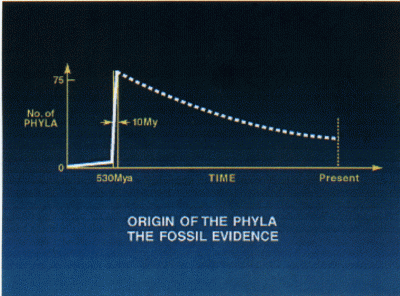
The Cambrian explosion: biology’s Big Bang

Consider this article by Jonathan Wells.

First, let’s re-cap the challenge to evolution from the phenomenon of the Cambrian explosion.

The newly released film “Darwin’s Dilemma” argues that the geologically abrupt appearance of the major groups of animals (the “phyla”) in the Cambrian Explosion posed a serious problem for Charles Darwin’s theory of evolution (as he himself knew), and that subsequent fossil discoveries—far from solving the problem—have made it worse.

Basically, all the major body plans we have today appear in the fossil record in a 2-3 million period about 543 million years ago. There are no precursors in the fossil record showing the gradual evolution of these major body plans.

The Cambrian Explosion: 0 to 60 in a few million years

Darwin expected to discover lots and lots of fossils leading up to the Cambrian explosion period that would show how all these phyla came into existence slowly over time. Unfortunately for the naturalistic evolutionists, the discoveries we’ve been making haven’t shown any hint of precursor fossils leading up the Cambrian explosion.

Since 1859, however, many Precambrian fossils have been found, including microfossils of single-celled bacteria in rocks more than three billion years old. In addition, multicellular Precambrian fossils have been found in the Ediacara Hills of Australia, though there is continuing debate over whether any—or how many—of the Ediacaran fossils were animals, or what relationship—if any—they had to the Cambrian phyla. In 1998, Cambridge University paleobiologist Simon Conway Morris (who is featured in the film “Darwin’s Dilemma”) wrote, “Apart from the few Ediacaran survivors… there seems to be a sharp demarcation between the strange world of Ediacaran life and the relatively familiar Cambrian fossils” (Crucible of Creation, 30).

But wait! Maybe we can’t find the precusor fossils required by Darwinism because they are too small or too soft to have survived for so long?

Since 1859, however, many Precambrian fossils have been found, including microfossils of single-celled bacteria in rocks more than three billion years old. In addition, multicellular Precambrian fossils have been found in the Ediacara Hills of Australia… In 1998, Cambridge University paleobiologist Simon Conway Morris… wrote, “Apart from the few Ediacaran survivors… there seems to be a sharp demarcation between the strange world of Ediacaran life and the relatively familiar Cambrian fossils” (Crucible of Creation, 30).

So there is now no shortage of Precambrian fossils. Not only do we have fossils of bacteria, but we also have many fossils of soft-bodied Multicellular organisms. “In the Ediacaran organisms there is no evidence for any skeletal hard parts,” wrote Conway Morris in 1998. “Ediacaran fossils look as if they were effectively soft-bodied” (Crucible of Creation, 28). The same is true of many of the organisms fossilized in the Cambrian explosion.

But wait! Scientists have discovered lots of exceptionally preserved microbes just before the Cambrian explosion. Don’t microbes count as precursors to the Cambrian explosion phyla?

Richard Callow and Martin Brasier reported in the January 2009 issue of the Journal of the Geological Society, London “a variety of exceptionally preserved microbes” from late Precambrian rocks in England that address “the paradox known as ‘“Darwin’s dilemma’.”

[…]Callow and Brasier didn’t solve Darwin’s dilemma. Instead, they put one more nail in the coffin of Darwin’s attempt to salvage his theory from it. The truth is that “exceptionally preserved microbes” from the late Precambrian actually deepen Darwin’s dilemma, because they suggest that if there had been ancestors to the Cambrian phyla they would have been preserved.

I am willing to believe in evolution. But in order to get me to believe it, I insist on seeing a fossil record that shows the gradual emergence of phyla, one or two at a time, over hundreds of millions of years. That is what Darwinism predicts. We now have a solid record of what came before the Cambrian explosion. So where are the precursors? Where is the record of gradual emergence? Where is my evidence?

What does the peer-reviewed research say?

Story from the Discovery Institute.

A new peer-reviewed paper has been published that concludes that there is no material explanation for the massive amounts of information introduced during the Cambrian explosion, when all of the phyla came into being in the blink of an eye, geologically speaking, with no fossilized precursors.

Excerpt:

Thus, elucidating the materialistic basis of the Cambrian explosion has become more elusive, not less, the more we know about the event itself, and cannot be explained away by coupling extinction of intermediates with long stretches of geologic time, despite the contrary claims of some modern neo-Darwinists.

Once again, the progress of science brings light.

The DI post goes on to cite another passage from the paper:

Beginning some 555 million years ago the Earth’s biota changed in profound and fundamental ways, going from an essentially static system billions of years in existence to the one we find today, a dynamic and awesomely complex system whose origin seems to defy explanation. Part of the intrigue with the Cambrian explosion is that numerous animal phyla with very distinct body plans arrive on the scene in a geological blink of the eye, with little or no warning of what is to come in rocks that predate this interval of time. The abruptness of the transition between the ‘‘Precambrian’’ and the Cambrian was apparent right at the outset of our science with the publication of Murchison’s The Silurian System, a treatise that paradoxically set forth the research agenda for numerous paleontologists — in addition to serving as perennial fodder for creationists. The reasoning is simple — as explained on an intelligent-design t-shirt.

Fact: Forty phyla of complex animals suddenly appear in the fossil record, no forerunners, no transitional forms leading to them; ‘‘a major mystery,’’ a ‘‘challenge.’’ The Theory of Evolution – exploded again (idofcourse.com).

Although we would dispute the numbers, and aside from the last line, there is not much here that we would disagree with. Indeed, many of Darwin’s contemporaries shared these sentiments, and we assume — if Victorian fashion dictated — that they would have worn this same t-shirt with pride.

Here is the reference for the paper:

(Kevin J. Peterson, Michael R. Dietrich and Mark A. McPeek, “MicroRNAs and metazoan macroevolution: insights into canalization, complexity, and the Cambrian explosion,” BioEssays, Vol. 31 (7):736 – 747 (2009).)

I linked before to a bunch of easy-to-understand videos that explain the Cambrian explosion. Here’s another peer-reviewed research paper on the Cambrian explosion written by Stephen C. Meyer, on the Cambrian explosion. This is the paper that got evolutionary biologist Richard Sternberg fired by secular leftists. He has two earned Ph.Ds in biology. I would expect that the people who fired him had never seen the inside of a biology lab. That’s the way it goes – science (intelligent design) vs. religion (materialism).

Videos on intelligent design

Signature in the Cell – a review of the first year

Here’s a neat video. I hope you all read this book.

Because everyone else has!

I donate to the Discovery Institute. Do you? Because you should. And make sure it goes to the Center for Science and Culture – they’re the guys who do the research on intelligent design.

More Stephen C. Meyer videos are here.

What is intelligent design?

Free documentaries on intelligent design

Here are the 2 playlists:

Related posts